The Trojan Horse: Ancient Deception, Modern Malware, and Timeless Security Lessons
The story of the Trojan Horse is one of the oldest and most powerful lessons in deception, trust, and strategic infiltration. While it…
The Trojan Horse: Ancient Deception, Modern Malware, and Timeless Security Lessons
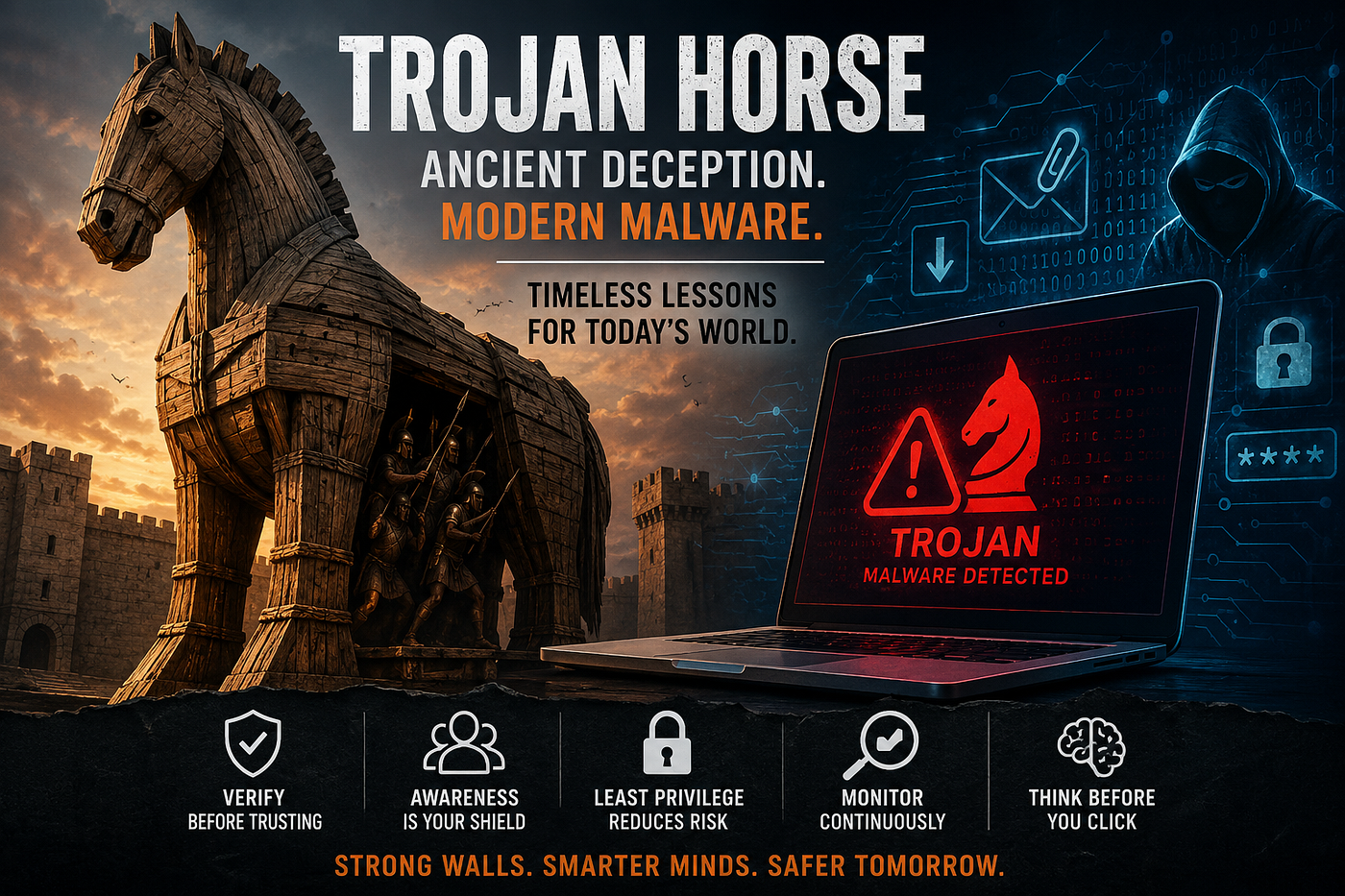
The story of the Trojan Horse is one of the oldest and most powerful lessons in deception, trust, and strategic infiltration. While it originated in ancient warfare, the same principles continue to shape modern cybersecurity threats — especially Trojan malware.
Technology evolves. Human psychology changes very little.
The Original Trojan Horse Story
In Greek mythology, the Greeks were unable to breach the fortified city of Troy after years of war. Instead of attacking directly, they used deception.
They built a massive wooden horse and presented it as a “gift” while pretending to retreat. The Trojans believed the war was over and brought the horse inside their city walls.
Hidden inside the horse were Greek soldiers.
At night, the soldiers emerged, opened the city gates, and Troy fell from within.
The key point was simple:
The enemy did not break the walls. The defenders willingly allowed the threat inside.
That exact principle powers many modern cyberattacks.
What is Trojan Malware?
A Trojan (or Trojan Horse malware) is malicious software disguised as something legitimate, useful, or attractive.
Unlike ransomware or worms that may openly attack systems, Trojans rely heavily on trust and social engineering.
Examples include:
- Fake software installers
- Cracked applications
- Malicious email attachments
- Fake banking apps
- “Free” utilities downloaded from unknown websites
- Infected office documents
- Fraudulent browser extensions
- Fake updates
The malware appears harmless on the surface.
Once executed, it can:
- Steal credentials
- Capture banking information
- Install spyware
- Open remote access backdoors
- Download additional malware
- Encrypt files
- Monitor user activity
- Disable security protections
The attack succeeds because the victim voluntarily runs the software.
Just like Troy voluntarily opened its gates.
Why Trojan Attacks Still Work
Many organizations invest heavily in:
- Firewalls
- Encryption
- VPNs
- Cloud security
- Endpoint protection
- Access control systems
Yet attackers still succeed through deception.
Why?
Because humans often become the weakest security layer.
Attackers exploit:
- Curiosity
- Fear
- Urgency
- Greed
- Trust
- Lack of awareness
- Poor verification practices
A user clicking a malicious attachment can bypass millions spent on infrastructure security.
The Trojan Horse remains relevant because psychological manipulation remains effective.
Common Modern Trojan Scenarios
1. Fake Job Offer Attachments
An employee receives a resume or portfolio attachment.
The file contains malicious macros or scripts.
One click compromises the system.
2. Cracked Software Downloads
A “free premium software” installer contains hidden malware.
The user disables antivirus temporarily to install it.
The attacker gains remote access.
3. Fake Banking Applications
Users install unofficial finance apps from unknown sources.
Credentials and OTPs are silently captured.
4. Browser Extensions
An extension promises productivity or AI features.
Behind the scenes, it collects browsing data, cookies, and session tokens.
5. Fake IT Support Emails
Employees receive “mandatory password reset” emails.
The link leads to credential harvesting pages.
Lessons Businesses Must Learn
1. Not Every Threat Looks Dangerous
The most dangerous attacks often appear helpful, attractive, or harmless.
Security teams must evaluate trust boundaries carefully.
In cybersecurity:
A trusted-looking object can still be hostile.
2. Human Awareness is Critical
Technology alone cannot solve social engineering.
Regular employee awareness training is essential.
Teams should learn to identify:
- Suspicious attachments
- Fake domains
- Unexpected downloads
- Permission abuse
- Social engineering tactics
Security awareness is no longer optional.
It is operational survival.
3. Verify Before Trusting
Modern security architecture increasingly follows the principle of:
“Never trust, always verify.”
This applies to:
- Software downloads
- External USB devices
- Third-party integrations
- Vendor tools
- Email links
- API access
- Cloud permissions
Blind trust creates attack surfaces.
4. Least Privilege Matters
If malware executes under highly privileged accounts, damage multiplies rapidly.
Organizations should implement:
- Role-based access control (RBAC)
- Segmentation
- Limited admin privileges
- Application whitelisting
- Endpoint restrictions
Even if a Trojan enters, containment becomes possible.
5. Monitoring and Logging are Essential
Trojan malware often stays hidden for long periods.
Without proper:
- Endpoint monitoring
- SIEM logging
- Threat detection
- Behavioral analytics
- Audit trails
Organizations may not realize they are compromised until major damage occurs.
Visibility is critical.
6. Convenience Can Become a Vulnerability
Users often prioritize speed and convenience:
- “Install quickly”
- “Skip warnings”
- “Disable antivirus temporarily”
- “Use personal USB”
- “Download from random websites”
Attackers depend on these shortcuts.
Security culture must balance usability with discipline.
The Bigger Strategic Lesson
The Trojan Horse story teaches a broader principle beyond cybersecurity.
Many failures in business, engineering, governance, and operations happen not because of external force — but because threats are allowed inside through poor judgment, unchecked trust, or lack of verification.
This applies to:
- Vendor onboarding
- Supply chain security
- Insider threats
- Third-party software
- Cloud permissions
- AI integrations
- Corporate partnerships
Strong walls are meaningless if the gates are opened willingly.
Final Thoughts
The Trojan Horse is more than mythology.
It is a timeless security model.
Modern malware continues to exploit the same human behaviors that caused the fall of Troy thousands of years ago:
- Trust without verification
- Curiosity without caution
- Convenience over security
- Lack of situational awareness
Cybersecurity is not only about defending systems.
It is about understanding deception.
The organizations that survive modern cyber threats are not necessarily the ones with the biggest security budgets — but the ones that combine technology, process, awareness, and disciplined decision-making.
Because in cybersecurity, the most dangerous threat is often the one invited inside willingly.
#SystemsIndia #CyberSecurity #Malware #TrojanHorse #InformationSecurity #CyberAwareness #SecurityArchitecture #CloudSecurity #SocialEngineering #CyberThreats
메타데이터
- post_id
- ff4fe2f50cfe
- slug
- the-trojan-horse-ancient-deception-modern-malware-and-timeless-security-lessons-ff4fe2f50cfe
- url
- https://medium.com/%E0%A4%9C%E0%A5%8D%E0%A4%9E%E0%A4%BE%E0%A4%A8%E0%A4%B8%E0%A5%8D%E0%A4%B0%E0%A5%8B%E0%A4%A4%E0%A4%B8%E0%A5%8D/the-trojan-horse-ancient-deception-modern-malware-and-timeless-security-lessons-ff4fe2f50cfe
- canonical_url
- https://medium.com/%E0%A4%9C%E0%A5%8D%E0%A4%9E%E0%A4%BE%E0%A4%A8%E0%A4%B8%E0%A5%8D%E0%A4%B0%E0%A5%8B%E0%A4%A4%E0%A4%B8%E0%A5%8D/the-trojan-horse-ancient-deception-modern-malware-and-timeless-security-lessons-ff4fe2f50cfe
- author_url
- https://medium.com/@geeky.vartika
- status
- ok
- fetched_at
- 2026-06-15 22:55:51