I Built a Tool for a Category That Did Not Have a Name Yet
I built a tool for a category that did not have a name when I started. People were searching for it using approximations — close enough to…
I Built a Tool for a Category That Did Not Have a Name Yet
I built a tool for a category that did not have a name when I started. People were searching for it using approximations — close enough to find the wrong thing, not precise enough to find what they actually needed. Watching that pattern unfold taught me more about how new product categories form than anything I read about building startups. This article is about what I found when I looked closely at the dark mode extension builder space — the demand signals, the capability gaps, and what it feels like to build something before the market has language for it.
The Search That Does Not Return What People Are Looking For
The first thing I noticed was the SERP. Search for “dark mode extension builder” and every result is an existing dark mode extension — Dark Reader, Night Eye, product pages, a Lifehacker recommendation piece. Not a single result for a tool to build one. That gap between what people are searching for and what they find is not an SEO anomaly. It is a category signal.
The keyword carries two completely different intentions. One type of searcher wants a tool that generates a browser extension — a packaged file users install in Chrome, Firefox, or Edge that applies dark theme CSS to any site it targets. The other type uses Joomla, WordPress, or a similar platform and wants a site-level toggle installed on their own website. These are different products solving different problems, and the same search string pulls both of them in.
What this disambiguation reveals is not a keyword problem — it is a maturity problem.
When a category is established, searchers use precise language. When it is still forming, they reach for the closest approximation available. The volume of mismatched intent in this keyword tells you exactly how early the browser extension builder category still is.
That realization changed how I thought about content, positioning, and what Extinde was actually building toward.
What Actually Separates Builders From File Generators
When I started evaluating what a dark mode extension builder actually needs to do well, four capabilities kept surfacing as the meaningful dividers — not as marketing claims, but as functional requirements that determine whether the tool delivers or just produces a starting point you then have to fix.
Live preview matters for dark mode in a way it does not for other extension types. A redirect rule or a keyboard shortcut can be verified by reading the code. Dark mode CSS cannot. Inversion ratios, contrast behaviour, and background layering interact in ways that only become apparent when rendered. Without live preview, every iteration requires loading the extension into a developer environment just to see what it actually does. That is not a no-code workflow — it is a no-code file generator with a manual testing step appended.
Multi-browser export should be the builder’s responsibility, not the user’s. Firefox requires a gecko ID in the extension manifest — a field that is invisible in normal use but mandatory for Firefox AMO submission. A builder that handles this automatically on export is absorbing a technical detail the user should never have to think about. One that produces Chrome-only output and leaves the rest to the developer has quietly broken the promise that brought the user to the tool in the first place.
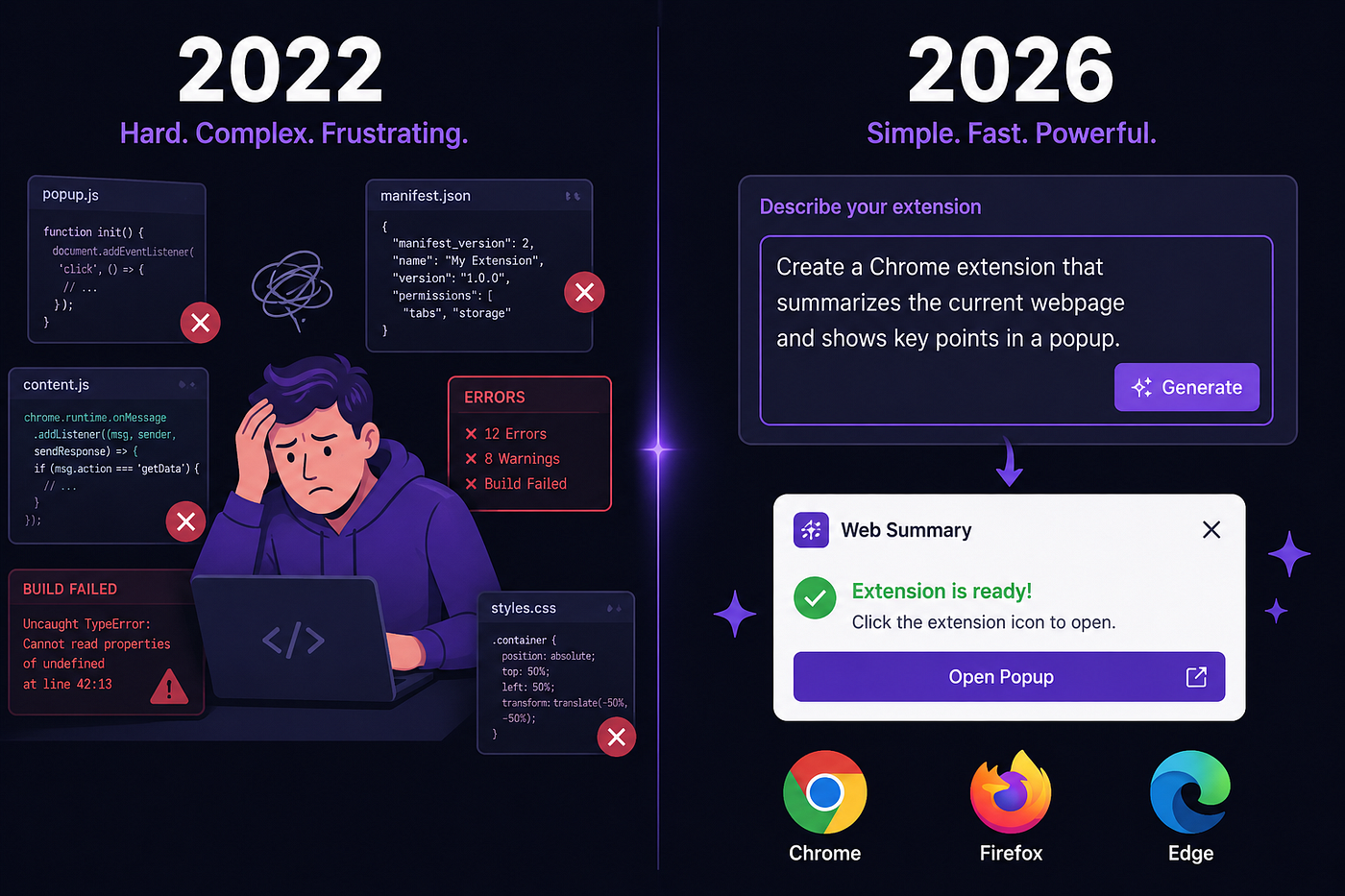
Conversational refinement is what separates a builder from a generator. The first output of any AI-produced extension will not be perfect. Colors will be too aggressive on some sites. Specific elements will not invert correctly. Without the ability to describe what needs fixing in plain English and have the builder apply it, every imperfect result requires opening the code directly. That is the moment the no-code premise collapses. I built Extinde’s refinement loop specifically because I kept hitting this wall when testing early versions.
Manifest V3 compliance is not a differentiator — it is the baseline. Chrome Web Store no longer accepts Manifest V2 submissions for new extensions. Any builder producing MV2 output is generating files that cannot be published to the primary distribution channel. Confirming MV3 output should be the first question asked of any tool in this category. The full comparison — including a verified feature table and decision framework — is at extinde.com/blog/dark-mode-extension-builder.
The Platforms Nobody Is Building For
The demand for niche dark mode extensions is not a hypothesis. It is sitting in public feature request threads that have been open for years without resolution.
Make.com has had dark mode in its top ten most upvoted feature requests since 2022. The design team publicly acknowledged that updating the scenario builder involves a larger engineering scope than standard interface theming. It remains unimplemented. Users rely on universal dark mode tools as workarounds — tools that were not built for the platform and handle it imperfectly.
Confluence presents a different version of the same problem. The cloud instance applies theming to the shell but excludes content within macros and third-party components. iNaturalist formally declined to implement dark mode, citing development resource constraints. The community has documented cosmetic glitches when universal tools are applied to the platform. In both cases, the gap is structural — not a roadmap item that will eventually close.
Softonic’s list of the fourteen best dark mode Chrome extensions includes seven platform-specific variants: Google Docs, Facebook, Salesforce, Google Classroom, Canvas, Instagram, and Outlook. Each one exists because a universal dark mode tool failed on that specific platform. Each one reaches a self-selected, high-intent audience searching for exactly that solution. The pattern is consistent: niche extensions serving specific platforms earn consistent installs from users who have already tried the general solutions and found them insufficient.
The B2B version of this demand is worth noting separately. Enterprise teams whose internal tools have no native dark mode are beginning to request purpose-built extensions for their specific stack. This is not consumer demand with casual intent — it is teams with a persistent daily friction point and no off-the-shelf solution that handles their interface correctly.
What Building in an Unnamed Category Feels Like
The moment I realized this category did not have a name was not dramatic. It arrived quietly, when I noticed that every conversation about what Extinde does required a sentence of explanation before the other person understood the product type. “AI browser extension builder” is not a phrase that lands instantly. People nod, then ask a follow-up question. That follow-up question is the category still forming in real time.
What surprised me was watching searchers arrive with the wrong query and leave having found the right thing. Someone searching for a dark mode extension — meaning they want to install one — sometimes lingers on builder content long enough to realize they want to build one instead. The query was imprecise but the underlying intent was closer to the right place than the words suggested. That is how people discover new tool categories before the vocabulary exists to search for them directly: they arrive through the nearest approximation and recognize what they actually needed when they see it.
The third thing building in this space taught me is the one I did not expect. I had assumed that being first to build a product in an emerging category was the primary advantage. What I found is that naming the category clearly — in content, in positioning, in the language used to describe what the tool does — matters more than the build timing. When no one has written the definitive piece on “dark mode extension builder” as a category, the first piece that does it well does not just rank. It defines what the category means to everyone who arrives after. The product you build is one advantage. The category you name is a different one, and it compounds differently.
I did not expect to be writing category-defining content as part of building a browser extension tool. I thought the product would speak for itself. It turns out the words matter just as much as what the tool actually does.
Bishal Paul is the founder of Extinde , an AI browser extension builder that generates Manifest V3-compliant extensions for Chrome, Firefox, and Edge from plain English prompts. No coding required.
메타데이터
- post_id
- ff5ae12fa2aa
- slug
- i-built-a-tool-for-a-category-that-did-not-have-a-name-yet-ff5ae12fa2aa
- url
- https://medium.com/@extinde/i-built-a-tool-for-a-category-that-did-not-have-a-name-yet-ff5ae12fa2aa
- canonical_url
- https://medium.com/@extinde/i-built-a-tool-for-a-category-that-did-not-have-a-name-yet-ff5ae12fa2aa
- author_url
- https://medium.com/@extinde
- status
- ok
- fetched_at
- 2026-06-13 12:55:53