Traditional Training vs Experiential Learning Programs.
Every year, organizations invest significant time and money in training. Employees attend workshops, take notes, participate in…
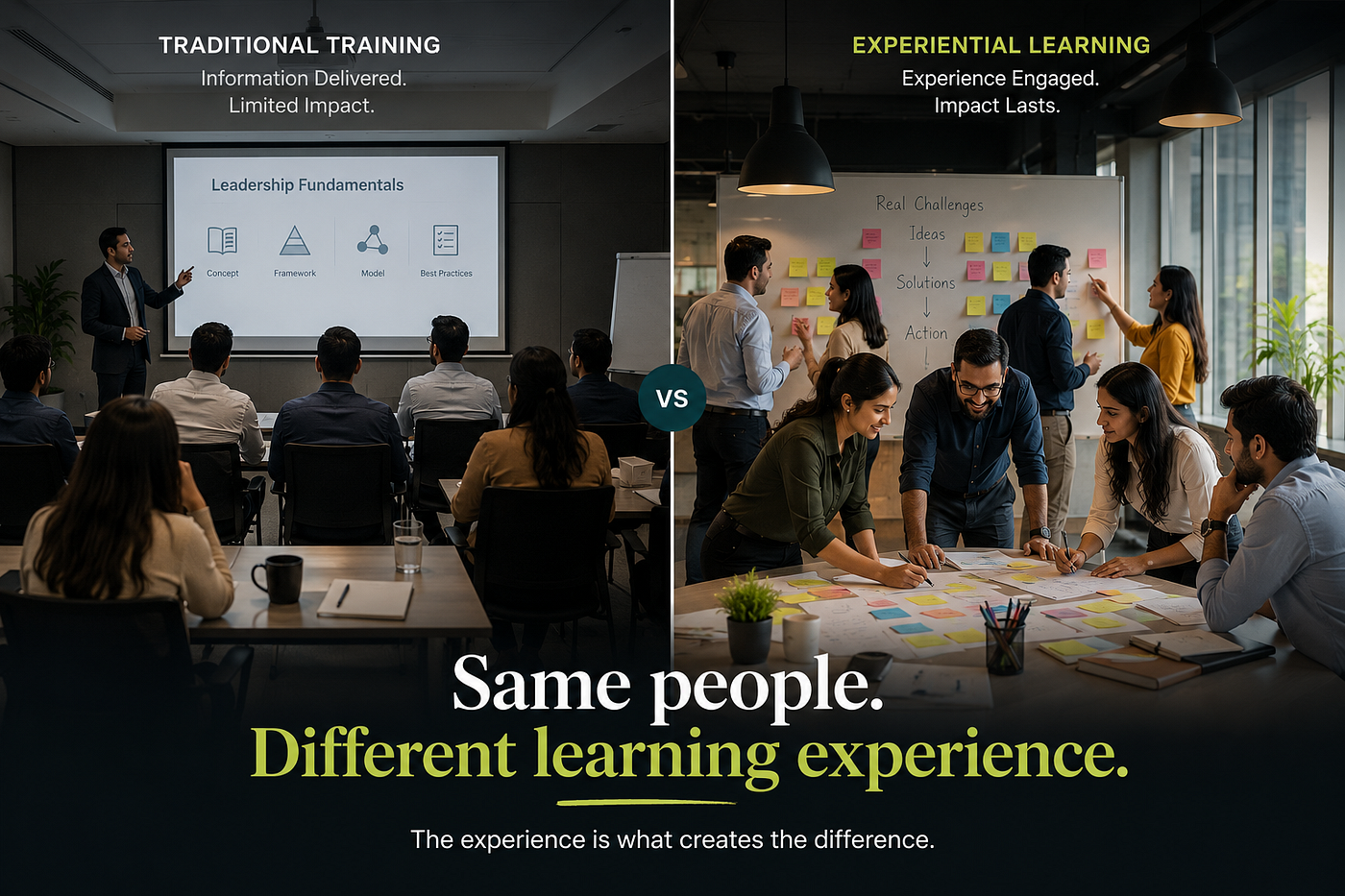
This Image is AI-Generated
Traditional Training vs Experiential Learning Programs.
Every year, organizations invest significant time and money in training. Employees attend workshops, take notes, participate in discussions, and often leave feeling motivated.
Yet a few weeks later, many leaders find themselves asking the same question:
If everyone attended the training, why hasn’t anything changed?
The answer isn’t that people didn’t pay attention. More often, it’s because learning and behaviour are two very different things.
Think about it this way. Reading a book about swimming won’t teach you how to swim. Watching videos on public speaking won’t automatically make you confident in front of an audience.
The same is true in the workplace. Understanding a concept doesn’t necessarily mean someone can apply it when the situation demands it.
This is one of the biggest challenges with many corporate training programs. They focus heavily on transferring knowledge but spend far less time helping people practise new behaviours.
A manager can understand the principles of giving feedback but still hesitate when faced with a difficult conversation.
A team can learn about collaboration but continue working in silos because they’ve never had the opportunity to solve problems together in a realistic setting.
This is where the design of a learning experience makes all the difference.
The most effective programs don’t simply tell people what to do. They create opportunities to experience real workplace situations in a safe environment.
Participants make decisions, solve problems, communicate under pressure, negotiate, reflect, and learn from the consequences of their actions.
Those experiences are far more memorable than a presentation because they mirror the challenges people face every day at work.
Another important element is reflection.
Learning doesn’t end when an activity finishes. In fact, that’s often when it begins.
Asking questions like What happened? Why did it happen? What would you do differently next time? encourages people to connect the experience with their own workplace, making it much more likely that they’ll apply those lessons later.
Organizations also need to rethink how they measure the success of training.
Attendance numbers, feedback forms, and completion certificates tell you whether people participated.
They don’t tell you whether behaviour changed.
A better question is:
Are managers leading differently?
Are teams collaborating more effectively?
Are employees making better decisions?
When the answer to those questions is yes, training has achieved its real purpose.
At the end of the day, organizations don’t invest in training because they want employees to know more. They invest because they want people to perform better.
Knowledge is the starting point.
Practice is what turns knowledge into capability.
And capability is what creates lasting business impact.
How does your organization ensure learning translates into lasting behaviour change?
We’d love to hear what’s worked for you.
메타데이터
- post_id
- ff5bc9574d6c
- slug
- traditional-training-vs-experiential-learning-programs-ff5bc9574d6c
- url
- https://medium.com/@atlas_learning/traditional-training-vs-experiential-learning-programs-ff5bc9574d6c
- canonical_url
- https://medium.com/@atlas_learning/traditional-training-vs-experiential-learning-programs-ff5bc9574d6c
- author_url
- https://medium.com/@atlas_learning
- status
- ok
- fetched_at
- 2026-07-13 06:23:13



