The Multi-Cloud Strategy Nobody Wants to Admit Is Failing
For years, multi-cloud was presented as the future.
The Multi-Cloud Strategy Nobody Wants to Admit Is Failing
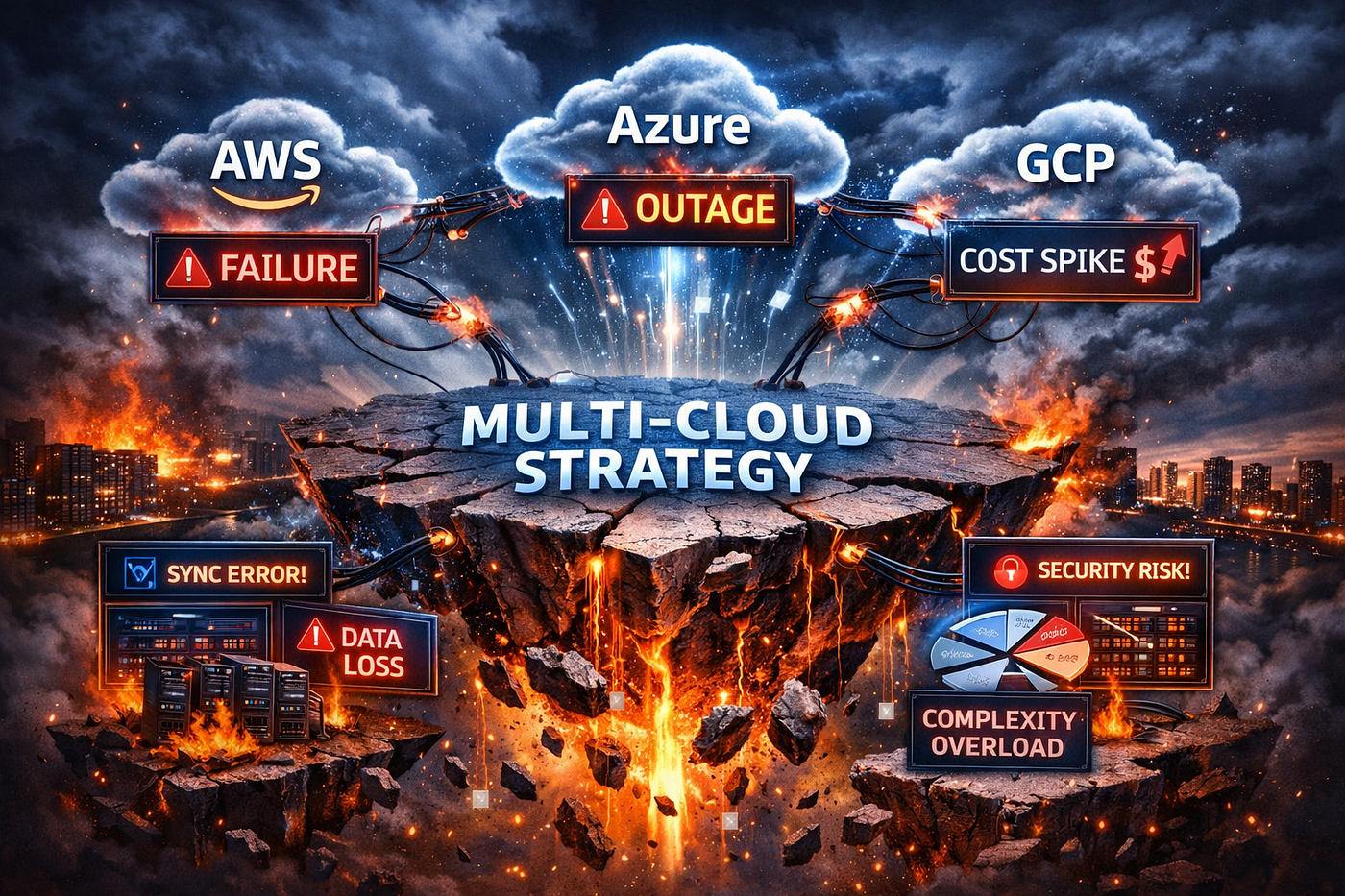
AI Generated Image
For years, multi-cloud was presented as the future.
The argument sounded logical.
Why depend on one provider when you can use several?
Avoid vendor lock-in.
Improve resilience.
Gain negotiating power.
Increase flexibility.
On paper, it looked like a strategic masterpiece.
In practice, many organizations discovered something else.
Operational complexity.
The hidden truth about multi-cloud is that cloud providers are not interchangeable.
They offer different:
networking models
IAM systems
observability tooling
managed services
pricing structures
governance mechanisms
Each cloud introduces its own operational language.
Learning one cloud deeply is difficult.
Operating three simultaneously is an entirely different challenge.
Many enterprises now find themselves maintaining:
AWS expertise
Azure expertise
Google Cloud expertise
Alongside Kubernetes expertise, DevOps expertise, security expertise, and AI expertise.
The result is a growing cognitive burden across engineering organizations.
The problem becomes especially visible during incidents.
Imagine a production issue involving:
workloads running on AWS
identity systems in Azure
analytics workloads in GCP
Root-cause analysis becomes dramatically harder.
Not because engineers are incapable.
Because complexity compounds.
And complexity scales faster than human understanding.
This is why many organizations are quietly shifting toward a different model.
Not true multi-cloud.
Strategic cloud concentration.
In this model, one provider becomes primary.
Additional providers serve specific business requirements.
Examples include:
regulatory compliance
disaster recovery
specialized AI workloads
regional requirements
This approach preserves flexibility without multiplying operational complexity.
The lesson is important.
Technology leaders often optimize for theoretical architecture.
Successful organizations optimize for operational reality.
Theoretical flexibility sounds attractive.
Operational simplicity often delivers greater long-term value.
Cloud history repeatedly demonstrates the same pattern.
Every powerful abstraction eventually creates complexity.
Every complexity eventually creates simplification.
The next decade may not be defined by organizations expanding into more clouds.
It may be defined by organizations learning how to operate fewer clouds more intelligently.
Because the future cloud battle may not be about infrastructure capability.
It may be about complexity management.
And complexity is becoming one of the most expensive resources in modern engineering.
메타데이터
- post_id
- ff64bc55016e
- slug
- the-multi-cloud-strategy-nobody-wants-to-admit-is-failing-ff64bc55016e
- url
- https://medium.com/beyond-the-algorithm/the-multi-cloud-strategy-nobody-wants-to-admit-is-failing-ff64bc55016e
- canonical_url
- https://medium.com/beyond-the-algorithm/the-multi-cloud-strategy-nobody-wants-to-admit-is-failing-ff64bc55016e
- author_url
- https://medium.com/@pranavprakash4777
- status
- ok
- fetched_at
- 2026-06-17 08:20:12