The Real Moat is in the Machine Room
At Maverix, we’ve developed a conviction that we’re actively building around: many of the best software businesses of the next decade will…
The Real Moat is in the Machine Room

At Maverix, we’ve developed a conviction that we’re actively building around: many of the best software businesses of the next decade will be built on proprietary operational data from the physical world. Specifically, we are focused on software that helps owners and operators run and maintain large physical assets.
Despite tens of trillions of dollars of physical infrastructure underpinning the global economy, much of it is still operated using workflows that would not survive a modern software audit. The sophistication of the assets stands in stark contrast to the primitiveness of the systems used to run them.
We value systems that go beyond monitoring to enable agentic workflows. Imagine a thousand domain experts continuously investigating a portfolio, surfacing why a solar asset is underperforming, why an HVAC unit is about to fail, and what that failure will cost, and dispatching the follow-up actions to resolve them. Our investments in Raptor Maps and KODE Labs are clear expressions of that thesis, and we are looking for more.
The scale of the opportunity is difficult to overstate. The world runs on an enormous base of physical infrastructure: energy and power systems, transportation networks, real estate and the built environment, industrial facilities, and the public infrastructure that underpins everyday life. These categories represent tens of trillions of dollars in global asset value, and the annual cost of operating and maintaining infrastructure of this scale is itself a multi-trillion-dollar, recurring burden.
The operations and maintenance cost line is where the software opportunity lives.
The paradox is that the physical assets and the operating budgets are enormous, and yet the software layer managing the day-to-day operations of these assets is remarkably thin. Operators still rely on spreadsheets, fragmented point solutions, and institutional knowledge embedded in a shrinking workforce. Maintenance is often reactive. Data is incomplete. Decisions are local rather than systemic.
This model is breaking down. Skilled tradespeople are retiring faster than they can be replaced, taking institutional knowledge with them. Margin pressure makes reactive maintenance — emergency labour rates, unplanned downtime, and supply chain scrambles — increasingly untenable. Regulatory requirements around energy, emissions, safety, and reporting are tightening beyond what manual processes can support. And managing large, geographically distributed asset portfolios through site visits and ad hoc communication is no longer operationally viable.
Closing this gap requires a fundamental shift from reactive to predictive operations. The holy grail is identifying failures before they happen, dispatching the right resource during a planned window, and avoiding unplanned downtime altogether. Achieving this requires continuous, long-duration datasets built across thousands of assets and years of operating history. The best companies in this category are quietly assembling exactly that.
Conventional wisdom suggests that vertical software, particularly anything adjacent to infrastructure, is easy to displace. The assumption is that a new entrant can undercut on price, or that a horizontal platform can absorb the use case over time. That view underestimates how moats are actually built in these environments.
Data accumulation is the foundation that creates a durable and widening moat. Every fault logged, every maintenance event resolved, and every sensor reading captured contributes to a growing proprietary dataset that reflects real-world operating conditions, edge cases, and failure patterns that cannot be synthetically generated or quickly reproduced. What matters is not only the depth of that history but also the freshness of it. Operating conditions, equipment configurations, and failure modes evolve continuously, which means the dataset must be constantly refreshed, not just preserved. The most useful AI systems today depend on up-to-the-minute information rather than stale snapshots, and the same logic applies here.
Domain expertise compounds that advantage. In these businesses, expertise is not a layer on top of the product; it is the product. Understanding how specific equipment behaves across conditions, configurations, and geographies requires years of interaction with both the assets and the operators who run them. That knowledge becomes embedded in workflows, benchmarks, and decision-making systems that improve over time.
Switching costs follow naturally. Once an operator has run on a system long enough, it becomes interwoven with how work gets done. Migration is not just a technical exercise; it is an operational and organizational undertaking. Adoption may be deliberate, but retention is durable and it compounds over time.
The moat is not the software. It is the data that makes the software irreplaceable.
A frequent question we get is whether AI will disrupt these companies. Our view is the opposite. These companies are uniquely positioned to benefit from AI because they control the underlying data and the physical-layer relationships that make AI useful in this domain. AI does not commoditize their advantage; it gives them the leverage to expand into adjacent workflows that were previously out of reach. The generalists have more to fear from these companies than the other way around.
The counterargument is that well-resourced generalists, such as hyperscalers, large industrial conglomerates, or horizontal platforms, could compete by assembling sensor access and distribution at scale. We take that risk seriously, but volume is not the same as depth, and a snapshot is not the same as a live feed. Generic models can generate insights, but they cannot produce accurate, asset-specific predictions without access to labeled operational histories.
Knowing that the substation connecting your solar farm to a data center is about to fail, that a defective connector between panels is about to spark a wildfire, or that your building in downtown Montreal is overcooling the northeast corner due to a misconfiguration requires context built over time and signal that arrives in real time.
The companies that win in applying AI to the physical world will not be those with the best generic models. They will be those with the deepest collections of fresh, ground-truth operational data, and the orchestration layer that ties humans, agents, and robotics into a single workflow. The moat is the data that makes the algorithm useful.
Looking ahead, this thesis compounds and becomes more interesting. We are moving towards a world of ‘lights out’ autonomous operations where assets are monitored, diagnosed, and maintained autonomously. Early examples are already visible: drones autonomously inspecting solar farms, automated workflows reducing on-site visits, and AI-driven systems managing energy dispatch and equipment cycling in real time without a human in the loop. Robotic repair is beginning to follow.
This transition will not happen overnight, but the shift is accelerating. Organizational resistance to removing humans from high-stakes operational decisions is real and often well-founded. But directionally, the shift is not in question.
The companies that master the operational layer earn the right to the autonomous layer. In a ‘lights out’ world, control shifts to the intelligence layer. The critical question becomes who owns the data, the models, and the decisioning systems that orchestrate physical operations. The companies building deep operational data and domain expertise today are not at risk of displacement in that future. They are positioning themselves to be the operating systems that enable it.
The ecosystem is already taking shape. The following market map highlights the private market landscape in Canada alone, which is a fraction of the global opportunity but illustrative of the depth of activity underway across these verticals.
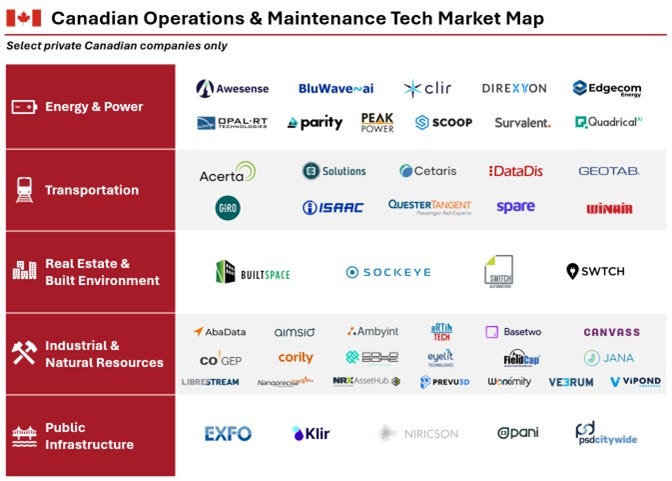
We are actively looking for more companies in asset-heavy verticals where operations and maintenance represent a significant recurring cost, where data remains fragmented or underutilized, and where domain expertise creates a genuine barrier to entry.
If you are building at the intersection of physical infrastructure and intelligent operations, we’d like to talk.
메타데이터
- post_id
- ff6c442a8cff
- slug
- the-real-moat-is-in-the-machine-room-ff6c442a8cff
- url
- https://medium.com/@motalwar/the-real-moat-is-in-the-machine-room-ff6c442a8cff
- canonical_url
- https://medium.com/@motalwar/the-real-moat-is-in-the-machine-room-ff6c442a8cff
- author_url
- https://medium.com/@motalwar
- status
- ok
- fetched_at
- 2026-06-09 15:37:30