How a Neural Network Learns Like a Toddler — One Mistake at a Time
Let’s be real: Artificial Intelligence sounds intimidating. “Neural networks,” “gradient descent,” “activation functions” — it all feels…
How a Neural Network Learns Like a Toddler — One Mistake at a Time
Let’s be real: Artificial Intelligence sounds intimidating. “Neural networks,” “gradient descent,” “activation functions” — it all feels like something you need a PhD to understand.
But what if I told you that a neural network actually learns the same way a toddler does? Messily. Repetitively. One mistake at a time.
Meet Your Digital Toddler
Picture this. You show a toddler a photo of a cat and say, “Look! Cat!” Next day, they see a dog and yell, “Cat!” You laugh, correct them, and move on. But that tiny correction sticks. Their little brain adjusts, learning the difference between “fluffy tail” and “wagging tail.”
That’s exactly what happens when we train a neural network. Except instead of photos and giggles, we feed it data — thousands of examples — and let it make guesses. It’s born clueless, makes mistakes, and learns through corrections.
The only difference? Your AI toddler learns in milliseconds, not months.
How the Learning Actually Happens
At the start, a neural network knows nothing. Every connection inside it — the “neurons” — has random values. When you show it an input (say, a cat image), it spits out a random guess (“dog,” “car,” who knows?).
Then it checks how wrong that guess was using something called a loss function. Think of it like a “how bad did I mess up?” scorecard.
Once it knows how off it was, it performs backpropagation, which is just a fancy way of saying:
“Alright, I’ll tweak my thinking a bit so I make fewer mistakes next time.”
It adjusts millions of internal weights, slowly reducing errors — just like a child refining their mental model of the world.
Every single training cycle is basically the model going: “Oops.” → “Let’s fix that.” → “Oops again.” → “Okay, getting closer!”
And after thousands (or millions) of oopsies, the AI finally learns to say “cat” when it sees one.
Mistakes Are the Secret Ingredient
Here’s the part most beginners miss: Mistakes are not bad — they’re the whole point.
A neural network’s power comes from its ability to fail fast and improve faster. The reason it eventually outperforms humans in specific tasks (like identifying tumors or classifying sound waves) isn’t because it’s smarter — it’s because it learns through sheer repetition.
Imagine a toddler trying to stack blocks. They fail hundreds of times before building a stable tower. The neural network does the same — but instead of blocks, it’s stacking layers of logic and pattern recognition.
Failure isn’t a setback; it’s literally the training process.
Layers: The Building Blocks of Understanding
Let’s peek inside that “brain.”
Neural networks are made up of layers — each one learning a different level of understanding.
- The first layer detects simple things like edges or colors.
- The next one combines those into shapes — circles, lines, eyes, tails.
- Deeper layers start recognizing concepts — like “this looks like a cat.”
It’s like how a child first notices colors, then learns to identify objects, and finally understands ideas.
That’s why we call them deep neural networks. The “depth” comes from stacking these layers to form a hierarchy of learning — from raw pixels to meaningful concepts.
But… Toddlers Need Teachers
Now here’s where it gets interesting. Just like a child left alone can learn the wrong thing (“every animal = cat”), an AI can also absorb bad lessons if trained on biased or unbalanced data.
If you train a model to recognize “doctors” using images that mostly show men, it might start assuming “doctor = man.” That’s not intelligence — it’s learned bias.
So while neural networks can learn fast, they don’t know what they’re learning unless we guide them. We’re the teachers, defining what’s “correct,” what’s “fair,” and what’s “useful.” AI learns from humans — but it also inherits our flaws if we’re careless.
From Crawling to Running
Over time, as the neural network trains on more data, it gets astonishingly accurate. What started as random guesses turns into sharp, meaningful predictions — like recognizing faces, understanding speech, or recommending songs that hit exactly right.
It’s gone from “What even is a cat?” to “That’s a Maine Coon with 92% confidence.” That’s the toddler turning into a fast learner — a mini prodigy with digital neurons firing at lightning speed.
But just like human learning never truly ends, neural networks also keep evolving. With every new dataset, update, and tweak, they grow a little more capable — and a little closer to how we think.
Humans Still Hold the Crayons
AI can learn patterns, but it doesn’t feel them. It doesn’t understand context, emotion, or irony. It doesn’t know that a cat meme is funny or that a color palette “feels warm.”
That’s where we come in. Humans give AI meaning. We decide what’s beautiful, ethical, and worth building. Neural networks may learn like toddlers, but we’re still the parents guiding what they grow into.
The Big Picture
So, next time you see a neural network doing something jaw-dropping — painting art, detecting diseases, or driving cars — remember this: It didn’t get there by magic. It got there by making millions of tiny mistakes and correcting them, just like we all did when we learned to walk, talk, and navigate the world.
AI is learning from its failures at a scale we can barely comprehend. And that’s what makes it both fascinating and humbling.
Because in the end, intelligence — human or artificial — isn’t about getting things right the first time. It’s about learning to learn.
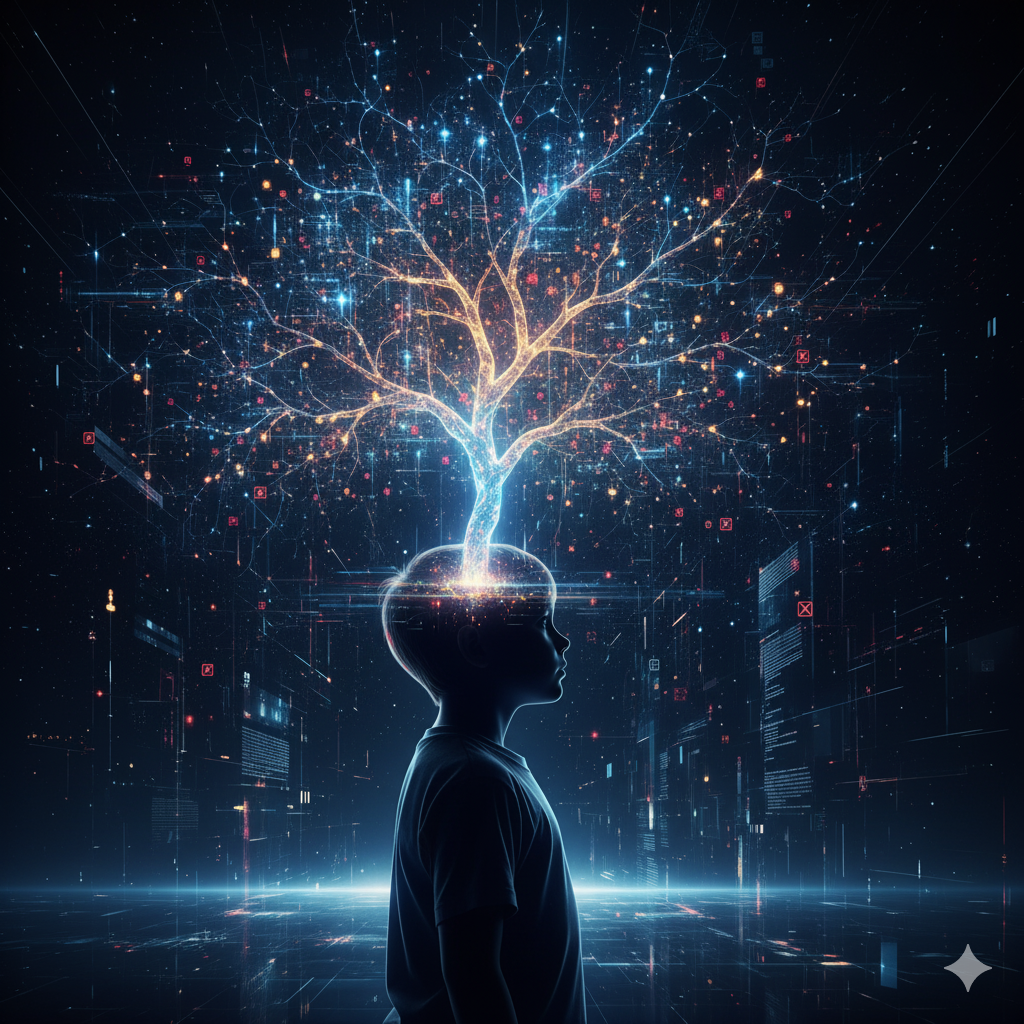
Image generated using Gemini
메타데이터
- post_id
- ff7269ee566f
- slug
- how-a-neural-network-learns-like-a-toddler-one-mistake-at-a-time-ff7269ee566f
- url
- https://medium.com/@ajin.george_98109/how-a-neural-network-learns-like-a-toddler-one-mistake-at-a-time-ff7269ee566f
- canonical_url
- https://medium.com/@ajin.george_98109/how-a-neural-network-learns-like-a-toddler-one-mistake-at-a-time-ff7269ee566f
- author_url
- https://medium.com/@ajin.george_98109
- status
- ok
- fetched_at
- 2026-06-20 20:29:01




