What Does a Successful AI Strategy Look Like in 2026?
AI is everywhere in 2026, but most businesses are still confused about what to actually do with it. Teams are buying tools, doing…
What Does a Successful AI Strategy Look Like in 2026?

AI is everywhere in 2026, but most businesses are still confused about what to actually do with it. Teams are buying tools, doing experiments, and talking about innovation, yet real results like revenue growth or cost savings often stay unclear.
According to McKinsey, most companies fail to scale AI beyond the pilot stage due to a strategy gap.
The problem isn’t the technology, it’s the way companies approach it. Many start with tools instead of real business problems, which leads to wasted time and budget.
This blog breaks that confusion and shows a simple way to think about AI native strategy, so you can focus on what truly works, make better decisions, and turn AI into measurable business results without overcomplicating things.
Why Strategic AI Implementation Matters in 2026?
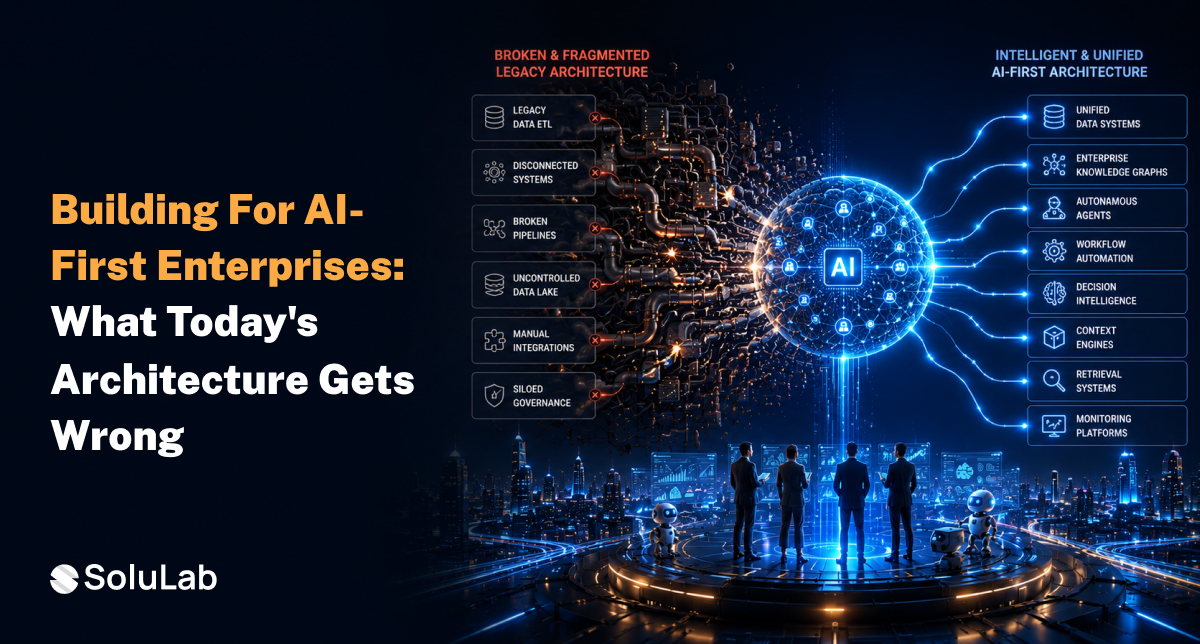
By 2026, Artificial Intelligence will not be an experiment anymore, but a fundamental business force. The companies that have adopted AI in their strategic approaches are winning the competition because they are transforming data and automation into quantifiable growth results.
- Direct Impact on Revenue Growth: AI is now tied directly to revenue through predictive analytics, personalization, and sales systems, enabling businesses to identify high-value opportunities and convert them faster with precision-driven decision-making.
- Operational Efficiency at Scale: Strategic AI implementation automates repetitive workflows, reduces manual dependency, and optimizes processes across departments, helping companies scale operations without proportionally increasing costs or workforce requirements.
- Faster, Data-driven decision-making: Predictive analytics systems handle massive data in real-time, providing real-time data that can be used to make fast and data-driven decisions, eliminating guesswork and enhancing accuracy in critical business strategies and planning.
- Competitive Advantage: Competitors are already adopting AI as part of their operations, and the difference between them is growing rapidly. Strategic implementation is a way of helping businesses remain competitive rather than being left behind in fast-changing markets.
- Cost Optimization and Resource Allocation: AI can be used to find areas of inefficiency, streamline spending, and allocate resources more efficiently to make sure that budgets are deployed where they provide the best payoff and remove unnecessary operational costs.
Build vs Buy vs Integrate — What Startups Should Do?
Startups often struggle with choosing the right AI approach. Deciding whether to build, buy, or integrate AI solutions can directly impact speed, cost, scalability, and long-term business value.
1. When to use Existing AI tools
Choose ready-made AI tools when speed matters most. They offer quick deployment, lower upfront costs, and proven reliability, making them ideal for testing use cases without heavy technical investment.
2. When to Integrate AI into Current Systems
Integrate AI when you already have strong systems in place. This approach enhances existing workflows, improves efficiency, and delivers value without disrupting operations or requiring complete infrastructure changes.
3. When to Build Custom AI Solutions
Build custom AI when your needs are unique or core to your business. It provides full control, scalability, and differentiation, especially when AI directly impacts your product, revenue model, or competitive advantage.
A Smarter Approach: Turning AI Questions Into Actionable Strategy
A clear AI strategy starts by asking the right questions and following a structured approach. Instead of guessing, businesses can turn uncertainty into focused actions that deliver measurable outcomes and real value.
Step 1: Business Context Mapping
Understand your business deeply by analyzing goals, revenue streams, customer journeys, and operational gaps. This ensures that AI efforts align with real needs, rather than relying on random experimentation or trend-driven decisions.
Step 2: AI Opportunity Discovery
Identify where AI can create the most impact across sales, operations, or customer experience. Focus on high-value use cases that improve efficiency, reduce costs, or unlock new revenue opportunities.
Step 3: AI Implementation Roadmap
Translate ideas into execution with clear priorities, timelines, and required technologies. A structured roadmap helps teams move faster, track progress, and achieve measurable results without confusion or delays.
How to Measure ROI from AI Initiatives?
Turning AI into measurable ROI is no longer about experimentation. The metrics required by decision-makers should be straightforward and should directly correlate AI investments to business revenue, business operation efficiency, business speed, and quantifiable workforce impact.
- Revenue Impact: It is important to quantify the contribution of AI to new revenue, conversion rates, upsells, and customer lifetime value by directly correlating AI-driven insights with sales performance and sales growth indicators.
- Cost Savings: Consider operational cost-saving measures that can be achieved by automation, reduced manpower, effective resource management, and reduced reliance on various instruments, so that AI projects produce a direct cost impact on the bottom line.
- Time-to-Value: Track how quickly AI solutions move from deployment to delivering measurable business outcomes, focusing on faster implementation cycles, reduced experimentation time, and quicker realization of tangible benefits.
- Productivity Gains: Evaluate the AI improvement on employee performance through decreased repetitive work, better decision-making time, and allowing teams to concentrate on more valuable work that positively affects business performance and scalability.
From Strategy to Execution: What Founders Should Do Next?
Making AI strategy execution-oriented needs to be clear, prioritized, and disciplined. Founders who are oriented on orderly implementation achieve quicker ROI, less risk, and quantifiable business effect.
- Audit current processes: Evaluate existing workflows, tools, and inefficiencies across teams to identify gaps where AI can reduce manual effort, eliminate redundancies, and improve decision-making speed.
- Identify 2–3 high-impact AI opportunities: Focus on use cases directly tied to revenue growth, cost reduction, or customer experience, ensuring each initiative has clear business value and measurable outcomes.
- Start with pilot implementation: Launch a controlled AI pilot within a specific function to validate feasibility, test performance, and gather real-world insights before committing larger resources or scaling organization-wide.
- Scale based on results: Expand successful AI initiatives across departments using performance data, refining models and integrations while ensuring scalability, governance, and alignment with long-term business goals.
Before You Go…
AI in 2026 is no longer about trying everything and hoping something works. It’s about making clear decisions that connect directly to business outcomes. Companies that succeed are not the ones using the most tools, but the ones using AI with purpose.
By focusing on real problems, identifying high-impact opportunities with expert AI consultants, and following a structured approach, businesses can move from confusion to clarity.
The shift is simple but powerful: stop chasing trends and start building strategies that deliver results. When done right, AI becomes less about experimentation and more about consistent growth, efficiency, and long-term value.
메타데이터
- post_id
- ff895b8fed4b
- slug
- what-does-a-successful-ai-strategy-look-like-in-2026-ff895b8fed4b
- url
- https://medium.com/@solulab/what-does-a-successful-ai-strategy-look-like-in-2026-ff895b8fed4b
- canonical_url
- https://medium.com/@solulab/what-does-a-successful-ai-strategy-look-like-in-2026-ff895b8fed4b
- author_url
- https://medium.com/@solulab
- status
- ok
- fetched_at
- 2026-06-09 15:37:30