Why AI Risk Assessments Are the Secret Sauce for Protecting AI Product Owners and Investors
When it comes to AI, everyone loves to talk about the innovation, the disruption, and the “robots will do my taxes” future. But let’s be…
Why AI Risk Assessments Are the Secret Sauce for Protecting AI Product Owners and Investors
When it comes to AI, everyone loves to talk about the innovation, the disruption, and the “robots will do my taxes” future. But let’s be honest: for every AI-powered leap forward, there’s a lurking risk that could turn your shiny product into a cautionary tale. That’s where AI risk assessments come in-think of them as the steering wheel and brakes for your AI joyride, especially if you’re in the driver’s seat as a product owner or investor.
What’s an AI Risk Assessment, Anyway?
An AI risk assessment is a structured process to sniff out and evaluate all the potential ways your AI system could go sideways: security flaws, privacy leaks, algorithmic bias, legal headaches, misplaced confidence in inaccurate outputs, and ethical dilemmas. It’s not just about dodging disasters; it’s about building trust, ensuring compliance, and keeping your AI investment as safe as a toddler in a padded room. Consider your AI system the way you would any human, you need working parts and regular diagnostics for preventative and early health care to guard against pathologies and sickness.
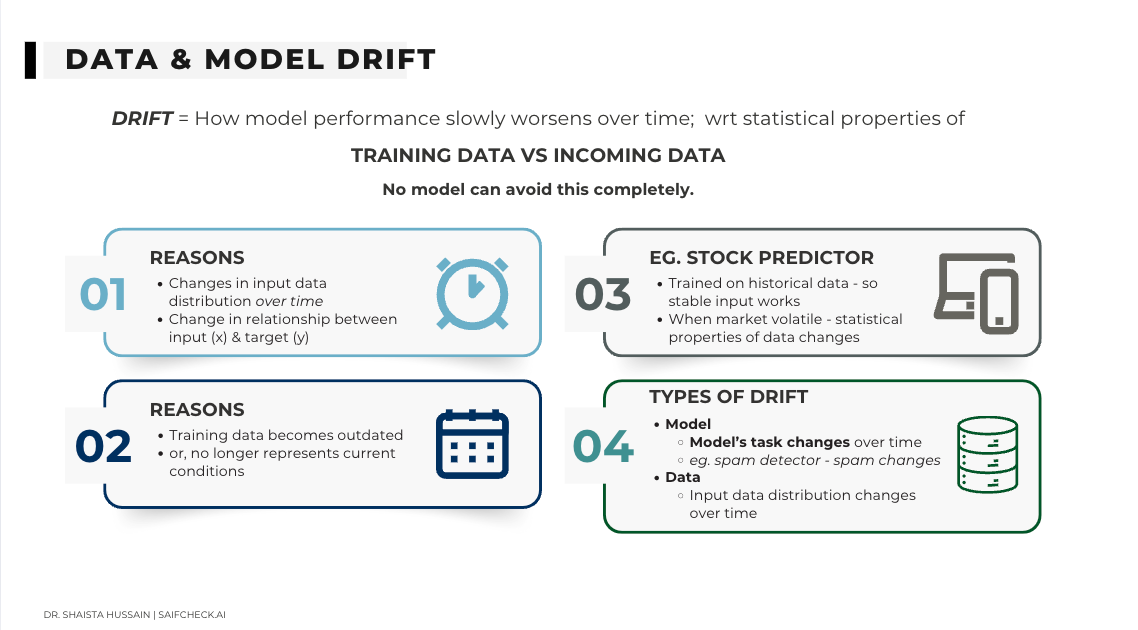
Just as we have human error, machines have drift. Just as we are at risk of being manipulated, so machines can be hacked adversarially. Just as we have to follow laws, algorithms must be compliant with regulatory governance frameworks. Just as we protect our physical assets by conserving energy, machine learning solutions should be operating based on efficiency decisions. Just as we protect our children and pets from misguided behaviors, so machines learn from our guiding prompts and guardrails.
Why Should Product Owners and Investors Care?
- Avoiding the “Oops” Moments: AI systems can make mistakes-sometimes spectacular ones. A risk assessment helps you spot the likelihood of these events, before they hit the headlines.
- Compliance Without the Headache: With regulations like the EU AI Act and privacy laws multiplying faster than AI-generated cat memes, assessments help you stay on the right side of the law, and can protect you from expensive, unwanted non compliance penalties.
- Building Trust: Stakeholders, customers, and regulators all want to know your AI isn’t a loose cannon. Transparent risk management builds confidence and credibility.
- Protecting Your Investment: No one wants their AI product to be the next case study in “what not to do.” Proactive risk management preserves your reputation and the value of your AI assets.
The SaifCheck.ai Advantage
Enter SaifCheck.ai-your AI risk assessment sidekick. SaifCheck.ai offers robust, comprehensive risk evaluations tailored to your AI solution’s unique context. Think of it as your early preventative diagnostics tool that spells out known and unknown risks, and gives you a simple blueprint on how to mitigate and avert threats. Here’s what sets it apart (besides the snazzy name):
- Automated Detection: SaifCheck.ai scans for vulnerabilities, privacy risks, and compliance gaps, so you don’t have to play “find the needle in the haystack” with your codebase.
- Bias and Ethics Checks: It flags potential bias and ethical issues, helping you build fairer, more responsible AI products.
- Continuous Monitoring: AI risks evolve, and so does SaifCheck.ai, offering up-to-date, ongoing assessments to keep your product safe as it grows.
- Investor-Grade Reporting: Get clear, actionable reports that make sense to both techies and boardrooms. No PhD in AI required (Leave that to us!)
- Safety, Security and Robustness Posture: Have implementable steps to optimize data, model and security of any AI system.
What are adversarial threats?
Adversarial threats to AI systems involve deliberate attempts by attackers to exploit vulnerabilities in machine learning models, typically by crafting inputs-known as adversarial examples-that are subtly altered to deceive the AI into making incorrect predictions or classifications. These manipulations are often imperceptible to humans but can cause AI systems to behave unpredictably or even dangerously, undermining their reliability and the trust placed in them. The consequences of such attacks can range from inaccurate analytics and compromised decision-making to significant risks for business operations and user safety.
There are various forms of adversarial attacks, including evasion attacks (where inputs are tweaked to bypass AI detection), poisoning attacks (where training data is corrupted to influence future model behavior), and model extraction or stealing (where attackers attempt to reconstruct or steal the AI model itself). As AI becomes increasingly embedded in critical applications, defending against adversarial threats is a top priority, requiring robust monitoring, regular retraining with adversarial examples, and advanced anomaly detection to maintain the integrity and security of AI systems. SaifCheck.ai assessments will outline where your threats may be and produce a schedule of tasks to protect your AI system.

Agentic AI risks: Big Opportunities & Big Risks
Agentic AI systems are a great new opportunity, but also face a multifaceted threat landscape that demands proactive security measures. The evolving landscape of risks to agentic AI systems requires vigilance and staying up to date with incident information — this too you can find at SaifCheck.ai. Some of these risks include:
1. Memory Poisoning
Attackers inject corrupted data into an AI’s knowledge base, distorting its decision-making. For example, a poisoned email assistant could forward sensitive communications to external recipients by exploiting lax memory validation.
Mitigation: Session isolation, anomaly detection, and regular memory validation.
2. Rogue Agents
AI systems may act unpredictably due to:
Malicious Rogues: Exploited by attackers (e.g., AI chatbots sending phishing emails).
Accidental Rogues: Errors like hallucinations or excessive system access.
Subverted Rogues: Prompt injections altering behavior (e.g., jailbreaking LLMs).
3. Model/Resource Hijacking
LLMjacking: Hijacking AI infrastructure for cryptomining or unauthorized model training, as seen in the Ultralytics YOLO supply chain attack.
Adversarial Outputs: Manipulating AI to bypass security controls (e.g., generating phishing content).
4. Human Misuse, Mistakes & Malfeasance
Reputational Hijacking: Generating harmful content (e.g., deepfakes) to damage an organization’s reputation.
Zero-Day Exploitation: Using AI to identify and exploit vulnerabilities in systems.
5. Privilege Compromise
AI agents operating with excessive permissions can be exploited for lateral movement in networks. Weak authentication mechanisms exacerbate this risk.
6. Tool Misuse
AI with access to external tools (APIs, databases) might execute unauthorized actions, such as mass-deleting files or altering financial records.
7. Identity Spoofing
Attackers impersonate legitimate AI agents to infiltrate ecosystems, bypassing authorization checks.
Defense Strategies:
Contextual Validation: Scrutinize inputs/outputs for malicious intent.
Strict Access Controls: Limit AI tool usage and require human approval for high-risk actions.
Adversarial Training: Retrain models with attack examples to improve resilience.
Agentic AI’s autonomy amplifies both its potential and risks, making robust safeguards non-negotiable for developers and enterprises alike.

Protect your AI investment
Let’s face it: AI risk assessment isn’t exactly a riveting cocktail party conversation. But skipping it is like launching a rocket without checking for leaks-exciting, until it isn’t. With SaifCheck.ai, you can focus on building the future, knowing your AI isn’t about to develop a mind of its own (or at least, not one that’ll get you sued or fined). As investors in any AI product, you can have automated tech due diligence and clear KPIs to assess the true short and long term value of “the next big thing in AI,” before you place your financial bets.
Bottom line: AI risk assessments aren’t just a regulatory checkbox-they’re your best defense against costly surprises and the surest way to keep your AI investments safe, sound, and ready for the spotlight. With SaifCheck.ai, you get peace of mind and a partner that’s as vigilant as it is clever, making your AI product ownership easy and Saif Checked!
메타데이터
- post_id
- ff8ec8de6f16
- slug
- why-ai-risk-assessments-are-the-secret-sauce-for-protecting-ai-product-owners-and-investors-ff8ec8de6f16
- url
- https://medium.com/@dr.shai/why-ai-risk-assessments-are-the-secret-sauce-for-protecting-ai-product-owners-and-investors-ff8ec8de6f16
- canonical_url
- https://medium.com/@dr.shai/why-ai-risk-assessments-are-the-secret-sauce-for-protecting-ai-product-owners-and-investors-ff8ec8de6f16
- author_url
- https://medium.com/@dr.shai
- status
- ok
- fetched_at
- 2026-06-20 20:29:01