Balancing In-House Expertise and External Consultancy for Investor ESG Requirements
How to build sustainable capacity and competency when implementing the IFC Performance Standards
Balancing In-House Expertise and External Consultancy for Investor ESG Requirements
How to build sustainable capacity and competency when implementing the IFC Performance Standards
I. Introduction
If you have recently secured investment from a development finance institution (DFI) or a private equity impact investor, you have likely encountered the IFC Performance Standards. Your first challenge will be implementing Performance Standard 1 (PS1).
PS1 functions as the instruction manual for managing environmental and social (E&S) risks and impacts throughout the life of a business or project. It sets out the framework (the Environmental and Social Management System or ESMS) through which a company identifies, avoids, minimises and manages the E&S consequences of its activities.
For companies receiving new investment, building an effective ESMS is not optional. This underpins financial viability, supports lender covenants (watch out for conditions precedent or CPs) and protects the company’s social license to operate, the often unwritten but very real permission a business needs from the communities, regulators and other stakeholders it affects.
The questions that follow almost every conversation about ESMS implementation is: Who actually does this work? Does the company hire its own people or does it rely on consultants? And if there are budgetary constraints, where should one start?
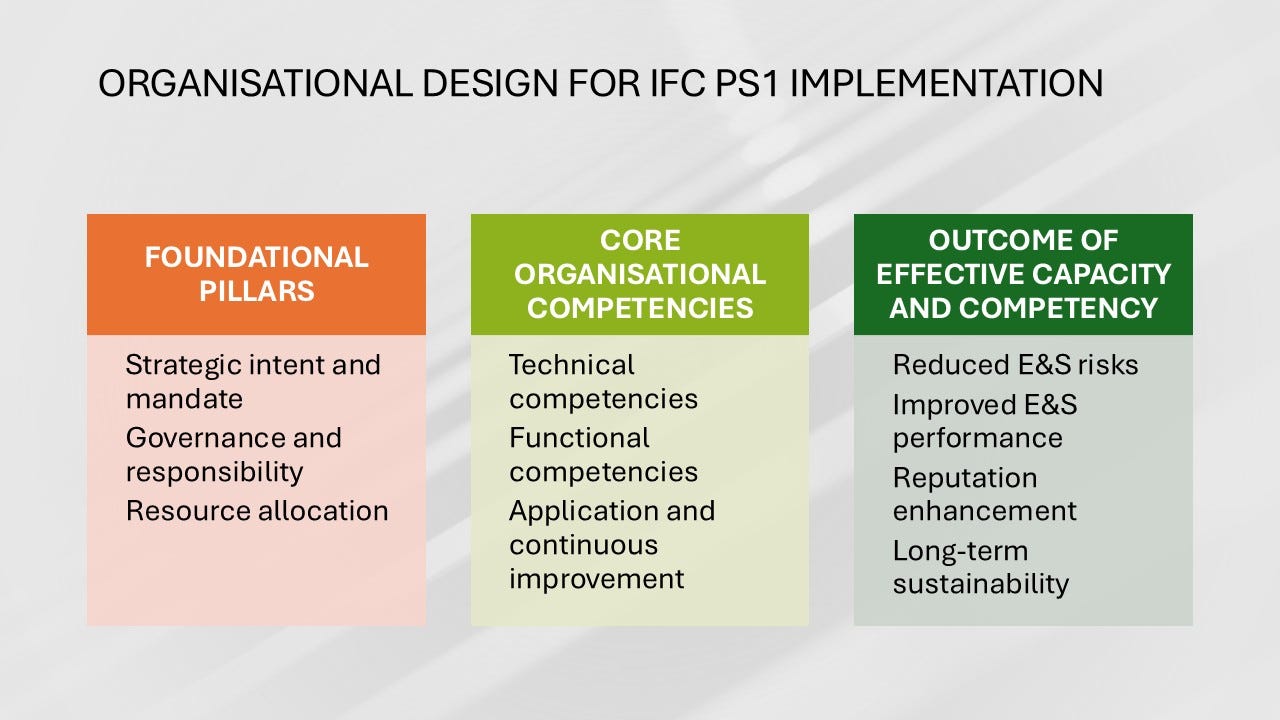
The premise of PS1 is that a company receiving finance must build an in-house organisational structure for ongoing E&S management. There is no substitute for internal ownership; however, the organisation can also prudently leverage external consultants for technically complex assessments, early-stage screening and independent verification, particularly where international standards demand a level of specialisation that few organisations carry in-house.
The skill is not in choosing one over the other. It is in knowing which tasks belong where and when.
II. Establishing In-House Capacity and Competency
Defining Roles and Authority
PS1 is explicit that an ESMS cannot function as a document sitting in a shared drive. It requires an organisational structure with clearly defined roles, responsibilities and lines of authority for implementation. Someone (or, ideally, several people) must own specific elements of the system: it must be clear who updates the risk register, who manages stakeholder engagement records, who signs off on corrective actions, and who reports performance to the board.
Without this clarity, an ESMS tends to become everyone’s responsibility in theory and no one’s responsibility in practice. When a lender’s E&S specialist arrives for a supervision visit and asks “who manages this?”, the answer needs to be a name and a job title, not a shrug toward the consultants who wrote the original report.
The Management Representative
A central requirement under PS1 is the designation of a management representative. This is typically a senior individual who acts as the link between the board or executive leadership and the operational teams responsible for day-to-day E&S management. This person does not need to be an E&S technical expert in every domain, but they do need authority, access to resources and a genuine mandate to drive implementation.
This role matters because it signals, both internally and to investors, that E&S management has organisational weight. A management representative who is senior enough to reallocate budget, pause an activity on safety grounds or escalate a community grievance to the board is fundamentally different from a junior coordinator with a title but no influence.
Cross-Functional Integration
One of the most common failure points in ESMS implementation is treating E&S as a siloed function. ESG professionals are all too familiar with E&S being designated as the domain of a standalone “sustainability department” that operates parallel to, rather than within, the business. PS1 implicitly rejects this model. Effective E&S management depends on the active contribution of departments that, on paper, have “nothing” to do with sustainability.
Human Resources needs to embed E&S awareness into induction and ongoing training. Procurement needs to evaluate contractor E&S performance as part of vendor selection and management; this is particularly relevant where supply chain risks (e.g. labour practices and environmental compliance) sit outside the company’s direct control. Maintenance and operations teams need to understand how equipment efficiency, waste handling and incident reporting connect back to the ESMS. When these functions operate in isolation from E&S, the management system becomes a parallel bureaucracy rather than a part of how the business runs.
Sustained Resource Allocation
Perhaps the most underappreciated requirement in PS1’s capacity provisions is the expectation of sustained resource allocation. While a company can absolutely fund an initial ESMS development project through a grant or a one-time consulting budget, PS1 expects ongoing human and financial resources to maintain and continuously improve E&S performance.
This has direct implications for budgeting. If your E&S function only receives attention (and funding) in the run-up to an audit or a lender reporting deadline, this is crisis management, not sustained capacity. Sustained capacity means an annual budget line, a named individual (even if part-time) with E&S responsibilities built into their job description and management review processes that happen whether or not an investor is currently watching.
III. Circumstances for Engaging External Consultants: The Assessment Phase
The Start of the Process: Screening and Scoping
Even companies committed to building internal capacity will need external support at the outset. Determining the appropriate level of E&S assessment (what PS1 refers to as the process of identifying and evaluating risks and impacts) often requires expertise that a company developing its first ESMS simply may not have.
External consultants bring the frameworks, checklists and comparative experience needed to scope this work efficiently: what level of assessment is proportionate to the risk profile of the business, which Performance Standards are likely to be triggered and where the genuine areas of concern lie versus where compliance is relatively straightforward. Attempting to do this scoping internally, without prior experience, risks either under-scoping (missing material risks) or over-scoping (wasting resources on a full assessment where a more proportionate approach would do).
Complex Risk Identification
For projects or business activities that pose potentially significant adverse E&S impacts, or that involve technically complex issues, PS1 generally expects (and many DFIs explicitly require) that external experts be involved in the risk and impact identification process. Once a project crosses certain risk thresholds, this becomes a documented expectation tied to the categorisation of the investment.
Specialised Performance Standards
Beyond PS1’s general framework, several of the other Performance Standards address specialised issues that internal teams may not have the technical skill or experience to address without expert input.
These include:
- Land acquisition and involuntary resettlement (PS5), where the legal, social, and livelihood-restoration complexities typically require specialists experienced in resettlement action planning.
- Biodiversity conservation (PS6), where assessments of critical habitat, ecosystem services, and mitigation hierarchies demand ecological expertise most companies do not employ.
- Indigenous Peoples (PS7) and Cultural Heritage (PS8), where free, prior and informed consent (FPIC) processes and heritage impact assessments require not just technical skill but cultural and contextual sensitivity built over years of practice in specific regions.
For these areas where the need is often project-specific and ad hoc, the prudent approach is to maintain relationships with qualified specialists who can be engaged when these issues arise.
IV. Strategic Use of Consultants for Review and Verification
Independent Monitoring
For higher-risk projects, PS1 anticipates that clients will retain external experts to verify monitoring information. This is essentially a check on whether the company’s own internal reporting reflects the reality in the organisation. This is distinct from the day-to-day monitoring that should be an internal function. Independent verification provides assurance to both the company’s management and its investors that internal data can be trusted, and it often catches issues that internal teams may not see as they are too close to the work.
Financier Due Diligence
External consultants are not only engaged at the company’s initiative. DFIs and impact investors routinely commission their own independent E&S due diligence, both at the point of investment and periodically thereafter, to confirm the company’s ongoing compliance with the Performance Standards. (Note that this is usually mandatory under the investor agreements.) Companies should view their own internal ESMS not merely as an operational tool, but as the evidence base that will be scrutinised by external reviewers they do not control. A well-maintained, internally credible system makes these external reviews far less stressful and far less likely to surface findings that delay disbursements or trigger covenant discussions on breach of contract.
Grievance Resolution
Most grievances (e.g. a noise complaint, a query about a recruitment process, a request for information about an environmental authorisation) can and should be handled through an internal grievance mechanism, staffed by the company’s own team. This is an important demonstration of organisational capacity: an internal team that can receive, log, investigate and close out grievances in a reasonable timeframe is functioning exactly as PS1 intends.
However, for complex or recurring problems (e.g. widespread contamination affecting multiple households, a pattern of grievances suggesting systemic failure, disputes where the community has lost trust in the company’s internal processes) independent mediators or neutral third parties become essential. Bringing in an external party at this stage is often the only way to restore the legitimacy needed to resolve the issue and maintain the social license to operate.
V. Developing Competency through Training and Lifecycle Management
Assessing Competency Gaps
PS1’s competency requirements are not satisfied simply by having people in E&S roles. It is essential that the E&S team have the knowledge and skills appropriate to the risks the company actually faces. The starting point, therefore, is an honest gap assessment: what does the current team know, and what does the risk profile of the business demand they know?
Where gaps exist, the company has two broad options: recruit individuals who already hold the necessary competencies or invest in developing those competencies in existing staff. In practice, most companies do both: recruiting for foundational E&S management capability while building specialist knowledge in-house through training and exposure.
Systematic Training Programmes
A one-off training session at the point of ESMS launch is not sufficient to qualify as competency development. PS1’s expectation of sustained capacity implies systematic, ongoing training programmes: needs are identified, training is delivered against those defined needs, effectiveness is evaluated (did the training actually change behaviour or improve performance?) and refresher courses are scheduled to prevent knowledge decay over time.
This is particularly important in industries with high staff turnover or where E&S responsibilities are distributed across many operational roles (site supervisors, contractor liaisons, community relations officers) rather than concentrated in a single department. A training programme that reaches these roles and refreshes their knowledge periodically, is a strong indicator to investors that competency is embedded rather than performative.
Lifecycle Adaptability
Capacity needs are not static. The skills required during the design and planning phase of a project include environmental and social impact assessment, stakeholder mapping and permitting. These differ substantially from those required during construction, where contractor management, labour practices and incident response dominate. Once a project moves into commissioning and operations, the focus shifts again toward ongoing monitoring, community relations and continuous improvement. And at decommissioning, an entirely different set of issues (like site rehabilitation, retrenchment management and legacy liabilities) comes to the fore.
A company that builds a static internal team, sized and skilled for the construction phase, may find that team is misaligned with the needs of operations a few years later. The flexible deployment of external experts at each transition, in order to supplement or temporarily expand internal capacity, allows the organisation to manage these shifts without either overstaffing during quiet periods or being caught short when a new phase begins.
VI. Conclusion
Summary of the Hybrid Model
The evidence, drawn directly from PS1’s own structure, points consistently toward a hybrid model. Internal staff provide the continuity, contextual knowledge and day-to-day integration that a consultant cannot replicate from outside the organisation. The internal team understand the history of a site, the relationships with neighbouring communities and the operational realities that shape what is actually achievable.
External experts provide the specialised rigour required for high-stakes E&S challenges: the technical depth for complex assessments under PS5 through PS8, the independence required for credible verification and the surge capacity needed at critical project transitions. Neither replaces the other. The internal team without access to specialist input will struggle with the technically complex elements of compliance. The external consultants without an empowered internal counterpart will produce documents that gather dust.
The Impact of Competency on Success
It is a mistake to treat capacity and competency requirements as compliance boxes, i.e. items on an investor’s checklist to be satisfied and then forgotten.
Inadequate capacity is one of the most common root causes of the outcomes that DFIs and impact investors are most concerned about: project delays caused by E&S non-compliance discovered too late, litigation arising from poorly managed resettlement or community relations, and reputational damage that follows a company long after the specific incident is resolved.
A company with genuine capacity and competency (whether built internally, supplemented externally or both) catches these issues early, when they are manageable, rather than when they are not.
Final Thought
Perhaps the most important shift for any company navigating this terrain is a change in mindset: acknowledging organisational limitations is a normal and expected part of operating responsibly. The continual improvement that PS1 calls for is only possible when a company is honest about what it does not yet know and deliberate about supplementing its core team with expert guidance in the circumstances when that guidance matters most.
The companies that get this balance right build organisations that are genuinely more resilient, more credible and better positioned for the next stage of growth, and the next round of investment.
메타데이터
- post_id
- ff8ed3a32174
- slug
- balancing-in-house-expertise-and-external-consultancy-for-investor-esg-requirements-ff8ed3a32174
- url
- https://medium.com/@sayuri-moodliar/balancing-in-house-expertise-and-external-consultancy-for-investor-esg-requirements-ff8ed3a32174
- canonical_url
- https://medium.com/@sayuri-moodliar/balancing-in-house-expertise-and-external-consultancy-for-investor-esg-requirements-ff8ed3a32174
- author_url
- https://medium.com/@sayuri-moodliar
- status
- ok
- fetched_at
- 2026-06-16 19:09:56



