The Rise of the Enterprise Cognition Matrix
“introducing Enterprise Cognition Matrix, a strategic framework that maps concepts of enterprise search and data infrastructure directly to…
The Rise of the Enterprise Cognition Matrix
“introducing Enterprise Cognition Matrix, a strategic framework that maps concepts of enterprise search and data infrastructure directly to human cognitive capabilities ”
Over the last several years, I’ve found myself returning to the same question whenever AI strategy comes up in executive discussions.
The technology keeps changing. Search became APIs. APIs became services. Services evolved into modern retrieval platforms. Today, nearly every enterprise AI conversation seems to revolve around a single topic: How do we build a better Retrieval-Augmented Generation (RAG) system?
Yet the more I look at these discussions, the more I wonder whether we’re focusing on the symptom rather than the underlying transformation.
For technology leaders shaping long-term platform strategy, evaluating RAG in isolation can sometimes obscure a much larger architectural shift. What appears to be a conversation about retrieval may actually be a conversation about how enterprises evolve from Information Systems into Intelligence Systems. That broader transition is what led me to think about enterprise technology through the lens of cognition.
The Origin of the Framework
My obsession with this problem didn’t start with the current generative AI boom; it began in 2007, building early search algorithms to match digital advertisements to target web pages. Over nearly two decades — leading engineering initiatives across platforms at different enterprises — I noticed a strange, repeating pattern. Every few years, my teams weren’t just upgrading software; we were forced to build infrastructure that mimicked a progressively higher tier of human cognitive capability just to handle the scale and nuance of enterprise data.
We moved from simply finding information, to parsing semantic meaning, to validating truth, and eventually to anchoring structural memory.
I conceptualized the Enterprise Cognition Matrix out of pure architectural frustration. I watched our industry go through multiple cycles of complete technical rebranding. We tore out legacy search systems to build custom APIs; we tore out APIs to build microservices; now, we are tearing those out to build vector pipelines.
Yet, when you strip away the shifting vendor syntax, the underlying architectural objective hasn’t changed in twenty years. I realized that if we anchor our long-term strategy to an enduring model — human cognitive capability — the constant technology churn suddenly makes systemic, predictable sense.
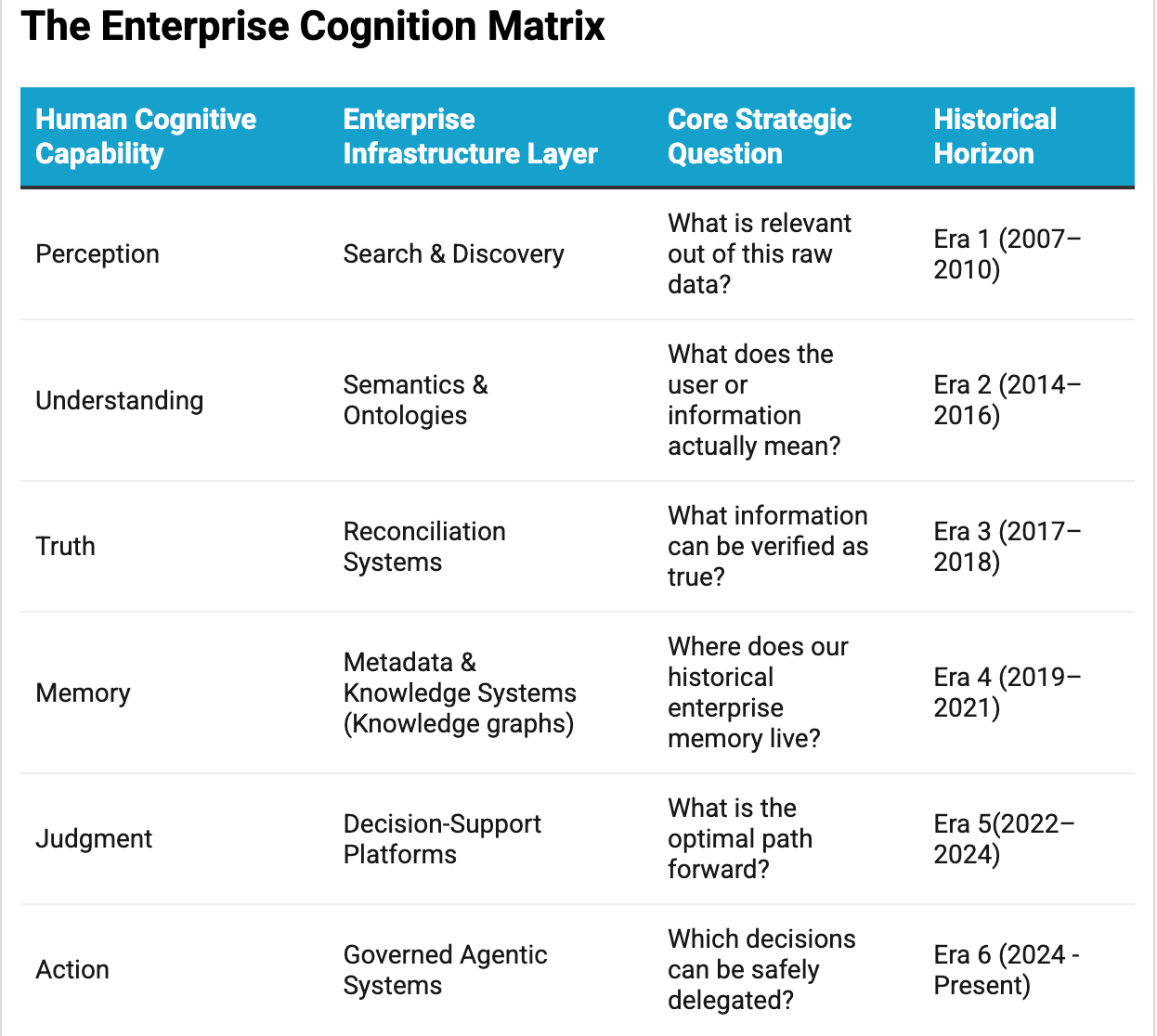
The Enterprise Cognition Matrix
I developed the Enterprise Cognition Matrix as a structural blueprint for this evolution, tracking how technical infrastructure scales organizational judgment over time.
The Trap of Premature Autonomy
The single most expensive mistake I have repeatedly seen enterprises make is chasing the top of this matrix before mastering the middle. Right now, billions of dollars are being poured directly into the “Action” layer — attempting to build fully autonomous agentic workflows. But when you look under the hood of these enterprise pilots, the execution breaks down because the system lacks a reliable foundation.
You cannot safely delegate action to an agent if the system cannot accurately remember its own operational boundaries or verify its data.
What has surprised me most over this journey is how upside-down our collective focus remains. We treat the large language model as 90% of the solution, when in production reality, it is barely 10%. The models have become a commodity utility; raw compute behaves like electricity.
The true, unyielding bottleneck is the absolute chaos of fragmented enterprise knowledge. A useful lens I have leaned on across different domains is that datasets don’t create intelligence — context does.
This is where RAG fits into the larger picture. Modern RAG is not a destination architecture; it is a temporary bridge between Memory (extracting institutional context from metadata layers) and Judgment (using an LLM to reason over that context).
The differentiator for an enterprise isn’t the model it rents; it is its metadata layer — the data lineage, catalogs, schemas, and semantic graphs that form the actual operating system of the intelligent enterprise. Without it, an LLM is merely a reasoning engine with amnesia.
Navigating the Hierarchy of Bottlenecks
When we look at enterprise evolution through this lens, it becomes clear that this progression is not random. Every era was built to solve the bottleneck of the previous one.
Early keyword search solved the bottleneck of data perception — simply discovering that a record existed. Semantic ontologies evolved to solve the bottleneck of understanding what that data meant. Reconciliation and entity resolution platforms emerged because data silos exploded, creating a critical bottleneck around operational truth. Knowledge graphs were built to anchor corporate memory. Today, we use models to solve the bottleneck of scalable judgment.
The ultimate value of the Enterprise Cognition Matrix is not to predict which specific AI vendor will win the next market cycle. Instead, it serves as an internal diagnostic tool to help technology leaders identify exactly which cognitive capability their organization is actually missing.
When evaluating an enterprise AI portfolio, the strategy conversation shifts from technical adoption to structural diagnostics:
1. Are we prematurely chasing Action before establishing Memory?
When organizations find their autonomous agentic systems failing, the issue is rarely model performance or orchestration frameworks. The breakdown happens because the system lacks structural memory. If an enterprise has not built a unified metadata layer, its agents are forced to operate in a vacuum — executing actions flawlessly based on fragmented, outdated assumptions.
2. Are we still trapped solving Perception and Truth problems?
It is common for enterprises to allocate capital toward cutting-edge decision-support platforms while their underlying engineering teams are still actively drowning in basic perception and reconciliation issues. They are still struggling to discover clean data across isolated systems or resolve conflicting identities across datasets. Pouring investment into the “Judgment” layer while the “Truth” layer is fractured introduces an architectural tax that yields diminishing returns.
3. How are we aligning platform capacity to the matrix?
When engineering organizations face the structural challenge of being chronically overcommitted — the “120% problem” — it is often because they are attempting to build capabilities across the entire matrix simultaneously.
By treating infrastructure through the lens of cognition, platform leaders can clearly map their resource allocation. We can stop asking our engineering teams to endlessly optimize localized retrieval scripts from scratch, and instead focus our organizational capacity on establishing the foundational layers — Memory, Fit, and Governance — that make scalable judgment possible.
The Next Frontier
Looking back across nearly two decades of platform evolution, I no longer think the defining question of enterprise AI
“is whether agents will replace workflows?.”
The more interesting question is
whether enterprises can build the institutional memory required to support machine judgment.
Every generation of technology has attempted to solve the bottleneck of the one before it. The organizations that thrive in the next decade may not be those with the most sophisticated models, but those that understand where they truly sit on the cognition curve — and invest accordingly.
메타데이터
- post_id
- ff9aab657d16
- slug
- the-rise-of-the-enterprise-cognition-matrix-ff9aab657d16
- url
- https://medium.com/@aditya2510/the-rise-of-the-enterprise-cognition-matrix-ff9aab657d16
- canonical_url
- https://medium.com/@aditya2510/the-rise-of-the-enterprise-cognition-matrix-ff9aab657d16
- author_url
- https://medium.com/@aditya2510
- status
- ok
- fetched_at
- 2026-08-05 23:46:44