When the World Stopped Looking Up: How the Renaissance Taught Humanity to Look at Itself
How humanism, the Renaissance, and Descartes transformed the Western mind—from a God-centered universe to the birth of modern science…
There is a curious moment that almost everyone experiences, although few notice its philosophical significance.
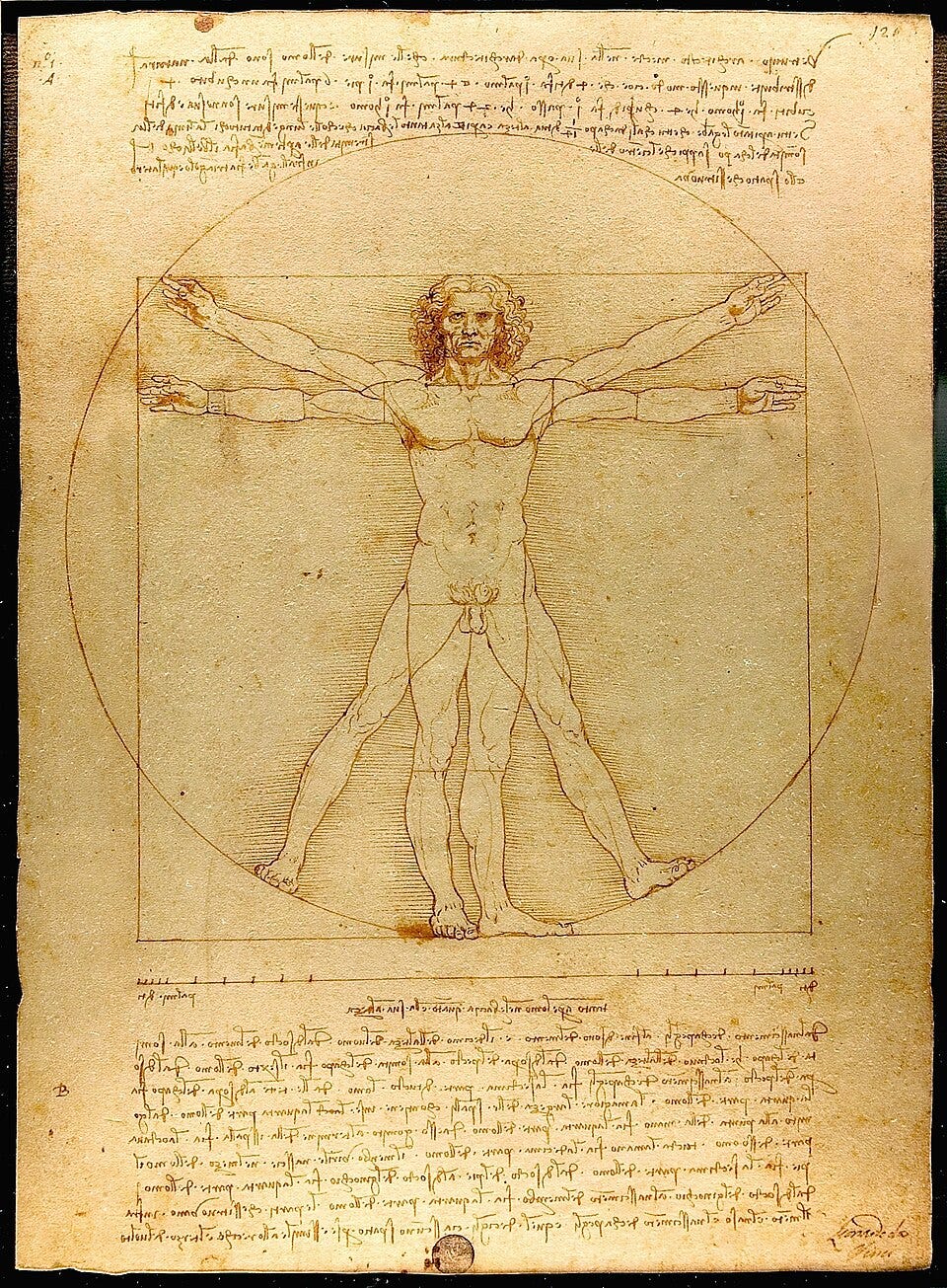
Vitruvian Man by Leonardo da Vinci on Wikimedia Commons
Imagine a child asking a simple question: Why is the sky blue?
Centuries ago, the answer would likely have begun with God. The blue sky reflected divine wisdom, or perhaps it was simply part of the order established by the Creator. The question itself pointed upward. Truth descended from heaven.
Today, the same child receives a very different answer. Light from the sun scatters through Earth's atmosphere. Shorter wavelengths—blue—scatter more efficiently than longer wavelengths. The explanation begins not with heaven but with physics.
The question is the same. The sky has not changed. What has changed is where we begin looking for answers.
That quiet shift—from looking upward to looking outward, and eventually inward—marks one of the greatest revolutions in human history. It was not a revolution of swords or kings, but of imagination. Historians call it the Renaissance. Philosophers often describe it as the birth of modernity. At its heart stood a deceptively simple conviction: perhaps human beings themselves are capable of understanding reality.
This idea feels obvious to us today. Yet for centuries it was anything but obvious.
The Renaissance literally means "rebirth." But what, exactly, was reborn?
It was not Europe itself. It was Europe's memory.
Scholars, artists, merchants, and independent intellectuals began rediscovering the literature, philosophy, science, and political ideals of ancient Greece and Rome. They encountered Plato discussing justice, Aristotle investigating nature, Euclid demonstrating geometry, and Sophocles exploring the tragic complexity of human freedom.
These texts were old, yet they felt astonishingly new.
To Renaissance thinkers, classical civilization represented something that medieval Europe seemed to have gradually lost: confidence in human reason.
This did not mean medieval society lacked intelligence. Medieval theologians such as Thomas Aquinas produced intellectual systems of extraordinary sophistication. Universities flourished, monasteries preserved learning, and philosophy remained alive.
Yet by the late Middle Ages, institutional Christianity had become entangled with political authority, wealth, and corruption. The moral failures of church leaders, the sale of indulgences, and endless struggles for power produced widespread disappointment. Many people felt that religious institutions had become more interested in preserving authority than pursuing truth.
The rediscovery of classical antiquity therefore appeared not merely as an academic exercise but as a cultural alternative.
Ancient Greece became less a historical period than an ideal—a symbol of intellectual freedom, civic participation, artistic creativity, and confidence in human potential.
Whether that image was historically accurate mattered less than what it inspired.
The movement that emerged from this rediscovery became known as humanism.
The word often causes confusion today. Modern audiences sometimes associate humanism with atheism or secularism. Renaissance humanism meant something different.
It was first and foremost an educational and cultural movement.
Its pioneers were often not priests or monks but educated laypeople—merchants, lawyers, diplomats, writers, and independent scholars. Many studied what became known as the studia humanitatis: grammar, rhetoric, history, poetry, and moral philosophy.
These subjects were not intended merely to produce educated professionals.
They aimed to produce better human beings.
Education was no longer viewed simply as preparation for eternal salvation. It also became preparation for living wisely in this world.
This subtle shift changed everything.
Instead of asking only, "How should we please God?" people increasingly asked, "How should human beings live together?"
Instead of focusing exclusively on heaven, attention turned toward history, politics, ethics, literature, and civic responsibility.
The center of gravity slowly moved.
Not away from God altogether.
But toward humanity.
One Renaissance idea captured this transformation with remarkable elegance.
Human beings are neither angels nor beasts.
They are what they choose to become.
Unlike animals, humans are not trapped by instinct.
Unlike angels, they are not already perfect.
Human nature is unfinished.
This was a radically optimistic anthropology.
Instead of seeing humanity primarily through the lens of sin, humanists emphasized possibility.
A person was not defined entirely by birth, social status, or inherited destiny. Through education, discipline, and moral effort, individuals could shape themselves.
Centuries later, existentialist philosophers would express remarkably similar ideas.
Jean-Paul Sartre famously declared that existence precedes essence. We become who we are through our choices.
Although separated by hundreds of years, Sartre's existential freedom echoes an intuition already present during the Renaissance: humanity is a project rather than a completed product.
Humanism transformed not only philosophy but also perception itself.
Walk into an Italian Renaissance gallery and notice the paintings.
Earlier medieval icons often appear flat. Figures float against golden backgrounds, their proportions determined more by symbolic meaning than visual realism.
Then something changes.
Artists begin using perspective.
Roads narrow toward the horizon.
Buildings recede naturally.
Bodies occupy believable space.
The world suddenly looks as though it is being seen by an actual observer.
Perspective was more than an artistic technique.
It was a philosophical statement.
Reality was now organized around the position of the human observer.
The human eye became the reference point from which the world acquired order.
In this sense, Renaissance painting quietly expressed the same conviction as Renaissance philosophy:
Human beings are capable of making sense of reality.
Ideas alone rarely transform civilizations.
Economic change often prepares the ground first.
The Renaissance coincided with the rise of prosperous merchant classes across Italian city-states and later throughout Europe.
Unlike medieval nobles, merchants accumulated wealth through commerce rather than inherited land.
Unlike clergy, they were not financially dependent upon ecclesiastical institutions.
Economic independence created intellectual independence.
A merchant financing voyages, patronizing artists, or sponsoring universities naturally became interested in practical knowledge: navigation, mathematics, accounting, engineering, geography, and foreign languages.
Knowledge became economically valuable.
At the same time, several technological developments dramatically expanded Europe's intellectual horizon.
The printing press allowed books to circulate with unprecedented speed.
The magnetic compass made long-distance navigation increasingly reliable.
Improved shipbuilding encouraged exploration.
Trade in spices, silk, precious metals, and luxury goods created incentives to venture beyond familiar borders.
The world suddenly became larger.
And once people realized that the world was larger than they had imagined, they also began suspecting that their knowledge might be smaller than they had assumed.
Curiosity became both an intellectual virtue and an economic necessity.
The age of discovery had begun.
Yet every discovery carried its own shadow.
메타데이터
- post_id
- ff9c0d90772d
- slug
- when-the-world-stopped-looking-up-how-the-renaissance-taught-humanity-to-look-at-itself-ff9c0d90772d
- url
- https://medium.com/@shrimpmindparadox/when-the-world-stopped-looking-up-how-the-renaissance-taught-humanity-to-look-at-itself-ff9c0d90772d
- canonical_url
- https://medium.com/@shrimpmindparadox/when-the-world-stopped-looking-up-how-the-renaissance-taught-humanity-to-look-at-itself-ff9c0d90772d
- author_url
- https://medium.com/@shrimpmindparadox
- status
- ok
- fetched_at
- 2026-08-02 09:23:06