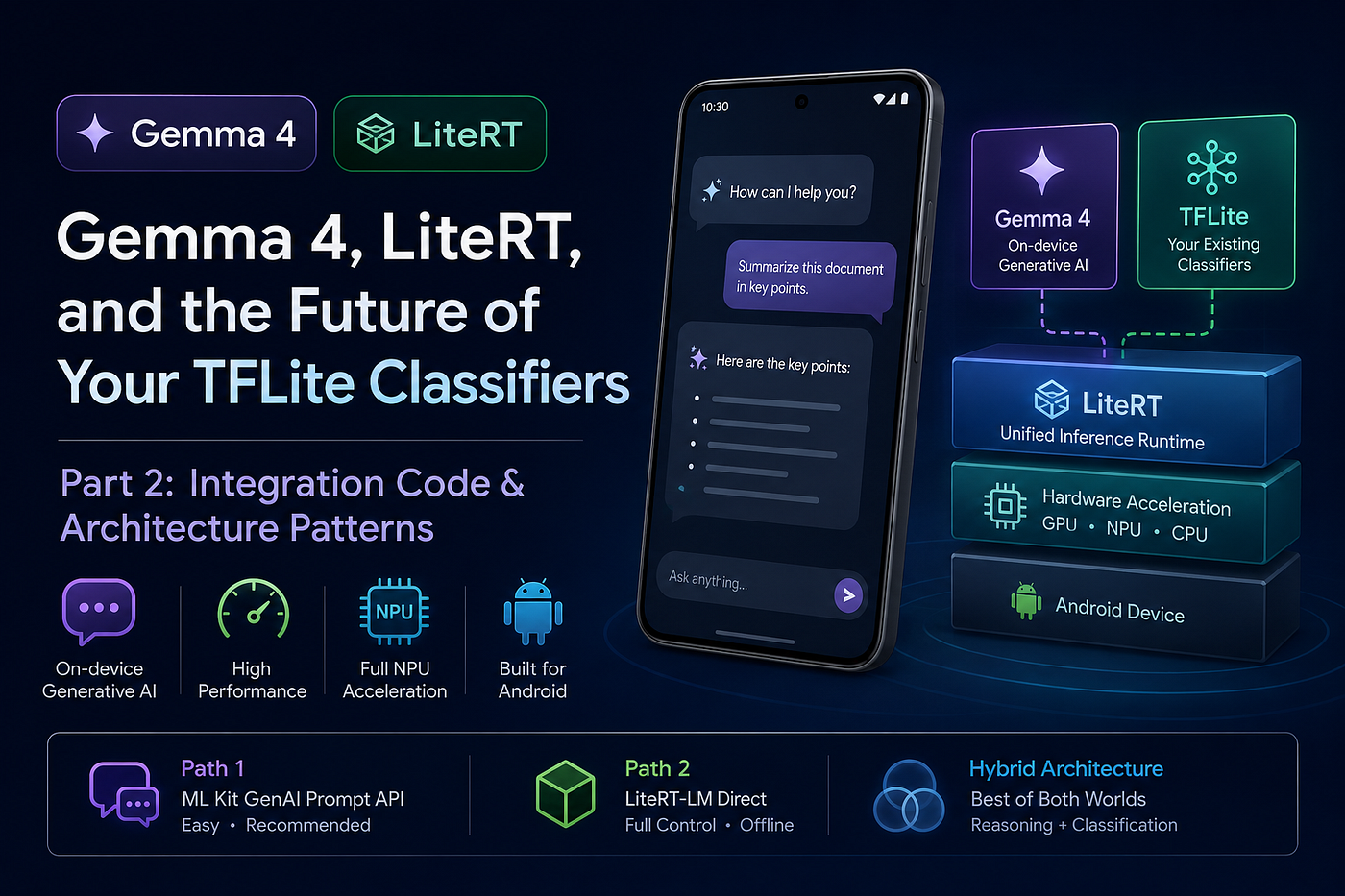
On-Device AI on Android in 2026: What Gemma 4 Means for Your TFLite Classifiers
Part 1: Understanding the Stack
On-Device AI on Android in 2026: What Gemma 4 Means for Your TFLite Classifiers
Part 1: Understanding the Stack
The short answer: they’re not competitors. But understanding why will change how you architect your next Android app.
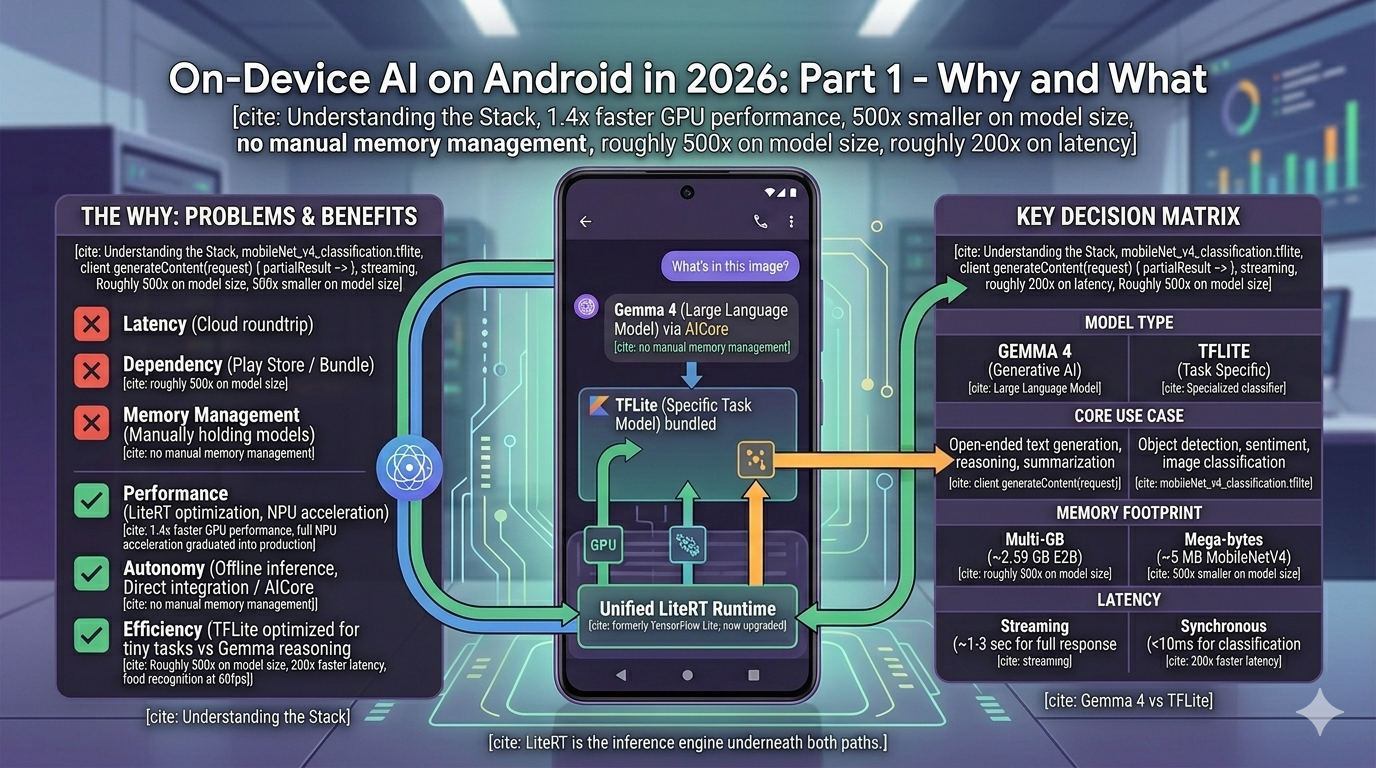
When Google announced Gemma 4 with edge-optimized models capable of running entirely on a Pixel 9, the natural question from Android developers was: does this replace TensorFlow Lite?
It’s the right question to ask. If you can run a multimodal AI model that understands text, images, and audio directly on-device , no internet required, why would you maintain a fleet of small, purpose-built TFLite classifiers?
The answer is nuanced, and it matters a lot for how you design your app.
First: What Is Gemma 4, Really?
Gemma 4 is Google DeepMind’s latest family of open-weight language models, built on the same research foundation as Gemini 3. What makes it interesting for mobile developers specifically are the two edge-optimized variants: E2B (~2 billion effective parameters) and E4B (~4 billion effective parameters).
These aren’t just smaller versions of a big model. They were designed from the ground up for mobile deployment — with Per-Layer Embeddings (PLE) to minimize RAM usage, hybrid attention mechanisms to reduce latency, and native support for text, images, and audio inputs. Both fit on a modern Android flagship and run entirely offline.
You can try them today via the Google AI Edge Gallery app on the Play Store, no account required, no cloud, no API keys. Everything runs locally on your device.
On a Pixel 9, the Tensor G4 chip’s NPU handles inference efficiently enough that battery drain is manageable for moderate use. The E4B model file weighs in around 2.5 GB after quantization, so it’s not trivial — but it fits.
And What Is TFLite / LiteRT?
Here’s something that surprises a lot of developers: TensorFlow Lite (TFLite) has been evolving into LiteRT since 2024. LiteRT is Google’s modern on-device inference framework, delivering 1.4x faster GPU performance than the legacy TFLite GPU delegate, with full NPU acceleration now available in production.
The .tflite format still exists. The toolchain is largely familiar. But the runtime underneath has been substantially upgraded. LiteRT is what’s powering the AI Edge Gallery app, and it’s the same runtime that Gemma 4 edge models use.
This means TFLite and Gemma 4 aren’t competing technologies — they’re layers of the same stack.
The Real Question: Should Classification Tasks Move to Gemma 4?
Let’s get concrete. Suppose you’re building an Android app that classifies food photos into 50 categories. Today you’d use a fine-tuned MobileNetV4 or EfficientNet model via TFLite, probably 5–15 MB, loading in milliseconds, running at 30–60fps.
Could Gemma 4 do that classification instead? Technically yes. Practically, probably not — and here’s why:
Gemma 4 is a generative model. It produces text token by token. Even asking it “which of these 50 food categories does this image belong to?” requires a full autoregressive inference pass over a multi-billion-parameter network. The first token might take 1–3 seconds. That’s fine for a chat interface; it’s terrible for a real-time classification pipeline.
TFLite classifiers are purpose-built. A classification model trained specifically for your task is a single forward pass through a comparatively tiny network. It’s not “worse AI” — it’s the right tool for a constrained, well-defined problem.
The size difference is enormous. A quantized MobileNet is around 4 MB. Gemma 4 E2B is around 1.3 GB. For classification, you’re carrying 300x more model weight than you need.
When Gemma 4 **Does Make Sense on Android**
That said, Gemma 4 opens up use cases on Android that simply weren’t possible before. The distinction is whether your task is closed (fixed label set, fixed input format) or open (flexible, reasoning-dependent, multi-step).
Good fits for Gemma 4 on-device:
-
Open-ended image understanding. “What’s wrong with this photo?” or “Describe the contents of this receipt” — tasks where the answer space isn’t predefined.
-
Conversational assistants. Full chat interfaces that can also process images and audio, entirely offline.
-
Document understanding. Parsing receipts, forms, or handwritten notes with flexible output.
-
Agentic workflows. Using Gemma 4’s native function-calling support to chain actions together on-device.
-
Audio transcription and translation. The E2B and E4B models support audio natively — turning speech into text or translating it, offline.
-
Privacy-sensitive applications. Medical notes, legal documents, personal journals — scenarios where sending data to a cloud API is unacceptable.
Still better with TFLite/LiteRT classifiers:
- Real-time object detection in a camera feed
- Face/gesture/pose recognition
- Audio event classification (dog barking, glass breaking)
- Any task with a fixed label set and latency requirements under 100ms
- Scenarios where model size and app download weight matter
How the Stack Actually Works Together
Here’s what’s useful to understand architecturally: LiteRT is the inference engine underneath both.
When you deploy a Gemma 4 E2B model on Android, it runs via LiteRT-LM, a specialized orchestration layer built on top of LiteRT that handles tokenization, the KV cache, and the autoregressive generation loop. The model weights are packaged in .litertlm format (an evolution of .tflite), and the same hardware delegates, XNNPack for CPU, ML Drift for GPU, QNN for Qualcomm’s NPU, handle the actual compute.
Your existing TFLite classifier pipeline continues to work exactly as before. You can run both in the same app: a TFLite object detection model for real-time bounding boxes, and a Gemma 4 E2B instance for a contextual Q&A interface, each using the same underlying LiteRT runtime.
Google’s ML Kit GenAI Prompt API provides a high-level Android API for integrating Gemma 4 into production apps. And on supported Pixel devices, Gemma 4 is available through Android AI Core as Gemini Nano, the recommended path for production, as it lets the OS manage the model lifecycle and avoids each app shipping its own 2.5 GB file.
A Framework for Deciding
Before reaching for Gemma 4 in your Android app, ask these three questions:
1. Is the label set fixed?
If yes, a trained TFLite classifier will almost always be faster, smaller, and more accurate for that specific task.
2. Does the task require understanding, reasoning, or flexible output?
If yes, Gemma 4 is worth the overhead.
3. What are the latency and battery constraints?
If you need sub-100ms responses or the feature runs continuously in the background, a TFLite model is the right choice. Gemma 4 is suited for interactive, user-triggered flows.
The Bottom Line
Gemma 4 on Android is genuinely exciting — not because it replaces existing tools, but because it fills a gap that previously required a cloud API. Offline, private, multimodal intelligence on a phone is a real capability now, not a research demo.
But TFLite classifiers aren’t going anywhere. They remain the best tool for classification, detection, and real-time inference tasks. The arrival of Gemma 4 doesn’t deprecate that work, it extends what’s possible alongside it.
If you’re an Android developer, the question isn’t Gemma 4 or TFLite. It’s *which tasks belong to which layer of your on-device AI stack**— and for the first time, that stack is genuinely rich enough to be interesting.
What’s Next
Now that the why is clear, it’s time to get into the how.
In Part 2, we go hands-on with real Kotlin code: integrating Gemma 4 via the ML Kit GenAI Prompt API, wiring up LiteRT-LM for full in-app control, running a TFLite classifier alongside Gemma 4 in the same ViewModel, and the production gotchas that the official docs don’t warn you about.
👉On-Device AI on Android in 2026: Gemma 4, LiteRT, and the Future of Your TFLite Classifiers. [Part 2. Integration Code and Architecture Pattern]
Tested on Pixel 9 with Gemma 4 E4B via Google AI Edge Gallery.
메타데이터
- post_id
- ffb349e9e28f
- slug
- on-device-ai-on-android-in-2026-what-gemma-4-means-for-your-tflite-classifiers-ffb349e9e28f
- url
- https://medium.com/@njiang.pin/on-device-ai-on-android-in-2026-what-gemma-4-means-for-your-tflite-classifiers-ffb349e9e28f
- canonical_url
- https://medium.com/@njiang.pin/on-device-ai-on-android-in-2026-what-gemma-4-means-for-your-tflite-classifiers-ffb349e9e28f
- author_url
- https://medium.com/@njiang.pin
- status
- ok
- fetched_at
- 2026-07-14 21:31:35