From MGNREGA to VB-G RAM G…
The story so far:
From MGNREGA to VB-G RAM G…
The story so far:
On December 18 the government passed the Viksit Bharat Gurantee For Rozgar and Ajeevika Mission(Gramin) VB-G RAM G which will going to replace Mahatma Gandhi National Rural Employment Guarantee Scheme MGNREGA. The move has triggered widespread nationwide debate and protest by opposition parties in parliament , who argue that the government is changing the very essence of the scheme.
What was MGNREGA and why it was important?
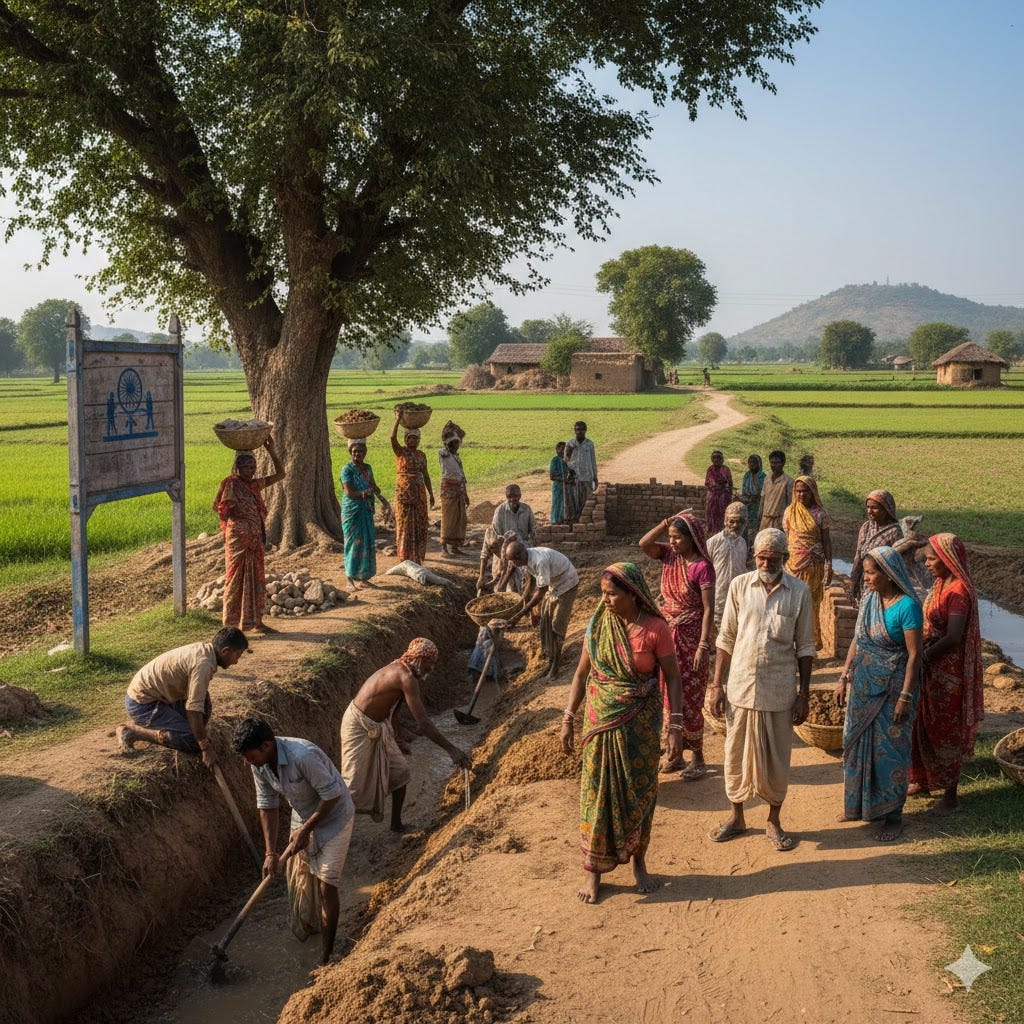
MGNREGA which stands for Mahatma Gandhi National Rural Employment Guarantee Act was launched in 2005 by then incumbent government led by UPA and Congress alliance, initially when it was launched it was known by the name National Rural Employment Guarantee Act (NREGA) but by 2008 its name was changed to Mahatma Gandhi National Rural Employment Guarantee Act.
This scheme had made a pivotal change in the employment and wages sector of rural household as it gave every rural household guarantee work for 100 days per household per year in unskilled manual labour on modest wages.It was meant to save poor from complete destituion, a fallback option.It was unique because it gave employment irrespective of the fact that if person is below poverty line or not only in rural areas.It did not target any particular sections of society like Scheduled Castes (SC) or Scheduled Tribes(ST).With the huge disputed metric of measuring poverty, this was a great advantage.Anyone willing to work was able to access it.
Why does the government want to replace MGNREGA?
Union Rural Development Minister Shivraj Singh Chouhan informed Parliament that MGNREGA has several deficiencies including rampant corruption and misuse of funds by state government. Government also reported cases of pilferage and many implementation issues. Though government has taken several initiatives like linking worker Aadhaar card to bank under the protection of NPCI making aadhar based credit system and making the whole system robust by using apps like National Mobile Monitoring Software (NMMS) App, the Janmanrega App, the Ombudsperson App, and the **Area Officer Monitoring App. **But still people circumvent the technology measures and cases of corruption are recorded, that’s why government has decided to renew the structure of this scheme which include its name as well.
What are the differences between the two?
The new bill marks a major shift from the “demand -driven framework ” to “ supply-driven scheme”.Under the new system (1) Budget Allocation will be capped and only certain amount will be reimbursed state wise based on the “parameters ” which are not yet specified by the government.
(2) Number of days of work will increase from 100 to 125 days.
It also raises the financial burden on state from the current 10% to 40% of total expenditure.
Earlier under MGNREGA the Union government was responsible for the 100% of the labour wages and 75% of the material wages.In practice the expenditure distribution was in the ratio of 90:10 between central and state government.
(3) Under section 22(2) of VB G RAM G this is now changed to ratio of 60:40 but for the north-eastern states,Himalayan States /Union Territories (Uttarakhand, Himachal Pradesh, and Jammu and Kashmir) is still 90:10.
(4) Section 4(5) states that : “ The Central government will decide state wise allocation of funds for each financial year”.This now give Centre greater control over where and how the scheme will be implemented.
(5) Section 5(1) empowers the Union government “ to notify rural areas in State”.
(6) Also the new bill allows for a blackout period , pausing the programme during peak agricultural season to facilitate availability of labour.
Conclusion
While the VB-G RAM G aims to reform MGNREGA and address issues like corruption and pilferage, it also shifts the scheme from a universal, demand driven model to supply driven model and centrally controlled scheme.The increase in the workdays is positive but the higher financial burden already put the state at risk after they have surrendered their financial powers to centre under GST Bill. Also the introduction of black out periods may affect rural workers access to guaranteed employment.As India navigates rural development and job security , it will be crucial to balance efficiency, transparency and the rights of millions of rural households who depend on this programme amid the federal issues between centre and state.
메타데이터
- post_id
- ffb9bcb4c021
- slug
- from-mgnrega-to-vb-g-ram-g-ffb9bcb4c021
- url
- https://medium.com/@formypersoneluse01/from-mgnrega-to-vb-g-ram-g-ffb9bcb4c021
- canonical_url
- https://medium.com/@formypersoneluse01/from-mgnrega-to-vb-g-ram-g-ffb9bcb4c021
- author_url
- https://medium.com/@formypersoneluse01
- status
- ok
- fetched_at
- 2026-06-09 15:37:30