From Symbol to Philosophy: The Hidden World of the I Ching
Preface
From Symbol to Philosophy: The Hidden World of the I Ching
Preface
Although I grew up Chinese, I knew surprisingly little about the I Ching for much of my life. The reason is simple: I had always thought of it primarily as a book of fortune-telling, and I have never had much interest in divination. Like many people trained in science and rational inquiry, I tended to dismiss such things as superstition.
Ironically, I came to the I Ching through a completely different path. In recent years, I have been debating Christians who argue that the Tao is equivalent to the Christian Logos — that Laozi somehow anticipated Christianity. These discussions pushed me to look more deeply into the foundations of Chinese thought itself.
What I discovered surprised me. The deeper I looked, the more I came to feel that Chinese culture and Christian culture rest on very different assumptions about reality, history, nature, and human life. Chinese civilization grew out of an indigenous and agrarian world shaped by seasons, cycles, and harmony with nature. By contrast, the Judeo-Christian tradition emerged from a very different historical experience and symbolic imagination.
In the process, I also discovered that the I Ching may have been misunderstood by many modern readers, including myself. Beneath its reputation as a book of divination lies something much deeper: a profound philosophy of change and one of humanity’s earliest explorations of process and relationship.
This essay is part of my own rediscovery.
I Ching: The King of Chinese Classics
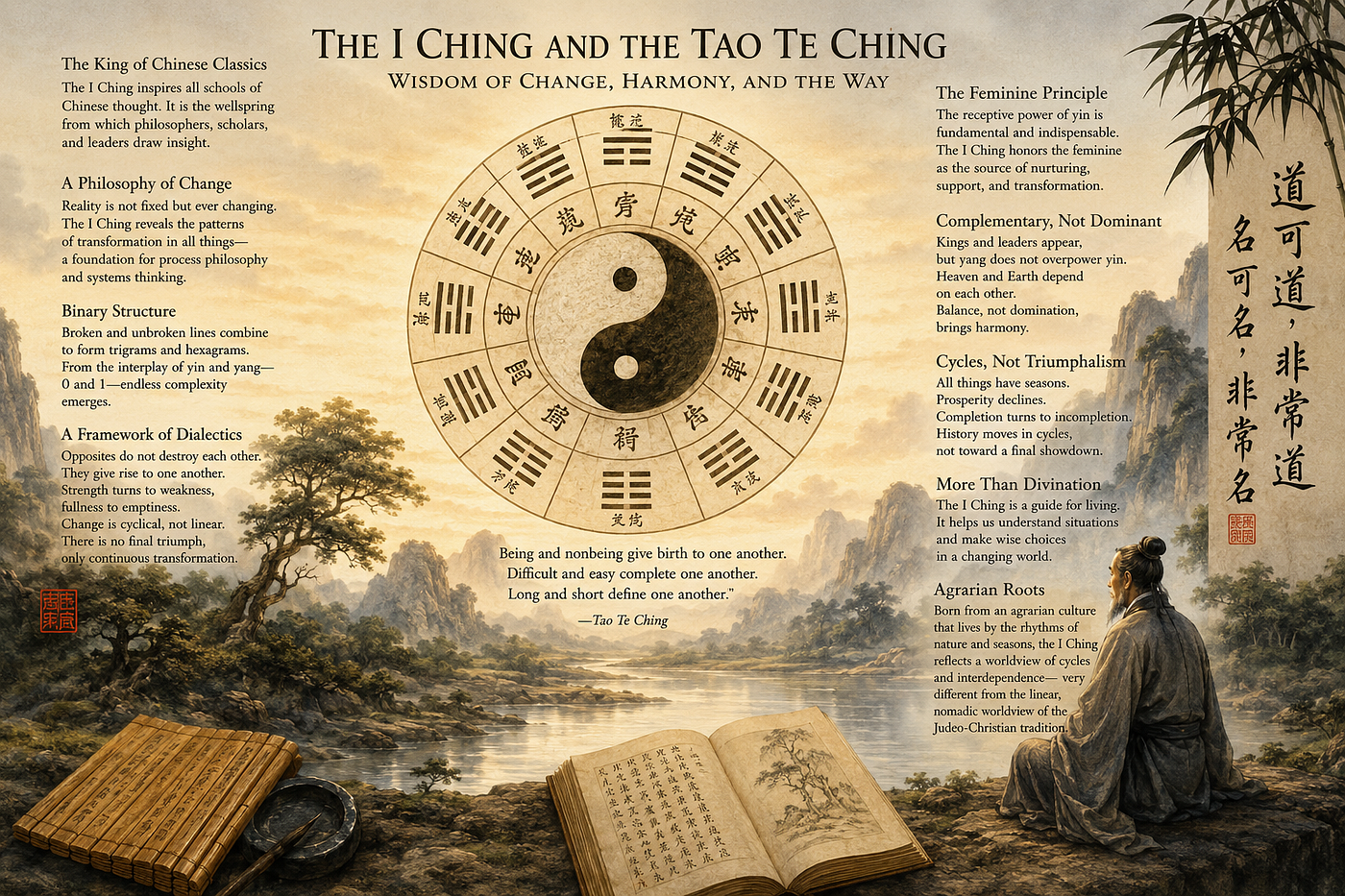
Among the classics of Chinese civilization, the I Ching occupies a unique position. In a sense, it is the king of all Chinese classics. Few texts have exercised a broader influence. Confucians, Taoists, Neo-Confucians, military strategists, physicians, artists, and even modern scholars of science and systems theory have all drawn inspiration from it. Unlike texts tied to a single school, the I Ching functions almost as a common symbolic language shared across Chinese civilization. One may disagree with Confucius, Laozi, or Zhu Xi, but almost everyone in the Chinese intellectual tradition eventually enters into conversation with the I Ching.
The connection between the Tao Te Ching and the I Ching is especially profound. While the Tao Te Ching may not directly quote the I Ching, it seems to emerge from the same intellectual atmosphere and carries many of its central insights into a more philosophical direction. If the I Ching provides a grammar of change, Laozi transforms that grammar into philosophy.
A Philosophy of Change Rather Than Substance
The I Ching begins with a striking premise: reality is not fundamentally made of fixed substances but of changing patterns. Things rise and fall. Growth becomes decline. Fullness becomes emptiness. Strength turns into weakness.
Unlike much of classical Western philosophy, which often sought permanent essences — Plato’s Forms, Aristotle’s substances, or later theological notions of immutable being — the I Ching begins with transformation itself. Reality is a process.
For this reason, the I Ching offers a powerful foundation for process philosophy. Rather than asking, “What is the essence of this thing?” it asks, “What pattern is unfolding?” It anticipates a worldview in which things are understood through relationships, interactions, and movement rather than isolated objects possessing fixed identities.
In this respect, it resonates not only with Taoism and Buddhism but also with systems theory and modern process thought.
Philosophy Rather Than Mysticism
Modern readers often approach the I Ching as a mysterious oracle book filled with esoteric symbolism. Yet a strong case can be made that the I Ching is fundamentally philosophical rather than mystical.
Many religious traditions begin with metaphysical claims concerning God, souls, heaven, or transcendent realities. The I Ching begins elsewhere. It begins with observable patterns of change: day and night, growth and decline, winter and spring, advance and retreat, prosperity and collapse.
Its central concern is not primarily:
“What supernatural world lies behind appearances?”
Rather, it asks:
“What pattern is unfolding?”
This difference is significant.
The I Ching is less concerned with ontology and metaphysics than with process and relationship. Instead of searching for a hidden substance beneath reality, it studies transformations occurring within reality itself.
Even its use as a divinatory text may be secondary to a broader purpose. Historically, people from all walks of life consulted the I Ching not simply to predict fate but to understand situations, recognize tendencies, and make wiser decisions. It functioned less as a crystal ball and more as a framework of pattern recognition.
Like much of classical Taoism, the I Ching may have gradually accumulated later metaphysical and mystical interpretations. But one may plausibly argue that its earliest orientation was closer to practical philosophy and proto-systems thinking than supernatural speculation.
The Binary Structure of Reality
The structure of the I Ching itself reflects this dynamic worldview. At its foundation lies a binary system of broken and unbroken lines. From combinations of these simple opposites arise trigrams and eventually the sixty-four hexagrams.
There is something strikingly modern about this. Modern computers operate using binary code — zero and one. The I Ching similarly generates immense complexity from simple dual principles.
Of course, one should not push the analogy too far. The I Ching is not a computer science text. Yet the parallel remains suggestive. Just as binary logic underlies modern computation, the interaction of yin and yang generates the symbolic universe of classical Chinese thought.
The I Ching as a Framework of Dialectics
Another remarkable feature of the I Ching is that it provides a framework that can be described as dialectical thinking. However, it is a very different kind of dialectic from what later developed in the West.
Western dialectics, particularly in thinkers such as Georg Wilhelm Friedrich Hegel and Karl Marx, often proceeds through tension and contradiction: the thesis confronts the antithesis, producing a synthesis. History advances through struggle and contradiction.
The I Ching presents a different vision. Opposites do not seek to destroy one another. Rather, they mutually define and generate one another. Yin and yang are not enemies locked in battle. They are complementary principles whose interaction produces transformation.
Strength turns into weakness.
Fullness becomes emptiness.
Advance becomes retreat.
Prosperity gives way to decline.
Each condition carries within itself the seeds of its opposite.
The I Ching, therefore, offers a dialectic without final synthesis. There is no ultimate endpoint where contradictions disappear permanently. Reality remains dynamic, cyclical, and relational.
Laozi later carries this logic into philosophy:
Being and nonbeing give birth to one another. Difficult and easy complete one another. Long and short define one another.
This is not a dialectic of conquest but a dialectic of mutual arising.
The Prominent Role of the Feminine Principle
This binary structure also points to one of the most remarkable features of the I Ching: the central role of the feminine principle.
The receptive, nurturing, yielding principle of yin occupies a foundational position. The second hexagram, Kūn, represents Earth, motherhood, receptivity, and support.
Heaven alone cannot generate the world.
Creative force requires receptivity.
This presents a sharp contrast with the symbolic world of the Bible. The biblical tradition overwhelmingly emphasizes masculine imagery: Father, King, Lord, patriarchs, prophets, and male authority figures.
There is no enduring divine polarity equivalent to yin and yang.
By contrast, the I Ching assumes reality itself unfolds through complementary principles.
Masculine and Feminine as Complementary
Yet the I Ching does not eliminate masculine imagery. Kings, rulers, armies, fathers, and authority figures appear throughout the text.
However, the masculine does not completely dominate the feminine. This reflects a worldview very different from that of the Judeo-Christian tradition. In particular, in both the I Ching and the Tao Te Ching:
(a) Heaven and Earth stand together.
(b) Creative force and receptivity remain mutually dependent.
(c ) Excessive yang becomes dangerous. Dominance without balance creates instability.
This equilibrium later becomes central to Laozi, who repeatedly praises water, valleys, softness, mothers, and what he calls “the mysterious female.”
The ideal is not the victory of one side over another but a dynamic balance.
Cycles Rather Than Triumphalism
Another major contrast with many Western religious traditions concerns history itself.
The I Ching does not embrace a triumphalist view of history moving toward a final showdown. There is no final battle in which good permanently annihilates evil.
(a) Reality unfolds instead through cycles and seasons.
(b) Prosperity gives way to decline.
(c ) Winter becomes spring.
(d) Completion turns into incompletion.
The final two hexagrams themselves are revealing:
63: Already Completed 64: Not Yet Completed
The book refuses closure.
Even success contains seeds of reversal.
Laozi carries this insight further:
“Reversal is the movement of Dao.”
No condition remains permanent.
The wise person, therefore, does not cling to triumph.
More Than a Book of Divination
The I Ching is often misunderstood in the modern West as simply a fortune-telling manual.
Historically, however, it functioned as something much broader.
Statesmen, scholars, artists, physicians, and ordinary people consulted it not merely to predict events but to understand situations and seek wisdom regarding action.
It asks not:
“What fixed future awaits me?”
but rather:
“What pattern is unfolding, and how should I respond?”
It is less a crystal ball than a guide to understanding change.
Agrarian Roots and a Different Worldview
Finally, the I Ching reflects the sensibilities of an agrarian civilization.
Agricultural societies live through seasons, weather, planting, harvest, drought, and renewal. Such cultures naturally become sensitive to rhythms and cycles.
By contrast, the ancient Hebrew world emerged in a largely nomadic and pastoral environment and developed a more linear view of history:
Creation → Covenant → Exile → Redemption → Fulfillment
This does not mean one worldview is superior to another. But it helps explain why the I Ching and the Judeo-Christian tradition often speak different symbolic languages.
One sees reality as a continually turning wheel.
The other often sees it as a story moving toward an ultimate destination.
Conclusion: From Symbol to Philosophy
The Tao Te Ching drew heavily on the I Ching. It transformed symbols into philosophy and patterns into a vision of life.
If the I Ching maps the changing landscape of reality, Laozi asks what underlying process makes change possible at all.
Together they form two streams of a larger Chinese worldview — one symbolic and one philosophical, one mapping transformation and the other explaining its movement.
Both continue to speak powerfully to a modern world increasingly aware that reality may be less like a machine composed of fixed objects and more like a living system in perpetual transformation.
메타데이터
- post_id
- ffbae84ed5e7
- slug
- the-i-ching-and-the-tao-te-ching-two-great-streams-of-chinese-thought-ffbae84ed5e7
- url
- https://medium.com/@kleong54/the-i-ching-and-the-tao-te-ching-two-great-streams-of-chinese-thought-ffbae84ed5e7
- canonical_url
- https://medium.com/@kleong54/the-i-ching-and-the-tao-te-ching-two-great-streams-of-chinese-thought-ffbae84ed5e7
- author_url
- https://medium.com/@kleong54
- status
- ok
- fetched_at
- 2026-08-03 06:38:07