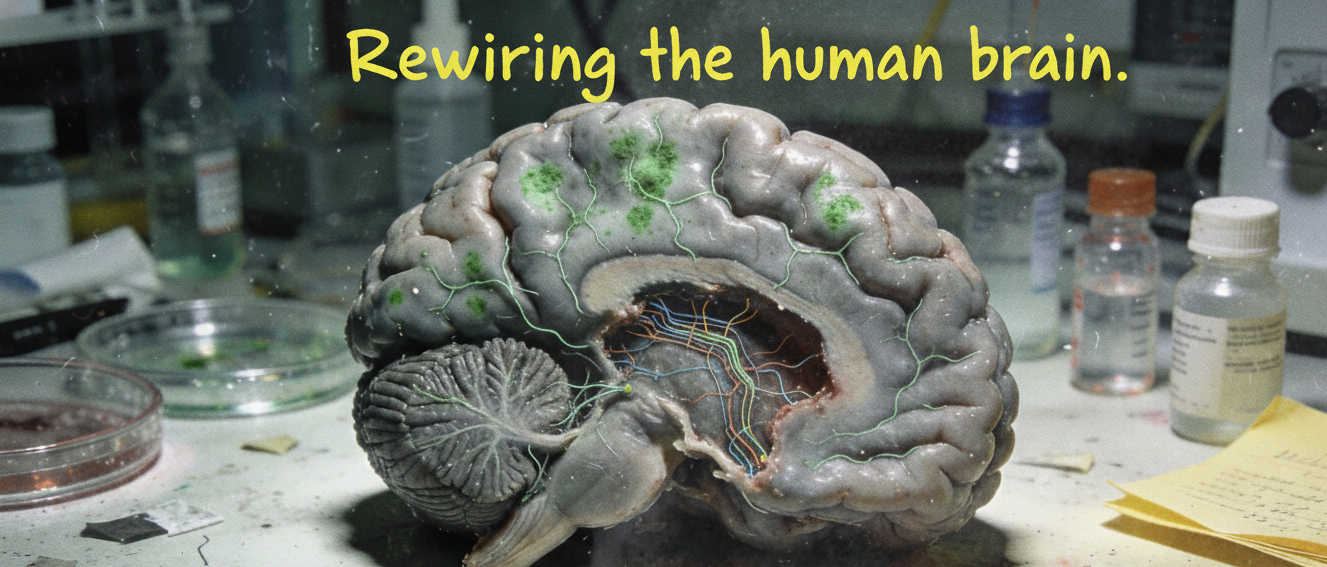
The Psilocybin Code That Hacked Human Software
I understood for the first time what the word ‘ecstasy’ actually meant — R. Gordon Wasson
The Psilocybin Code That Hacked Human Software
I understood for the first time what the word ‘ecstasy’ actually meant — R. Gordon Wasson
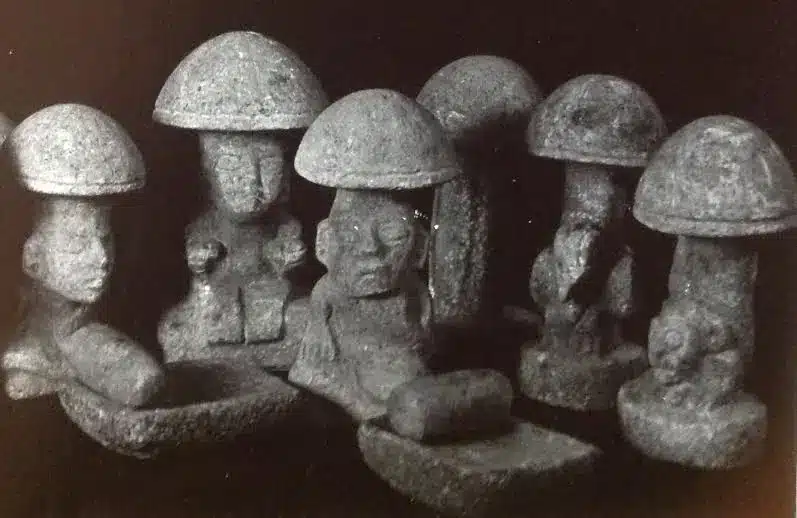
Miniature mushroom stones with metates. Culture: Highland Maya, Kaminaljuyú, Guatemala. Date: c. 1000–500 BC. Photographer: Leo Johnson.
In 1970, researcher Roland Fischer ran a series of experiments. He administered controlled doses of psilocybin to 16 volunteers, with a median age of 23.5, who received 160 μg/kg before their vision was tested. The study revealed a “drug-induced contraction of nearby visual space”. This contraction resulted in an “enlargement of the visual angle of given details”. Students could detect finer details and see contrast better because their perceptual constancies were transformed, making objects appear more defined.
Now, consider what this means for early humans. Better vision means better hunting. Better hunting means more food. More food meant bigger brains.
The Stoned Ape Hypothesis
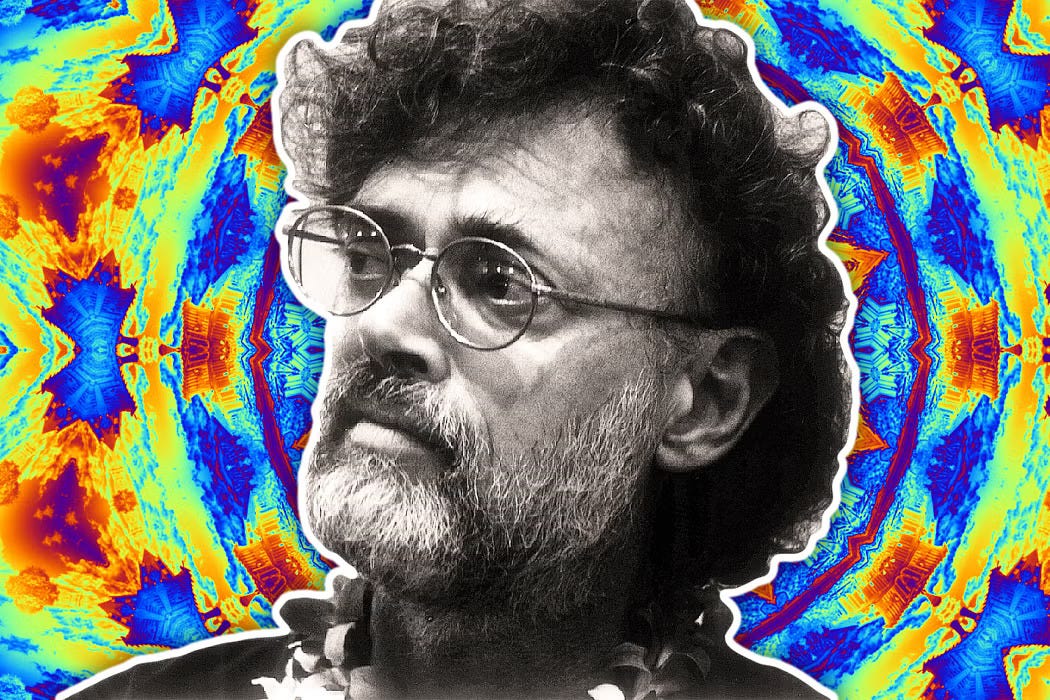
Terence McKenna via Wikimedia Commons
Two million years ago, our ancestors’ brains hovered around *900 cubic centimetres*. Then, in a radical shift — a mere 100,000 years — that volume hit 1600. It nearly doubled.
In the slow, grinding reality of evolution, that kind of explosion usually demands millions of years. But here it was: a sudden, violent surge in complexity that the standard timeline simply cannot explain.
Fire, tools, and eating meat all played their parts, yet the chronology didn’t match. *These developments came after brain expansion, not before*.
McKenna had one simple explanation.
Our ancestors followed wild herds across the African savanna, moving through the dung left in their wake. Sprouting from that waste was Psilocybe cubensis — the exact fungi *Fischer* later tracked at Harvard.
The scientific community despised the theory, mocking it as the ‘*Stoned Ape Hypothesis*’. Undaunted, McKenna didn’t refrain:
“Psilocybin didn’t just change the mind, it helped form the human experience.”
Modern Neuroscience says the Brain Gets Quieter
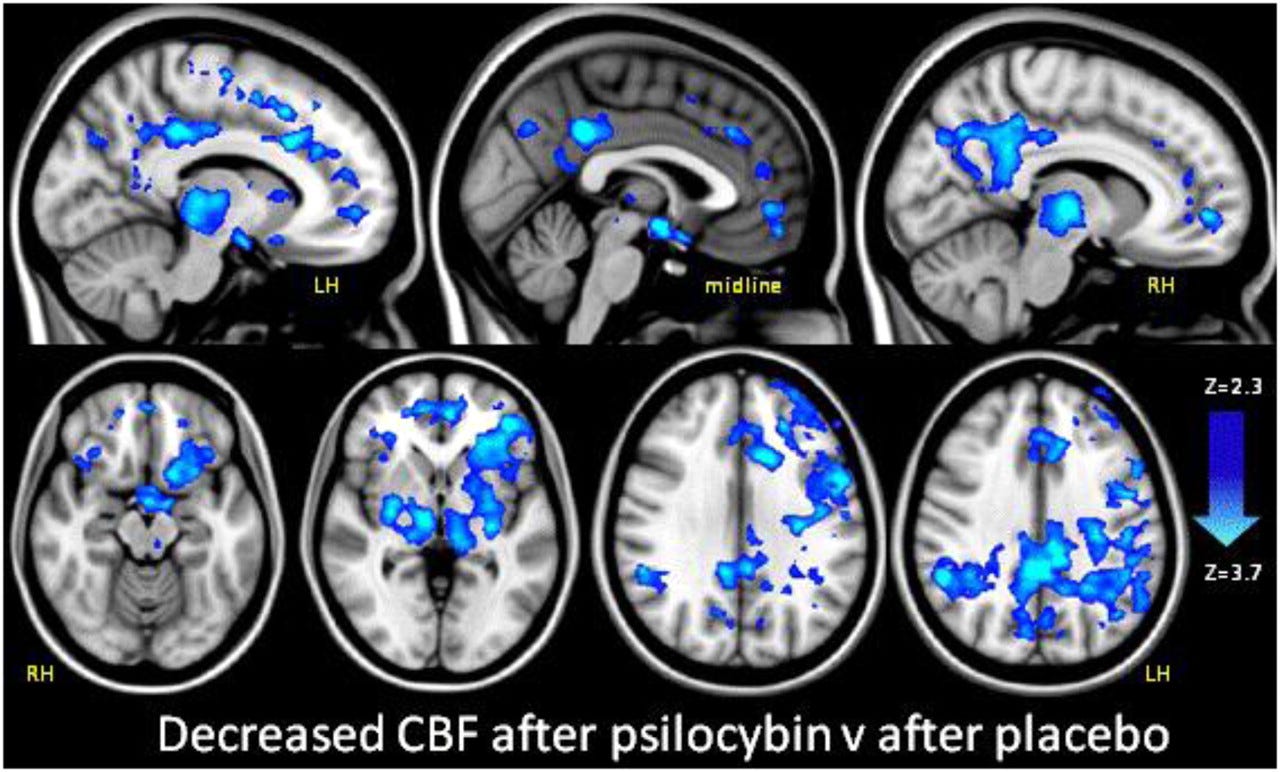
Decreased CBF after psilocybin (ASL perfusion fMRI). PNAS.
Thirty years later, *scientists scanned the brains* of those under the influence of psilocybin. Discovering McKenna wasn’t absurd at all; in fact, he was right about one important thing: the substance modifies the wires in a way no one anticipated.
When neuroscientists finally placed volunteers in MRI devices, they expected a neural explosion — a surge of activity, energy, and chaos. Instead, they saw the contrary. The brain grew tranquil.
Specifically, one region went almost silent: The Default Mode Network. Your brain’s control centre — the voice in your head that says “I” when you think about yourself. *It kills your ego*, the boundary between you, the world, and your very sense of self.
And when it does, something extraordinary happens. Brain regions that never sync up start communicating with areas that process emotion. Memory centres link up with parts that control body awareness. A city where everyone is unexpectedly *linked to their neighbourhoods by hyper roads* — a remarkable shift in connectivity.
Moreover, the connections constructed during these experiences *don’t wear off*, as the scans reveal that new neural pathways remain active for weeks, sometimes months. In some cases, the changes appear permanent.
Personality Changes and DNA
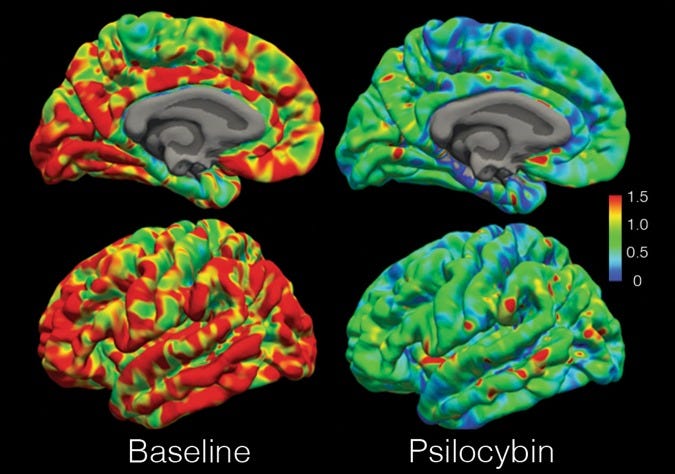
Psilocybin occupancy of 5-HT2AR. National Library of Medicine
There is something inherently *alien* about how psilocybin interacts with the human psyche. While including longitudinal analyses of personality change suggests that core personality traits are predominantly stable after age 30, this compound proves otherwise.
In the labs of Johns Hopkins, researchers watched as the unbreakable rules of identity faded away, replaced by a lasting openness and a raw, creative connection to the world that shouldn’t — by all accounts — be possible.
It all comes down to Psilocin. When psilocybin enters the bloodstream, it reacts with a strange, almost surgical accuracy. It mimics serotonin, slots into our 5-HT2AR receptors *like a key that has finally found its specific lock*. This is where the biology gets truly weird: despite a billion years of separate evolution, only sharing half our DNA with fungi, these mushrooms produce a chemical that fits the human mind perfectly.
Paul Stamets argues this isn’t some lucky accident:
[embed]The Neuroplasticity Secret: Paul Stamets on How Mushrooms Rewire the Brain
“Humans and mushrooms have been co-evolving together… not just genetically, but culturally.”
Ancient’s Technology
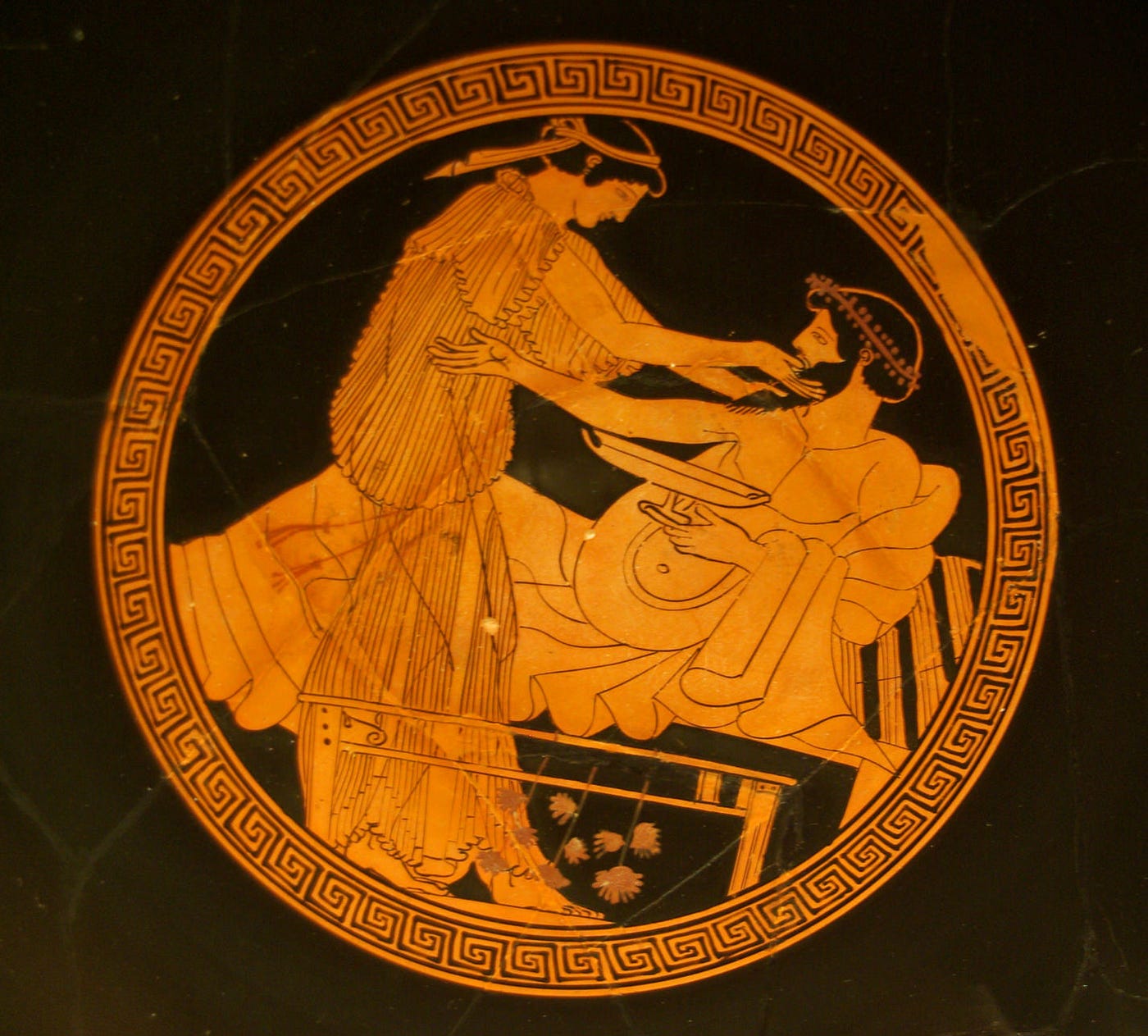
A scene from the interior bowl of a red-figure kylix or stemmed drinking cup (490–480 BCE) depicting a symposiast and hetaira — high-class prostitute. (Museum of Fine Arts, Boston)
Forget MRI machines. Ancient civilisations didn’t need them. For two thousand years, they used mushrooms as a tool — a biological technology to pierce through this reality and speak with those who came before.
It was their direct line to God.
Greece guarded this secret under a vow of death: *The Eleusinian Mysteries. Every September. You’d see an emperor’s sandals caked in the same dirt as a peasant’s, battle-scarred soldiers standing right next to philosophers, walking miles along [the road to Eleusis](https://archive.org/details/roadtoeleusisunv0000wass)*, solely to drink the Kykeon (An Ancient Greek drink referring to a psychoactive brew), break the walls of the mind.
Plato, Aristotle, Sophocles, Cicero and Marcus Aurelius all *reference the same*:
“Not only have we received the reason for living in joy, but also for dying with a better hope.”
Then, in 1978, it identified *Ergot*, a fungus growing on common rye. A natural, raw form of LSD hidden in plain sight.
The Flesh of the Gods
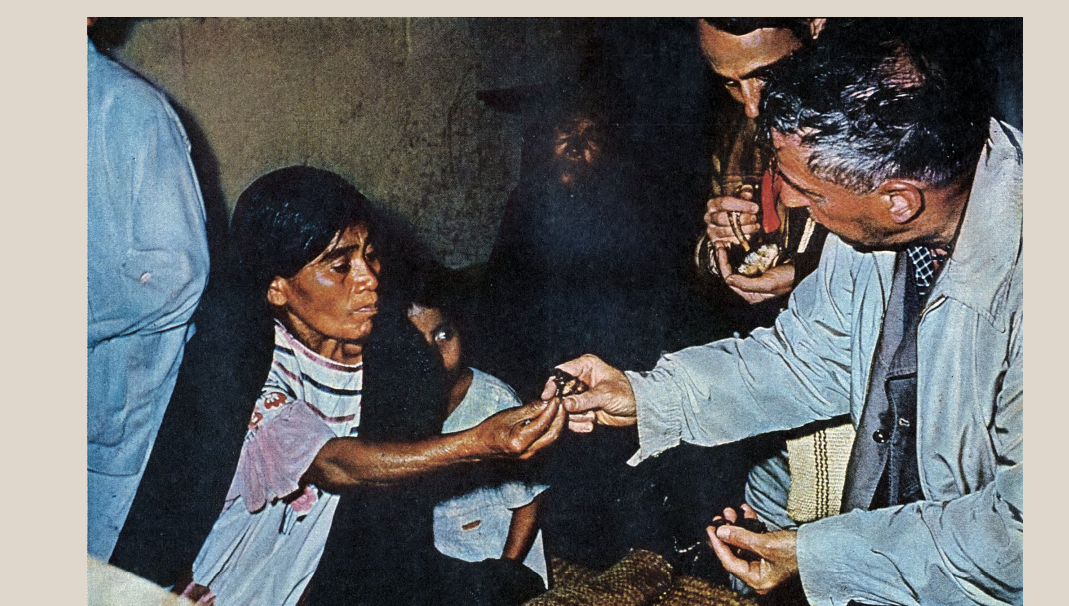
Life Magazine, 1957 — Gordon Wasson (Seeking the Magic Mushroom)
Across the ocean, it was called Teonanácatl. Flesh of the Gods. Or at least, that’s what the *Aztecs* called it: A doorway, not a drug.
When *the Spanish arrived in the 1500s*, they saw a spiritual allegiance that couldn’t be denied. It terrified them to the core.
Indigenous people were speaking directly to their gods — no priests, no intermediaries, no institutions. Just raw, divine contact. To the Spanish, this was heresy. Burned the temples down, turned the sacred codices to ash, and made using the flesh a crime punishable by death. They tried to wipe the story from the earth.
You can’t kill what grows in the dark. For four centuries, *the Mazatec people of Oaxaca* kept the tale alive. By moving the rituals into mountain caves, the truth was held through generations of healers in total silence. Protected the flame until the world was ready to see it again.
From Soma to Manna
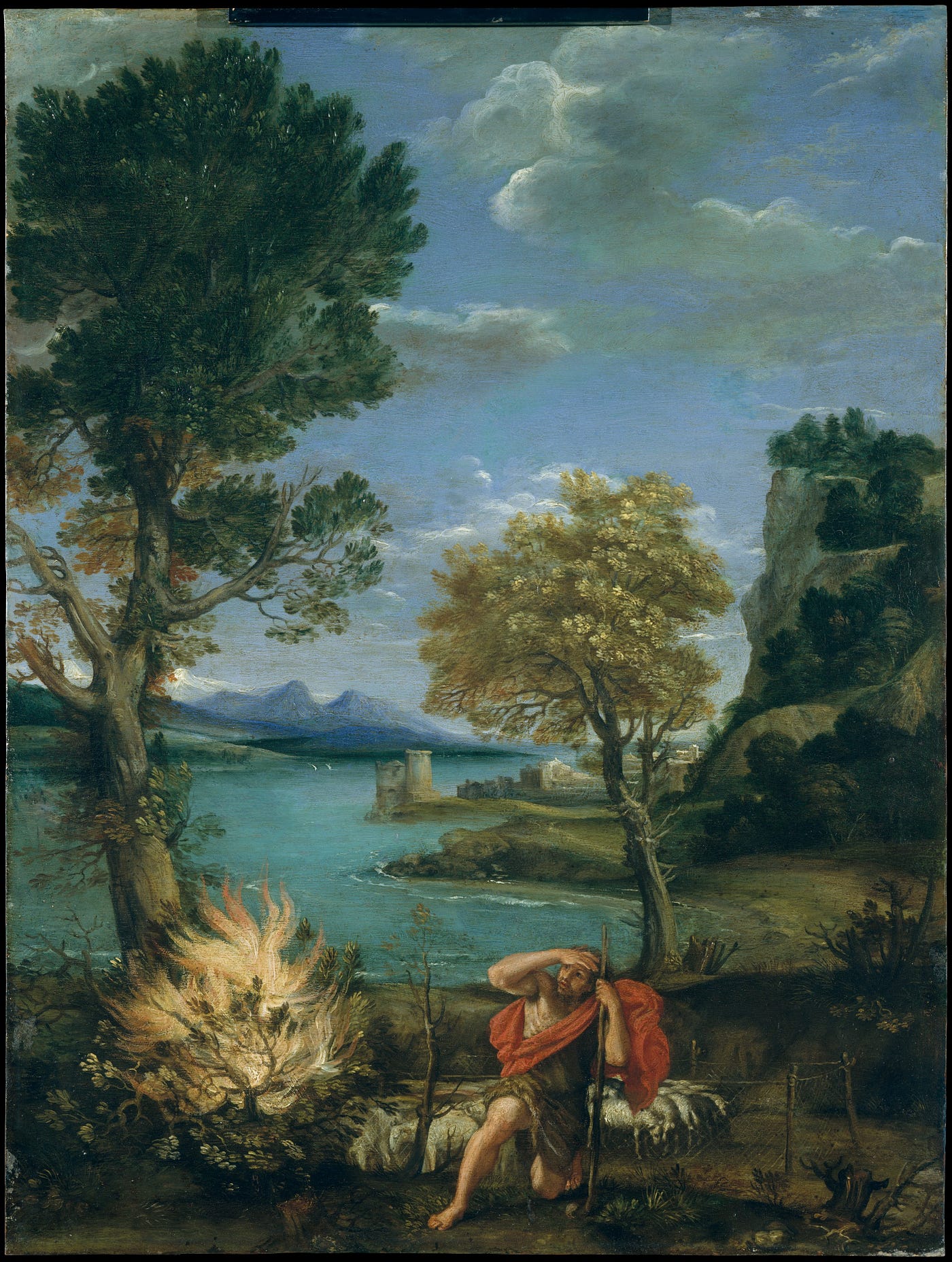
Landscape with Moses and the Burning Bush — painting by Domenichino (Domenico Zampieri) (MET, 1976.155.2)
Vedic texts from ancient India point to a divine plant that they are deeply devoted to. It is called Soma — a metaphysical catalyst that promised immortality, stripped away the mantle of the world.
Scholars remained in an academic deadlock trying to identify it until *R. Gordon Wasson examined the descriptions, finding a perfect match: Amanita muscaria. The red-and-white mushroom from every childhood fairy tale was actually the God-food* of the ancients.
While in Siberia, the most surreal tradition began. Shamans turned the reindeer into a biological filter. They’d feed the fungus to the animals, then — in a move that sounds like a fever dream — drink the reindeer’s urine. The animal’s body cleans out the lethal toxins but keeps the psychoactive fire intact. It was the only way to *fly* across the sky, visit other worlds without dying in the process — a spiritual journey powered entirely by reindeer pee.
Even the Bible might contain references to mushrooms. Moses talked with God for fifteen minutes at a burning bush. The bush was probably an Acacia. It is loaded with DMT — a compound that triggers visions for *precisely this duration when inhaled. Then there is the spiritual meat [(Manna)](https://archive.org/details/foodofgodssearch0000mcke)* that kept the Israelites outlasting the 40-year wandering in the desert. Appearing overnight, gathered before the sun rose, it gave people visions similar to an entheogenic essence.
*John Marco Allegro expanded the limit even further; He saw the Last Supper as a metaphor, where the body, blood of Christ, were just the cap and stem of fly agaric. A hypothesis that turned early Christianity into a mushroom cult. However, the Vatican destroyed [Allegro’s career](https://www.amazon.com/John-Marco-Allegro-Maverick-LITERATURE/dp/0802828493)* for it.
Maria Sabina
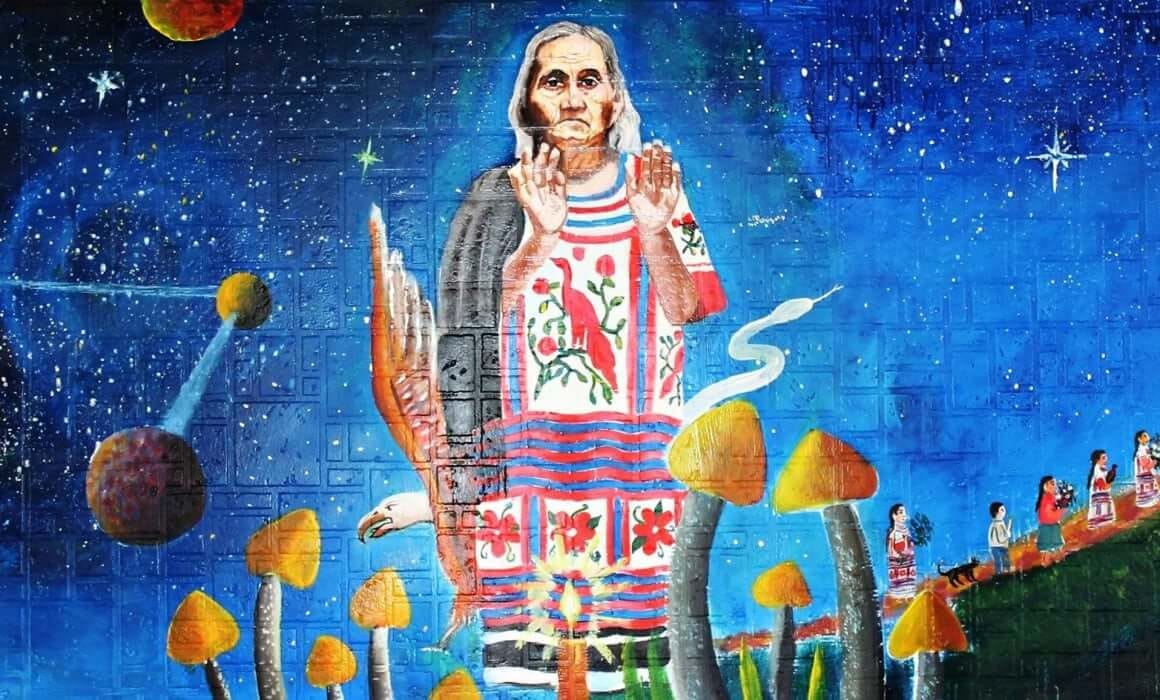
One of the commemorative murals of the 126th birthday of María Sabina in Oaxaca, Mexico
Every civilisation throughout history knew the power of mushrooms, yet every authority that rose to power tried to destroy that secret knowledge.
In 1955, R. Gordon Wasson traded his desk as a JPMorgan vice president for the mountains of Oaxaca, Mexico. Travelling with his wife, Valentina, he went in pursuit of the sacred rites that outlasted the Spanish conquest. This journey eventually led them to *Maria Sabina*.
As a Mazatec curandera healer, her family had guarded these fungal traditions for years, rarely allowing outsiders into the ceremonies. But something about the Wassons made her break that rule. She served them Psilocybe mexicana on a leaf. Once incense filled the room, the visions began; Wasson saw geometric patterns, palaces made of light, and later noted:
“I understood for the first time what the word ‘ecstasy’ actually meant — not happiness, but standing outside yourself, seeing reality from a perspective that normal consciousness just doesn’t allow.”
On June 29th, 1955, Wasson became the first known white person to attend the ceremony. Two years later, Life Magazine published an article that reached 6 million Americans, titled: *“Seeking the Magic Mushroom.”*
The Good Friday
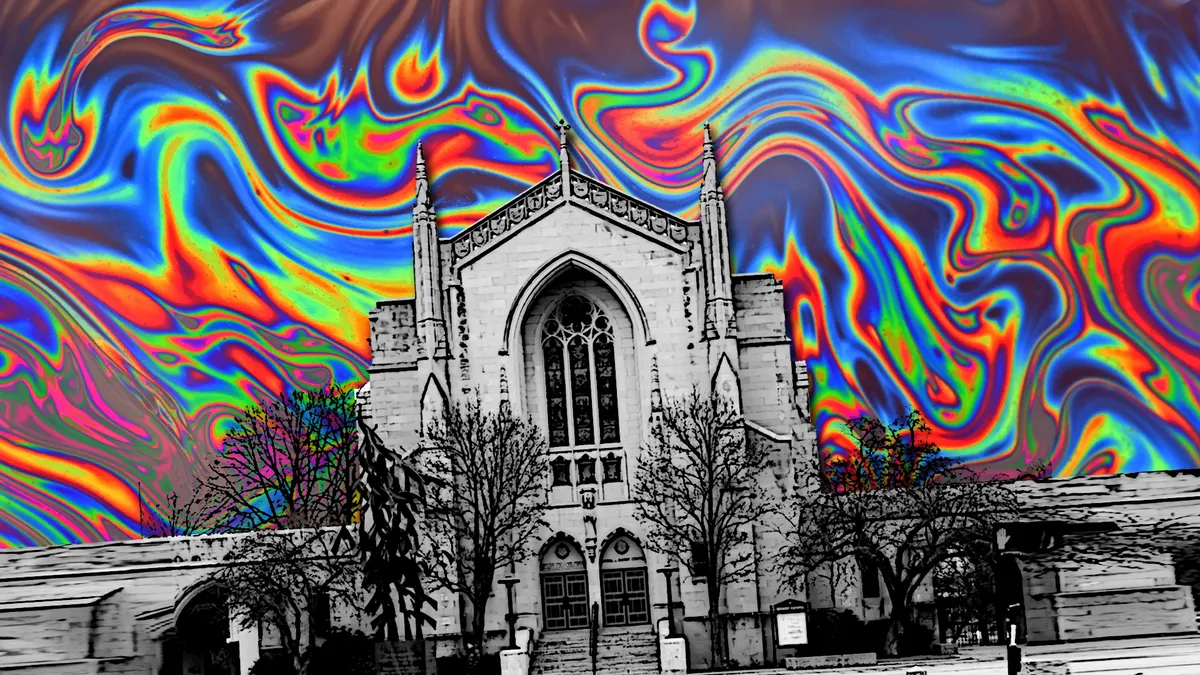
Image credit: Artography / dexterous simpson / Shutterstock.com; modified by IFLScience
The psychedelic revolution had begun. Timothy Leary read that article. So did Richard Alpert. They started the *Harvard Psilocybin Project in 1960. Giving mushrooms to graduate students, divinity students, and [prisoners](https://pubmed.ncbi.nlm.nih.gov/9924845/). Everyone reported profound experiences, life-changing revelations. Then came the [Good Friday Experiment](https://search.worldcat.org/title/Drugs-and-mysticism-:-an-analysis-of-the-relationship-between-psychedelic-drugs-and-the-mystical-consciousness-:-a-thesis/oclc/22195434)*.
On April 20th, 1962, 20 divinity students gathered in Boston University’s Marsh Chapel. Half received psilocybin, half got placebos. The results were undeniable. Nine of ten who took an active dose reported mystical experiences. They felt unity with all existence, direct contact with the divine. Time dissolved, and the boundaries between self and universe disappeared.
*25 years later*, researchers tracked down those experimenters. Still ranked Good Friday as the most significant experience of their lives. Fatefully, the establishment panicked. By 1970, psilocybin was illegal. Research stopped. The mushroom renaissance seemed over. It wasn’t.
*Undercover therapists kept using it. Treating depression, addiction, and PTSD, but couldn’t publish their papers for 40 years until, in 2006,[ Johns Hopkins published](https://pubmed.ncbi.nlm.nih.gov/16826400/)* the first legal study. Its data surprised the medical establishment. A single dose of the substance created lasting positive personality changes. People became more open, more creative, more connected.
By 2018, the FDA designated psilocybin as a *breakthrough therapy for depressive disorder (MDD). Studies showed 70% remission rates, compared to 30% for standard antidepressants. [Terminal cancer patients lost their fear of death after one session*.](https://pubmed.ncbi.nlm.nih.gov/27909164/) Addiction rates plummeted. PTSD symptoms vanished. The mushrooms that transformed consciousness 100,000 years ago were transforming it again.
Software
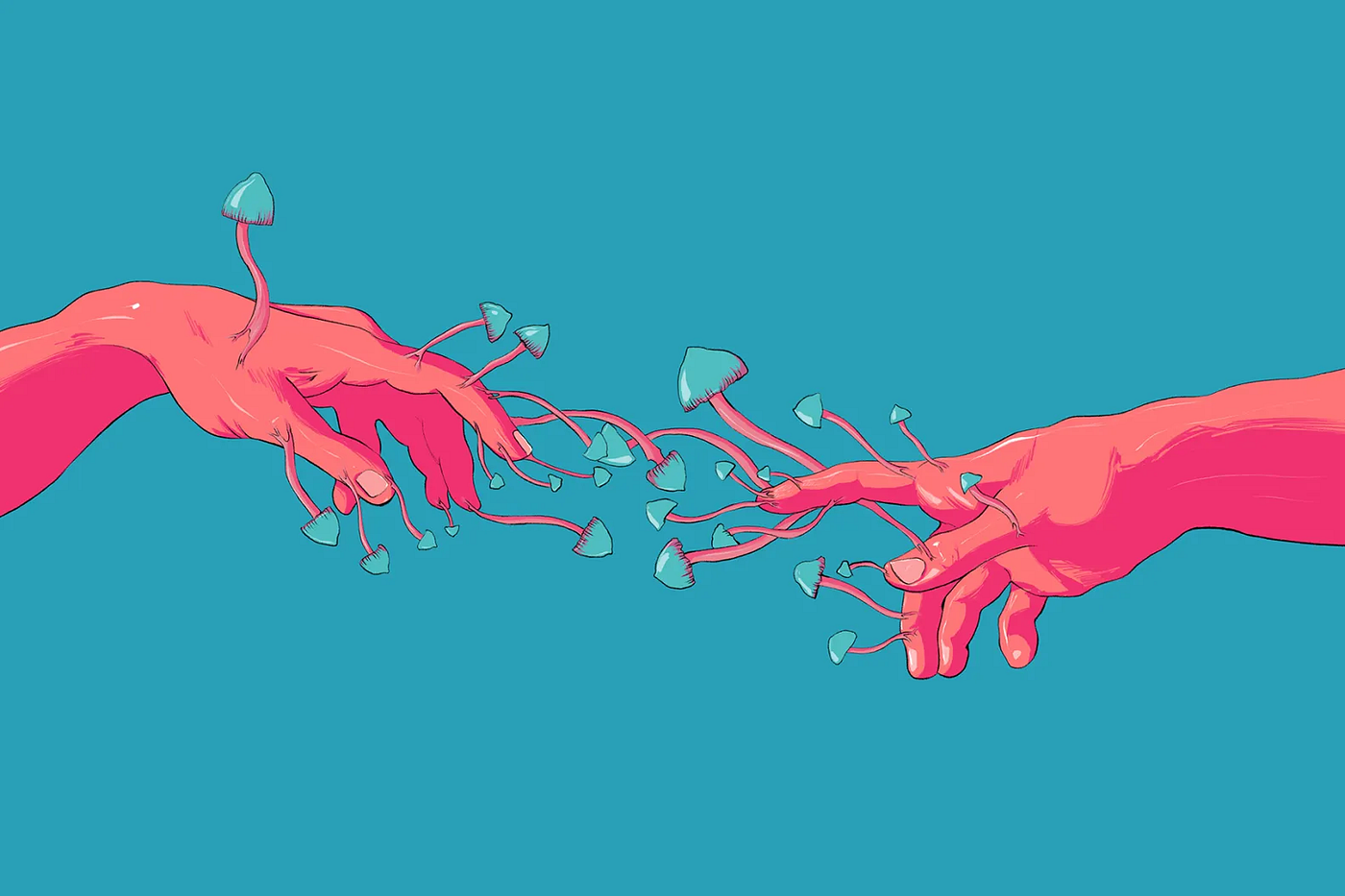
ILLUSTRATION BY CAROLINA RODRÍGUEZ FUENMAYOR FOR ROLLING STONE
The Stoned Ape offers a poetic solution to our greatest mystery: the concept that mushrooms enlightened humans’ curiosity. A beautiful story faces a cold, biological truth — evolution doesn’t work that way.
We know early humans walked alongside these fungi. Critically, the theory falters at the bloodline. A profound trip might rewire a single brain, Whereas it cannot rewrite a person’s DNA to be passed down to their children. That is Lamarckian evolution — a ghost story debunked a century ago. Genetics is a rigid architect; it does not take notes from a single night of revelation.
Yet, McKenna’s genius might lie in his error.
Instead of a genetic leap, researchers now point toward a cultural evolution. Perhaps these mushrooms didn’t upgrade our hardware — our DNA — though rather installed a new software. Look at the patterns: wherever psychedelic cultures bloomed, so did art, music, and the first whispers of religion — forming rites, engraving mythologies, building complex societies around shared, transcendent experiences. Not for bigger brains, but for a larger heart — the imagination to see beyond the horizon.
Modern theory reframes this sentience as an emergent property. Rather than evolving the physical brain, psychedelics perhaps unlocked its latent potential — much like discovering a hidden feature in software used for years. This explains the enduring personality shifts, why every culture that encountered these fungi eventually deemed them sacred.
McKenna may have asked the wrong question. It wasn’t:“How did mushrooms create the mind?” rather: “What is the mind, how do these substances reach its most profound layers?”
His vision may falter as science, but it succeeds as a provocation. It inspired a re-evaluation of our roots and how the spark of awareness arises. Right or wrong, it changed the conversation — in doing so, the Paradox remains.
메타데이터
- post_id
- ffbb03f3c6f3
- slug
- the-psilocybin-code-that-hacked-human-software-ffbb03f3c6f3
- url
- https://medium.com/the-haven/the-psilocybin-code-that-hacked-human-software-ffbb03f3c6f3
- canonical_url
- https://medium.com/the-haven/the-psilocybin-code-that-hacked-human-software-ffbb03f3c6f3
- author_url
- https://medium.com/@hwillraft
- status
- ok
- fetched_at
- 2026-06-15 20:49:13