🧠 Mental Health & Well-Being in the Digital Age: How Simple Code Can Help You Understand Your…
Estimated reading time: 10 minutes — Word count: ~1,750
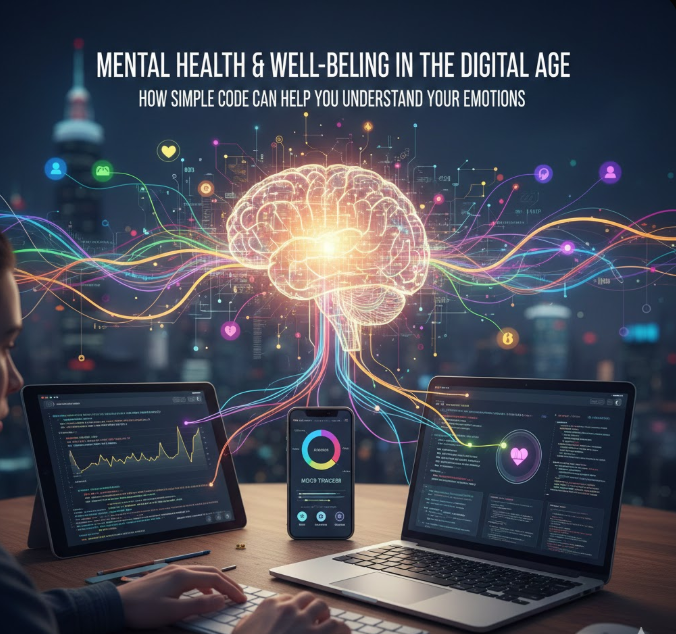
🧠 Mental Health & Well-Being in the Digital Age: How Simple Code Can Help You Understand Your Emotions
🧠 Mental Health & Well-Being in the Digital Age: How Simple Code Can Help You Understand Your Emotions
Estimated reading time: 10 minutes — Word count: ~1,750
🌍 Introduction: Mental Health in a Hyper-Connected World
We live in a time where technology has become part of every moment of our lives — our alarms, our work, our conversations, our entertainment, even our rest. In this hyper-connected world, our emotional well-being is constantly influenced by digital noise: endless notifications, the pressure to stay productive, the comparison culture of social media, and the blurred boundaries between work and personal time.
As a result, modern mental-health challenges often have digital roots:
- Burnout from always being “on”
- Anxiety linked to information overload
- Loneliness despite being more connected than any previous generation
- Decision fatigue from constant digital stimuli
Yet, the same digital tools that amplify stress can also help us heal, understand ourselves, and build healthier habits — if we use them intentionally.
This article explores how technology, specifically a simple piece of code, can help you understand your emotions more deeply and cultivate mental well-being in your daily life. We’ll discuss the psychology behind mood tracking, explore its benefits, and then build a working Python-based mood analyzer you can use right now.
Let’s begin with why self-awareness is the foundation of mental health.
🌱 Why Self-Awareness Matters More Than Ever
The World Health Organization recognizes mental health not simply as the absence of disorder, but as a state of well-being in which you understand yourself, cope with normal stresses, and function productively. At the core of this is self-awareness.
Self-awareness — the ability to observe and understand your thoughts, feelings, and patterns — allows you to spot early signs of stress, anxiety, or emotional imbalance. But self-awareness is not automatic. Most people move through their days reacting to their environment, rarely taking time to reflect on how they feel.
This is why practices like journaling, therapy, meditation, and mindfulness are powerful: they bring hidden emotions into the light.
But what if you don’t journal consistently? What if you want a tool that helps you interpret what you’re feeling? What if you’re curious whether there’s a pattern in your mood fluctuations?
This is where technology becomes an ally.
📊 The Power of Mood Tracking: A Psychology-Based Approach
Mood tracking, simply put, is recording how you feel over time. But why does it work?
1. It improves emotional literacy
Many people struggle to articulate their emotions. “I’m fine” becomes the default answer, masking stress, sadness, or overwhelm. Tracking your mood regularly helps you label your emotional states more clearly.
2. It reveals hidden patterns
You may not notice that every Sunday night you feel anxious, or that after certain meetings your mood dips. Over time, a mood log highlights patterns that might otherwise remain invisible.
3. It helps break negative cycles
When you identify recurring triggers, you can proactively manage or avoid them.
4. It supports healthier habits
Seeing your emotional trends helps you make lifestyle adjustments — better sleep, clearer boundaries, intentional rest.
5. It provides a data-based foundation for growth
Many therapists and mental-health practitioners encourage mood journals because they help track progress and identify triggers.
Now imagine pairing this psychological practice with simple code that analyzes your daily journal entries and automatically categorizes your mood.
That’s exactly what we’re about to build.
💻 A Simple Mood Analyzer in Python (Sentiment Analysis Version)
Below is a beginner-friendly Python script that allows you to write a daily journal entry and receive an instant analysis of your emotional tone using sentiment analysis.
You don’t need advanced coding skills — just Python installed on your system and the textblob library.
🔧 Step 1: Install TextBlob
Before running the script, install the required library:
pip install textblob
python -m textblob.download_corpora
🧩 Step 2: The Complete Mood Analyzer Code
# -----------------------------
# Simple Mood Tracker with Sentiment Analysis
from textblob import TextBlob
import datetime
def analyze_mood(text):
    analysis = TextBlob(text)
    polarity = analysis.sentiment.polarity

    # Mood classification based on polarity score
    if polarity > 0.2:
        mood = "😊 Positive"
    elif polarity < -0.2:
        mood = "😞 Negative"
    else:
        mood = "😐 Neutral"

    return mood, polarity
# Ask the user for today's journal entry
entry = input("Write your mood entry for today: ")
mood, score = analyze_mood(entry)
# Save the result with today's date
today = datetime.date.today()
record = f"{today} | Mood: {mood} | Score: {score:.2f} | Entry: {entry}"
# Append to a mood log file
with open("mood_log.txt", "a") as file:
    file.write(record + "\n")
print("\nYour mood has been analyzed!")
print(record)
print("Your entry has been saved in mood_log.txt")
# -----------------------------
🧠 How the Code Works
1. Sentiment Analysis
We use TextBlob, a natural language processing library, to calculate the polarity of your journal entry.
Polarity ranges from -1 (very negative) to +1 (very positive).
2. Mood Classification
We simplify emotions into:
- Positive: polarity > 0.2
- Neutral: polarity between -0.2 and 0.2
- Negative: polarity < -0.2
This isn’t a full psychological diagnosis — but it’s a helpful snapshot.
3. Daily Logging
Every entry, along with its mood score, is stored in mood_log.txt, creating a mood history.
📈 What You Can Do With Your Mood Data
Once your mood logs accumulate, you can use them for deeper insights.
1. Detect emotional patterns
Check if certain days of the week consistently show negative scores.
2. Measure progress
See if your average polarity score improves over time after starting new habits (exercise, therapy, journaling).
3. Correlate mood with events
You can annotate entries with tags like:
-
work
-
family
-
stress
-
happy
This helps identify triggers.
4. Visualize emotional trends
With a few more lines of Python, you can turn the log into a graph using Matplotlib.
If you’d like, I can provide a visualization script too.
🔬 The Psychology Behind Mood Tracking + Code
You may wonder: Why analyze my emotions with code instead of simply writing in a notebook?
Because digital tools unlock psychological benefits that manual journaling doesn’t always offer:
1. Objectivity
Humans are biased. We misremember. We exaggerate. Code doesn’t.
2. Real-time feedback
A mood analyzer gives you immediate insight into your emotional tone.
3. Pattern recognition
Your brain may not see weekly patterns — but a script can highlight them clearly.
4. Motivational gamification
Watching your emotional data evolve over weeks feels rewarding and encourages consistency.
5. Accountability without judgment
Your code doesn’t criticize or shame you — it simply reflects back your emotional truth.
In therapy, journaling is often called a “mirror for the mind.” In tech, code becomes a “mirror for your emotional patterns.”
⚙️ Extending the Script: More Advanced Features (Optional)
If you’re comfortable coding, here are features you can add:
1. Emotional categories (beyond positive/neutral/negative)
Use libraries like VADER or transformers to classify emotions such as:
- joy
- sadness
- fear
- anger
- surprise
2. Graphs and charts
Plot your mood over weeks or months.
3. Automatic reminders
Set the script to remind you daily to enter your mood.
4. Stress-level prediction
Use machine learning to predict future stress based on past patterns.
5. A full mental-health dashboard
Combine mood logs, sleep logs, and productivity metrics.
If you’d like, I can generate the code for any of these.
🧘 Practical Mental-Health Tips to Use With Your Mood Tracker
Your code is a tool — but real mental health requires intentional daily habits. Here are science-backed practices that pair well with mood tracking:
1. Micro-reflection
At the end of each day, write 2–3 sentences about your mood. Keep it simple.
2. Mindful breaks
Take a 2-minute pause every 90 minutes. Just breathe.
3. Digital detox hours
Choose one hour daily with no screens. Let your mind settle.
4. Curate your online environment
Mute negativity. Follow uplifting content. Unsubscribe from stress.
5. Sleep hygiene
Good sleep dramatically improves emotional stability.
6. Celebrate emotional wins
Not every positive day is a coincidence — recognize growth.
7. Seek professional support when needed
Your script analyzes mood — but it’s not a substitute for therapy.
💡 Why Combining Technology and Mental Health Works
Some people worry that emotion and technology are opposites. But technology is simply a tool — and when used consciously, it can amplify humanity.
Technology helps you:
- observe your emotions
- understand your patterns
- visualize your progress
- stay consistent
- receive feedback
- hold yourself accountable
Mental health is not about perfection. It’s about awareness, compassion, and progress.
And code — simple, minimal, helpful code — can be part of that journey.
🌟 Final Thoughts: Build a Healthier Relationship With Yourself
Mental health is not something you solve once. It is something you care for every day. In a world filled with digital noise, we often move through life without pausing to understand how we truly feel.
This article was designed to give you both knowledge and a practical tool — a small script that supports emotional awareness and personal growth.
If you use the mood analyzer daily, you will start noticing:
- clearer emotional patterns
- healthier habits
- better self-understanding
- improved emotional balance
And most importantly: A deeper, kinder relationship with yourself.
메타데이터
- post_id
- ffbcc1f7ffc8
- slug
- mental-health-well-being-in-the-digital-age-how-simple-code-can-help-you-understand-your-ffbcc1f7ffc8
- url
- https://blog.stackademic.com/mental-health-well-being-in-the-digital-age-how-simple-code-can-help-you-understand-your-ffbcc1f7ffc8
- canonical_url
- https://blog.stackademic.com/mental-health-well-being-in-the-digital-age-how-simple-code-can-help-you-understand-your-ffbcc1f7ffc8
- author_url
- https://medium.com/@gangoladeepa
- status
- ok
- fetched_at
- 2026-06-24 11:06:28