Neapolitan Songs
The music we carry through time and travel
Neapolitan Songs
The music we carry through time and travel

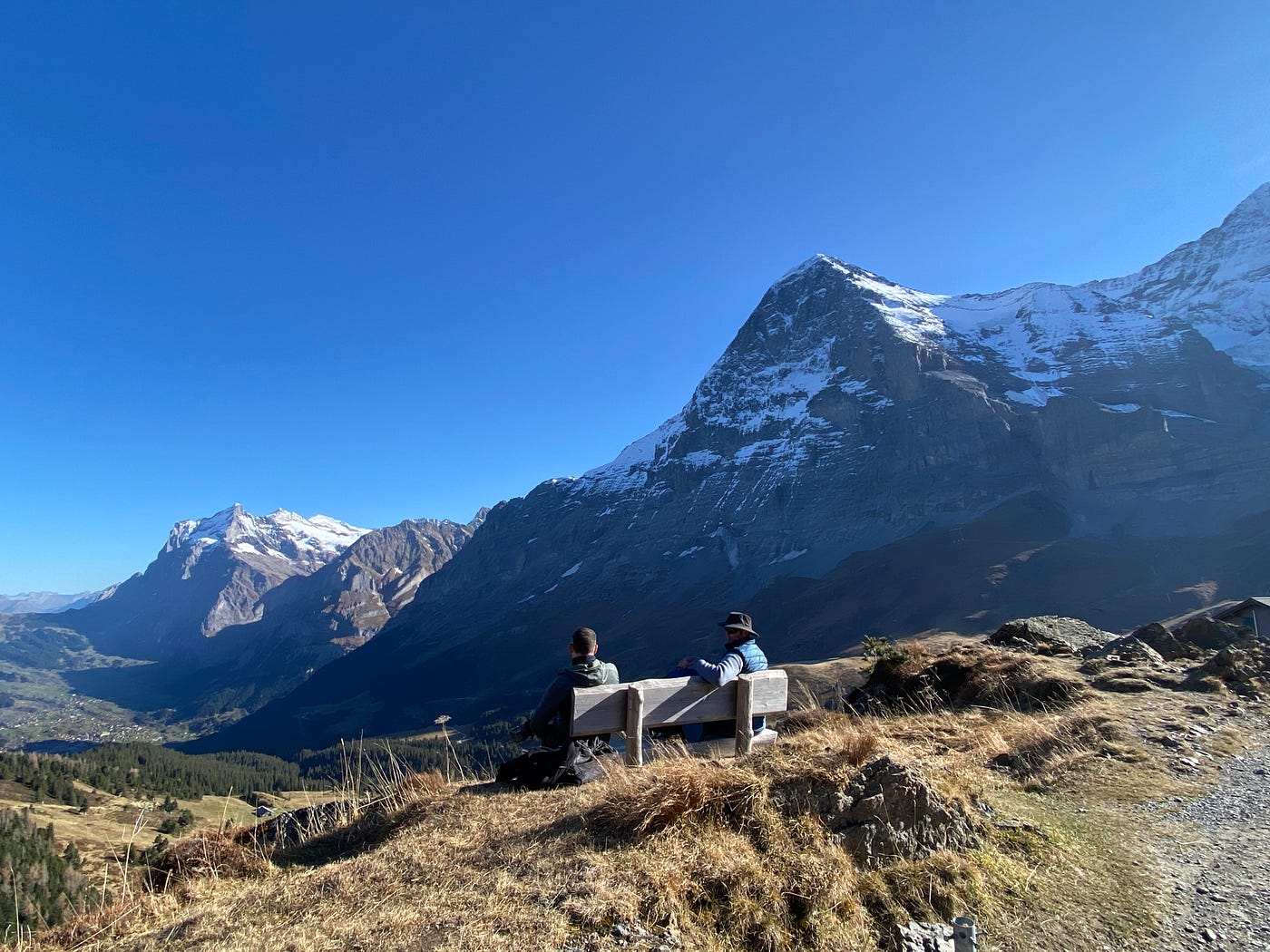
Picture by the author. The mountain, sea, and city.
A series of reflective essays from the Bay of Naples — Essay V
Long before I knew where Naples was, I had already encountered the Neapolitan musical genre.
While travelling through the Bay of Naples, these songs resurfaced spontaneously, providing the backdrop to what I saw, heard, and felt in the places before me.
Hearing matters to me because music has always held a special place in my life.
This essay centres on three Neapolitan songs, each opening a different vista: one through sunshine and rain, one through the motion of the sea, and one through the ascent of a mountain. Taken together, they reflect my journey from youth to old age.
And perhaps music is at its best when it helps us to relive the happy moments of bygone days. Songs have a way of travelling with us, carrying memories across time.
I. Under Autumn Skies: Sunshine, Rain, and Learning to Listen
Sunshine Songs
My kids will tell you that my favourite song for them was You Are My Sunshine. I often improvise by altering the lyrics when I sing to tease them. That was a long time ago; they are now grown-ups, independent and on their own paths.
My wife and I had gorgeous October weather in the Bay of Naples — just one rainy day. As for the rest of our stay, bright sunshine and clear blue skies were the order of the day. I look back with fondness at the tune running through my mind.
To many people, O Sole Mio (My Sunshine) is synonymous with Italy. And this belief was further reinforced when Luciano Pavarotti won the 1980 Grammy Award (for Best Classical Vocal Performance) for his rendition of this song.
We all love sunshine. But a life lived only in sunlight would be strangely incomplete, if not impossible.
A life lived only in sunlight would be strangely incomplete.
The Gift of Rain
Travel guides tell us that the best time to travel is the dry months. It took me time to convince others that rain, too, has its place. The landscape is lusher, waterfalls are more majestic, and wetlands are more alluring. Some photographers go out in the rain. Night photography featuring reflections in pools of water offers unique opportunities for creative expression. Be a contrarian.
My wife, a Singaporean, likes rainy days. She finds the perennial tropical heat oppressive. Rain brings relief and refreshes the day. So, when it rained one day during our stay in the Bay of Naples, it did not bother us in the slightest bit.

Picture by the author. Two children turning a grey day into a quiet celebration of colour.
But why are we so unhappy with rainy days?
Yes, wet days bring us inconvenience. The days are dull. We cannot do what we want. Yet without the refreshing showers, there is no growth. The plants depend on it, and life requires it. Hence, sunshine and rain are not opposites; they complement each other. They belong to the natural order of things.
To accept the rain should therefore come naturally, but to truly appreciate it is another matter. It offers a different way of experiencing the world. Listen to what Jose Feliciano has to say.
Learning to Listen
For some, appreciation begins not with sight, but with listening.
Jose Feliciano, a blind Puerto Rican, migrated to New York at age five and became a musical sensation. He wrote a musically interesting song called Rain. Feliciano chose the word listen: Listen to the falling rain, listen to it fall … It resonated with me because he lived in a world of sound rather than vision.
He does not need sunshine to perceive beauty.
The human brain is amazingly adaptable, a quality we call neuroplasticity, suggesting the brain is remarkably moldable. Of all our senses, nature has allocated the most resources, brain substance, to vision.
Feliciano’s available neural resources were redirected to enhance his sense of touch, position, and hearing, enabling him to accompany himself on the guitar and sing his own composition.
We can learn something about repurposing here.
Yes, the sun illuminates the world. But it is often the rain that teaches us how to hear it. Be happy for the plants that need it. And, of course, we need it as well-the balance of life — the yin and yang, sunshine and rain.
The sun illuminates the world, but it is often the rain that teaches us how to hear it. From the rhythm of falling rain, I shift to another cadence, the rocking motion of the sea.
II. The Sea: Santa Lucia, Sorrento, and the Call to Return
At the Water’s Edge
The seafront neighbourhood of Santa Lucia is a short walk from the ferry terminal where passengers depart for the islands in the Bay of Naples. It is popular with tourists and locals alike — pedestrians and cyclists.
The song Santa Lucia celebrates the idyllic shores of Santa Lucia in Naples, with an invitation from a boatman to take a turn in his boat to better enjoy the evening atmosphere. The melody is set in a lilting 6/8 time, reminiscent of a barcarolle, the rocking motion of a boat gliding across the sea.

Picture by the author. Lilting Santa Lucia boats under watchful Vesuvius eyes.
I tried to imagine what it would be like as the bright Italian autumn days slip into the dark winter months in Scandinavia. Santa Lucia Day, December 13th, is one of the darkest days of winter. It is part of the Scandinavian Christmas season, when candle-bearing Santa Lucias are lit, bringing light to the dark winter nights and promising the return of summer.
Interestingly, the Scandinavian Santa Lucia Day song is an adaptation of the Neapolitan boat song brought to Sweden in the 19th century. While the original Italian lyrics praise the scenic waterfront in Naples, the Swedish lyrics describe Saint Lucia bringing light to the dark winter.
Here, we see the idea of repurposing again.
For some people along the promenade, Santa Lucia brought the hope of brighter days. I saw many African migrants peddling their wares, drawn there by the possibility of a better life. The geography makes it inevitable: the Italian peninsula lies closer to the northern shores of Africa than many of us in faraway lands might imagine.

Picture by the author. Santa Lucia promenade — where the locals, visitors, and street vendors mingle.
Standing by the shore, looking out to the Mediterranean Sea, I recall the tragic stories of migrants coming ashore from northern Africa. Some have stories to tell; many never had the chance. They drowned during their failed attempt to seek a better future.
The Mediterranean, so often admired for its beauty, is a silent witness to loss, lives cut short in the pursuit of hope. But the idyllic seascape continues to beckon visitors to return.
The Call of Sorrento
The opening stanza of the song Torna a Surriento, or Return to Sorrento, accurately sums up what you will see and feel: Look at the sea, how beautiful it is; it inspires so many emotions.
The coastal view is indeed as charming and moving as the song’s music and lyrics. This Neapolitan song is in my classical guitar repertoire, and I have spent countless hours practising its phrases, trying to do justice to its quiet longing. In essence, the song is an invitation to return, to remain, and to linger in this picturesque place.

Picture by the author. Sorrento harbour — Vesuvius watches quietly from a distance.
And yet, I know, not every invitation must be accepted.
We often assume that what captivates us should also draw us back again. But for most of us, we do not have the luxury of returning freely, and even when we do, the choice is not simple. Therein lies the agony of choice — in choosing, we also forsake something that we want.
More importantly, we must ask why and when we want to return. To move on is to accept life’s invitation to broaden our perspective. But then, we miss a lot on a single visit. To return is to allow ourselves to explore deeper layers that familiarity makes possible.
Here, Heraclitus offers a helpful perspective. He once observed that we do not step into the same river twice, for it is not the same water, and we are not the same person. There are a few places I visit repeatedly. I have come to understand that it takes time to appreciate a place more.
If the sea along the Bay of Naples beckons migrants to come ashore for a better life, or Sorrento pleads with visitors to return, then Mt Vesuvius alerts the adventurous when to pause.
III. The Mountain: Vesuvius and the Wisdom of Limits
First Ascents
My first exposure to the funicular railway was in Penang, Malaysia.
The novel experience was exciting to a kid, and the cooler air of Penang Hill was undoubtedly inviting. I cannot remember exactly when I first heard the song Funiculì funiculà, but I am familiar with its con vivo, energetic, rhythmic pattern.
The inspiration for the song was the inauguration of the first Vesuvius funicular, built in 1879, to reach the volcano’s summit. The funicular, damaged several times by minor eruptions, was finally put to rest by an eruption in 1944. It is now relegated to the pages of history, existing no more, but kept alive by the song Funiculì funiculà.
There was a time when the instinct was always to go further, higher. But we should know when to stop.
The Mountain Before Us
We could see Vesuvius, which dominates the Bay of Naples, from almost anywhere around it. Although quiet now, it is still active. The most catastrophic eruption occurred in AD 79, burying Pompeii and making it a major tourist attraction today. And yet, millions continue to live in its shadow.

Picture by the author. Mount Vesuvius still watches over the ruins of Pompeii, which it destroyed.
I find it intriguing that three million people choose to live in the shadow of this temperamental giant. To me, life seems to go on ordinarily without any fuss, but under a looming presence of an ever-present disaster. Perhaps they did not have a choice. More likely, they have accepted that life is always lived with uncertainty.
Climbing Vesuvius was optimistically slotted as the last event during our stay in Sorrento. We realised we had already reached a kind of “best before” stage, an awareness of once distant limits.
At 69 and 67, we no longer had the youthful energy to climb to the volcanic crater after a vigorous day of walking through Capri’s hilly, undulating terrain the day before. We had to accept the limitations of age — we are no longer as we once were.
We decided that not every summit must be reached. But we can still stand in its presence, reflect on its meaning, and continue our journey home to Singapore.
IV. Coda: The Music We Carry
We carry with us the songs we love, sometimes over a lifetime. The songs remain unchanged, but we are never the same when we hear them again.
Travelling through the Bay of Naples has added new dimensions to Neapolitan songs. They have come alive, for now I can relate them more vividly to their origins, from sunshine and rain to sea and mountain. What I carry with me, in addition to fond memories of distant places, is a deep appreciation for the meanings I’ve gathered along the way.
And perhaps that is what music does best — it helps us to revive and relive the happy moments of bygone days.
This essay is part of an ongoing series of reflections inspired by travel, photography, and the ideas they reveal. More essays and photographs can be found on my website Unfinished Observations.
Retired professor of radiology writing on ageing, curiosity, and the inner life. Lifelong student of attention and meaning.
Originally published at https://agewelleveryday.org on April 20, 2026.
[embed]Write for True Travel Tales Submission Guidelinesmedium.com
메타데이터
- post_id
- ffc6e2cbc842
- slug
- neapolitan-songs-ffc6e2cbc842
- url
- https://medium.com/true-travel-tales/neapolitan-songs-ffc6e2cbc842
- canonical_url
- https://medium.com/true-travel-tales/neapolitan-songs-ffc6e2cbc842
- author_url
- https://medium.com/@vchongfh256
- status
- ok
- fetched_at
- 2026-07-09 08:02:55