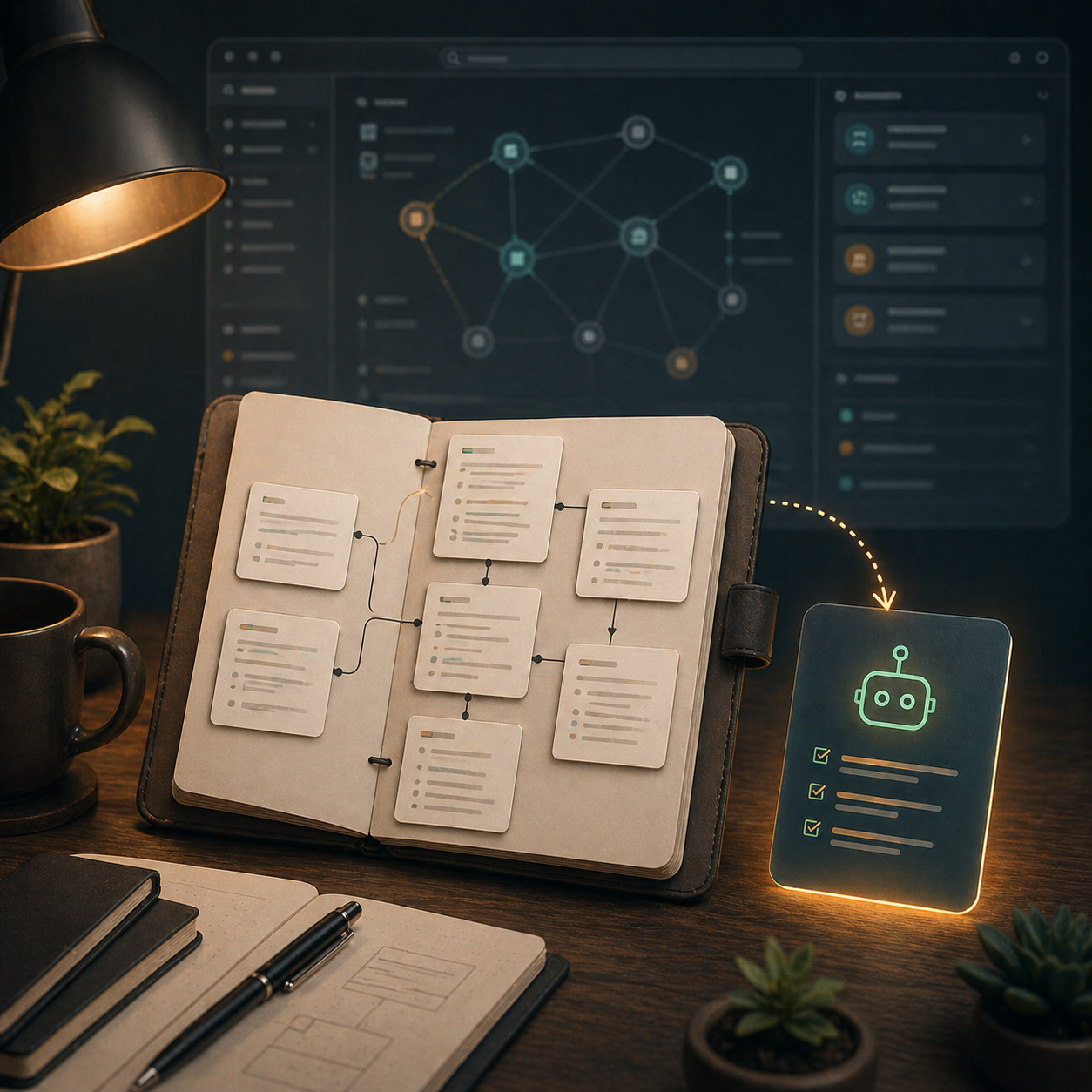
A Handoff Is a Love Letter to the Next Version of You
The best workflow note is not documentation. It is mercy for the person who has to return.
A Handoff Is a Love Letter to the Next Version of You
The best workflow note is not documentation. It is mercy for the person who has to return.
I came back from two weeks in Europe with the familiar mixture of clarity and administrative confusion.
The suitcase was unpacked. The laundry had developed opinions. My calendar had resumed its small campaign of legal intimidation. And Codex had been upgraded while I was away.
This is the sort of thing that can make a person feel briefly displaced inside their own work.
The tool is newer. The interface has changed in small ways. A few capabilities have improved. Meanwhile, the projects you left behind are sitting exactly where you left them, with their half-made decisions, their particular standards, and their extremely unreasonable belief that you will remember why a folder called final-final-actually-use-this-one contains three almost identical files.
But something lovely happened when I returned.
The workflow was still there.
Not only the folders and drafts. The taste was still there. The reasons behind the choices were still there. The boundaries were still there. A fashion prompt still needed to begin from the pressure of the heel, not a pile of decorative clothing words. A Medium essay still needed to be warm without opening the private room too far. A useful AI collaborator still needed to help with the work without quietly taking possession of the judgment.
The software had changed.
The work still knew what it was.
That is the quiet power of a good handoff.
We usually talk about handoffs as if they are corporate paperwork: the note you write before vacation, the message you leave in a project channel, the thing everyone promises to do and then replaces with “you can find it in the drive.”
But a real handoff is more intimate than that.
It is a message to the next version of you.
It says: I know you will return with less context than you think. I know life will have happened. I know the tools may look slightly different. Here is what matters. Here is where we were. Here is what not to break. Here is the next honest move.
That is not bureaucracy.
That is mercy.

Restarting Is More Expensive Than We Admit
Most people underestimate the cost of returning to work.
We count the obvious delay: opening the documents, finding the links, reading the last few notes. We do not count the more delicate reconstruction underneath it.
What was this project trying to protect?
Which version was nearly right, and why did we reject the other one?
What did “make it more elegant” mean here: fewer words, sharper materials, a different camera angle, less certainty, more air?
Which problem was truly unresolved, and which one had merely become emotionally expensive after too many tabs?
This is context recovery. It is real work. It asks the brain to rebuild a small world before it can make the next decision inside it.
AI can make this more visible because it is so good at starting from a clean surface. Give it a vague request and it will cheerfully produce a plausible answer with the emotional texture of a furnished apartment nobody lives in.
The problem is not that the answer is useless. The problem is that it has not inherited the right obligations.
A handoff gives the next session those obligations.
It tells a future collaborator, human or AI: this project is not merely about a topic. It has a history. It has standards. It has things it has already tried. It has a few traps it keeps falling into with impressive consistency.
The handoff reduces the cost of returning because it turns reconstruction into recognition.
You do not need to remember everything.
You need to leave enough of a trail that the right things can recognize you when you come back.
A Handoff Is Not a Diary Entry
The first mistake is making the handoff too comprehensive.
When people hear “document your work,” they often imagine a formal record of every file, decision, meeting, mood swing, and coffee preference. This is how a helpful note becomes a small archaeological dig.
The point is not to preserve the whole day.
The point is to preserve the decisions that would otherwise be expensive to remake.
A good handoff is closer to a good note left in the margin of a book. It does not summarize every chapter. It tells you where the argument became alive.
For most recurring creative or technical work, five things are enough.
1. The current state. What exists now? Link the draft, design, branch, repository, or working file. Say what is complete and what is still rough.
2. The governing decision. What is this work trying to do? Not the topic, but the choice that gives the project a center. For example: “This article is about returning to work, not AI memory.” Or: “The heel creates the posture; do not treat it as an accessory.”
3. The constraints worth protecting. What should the next version of you not casually undo? Tone, audience, privacy boundaries, visual rules, technical invariants, or a decision that was costly to reach.
4. The open question. What remains genuinely unresolved? Be specific. “Choose between these two endings” is useful. “Make it better” is a weather report wearing a fake mustache.
5. The next move. Give yourself a first action that is small enough to begin. Open the marked draft. Compare two reference images. Run the focused test. Write the third paragraph before touching the introduction.
That is the whole system.
It fits in a page. Often it fits in six sentences.
The handoff should create momentum, not another project to manage.
Taste Is Part of the Handoff
This is the part that gets missed when handoffs are treated as administrative chores.
Facts are useful. Taste is what keeps the facts from becoming interchangeable.
Suppose you leave a note that says: “Draft article about AI collaboration. Needs revision.”
That is technically accurate. It is also almost useless.
Now try this:
“Draft article about returning to a creative workflow after a break. Keep it personal but privacy-softened. The point is not that AI remembers everything; the point is that a thoughtful handoff lets the work survive a changed tool, a changed week, and a changed version of yourself. Avoid making it sound like productivity doctrine. End with a practical restart ritual.”
That second note contains taste.
It tells you what the work should feel like. It names the false version. It preserves the pressure that made the idea worth writing.
Taste notes do not need to be poetic. In fact, they are often better when they are blunt.
“Do not make this look like generic luxury.”
“Keep the joke, but do not let it become the paragraph.”
“This dashboard needs to help an operator decide, not admire its own gradients.”
“The opening should feel like a person returning from life, not a keynote about digital transformation.”
These are small sentences with a large job. They protect the work from drifting toward the nearest available cliche.
AI systems make this especially valuable. A model can follow instructions. It can also follow the wrong instruction very efficiently. The handoff gives it the context to recognize which kind of wrongness the project is trying to avoid.
The Upgrade Is Not the Continuity
It is tempting to put all the meaning in the upgraded tool.
New models are interesting. Better interfaces are interesting. A system that can hold more context, respond more precisely, or help across more parts of a workflow is genuinely useful.
But the upgrade is not the continuity.
The continuity lives in the relationship between the work and the standards that govern it.
This distinction matters because tools change. Models improve. Apps rename buttons with the serene confidence of people who do not have your habits. A workflow built entirely around a particular interface will eventually ask you to rebuild it from scratch.
A workflow built around clear decisions travels better.
It can move from one version of a tool to another.
It can move from a laptop to a notebook, from a solo project to a collaborator, from a pre-vacation self to a post-vacation self who has eaten too much good bread and has temporarily forgotten where anything lives.
The handoff is what makes the workflow portable.
It is not a backup of the software. It is a backup of the thinking.
That is why a handoff can feel strangely reassuring after time away. You are not relying on perfect recall. You are relying on a version of yourself who understood that perfect recall was never the plan.
Write to a Person, Not a System
The tone of a handoff changes its usefulness.
If you write it as a compliance artifact, future-you will read it like a parking ticket. If you write it as a note to a person you want to help, it becomes easier to trust.
This does not require sentimentality. It requires accuracy and a little kindness.
Instead of:
“Pending actions: resolve outstanding items.”
Try:
“Do not reopen the entire structure. The argument is sound. Start by testing whether the second section earns the ending.”
Instead of:
“Review design options.”
Try:
“The dark option is stronger because the heel makes the body look decisive. Preserve that. Repair the background tension before changing the silhouette.”
Instead of:
“Continue coding task.”
Try:
“The data path is correct; the remaining risk is how the operator sees exceptions. Run the focused test, then inspect the empty state before widening the scope.”
Notice what changes. The second versions do not merely list work. They lower the emotional activation required to begin it.
That is a profoundly practical form of care.
Good workflows are often described as systems that save time. The better description is that they save courage.
They reduce the number of times you must stand at the door of your own work and wonder whether you are about to make it worse.
The Return Ritual
When you come back after an absence, resist the urge to immediately optimize everything.
Do not begin by reorganizing the folders, changing the whole system, or asking the newest tool to explain your life back to you in a confident table.
Begin with a return ritual.
Read the handoff.
Open the actual artifact it points to.
Identify one thing that has changed: the tool, the project, the deadline, your energy, your opinion.
Identify one thing that has not changed: the governing decision, the reader, the constraint, the visual law, the problem that still deserves care.
Then make one small move.
This is enough to restart without pretending the interruption never happened.
The interruption did happen. You went somewhere. You rested, wandered, looked at buildings older than your inbox, ate well, forgot your usual routines, returned different in whatever small way people return different after being away.
The point of a handoff is not to erase that distance.
It is to make the distance survivable.
A Tiny Template for Future-You
Before you close a recurring project, leave this note:
Where we are:
What this is trying to do:
What must not drift:
What is unresolved:
Start here next:
If you work with AI, add one more line:
How to help without taking over:That final line is worth having.
Maybe the answer is: “Give options, then ask me to choose.”
Maybe it is: “Be strict about repetition, but protect the warmth.”
Maybe it is: “Do not invent missing facts. Help me see the next decision.”
This turns AI from a machine that generates continuation into a collaborator that can support return.
There is a difference.
One gives you more material.
The other gives you a way back into your own work.
After a two-week break, that difference feels almost luxurious.
Codex may be upgraded. The calendar may be waiting with a clipboard. The laundry may still have its position.
But the work is not lost.
It has been waiting with the lights on.
메타데이터
- post_id
- ffca4107daad
- slug
- a-handoff-is-a-love-letter-to-the-next-version-of-you-ffca4107daad
- url
- https://medium.com/@markchen69/a-handoff-is-a-love-letter-to-the-next-version-of-you-ffca4107daad
- canonical_url
- https://medium.com/@markchen69/a-handoff-is-a-love-letter-to-the-next-version-of-you-ffca4107daad
- author_url
- https://medium.com/@markchen69
- status
- ok
- fetched_at
- 2026-07-30 21:36:40