The Painter and the Castaway
The Story of Kawada Shoryu and John Manjiro, Two Men Who Drew a World Without Words
The Painter and the Castaway
The Story of Kawada Shoryu and John Manjiro, Two Men Who Drew a World Without Words

Prologue
Picture yourself in Japan. But Japan, at this moment, is completely cut off from the rest of the world. In 1852, Japan had been enforcing a policy known as Sakoku for more than two hundred years. Sakoku, which translates roughly as “the locked country,” was a strict national policy that forbade almost all contact with the outside world.
Foreign ships that approached Japanese shores were turned away. Japanese people who ventured abroad faced punishment upon their return. To know what was happening beyond the ocean was, in this country, something close to a crime.
And yet, into one of the port towns of this sealed nation, a man had come home.
His name was Nakahama Manjiro. In America, however, he had been known by a different name altogether. They called him John Man.
At the age of fourteen, he had been shipwrecked during a storm. Rescued by an American vessel, he spent more than a decade living in the United States. He learned to speak English. He attended school. He sailed across oceans to corners of the world that most Japanese people could not have imagined. He was the son of a fisherman, and he had become something no one in Japan had ever quite been before.
Now he had slipped back through the walls of his isolated homeland, returning to his birthplace of Tosa, a domain on the southern island of Shikoku.
And waiting for him there was a painter.
His name was Kawada Shoryu. He carried a brush and an ink stone. He was an artist and a thinker, and he was about to try to put onto paper the shape of a world that no one around him had ever seen.
Chapter One: The Room Where Two Men Met
The order from the Tosa domain officials was simple enough. “Get the story out of Manjiro.”
At the time, the Bakufu, the military government that ruled Japan under a hereditary commander called the Shogun, regarded any Japanese person returning from abroad with deep suspicion. Someone carrying foreign ideas and foreign knowledge was potentially a spy. Manjiro had barely set foot back on Japanese soil before he found himself subjected to a rigorous interrogation. Returning to a country in the middle of Sakoku from a foreign land was considered that dangerous an act.

Nakahama Manjiro
But Kawada Shoryu was no ordinary investigator.
With permission from the Tosa domain, Shoryu arranged for Manjiro to board at his own home. Rather than conducting formal questioning in a government office, he chose to live under the same roof as the man he was meant to question. The official hearings continued during the day, but each evening, the two men sat across from each other in the lamplight and talked.
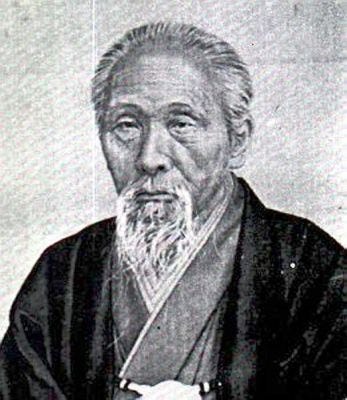
Kawada Shoryu
Manjiro was twenty-five years old. Shoryu was twenty-eight.
Both were from Tosa, but their lives had taken entirely different paths. Manjiro was a fisherman who had been swept out to sea in a storm at age fourteen and spent a decade in America. Shoryu had studied painting from childhood and trained as a scholar in Kyoto, the ancient imperial capital. The one thing they seemed to share was an outsized curiosity about the world.
On the first night, Shoryu studied Manjiro’s face. The skin was weathered and dark. The eyes were sharp. But when Manjiro began to speak, his words came out a little awkwardly. More than ten years abroad had loosened his grip on his native Japanese. What his words failed to convey, he filled in with gestures, or with fragments of foreign-sounding phrases woven into the Japanese.
Shoryu picked up his brush.
Chapter Two: The Iron Mountain That Breathed Smoke
“In America, there is something that breathes smoke and runs across the surface of the sea. It is like… an iron mountain.”
When Manjiro said this, Shoryu’s brush stopped moving.
An iron mountain. Running across the sea. Breathing smoke.
Shoryu thought for a moment, then turned to the paper and began to draw.
He sketched a dark mass shaped like a great rocky crag. From its peak, smoke billowed in great swirling clouds. The shape of the smoke curled like the open mouth of a dragon. Beneath it, the imagined beast moved slowly across a churning sea.
Manjiro leaned in and shook his head.
“No, no. It is more… flat. Many people can ride inside. There are no sails. It moves without sails. You boil water, and the power of that steam is what makes it go.”
Shoryu tilted his head.
The power of boiling water moves a ship? You light a fire, heat the water, and the steam that rises from it drives an enormous vessel through the ocean? What kind of mechanism could possibly do that?
He erased his drawing and began again.
This time he drew not a dragon but a long, narrow hull. A large wheel, resembling a waterwheel, protruded from its side, and it appeared to move forward by pushing water aside as the wheel turned. The smokestack was thick and pointed straight upward, pouring out black smoke.
Manjiro’s eyes lit up.
“Yes. Something like that. But bigger. Much, much bigger. Enough to carry a hundred people, two hundred people. Because it is made of iron, even when rain falls, even when fire burns nearby, it is fine.”
Shoryu drew again.
Through round after round of trial and error, the two men worked their way toward a single finished image. The monster that had started out as a dragon gradually changed its form, and when it finally appeared on the paper as a massive black steamship, Shoryu couldn’t help but gasp.
Was this really something that sailed the seas?
The ships Shoryu knew were wooden sailing vessels. Without wind, they could not move. When storms came, they were at the mercy of the waves. But the ship Manjiro was describing, this steamship, was an iron giant that answered to neither wind nor storm.
Shoryu looked up from the drawing and met Manjiro’s eyes.
“I do not… think you are lying to me. But… if this thing truly exists… Japan’s ships would be no match for it.”
Manjiro nodded quietly.
“Yes. That is why I felt I had to come home.”
Chapter Three: White Cotton Food and a Country Turned Upside Down
The language barrier lowered little by little through the medium of drawing. But what truly astonished Shoryu was not the talk of ships and machines. It was something far closer to everyday life.
“In America, there is a white food… like cotton. And you spread oil made from cow’s milk on top of it and eat it.”
When Manjiro tried to describe bread and butter, Shoryu’s expression grew complicated.
“You spread cow’s oil on food? And this white cotton thing… is it soft?”
“Yes. It has been baked. Hard on the outside, soft on the inside. Very light and airy.”
“Is it… good?”
Manjiro thought for a moment before answering.
“Once you get used to it, yes.”
“Once you get used to it,” Shoryu repeated, with a slight grimace.
He drew a picture of the food. Manjiro said Americans ate it every day in place of rice, which made it a world away from Japanese food culture. But what really surprised Shoryu was not the food, but a story about a certain social custom.
“In America, when people eat… a man pulls out a chair for a woman. He lets her be seated first.”
Shoryu set down his brush.
“A man serves a woman?”
“Serve is not quite right. It is more like… showing respect. When a woman enters a room, the men stand up.”
Shoryu blinked. The Japan he had grown up in was a society deeply shaped by Confucianism, the Chinese philosophy that emphasized hierarchy, deference to superiors, and the maintenance of social order. Within that value system, women were expected to remain a step behind men. At the dining table and in places of importance, it was nearly unheard of for a woman to take precedence over a man.
“That sounds as though… the host and the guest have been swapped,” Shoryu murmured.
Manjiro gave a rueful smile.
“After… I came back to… Japan, I made that mistake… more than once.”
But Shoryu did not laugh. As he listened to the story of the man pulling out the chair, something snagged in the back of his mind. He could not quite put it into words. But something was caught there.
Women are treated the same as men. If that was so, then what about the poor and the wealthy? What about farmers and samurai?
“Who exactly is considered important in America?”
Manjiro paused.
He knew the weight that question carried.
“In America, the president is at the top of the country. It’s like a samurai… a shogun. But… who becomes president isn’t decided by the family you’re born into. Everyone… um, gets to choose. You choose for yourself. The person who gets the most votes becomes president.”
The room went quiet.
Shoryu looked slowly at Manjiro’s face.
“Is that… true?”
“Yes. It is true.”
“Regardless of social rank? Even someone born into poverty?”
“Yes. From what I was told, there was even a man who became President from a family of woodcutters.”
Shoryu was silent for a long time.
In Japan, a samurai is born a samurai, and a peasant dies a peasant. That order was fixed from the moment of a person’s birth. That was the world Shoryu knew as normal. But in the country Manjiro described, everyone held an equal vote and chose their own leaders with their own hands.
Shoryu later recorded in writing that he “even doubted whether what Manjiro said about the President being chosen by election was true.” That is how profoundly the story shook the foundations of everything he understood.
Shoryu turned to the paper. He tried his best to draw the image of ordinary people casting their votes. But it was almost impossible to draw something he had never once seen. The brush wandered.
Manjiro said to him, “Shoryu, please add more people. Many, many more people gathering in one place together… and choosing as one.”
The two men worked late into the night, trying to bring that scene to life on the page.
Chapter Four: The Bitter Air Outside the Room
Beyond the walls of the room, a different story was unfolding.
The officials of the Tosa domain had not stopped doubting Manjiro. A Japanese man who had spent more than ten years abroad. A Japanese man who spoke English. A Japanese man who had taken on foreign customs. By the values of a sealed nation, that was more than enough reason for suspicion.
The question of whether he might be a spy did not go away.
Manjiro was required to report to the government offices every day, where officials grilled him and watched him with distrustful eyes. There was almost no precedent for a Japanese person who had returned from abroad being allowed to walk free, and Manjiro’s position was always precarious.
Yet inside the small outbuilding of Shoryu’s home, a different atmosphere prevailed.
In the lamplight, a world map lay spread out between the two men, and across its surface, the line of Manjiro’s journey had been traced. From Tosa to an uninhabited island in the Pacific. From the island to Hawaii. From Hawaii to New Bedford on the East Coast of America, a renowned port city for the whaling industry. From New Bedford onto a whaling ship, across the Atlantic, through the Indian Ocean, back into the Pacific. And then, via Okinawa, home to Tosa.
There lay the trail of a voyage across the vast ocean.
“Somewhere along this thin line, you could have died,” Shoryu murmured.
Manjiro smiled a little.
“I thought so many times. But I wanted to come back. I wanted to come back here.”
Shoryu sat still, brush in hand. Why had this man come home? He had known he might be punished. He had known he would be suspected. He had come anyway.
“Why did you really come back?”
Manjiro answered slowly.
“Because I felt I had to tell Japan… something. What I saw and learned in America… I had to tell someone. If this country remained unaware… someday, something terrible would happen. I knew that.”
Something kindled inside Shoryu.
This man’s story must not be allowed to go unheard.
Chapter Five: Not a Single Word of My Own Opinion
From that night on, the way Shoryu worked changed.
Until then, he had been writing down Manjiro’s words as an official record for the domain’s investigation. But that was no longer what this was. This was the first genuine picture of the outside world that Japan had ever had a chance to receive. Shoryu decided that from this point forward, he would transcribe every word Manjiro spoke exactly as he heard it, adding not a single opinion of his own.
Here, his instincts as a painter came fully to life.
The scenes that Manjiro described in his halting Japanese, Shoryu turned into images. Diagrams of steamships. Diagrams of railways. Drawings of American schools. Drawings of the port of New Bedford. Explanations of how a President was chosen by public vote. Images of people working in the gold mines.
When Manjiro could not find the words to make himself understood, the two men filled the gap with gestures and drawings. Manjiro would point at what Shoryu had drawn and say, “This part is wrong” or “That part is right,” and Shoryu would correct the image and draw it again. Manjiro would look it over once more. Then they would start the process again.
It was a strange kind of collaboration. A man who had never crossed the sea used his hands to help a man who had, bringing an unknown world into being on paper.
Shoryu recorded afterward that, in the course of listening to Manjiro for so long, he had found himself, without quite noticing when it happened, beginning to learn English. The door to the outside world had opened, gradually and quietly, through one man named Manjiro.
Chapter Six: The Finished Book
The work was completed under the title Hyoson Kiryaku, which can be translated as “A Brief Record of Drifting to the Southeast.” The character “Son” refers to the southeast, so the title signifies a summary of the account of a drift to the southeastern sea. The book ran to four volumes. It documented the ten years from Manjiro’s shipwreck in 1841 to his return to Japan in 1851, and accompanied by Shoryu’s precise illustrations, it became the first comprehensive account of America ever written in Japanese.
When the finished book lay before them, the two men sat side by side.
Manjiro turned the pages slowly. The steamship. The railway. The harbor of New Bedford. The explanation of the presidential election.
After a while, he looked up.
“Shoryu.”
“Yes?”
“You have never crossed the sea. And yet… the scenes I saw are here. Just as I remember them.”
Shoryu smiled quietly.
He said nothing.
Manjiro went on.
“I crossed the sea with my body. But you crossed it here, in this room. Anyone who looks at these pictures can come to know America without ever boarding a ship.”
The completed Hyoson Kiryaku was presented to Yamauchi Yodo, the lord of the Tosa domain, one of the most powerful regional rulers in Japan at the time. Yodo valued it highly, and when the book was taken to Edo, the city that served as the political center of Japan under the Shogunate, it became a subject of wide discussion among the lords of the realm. The spread of the book led to Manjiro being taken into the service of the Shogunate itself and granted the status of a samurai. The son of a fisherman had become a member of the warrior class.
And the book planted seeds that would help change the age. Young men gathered at the school Shoryu ran. Among them was a young man named Sakamoto Ryoma, who would go on to become one of the most celebrated figures in all of Japanese history, a visionary whose ideas helped bring the old order of the Shogunate to an end.
Shoryu is said to have told Ryoma, “The way forward for Japan is to acquire great foreign ships, fill them with like-minded men, and catch up to the foreign nations through trade.”
Epilogue
In 1853, not long after Shoryu and Manjiro completed their book, black steamships appeared off the coast of Japan. They were four vessels of the United States Navy, led by Commodore Matthew Perry. The “iron mountain that breathes smoke and runs across the sea,” the thing that Manjiro had described in halting Japanese while Shoryu drew and redrew his attempts to capture it, had appeared in real life, right before Japan’s eyes.
Japan was terrified.
But those who had read the Hyoson Kiryaku knew just a little more than the others. They knew something about what kind of country lay beyond the ocean, what technology it possessed, and what ideas drove it forward.
The wall of Sakoku, which had stood for more than two hundred years, began, from that moment, to slowly crumble.
One man had crossed the sea in body. Another had crossed it in imagination. Together, in a small outbuilding lit by a single lamp, they had created a book that pressed, gently and from the inside, against the door of a locked country.
And on the other side of that door was a new Japan, one that neither man had yet seen.
메타데이터
- post_id
- ffcb90b25246
- slug
- the-painter-and-the-castaway-ffcb90b25246
- url
- https://medium.com/@ytrnr.ozaki/the-painter-and-the-castaway-ffcb90b25246
- canonical_url
- https://medium.com/@ytrnr.ozaki/the-painter-and-the-castaway-ffcb90b25246
- author_url
- https://medium.com/@ytrnr.ozaki
- status
- ok
- fetched_at
- 2026-07-14 02:52:02





