The Real Economics of Ghost Kitchens: Beyond the Headlines
Ghost kitchens have become one of the most talked-about business models in food delivery. Headlines often frame them as a smarter, leaner…
The Real Economics of Ghost Kitchens: Beyond the Headlines
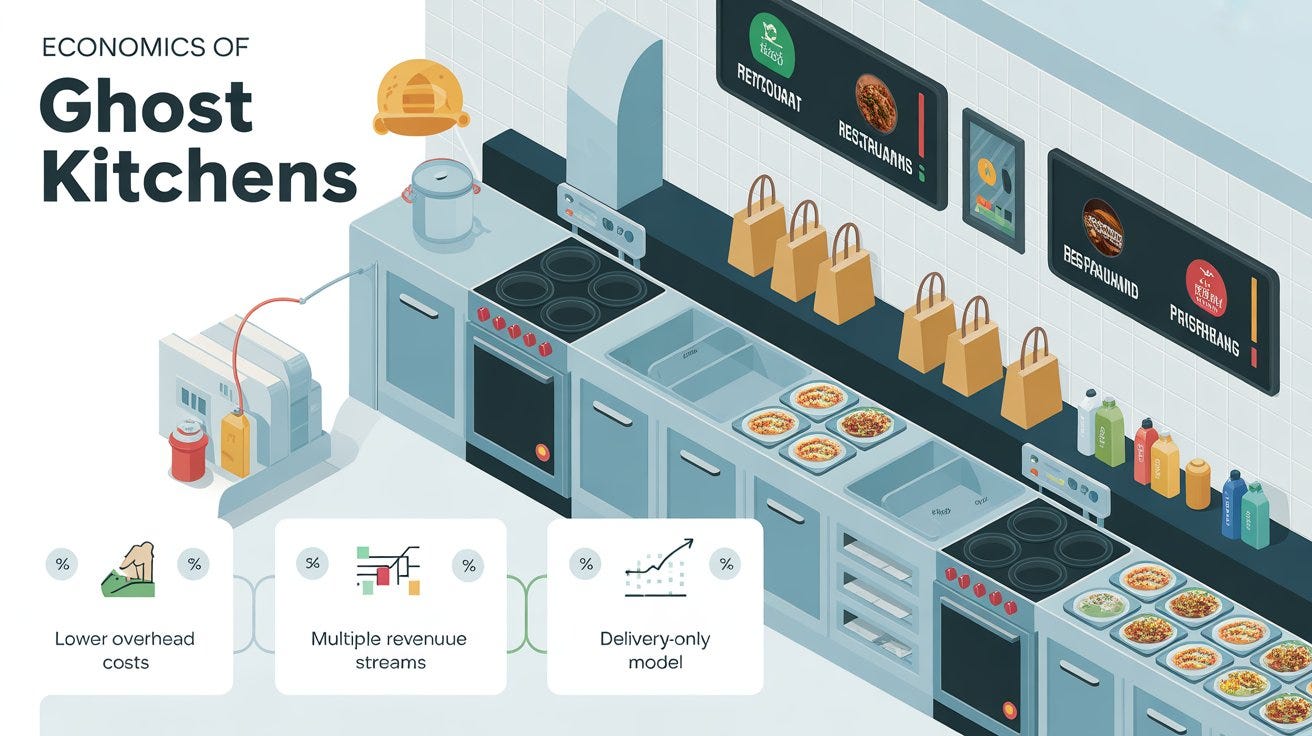
Image by author
Ghost kitchens have become one of the most talked-about business models in food delivery. Headlines often frame them as a smarter, leaner alternative to traditional restaurants. No prime real estate. No front-of-house staff. Faster launches. Higher margins. On paper, the model looks almost too efficient to fail.
But the reality is more complicated. While ghost kitchens remove certain visible costs, they introduce a new set of economic pressures that are easy to underestimate. Delivery commissions, marketing spend, operational intensity, and demand volatility quickly replace the savings founders expect from lower rent and smaller footprints.
This gap between perception and reality is where many operators get stuck. Ghost kitchens are not inherently unprofitable, but they are far less forgiving than the headlines suggest. Understanding their true unit economics is the difference between building a scalable food business and running an endlessly busy operation that never quite makes money.
The Original Ghost Kitchen Promise

The ghost kitchen model took off on a simple and compelling promise. By removing dine-in spaces, operators could cut rent dramatically, reduce staffing needs, and launch new food brands faster than ever before. Kitchens could operate out of industrial locations, focus purely on delivery demand, and scale without the overhead of traditional restaurants.
For founders, the appeal was obvious. Lower upfront capital, quicker market entry, and the ability to test multiple concepts from a single kitchen sounded like a more efficient path to profitability. Investors were drawn to the idea of asset-light food businesses that behaved more like software startups than hospitality operations.
What the promise overlooked was execution. Removing the dining room did not remove the complexity of running a food operation. It simply shifted where the pressure shows up.
Fixed Costs Did Not Disappear, They Just Shifted
One of the biggest misconceptions about ghost kitchens is that they dramatically reduce fixed costs. In reality, most costs do not disappear. They relocate. Rent may be lower than a high-street restaurant, but shared kitchens, industrial spaces, and long operating hours introduce their own expense structures.
Staffing remains a major cost driver. While there is no front-of-house team, kitchens still require skilled cooks, prep staff, and supervisors to maintain speed and consistency across delivery orders. Compliance costs around food safety, licenses, and inspections remain unchanged, regardless of whether customers ever walk through the door.
Packaging and logistics also add up quickly. Delivery-first operations rely heavily on branded packaging, tamper-proof seals, and materials that protect food quality in transit. These per-order costs scale directly with volume and can quietly erode margins if not modeled carefully.
Delivery Platform Fees and Margin Compression

For most ghost kitchens, delivery platforms are not just a sales channel. They are the primary source of demand. That dependence has a direct impact on margins. Commission fees, service charges, and promotional costs can consume a significant portion of each order before food costs and labor are even considered.
Beyond base commissions, visibility often comes at a price. Sponsored listings, boosted placements, and discount participation are frequently necessary to stay competitive inside crowded apps. These costs are optional in theory, but difficult to avoid in practice when multiple brands are competing for the same delivery radius and time slots.
Pricing control is another constraint. Ghost kitchens operate in a highly transparent environment where consumers compare prices instantly. Raising prices to offset platform fees risks losing volume, while keeping prices low tightens margins further. The result is a squeeze where growth does not always translate into profitability.
Volume Economics and the Break-Even Trap
Ghost kitchens are often described as scalable, but their economics are highly sensitive to volume. Fixed costs may look manageable on paper, yet they only make sense when order flow stays consistently high. The moment demand dips, margins tighten fast. Many operators discover they are busy every day but profitable only some of the time.
Breaking even usually requires sustained peak-hour performance. Lunch and dinner rushes must compensate for slower periods, which puts pressure on staffing, prep accuracy, and delivery coordination. As volume rises, so does operational strain. Mistakes increase, refunds climb, and customer ratings suffer, all of which feed back into platform visibility.
Where Ghost Kitchens Actually Work

Despite the challenges, ghost kitchens can be viable when the conditions are right. The model performs best in dense urban areas where delivery demand is consistent and order volumes are predictable across the day. High population density reduces delivery times, improves courier efficiency, and makes marketing spend more effective.
Strong brands also change the equation. Operators who bring existing customer recognition into the ghost kitchen model rely less on paid visibility and discounts. Repeat orders and direct demand soften the impact of platform fees and stabilize revenue.
Data discipline is another differentiator. Successful ghost kitchens use demand data to refine menus, limit SKUs, and align prep processes tightly with ordering patterns. Instead of chasing multiple concepts, they double down on what performs reliably.
What Founders Should Model Before Launching
Before** launching a ghost kitchen**, founders need to model the business with brutal honesty. That starts with true contribution margins, not top-line order volume. Food costs, labor, packaging, platform fees, refunds, and promos must be accounted for at the per-order level to understand what actually remains after each delivery.
Platform dependency risk deserves equal attention. Many models assume stable rankings and consistent demand, but algorithm changes, fee adjustments, or increased competition can quickly disrupt projections. Founders should stress-test scenarios where visibility drops or commissions rise and evaluate whether the business can still break even.
Demand predictability is another blind spot. Weekday versus weekend swings, seasonal dips, and local events all affect order flow. Modeling only peak performance creates false confidence. Finally, expansion constraints should be mapped early. Adding brands, kitchens, or cities multiplies operational complexity and capital needs.
메타데이터
- post_id
- ffcbc3db5577
- slug
- the-real-economics-of-ghost-kitchens-beyond-the-headlines-ffcbc3db5577
- url
- https://medium.com/write-a-catalyst/the-real-economics-of-ghost-kitchens-beyond-the-headlines-ffcbc3db5577
- canonical_url
- https://medium.com/write-a-catalyst/the-real-economics-of-ghost-kitchens-beyond-the-headlines-ffcbc3db5577
- author_url
- https://medium.com/@myoyelabs
- status
- ok
- fetched_at
- 2026-06-26 03:39:16