Most CI Managers Fail in Their First 90 Days. Here’s the Structural Reason Why.
The problem isn’t intelligence quality — it’s that new competitive intelligence leaders build libraries when they should be building…
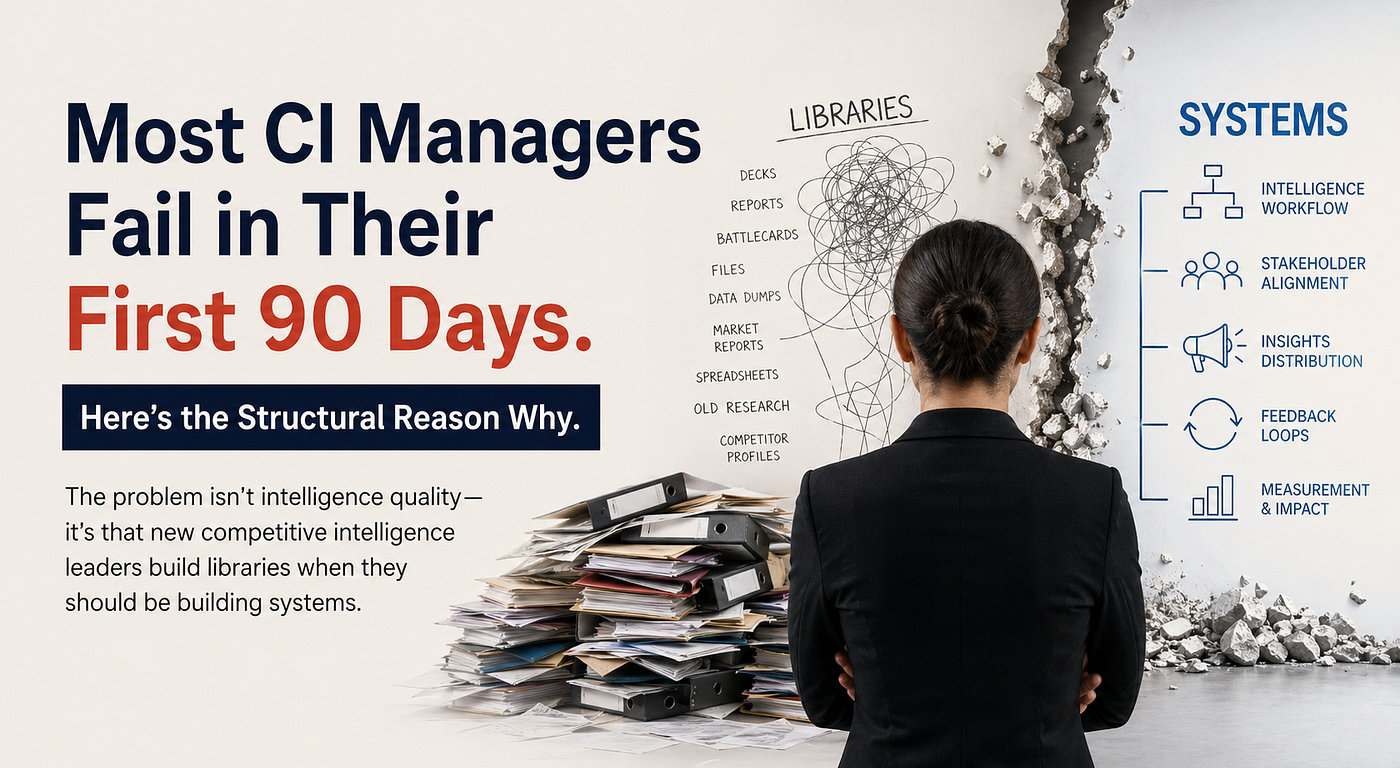
Most CI Managers Fail in Their First 90 Days. Here’s the Structural Reason Why.
The problem isn’t intelligence quality — it’s that new competitive intelligence leaders build libraries when they should be building systems.
I spoke with a CEO of a Series B SaaS company who fired their Competitive Intelligence Manager after five months.
She’d produced some of the most thorough competitor analyses they’d ever seen, forty-page decks with market positioning maps, feature-by-feature comparisons, pricing teardowns sourced from three different analyst firms.
Her research was impeccable.
But her Slack channel had twelve members.
And her battlecards lived in a Google Drive folder with a last-accessed date that made you wince.
When leadership asked what CI had done for win rates last quarter, she had no answer that connected to a number anyone cared about.
She didn’t fail because she lacked skill. She failed because she treated the job like an intelligence role when it was actually an infrastructure role.
The real mandate isn’t “know more about competitors.” It’s “change how sellers behave in live deals.”
Here’s the uncomfortable truth most CI managers don’t hear during the interview process: nobody actually wants competitive intelligence. What they want is for reps to stop losing winnable deals. Intelligence is a means, not an end, and the distinction matters enormously when you’re deciding how to spend your first twelve weeks.
The conventional wisdom says your first month should be about “getting up to speed.” Learning the product. Reading analyst reports. Building a competitor landscape. This advice is actively harmful. It trains you to be a researcher when the organization hired you to be an operator.
“The number one reason CI programs fail isn’t bad intelligence — it’s bad distribution.”
I’ve seen this pattern repeat across dozens of organizations. The CI manager who spends month one buried in research emerges in month two with beautiful documents that nobody asked for, addressing questions nobody’s currently losing sleep over. Meanwhile, three floors down, an enterprise AE just lost a $400K deal because he didn’t know how to counter a competitor’s new bundling play, and she didn’t even know a CI function existed yet.
Your first thirty days should produce zero deliverables and one critical asset: organizational trust
This is where I’ll challenge the instinct every new CI hire feels. You want to prove yourself. You want to ship something. Don’t.
The most valuable thing you can do in your first month is conduct what amounts to an anthropological study of your own company’s selling motion. Not the version on the enablement wiki — the real one. The one that lives in pipeline review meetings, in the shorthand between AEs and their managers, in the Slack DMs where someone asks “anyone beaten [Competitor X] lately?”
Concretely, this means sitting in on at least ten sales calls. Not listening for competitive mentions, listening for how deals actually move. What triggers a competitive evaluation? When does a prospect first mention an alternative? What stage do deals stall at, and why?
One CI leader I know spent her entire first two weeks just attending pipeline reviews and writing down every time a rep mentioned a competitor. She didn’t say a word. By day fifteen, she had a heat map of competitive pressure by deal stage, segment, and geography that was more actionable than anything the previous CI manager had produced in six months. She knew exactly which three competitors were costing the most revenue right now, not theoretically, not historically, but in the current quarter’s pipeline.
That’s the intelligence that matters. And you can only get it by shutting up and watching.
Simultaneously, and this is the part most people skip entirely, you need to design governance before you create a single asset.
- Who owns battlecard accuracy?
- What counts as credible intelligence versus sales floor rumor?
- How does a rep submit a competitive insight from a call?
- What triggers an update?
Skipping governance feels efficient. It’s actually the decision that determines whether your program scales or collapses at month four.
The best first battlecard isn’t about your biggest competitor, it’s about the objection that’s bleeding revenue this week
Month two is when you start producing. But what you produce matters more than how much.
I’ve watched CI managers launch with a battlecard covering their company’s oldest, most well-known competitor, the one every rep already has tribal knowledge about. It’s safe. It’s comprehensive. And it moves the needle approximately zero percent.
Instead, follow the pain. Work with your sales leaders to identify where competitive dynamics are actively costing deals this quarter. Often it’s not the biggest name, it’s a specific objection pattern that’s emerged around a competitor’s recent move.
Picture this: a competitor launches an aggressive bundling strategy. Suddenly your enterprise AEs are hearing “they give us the full platform for 30% less” in every negotiation.
That’s your first battlecard.
Not because it’s the most intellectually interesting project, but because solving it has an immediate, measurable revenue impact. Your card needs to reframe the conversation around total cost of ownership, implementation risk, and time-to-value, giving reps specific language they can use in their next call, not next quarter.
Three to five battlecards, maximum. Covering the competitors causing the most damage in active pipeline. Each one structured not as a competitor profile but as a decision-support tool, what to say when a specific objection surfaces, what questions to plant early that expose a competitor’s weakness, how to navigate a pricing comparison without discounting.
“Reps who used our battlecards won 12% more often against Competitor X this quarter. That’s not a nice-to-have. That’s a revenue story.”
And here’s where most CI managers make their second critical error: they announce the battlecards in Slack and assume adoption will follow. It won’t. You need to train on each card, fifteen-minute sessions, not hour-long lectures. You need office hours where reps bring live deal scenarios. You need to sit in on win/loss debriefs and show, in real time, how the intelligence connects to outcomes.
Distribution is the product. The battlecard is just the raw material.
Static intelligence is dead intelligence — and most CI programs are graveyards
By the time you’re six weeks in, you should have a small portfolio of battlecards generating real usage. Now comes the part that separates programs that last from programs that get cut: keeping everything alive.
A rep who uses an outdated battlecard and gets burned in a deal will never trust CI again. One bad experience poisons the well permanently. This is why real-time competitive monitoring isn’t a nice-to-have, it’s existential for your program’s credibility.
But raw alerts are worthless. Knowing a competitor hired a new VP of Engineering is trivia. Knowing that hire came from a company famous for vertical-specific solutions, which signals a likely push into healthcare, a segment where you have three deals in late-stage pipeline, that’s actionable intelligence. The translation layer between “what happened” and “what this means for your deals” is where CI earns its seat at the table.
Build a simple cadence: weekly digests for general awareness, immediate alerts for anything that could affect an active deal. And critically, create structured channels for intelligence to flow back from the field. Your SEs and AEs are encountering competitive realities every day that never make it into your battlecards unless you build explicit intake mechanisms.
One of the most powerful things I’ve seen: an SE joins a technical evaluation and discovers the prospect has already completed a proof-of-concept with a competitor. Through a structured feedback form, the specific technical criteria the competitor met, and the gaps the prospect still worried about, flow back to CI. Within a week, there’s a new battlecard section: “How to win when the prospect has already POC’d with Competitor Y.” That section came from the field, not from desk research. And it’s infinitely more credible because of it.
By day ninety, you need one thing: a number that makes leadership care
Your third month is about proving the machine works. Not with anecdotes — with data.
Track battlecard views by rep and team. Correlate usage with win rates. Identify which cards get traffic and which gather dust. The analytics aren’t just for your executive scorecard, they tell you where to invest your limited time next.
A battlecard nobody opens needs to be killed or rebuilt.
A battlecard with high usage but flat win rates needs better content.
A battlecard with high usage and improved win rates needs to be your template for everything else.
By day ninety, you should be able to walk into a leadership meeting and connect your work to revenue. Not “we published twelve battlecards” — that’s activity. Something like: “Deals where reps accessed competitive guidance closed at 8% higher rates against our top three competitors, representing $2.1M in influenced pipeline.” That’s a story that survives budget season.
The CI managers who build lasting programs understand something fundamental: you’re not in the intelligence business. You’re in the revenue infrastructure business. Every decision, what to build, how to distribute it, where to embed it in the sales process, should be evaluated against a single question: does this change seller behavior in a way that wins more deals?
If you’re building this kind of program and finding that scattered documents and manual processes are already becoming the bottleneck, tools like Playwise HQ exist precisely because this problem is structural, not solvable with more effort.
The competition is shipping updates, changing pricing, and hiring your former colleagues while you read this. Your sellers are in live deals right now without the intelligence they need. The question isn’t whether you can afford to spend ninety days building this right.
It’s whether you can afford not to.
메타데이터
- post_id
- ffcdc7e01ef2
- slug
- most-ci-managers-fail-in-their-first-90-days-heres-the-structural-reason-why-ffcdc7e01ef2
- url
- https://medium.com/playwise-hq/most-ci-managers-fail-in-their-first-90-days-heres-the-structural-reason-why-ffcdc7e01ef2
- canonical_url
- https://medium.com/playwise-hq/most-ci-managers-fail-in-their-first-90-days-heres-the-structural-reason-why-ffcdc7e01ef2
- author_url
- https://medium.com/@paultowers
- status
- ok
- fetched_at
- 2026-06-11 07:46:00