Google Just Changed Android Development Again And Most Developers Aren’t Ready
Kotlin 2.2, Jetpack Compose’s pausable composition, and AI-native UIs are rewriting the rules of Android in 2026. Here’s what you actually…
Google Just Changed Android Development Again And Most Developers Aren’t Ready
Kotlin 2.2, Jetpack Compose’s pausable composition, and AI-native UIs are rewriting the rules of Android in 2026. Here’s what you actually need to act on now.
Android development rewrote itself (again) and you blinked. If you have not looked at what Google and JetBrains delivered in the last half year, you are not only behind on syntax; you are hidden behind how to think apps.
Let’s fix that.
This time the pace is different
For years now, I have been developing Android applications. I survived the XML-to-Compose migration, the history of coroutines adoption and great ViewModel wars. But what we are seeing here and now seems to be qualitatively different. This is not a new API here, or a deprecation there — the whole basis of how we write, test and architect Android apps is changing all at the same time.
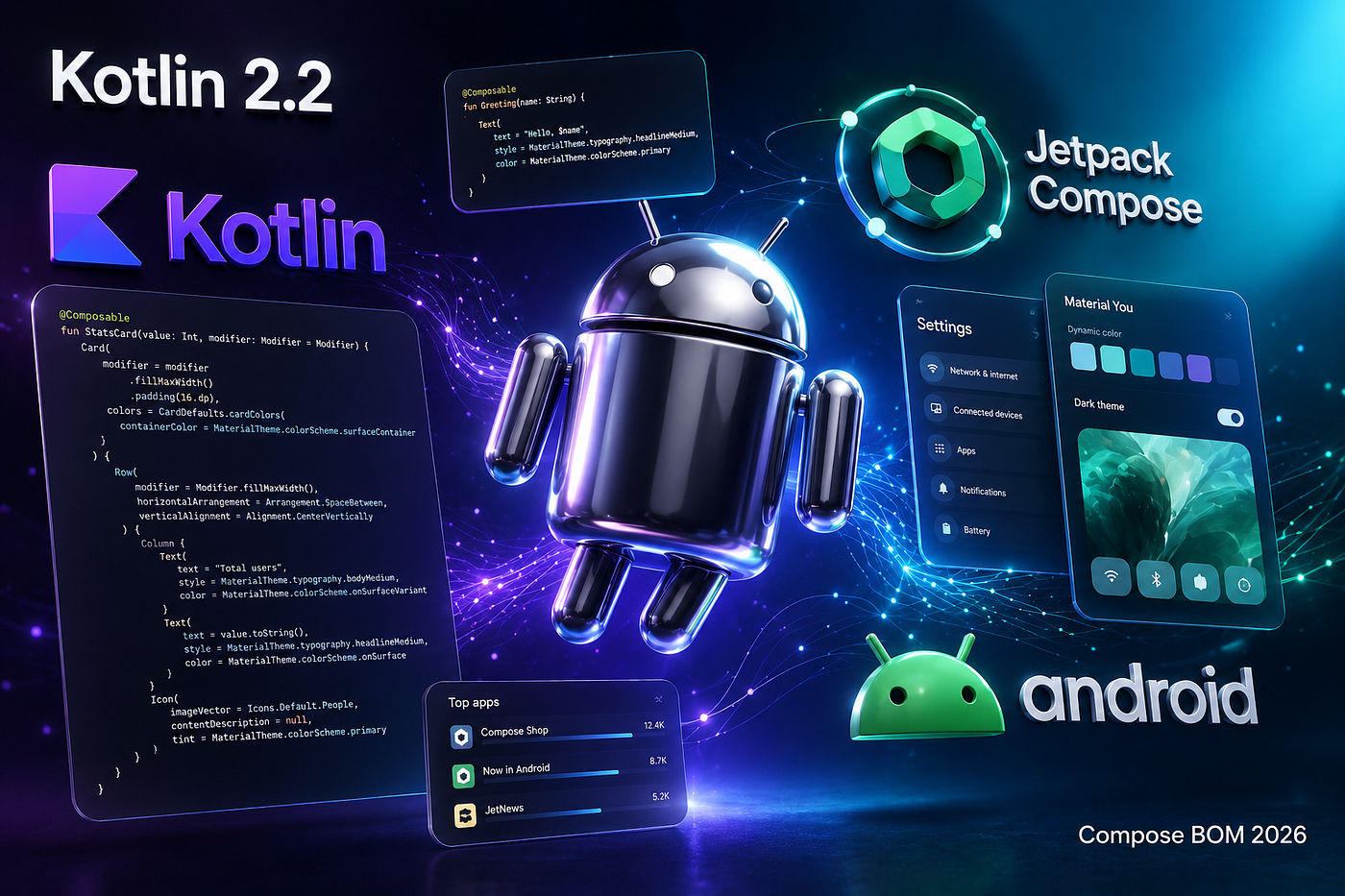
This is powered by three things: context parameters in Kotlin 2.2, pausable composition being default in Compose and AI running natively on device. Together all this would be momentous — each one individually. Together, they’re a platform reset.
1. Context Params: Kotlin 2.2 Got Context Params (This Is Big)
When Kotlin 2.2 shipped in June 2025, its headline feature — context parameters — somehow flew under the radar. Here’s why you should care.
Context parameters allow functions to embed some implicit dependency without needing to thread it through each of its signature. View it as dependency injection that is baked into the language.
// Before: passing dependencies manually everywhere — verbose and fragile
fun formatPrice(amount: Double, formatter: CurrencyFormatter, logger: AppLogger): String {
    logger.log("Formatting price: $amount")
    return formatter.format(amount)
}

// After: context parameters do the heavy lifting
context(formatter: CurrencyFormatter, logger: AppLogger)
fun formatPrice(amount: Double): String {
    logger.log("Formatting price: $amount")
    return formatter.format(amount)
}
This isn’t just syntactic sugar. In a real-life project this kind of refactor reduced boilerplate code substantially in big ViewModel trees. It reads closer to how you think about the problem, not how the compiler needs it wired.
All other Kotlin 2.2 wins you should know:
- Guard conditions in when expressions Now Stable — no more nested if-else inside branches
- Use when generating code or working with raw template strings. Multi-dollar string interpolation is Stable
- This will enable unified management of compiler warnings with -Xwarning-level, enabling finally some form granularity and configuration on individual diagnostics level.
With Kotlin 2.2 we got much more than additional syntax sugar, it made us rethink how we approach and think about state and architecture within and across platforms. — Benzies Rules, 2026 (When I’d have a job in UX) So you can imagine how long this leads to anxiety paranoia when the penalty for missing an opportunity is literally your entire UX.
2. The performance problem is solved; jetpack Compose
Scroll performance under heavy load has been the one legitimate criticism of Compose for years. That conversation is over.
With the release of December 2025 BOM (2025.12.00), it made pausable composition the default. This is a key change in runtime — previously, once a composition began, it would run until it ended (even if that meant blocking the main thread for more than one frame). Complex compositions now are automatically divided across frames, removing one of the main sources of scroll jank.
According to similar internal benchmarks at Google, Compose now achieves comparable performance in scroll scenarios vs. View-based implementations. This isn’t a case of “close enough” — it’s parity.
The April 2026 BOM (2026.04.01) added a bit more:
- New Grid API — fr units, responsive tracks and real gap. It just got an order of magnitude easier to build sophisticated tablet or foldable layouts.
- Custom Studio previews using @PreviewWrapper, define it once and reuse everywhere. You will not have to repeat copy-pasting your theme wrappers on a 50 different preview functions.
- API v2 Test v2 default — with the switch to StandardTestDispatcher your tests now queue coroutines and controls the virtual clock, exposing race conditions that UnconfinedTestDispatcher kept quiet. Move your test suite — that is not up for discussion but you have to do it.
3. AI on Device: Stop Treating It as a Feature Flag
Jetpack Compose already powers 60% of the top 1,000 Play Store apps. The next unique does not depend on the UI toolkit you use, but on whether your app has a way of intelligence or not.
Since Gemma runs locally on Android, that makes on-device inference a reality instead of just a research demo. When combined with the Android dedicated AICore APIs, you can create offline-capable experiences that respect privacy and feel instantaneous because that model is running right on the device’s hardware.
This isn’t about simply integrating a chatbot into your app. This is about re-imagining flows: Intelligent Autofill, Smart Contextual Suggestions, Edge Level summary. This is a product category that will feel like essentially a new type of app by 2027 — the apps that figure it out in 2026.
What You Really Need to Do This Week
Without any bullshit, here’s your actual to-do list:
- Kotlin 2.2 update in your build Also, be sure to call context parameters with
-Xcontext-parameters. As proof of concept, refactor one ViewModel. - Level up your Compose BOM to 2026.04.01 I let my UI tests run and 20 of their 100 failed — those are your hidden race conditions.
- Check the when expressions for guard condition opportunities This is a simple one and an improvement for code reviews.
- If you target the tablets or foldables, read up on Grid API docs. Disable old LazyVerticalGrid workarounds
- Spike at least one AI capability — even something small like local text classification. Knowing AICore before your PM asks for it is a career move.
Key Takeaways
- Context parameters in Kotlin 2.2 cut down on boilerplate considerably — especially in DSL design and deep call chains
- Default pausable composition — Problem with Compose performance is actually solved
- New in April 2026 BOM: proper Grid API and fixing long-standing testing reliability issues
- On-device AI: Gemma & AICore are production-ready, not experimental toys
- The developers who meet the new appography now will be building apps people actually discuss in 2027
Android in 2026 is not a harbinger for imminent change. The change has already happened, it’s in the stable releases, it’s in your build.gradle, waiting. Only you have to ask yourself if you shipped something great with it or another quarter spent ignoring the changelog.
Go update that BOM.
메타데이터
- post_id
- ffd2ee2b372a
- slug
- google-just-changed-android-development-again-and-most-developers-arent-ready-ffd2ee2b372a
- url
- https://medium.com/@androidlab/google-just-changed-android-development-again-and-most-developers-arent-ready-ffd2ee2b372a
- canonical_url
- https://medium.com/@androidlab/google-just-changed-android-development-again-and-most-developers-arent-ready-ffd2ee2b372a
- author_url
- https://medium.com/@androidlab
- status
- ok
- fetched_at
- 2026-06-09 14:34:10