Databricks AI + Data Summit 2026 — Part 2: They Didn’t Just Launch Genie One.
I watched the Databricks AI + Data Summit 2026 keynote expecting new AI features.
Databricks AI + Data Summit 2026 — Part 2: They Didn’t Just Launch Genie One. They Quietly Changed What It Means to Be a Data Engineer.
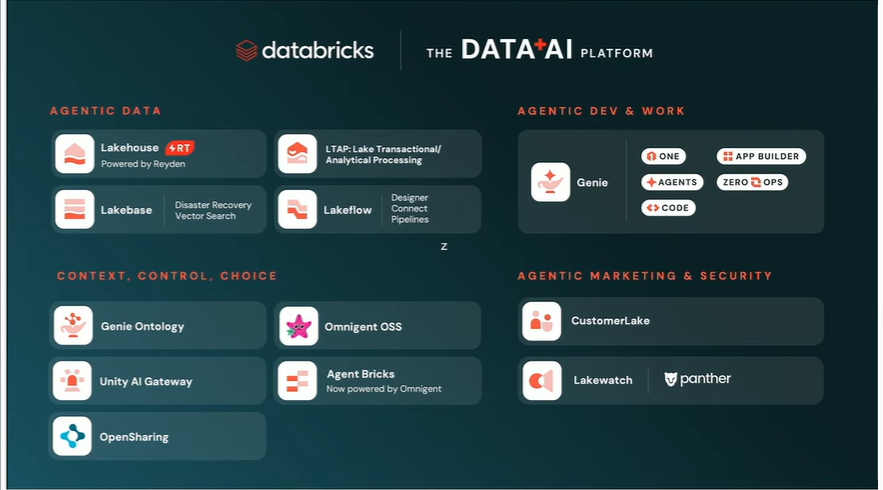
I watched the Databricks AI + Data Summit 2026 keynote expecting new AI features.
Instead, I came away thinking about something much bigger.
While watching the keynote, I found myself asking a question that was never directly answered on stage.
If Genie One can understand enterprise context, generate code, build AI agents, automate operations, and reason over business knowledge, how does the role of a Data Engineer change?
The more I thought about it, the more I realized this wasn’t just another AI product launch.
Databricks isn’t trying to build another chatbot.
They’re trying to build an operating system for enterprise AI.
And I think that’s the announcement many people will appreciate only after looking beyond the product demos.
We’ve Been Building AI the Hard Way
Imagine you’re asked to build an enterprise AI assistant today.
The first problem isn’t choosing an LLM.
It’s everything around it.
Where does the agent get data?
How does it know which dashboard Finance actually trusts?
How does it understand that “Revenue” has one approved definition instead of ten?
How do you stop it from exposing confidential information?
How do you switch from GPT to Claude next month without rewriting your application?
How do you know whether the answer came from a production table or someone’s experimental dataset?
Most teams solve these problems independently.
One team builds its own RAG system.
Another writes custom prompt templates.
Someone else maintains access policies.
Someone creates another semantic layer.
Someone documents business definitions in Confluence.
Everyone is solving the same problem differently.
The keynote made me think Databricks is trying to solve it once — for the entire platform.
Genie One Is Only the Tip of the Iceberg
Most conversations after the keynote focused on Genie One.
That’s understandable.
It can generate code.
Build pipelines.
Create dashboards.
Answer business questions.
Build AI agents.
Automate operational tasks.
Those capabilities are impressive.
But Genie One works because of everything underneath it.
Without those foundations, it would simply be another powerful language model.
Unity Catalog Semantics Gives AI a Business Vocabulary
One announcement that deserves far more attention is Unity Catalog Semantics.
Traditional AI understands text.
Enterprise AI must understand businesses.
Think about a simple question.
“How much revenue did we make last quarter?”
To a human, that sounds straightforward.
To an AI system, it raises dozens of questions.
Which revenue?
Gross?
Net?
Recognized?
Refund-adjusted?
Which table is certified?
Which metric definition did Finance approve?
Should regional adjustments be included?
The semantic layer provides those answers before the agent even begins reasoning.
Instead of forcing AI to infer business meaning from raw schemas, it provides a shared vocabulary for the entire organization.
That’s what transforms AI from generating SQL into answering business questions.
Ontology Helps AI Understand Relationships, Not Just Data
Understanding columns isn’t enough.
Enterprise decisions depend on relationships.
Customers belong to accounts.
Accounts belong to regions.
Products belong to categories.
Employees belong to business units.
Policies belong to members.
These relationships are different in every organization.
Genie Ontology gives AI a structured understanding of those business entities and how they connect.
Instead of asking AI to rediscover your organization every time someone asks a question, you’re teaching it how your business is structured from the beginning.
That dramatically changes how an agent reasons.
Unity AI Gateway Solves a Problem Every Enterprise Will Eventually Face
Today, most organizations are experimenting with multiple AI models.
Some teams prefer GPT.
Others use Claude.
Some deploy open-source models for privacy.
Different workloads require different models, costs, and response times.
Without a central control layer, every application ends up integrating with models differently.
Monitoring becomes inconsistent.
Security becomes fragmented.
Governance becomes difficult.
Unity AI Gateway appears to address that challenge by becoming a single place to manage model access, routing, observability, and governance.
It’s similar to how API gateways became essential when companies adopted microservices.
As enterprise AI grows, this kind of infrastructure becomes less of a convenience and more of a necessity.
So… Do We Still Need Data Engineers?
This is the question that stayed with me after the keynote.
Ironically, I don’t think AI is reducing the importance of Data Engineers.
It’s changing where we create value.
Five years ago, our value came from building pipelines.
Tomorrow, AI will generate many of those pipelines.
Five years ago, our value came from writing Spark transformations.
Tomorrow, AI will write much of that code.
But AI still depends on something it cannot create on its own.
Trust.
Someone must define certified metrics.
Someone must decide which datasets become the source of truth.
Someone must design row-level security.
Someone must determine which knowledge an AI agent can access.
Someone must build governance that balances productivity with compliance.
Someone must ensure that when the CEO asks for revenue, every employee receives the same trusted answer.
Those responsibilities don’t disappear because AI becomes better.
They become more important.
The Future Data Engineer Won’t Just Build Data Pipelines
After watching the keynote, I don’t believe the future belongs to engineers who simply know Spark or SQL.
Those skills remain important.
But they’ll increasingly become table stakes.
The engineers who stand out will understand governance, semantics, ontology, security, metadata, AI architecture, and enterprise decision-making.
In other words, they’ll design the systems that AI depends on rather than manually performing every task themselves.
That is a very different career than the one many of us entered.
And personally, I think it’s a far more exciting one.
Final Thoughts
When people remember the Databricks AI + Data Summit 2026, many will probably remember Genie One.
I think they’ll eventually realize that Genie One wasn’t the biggest announcement.
The real announcement was everything underneath it.
Unity Catalog Semantics.
Genie Ontology.
Unity AI Gateway.
Genie Agents.
Genie Zero Ops.
Individually, they’re impressive products.
Together, they form something much bigger: a platform where AI doesn’t just answer questions but operates with business context, governance, and trust built into its foundation.
For me, that’s what made this keynote memorable.
Not because AI is replacing Data Engineers.
But because the role of a Data Engineer is evolving from building pipelines to building the trusted knowledge systems that every future AI agent will depend on.
메타데이터
- post_id
- ffd3d7d8550e
- slug
- databricks-ai-data-summit-2026-part-2-they-didnt-just-launch-genie-one-ffd3d7d8550e
- url
- https://medium.com/@keerthireddysure/databricks-ai-data-summit-2026-part-2-they-didnt-just-launch-genie-one-ffd3d7d8550e
- canonical_url
- https://medium.com/@keerthireddysure/databricks-ai-data-summit-2026-part-2-they-didnt-just-launch-genie-one-ffd3d7d8550e
- author_url
- https://medium.com/@keerthireddysure
- status
- ok
- fetched_at
- 2026-07-14 13:28:58




