LIFE IN A ROGUE NATION
What is a rogue nation?
LIFE IN A ROGUE NATION
What is a rogue nation?
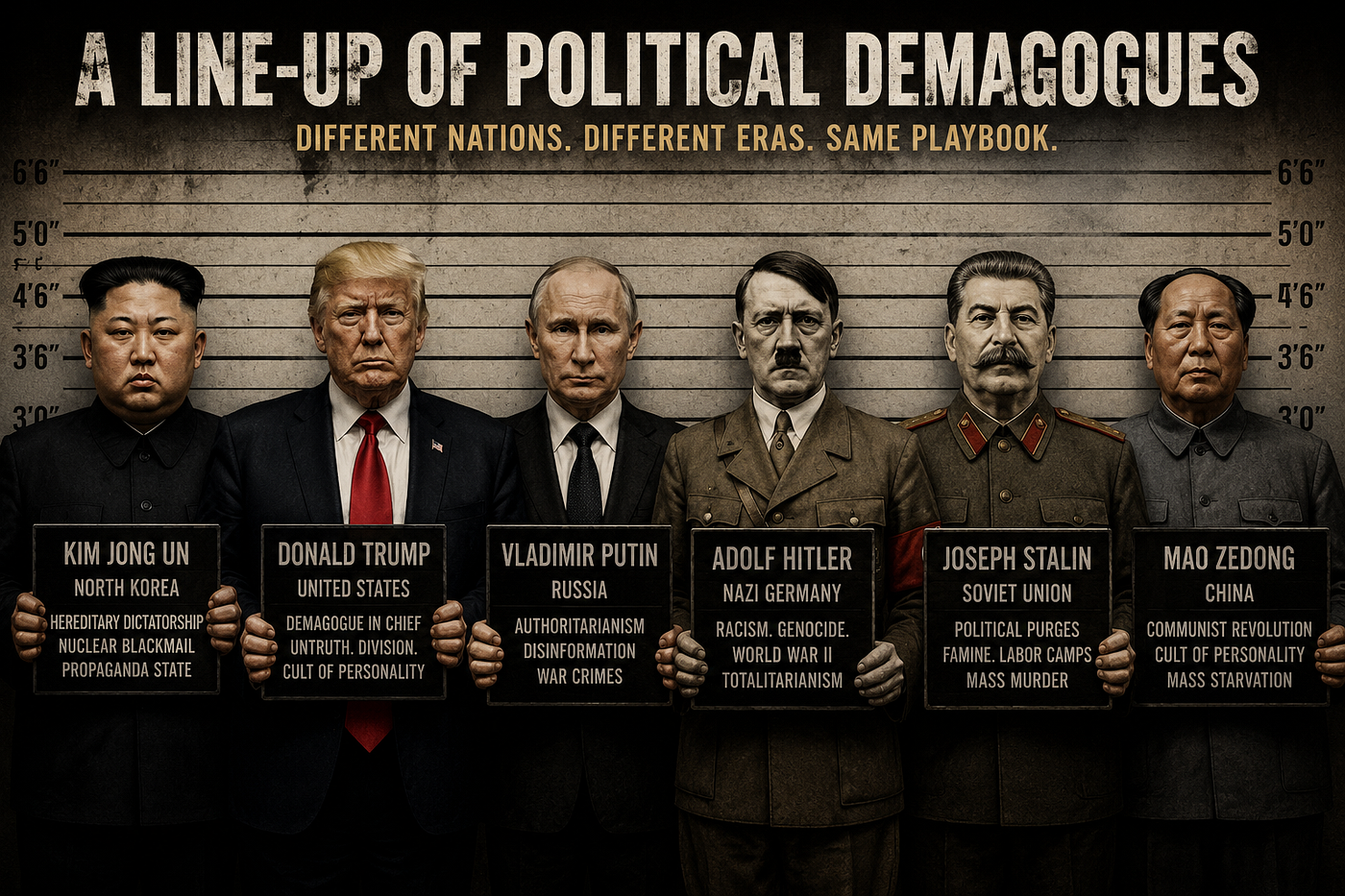
Ordinarily, the term is used by governments to describe some other country: a nation that violates international norms, bullies its neighbors, ignores law, threatens peace, plunders resources, and behaves as if morality applies only to the weak. A rogue nation is dangerous because it no longer recognizes moral limits. It treats power as permission. It treats wealth as entitlement. It treats other people’s suffering as the price of its own expansion.
But what happens when a nation becomes rogue from within?
What happens when the rogue force is not an outside enemy, not a foreign invader, not some distant dictator across the sea, but a movement rising inside the very institutions of the republic itself? What happens when the language of freedom is kept, but freedom itself is hollowed out? What happens when the Constitution is praised in public while its spirit is violated in practice? What happens when patriotism becomes a costume worn by those who are dismantling the country they claim to defend?
That is the nightmare of life in a rogue nation.
A rogue nation does not always announce itself with tanks in the streets. Sometimes it arrives wrapped in flags. Sometimes it quotes scripture. Sometimes it speaks of law and order while breaking the deeper moral law that holds a society together. Sometimes it praises the founders while betraying the principles of self-government, human dignity, equal justice, and constitutional restraint. The tragedy is not merely that corruption exists. Corruption has always existed. The deeper tragedy is that corruption begins to call itself righteousness.
In America today, many people feel that something has gone terribly wrong. The nation still has elections, courts, newspapers, churches, flags, slogans, and ceremonies. The outer structure remains visible. But beneath the surface, the soul of the republic appears to be under assault. The old American promises — liberty, equality, fairness, rule of law, freedom of conscience — are being turned into tools of factional power. Words that once pointed toward a shared ideal are now used as weapons in a war of domination.
This is what makes the present moment so disorienting. The attack does not always look like an attack. It looks like a movement to “restore” the country. It calls itself patriotic. It calls itself Christian. It calls itself constitutional. Yet too often its practical effect is the opposite: to narrow democracy, punish dissent, protect wealth, sanctify cruelty, and replace civic responsibility with tribal obedience.
At the center of this transformation stands an organized political army cultivated over years by far-right strategists, religious zealots, media propagandists, billionaires, and party loyalists willing to sacrifice truth for power. This army does not merely vote. It obeys, repeats, excuses, rationalizes, and defends. Its strength lies not only in numbers, but in discipline. It has been trained to distrust every source of information outside the movement. Courts are corrupt unless they favor the leader. Elections are fraudulent unless they produce victory. Journalists are enemies unless they flatter the cause. Science is suspect unless it can be bent to ideology. Compassion is weakness unless it serves the tribe.
This is how a cult of politics forms.
A cult does not require intelligence to disappear. Many cult members are intelligent. What disappears is independent moral judgment. The follower no longer asks, “Is this true?” or “Is this just?” or “Does this honor the Constitution?” The follower asks only, “Does this help our side?” Once that shift occurs, democracy has already begun to rot. The citizen has been replaced by the loyalist. The republic has been replaced by the movement.
The most disturbing part is that many of the people participating in this destruction believe they are saving America. They believe they are defending the nation from enemies, immigrants, liberals, secularists, intellectuals, teachers, judges, journalists, scientists, and anyone else cast as a threat to their imagined homeland. But the America they are defending is not the constitutional republic in its broadest and noblest sense. It is an emotional fantasy of ownership. It is a country where only certain people are considered truly American, only certain beliefs are treated as sacred, only certain histories are permitted, and only certain lives are protected.
This is not patriotism. It is possession.
The original American ideal, however imperfectly practiced, was not supposed to belong to one faction, one race, one religion, one party, one class, or one strongman. The Constitution was designed precisely because power is dangerous. It divided authority because human beings are corruptible. It protected speech because rulers lie. It protected religious liberty because conscience cannot be commanded by the state. It established law because personal rule leads to tyranny. It imagined, however incompletely, a republic of citizens rather than subjects.
A rogue America is the inversion of that dream.
In a rogue America, the powerful demand immunity while the weak are told to obey. The wealthy are protected while the poor are blamed. Corporations plunder while workers are lectured about responsibility. Religion is used not to deepen compassion, but to sanctify control. The flag becomes less a symbol of shared belonging than a banner of conquest. The Constitution becomes less a living guardrail against tyranny than a prop held up at rallies by people who would gladly ignore it when it restrains their side.
The nation, in this condition, becomes piratical. It raids its own future. It strips its own institutions. It devours its own citizens. It sells public goods to private interests. It turns neighbors into enemies. It turns fear into votes. It turns ignorance into loyalty. It turns resentment into policy. It hollows out the body of America while insisting that the corpse is more alive than ever.
This is what I mean by life in a rogue nation.
It is the experience of watching a country betray itself in real time. It is watching people cheer for their own dispossession because they have been taught to hate someone else more than they love their own freedom. It is watching religion become a spear instead of a lantern. It is watching capitalism become piracy, politics become theater, and citizenship become a loyalty test. It is watching a leader behave like a mad ruler while followers excuse every violation as strategy, every cruelty as strength, every lie as necessary, and every failure as someone else’s fault.
The shock is not simply that such a movement exists. History is full of authoritarian eruptions. The shock is that it can happen here, in a nation that told itself it was protected by its Constitution, its institutions, its founding myth, and its exceptional destiny. But no nation is immune to madness. No Constitution enforces itself. No republic survives when too many people prefer domination to truth.
This is where the political essay begins to touch science fiction. The future dystopia is no longer merely a literary invention. It becomes a method of seeing the present. In science fiction, the reader often watches a civilization cross a threshold before its citizens understand what has happened. The machines still run. The slogans still sound familiar. The leader still smiles from the screen. The citizens still go to work, shop, argue, vote, and entertain themselves. But reality has shifted. The old world has been replaced by an imitation of itself.
In that sense, life in a rogue nation resembles a political simulacrum. The symbols remain, but their meanings have been reversed. Democracy appears on the surface while domination operates underneath. Religion appears on the surface while cruelty is blessed beneath it. Freedom appears on the surface while obedience is demanded beneath it. The republic remains as scenery, but the drama being acted upon that stage is no longer republican. It is authoritarian theater.
This is why the citizen must learn to see like a science-fiction writer. The writer of speculative fiction does not merely ask what is happening. He asks what system is being built. He asks what hidden machinery is guiding the visible event. He asks what future is already present in embryo. He asks what kind of human being the system is trying to manufacture.
A rogue nation manufactures obedience. It manufactures fear. It manufactures false enemies. It manufactures citizens who no longer trust their own eyes. It manufactures followers who can watch constitutional values being gutted while believing they are witnessing national renewal. This is not simply propaganda. It is reality engineering.
And once reality is engineered, the greatest battlefield is no longer merely Congress, the courts, or the media. It is perception itself.
A nation becomes rogue when it seizes perception and teaches people to see lies as truth, cruelty as strength, plunder as prosperity, and tyranny as rescue. At that point, the crisis is not only political. It is spiritual, psychological, and metaphysical. The people must recover the power to perceive. They must see through the costume. They must recognize when the flag has been turned into a mask and when patriotism has been turned into a weapon.
A rogue nation is not only a nation that attacks others. It is also a nation that attacks its own moral foundations. It is a nation that forgets why law matters. It is a nation that mistakes wealth for virtue, cruelty for courage, propaganda for truth, and obedience for patriotism. It is a nation that can still sing its anthem while losing its soul.
And yet the recognition of this danger is not despair. To name the sickness is not to surrender to it. It is the first act of resistance. A people cannot heal what they refuse to see. A nation cannot return to itself while pretending that the wound is not there.
America, if it is to survive as anything more than a flag over a marketplace of fear, must recover the moral meaning of its own founding language. Freedom must again mean freedom for all, not privilege for the tribe. Law must again mean restraint on power, not punishment of enemies. Faith must again mean humility before the sacred, not domination in the name of God. Patriotism must again mean love of the republic, not worship of a ruler. The Constitution must again be understood not as a relic to be quoted, but as a discipline to be practiced.
Life in a rogue nation is painful because one can still remember the promise beneath the corruption. One can still hear the deeper music under the noise. One can still sense that America was never meant to become a pirate ship captained by grievance and greed. It was meant, at its best, to be an unfinished experiment in human dignity.
That experiment is now in danger.
The question is whether enough people can still see clearly, speak honestly, and act courageously before the mask of patriotism completely devours the face of the republic.
Bio-Bibliography
Nahu Lanham is an author, poet, speculative thinker, and lifelong explorer of consciousness, perception, power, and the hidden structures behind ordinary reality. His work often moves between philosophy, science fiction, metaphysics, political criticism, and visionary inquiry. Across his books and essays, Lanham examines the unseen forces that shape human behavior, social systems, spiritual awakening, and the fragile boundary between illusion and reality.
His science-fiction and speculative works include Murder Meme and Dominions of Power — title to be confirmed — both of which explore themes closely related to this essay: the manipulation of perception, the corruption of power, the engineering of belief, and the struggle of the individual mind against systems designed to control reality. In these works, as in his political and metaphysical essays, Lanham treats dystopia not merely as fantasy, but as a warning system. Science fiction becomes a lens through which the present can be seen more clearly.
Lanham’s broader writings include works on consciousness, psychic perception, future civilizations, simulated worlds, megalithic mysteries, alien contact, spiritual evolution, and the battle between domination and awakening. His recurring concern is the liberation of human perception from imposed systems of fear, obedience, materialism, and illusion.
Selected Bibliography
Lanham, Nahu. Murder Meme. Science-fiction novel.
Lanham, Nahu. Dominions of Power. Science-fiction novel. Title to be confirmed.
Lanham, Nahu. Psychic Ninja. Metaphysical and psychic-development work.
Lanham, Nahu. The Levitation Code. Speculative metaphysical inquiry into sound, resonance, and ancient technologies.
Lanham, Nahu. UFOs: Messages from a Future Civilization. Speculative inquiry into alien contact, time, consciousness, and future-human intelligence.
Lanham, Nahu. The Turning Point. Work on spiral forecasting, intuition, and hidden patterns of time.
메타데이터
- post_id
- ffe1ad0117f0
- slug
- ife-in-a-rogue-nation-ffe1ad0117f0
- url
- https://medium.com/@nahudini/ife-in-a-rogue-nation-ffe1ad0117f0
- canonical_url
- https://medium.com/@nahudini/ife-in-a-rogue-nation-ffe1ad0117f0
- author_url
- https://medium.com/@nahudini
- status
- ok
- fetched_at
- 2026-07-13 06:23:13