How the 2024 Election Was Won: The Tactics Shaping Our Democracy
This story was written with the assistance of an AI writing program.
How the 2024 Election Was Won: The Tactics Shaping Our Democracy

Democracy the game This image was created using an AI image creation program.
This story was written with the assistance of an AI writing program.
Introduction
Let’s be honest. Elections nowadays don’t feel like a simple choice between candidates. They’re more like a high-stakes strategy game, where the goal isn’t just to win votes, but to shape who can vote, what information they see, and even what “truth” actually means. A lot of these tactics might technically be legal, but they’re also pretty sneaky and, if we’re being real, unsettling. It’s like we’re living in a world George Orwell warned us about. Over the past decade, especially with Trump in the mix, Republicans have been using these strategies, some old and some new, to tip the scales in their favor.
In this piece, we’re diving into the playbook that helped sway the 2024 election. From social media bubbles to strict voting laws and gerrymandering, these tactics have created an election landscape where “truth” is kind of up for grabs. Remember when Kellyanne Conway talked about “alternative facts”? Well, here we are. Thanks to algorithms, AI, and partisan media, people can find “proof” for almost anything they want to believe. Let’s explore how these tactics are shaping what voters see, feel, and ultimately choose, and what that means for democracy.
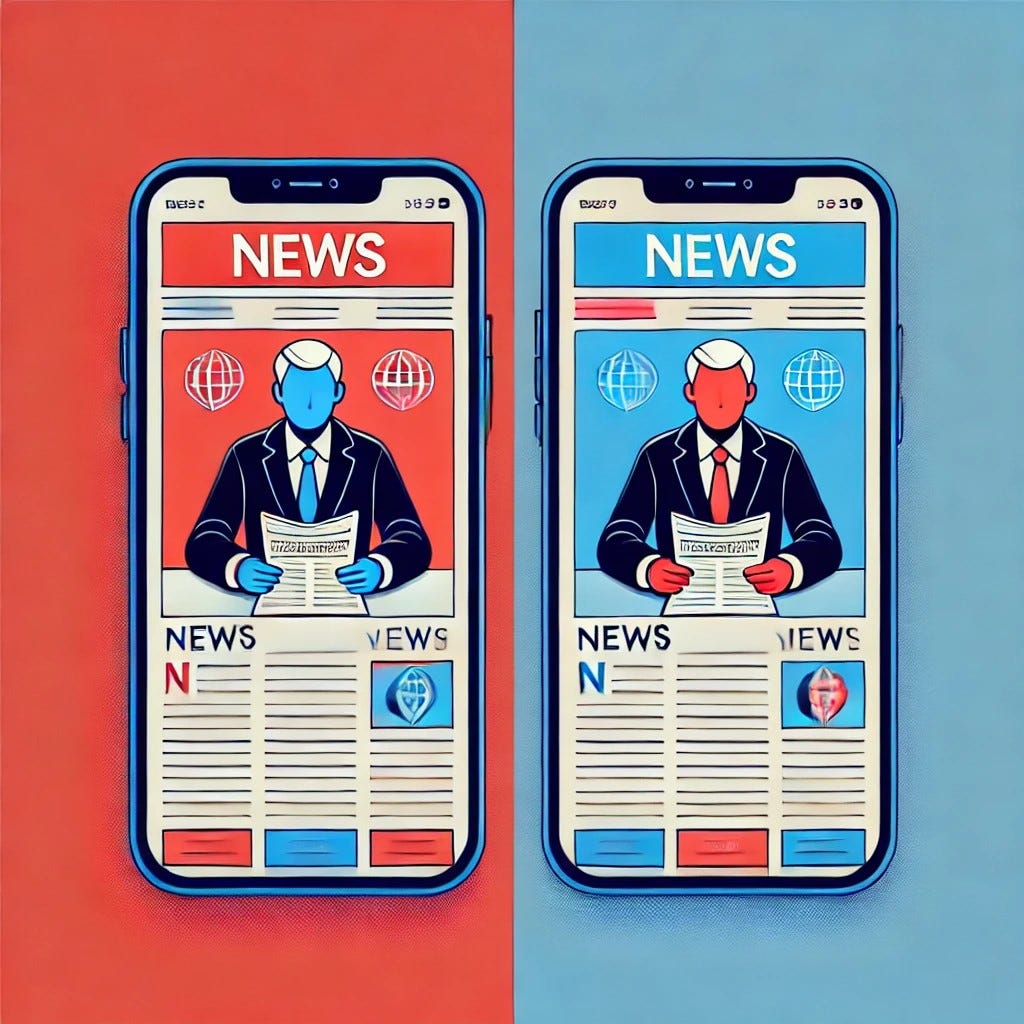
Choose your own reality This image was created using an AI image creation program.
1. Social Media Influence: Alternative Facts and Echo Chambers
Truth Social, X, and the Age of “Choose-Your-Own Reality”
Let’s start with social media — the front lines of this new battle over “truth.” Platforms like Truth Social and Elon Musk’s X (formerly Twitter) have totally changed how we consume information, and not always for the better. These sites are designed to keep us engaged, which usually means showing us content that reinforces what we already believe. Research from places like Pew and Harvard shows that people are way more likely to click on stuff that aligns with their views. And because algorithms prioritize whatever gets the most clicks, the loudest, most polarizing voices get amplified, while everything else fades away.
If you’re scrolling on X, you’re likely seeing a version of reality that just confirms your own perspective. It’s like living in a bubble where your viewpoint is the only one that exists. In a world where “truth” is whatever gets the most likes, it’s getting harder and harder to agree on basic facts, let alone find common ground.
Big Data and Real-Time Manipulation
Campaigns today are data-driven machines, and they’re scarily precise. Trump’s 2024 team took this to the next level, testing and tweaking their messages at rallies and online in real time to see what really hits. They’re running A/B tests on everything: words, images, even timing, to pull at people’s emotions and keep supporters hooked. This isn’t just about swaying undecided voters; it’s about drilling a narrative so deeply into people’s minds that it becomes an unshakeable “truth.”
Shaping Perception, One Algorithm at a Time
When social media controls what gets seen and shared, it also controls what issues people think about. Instead of an open exchange of ideas, we get a carefully curated version of reality, designed to fit specific agendas. It’s like looking at the world through a tiny keyhole instead of an open window. This manufactured “truth” shapes not just what voters think, but even what they think about, guiding them toward specific choices when they step into the voting booth.
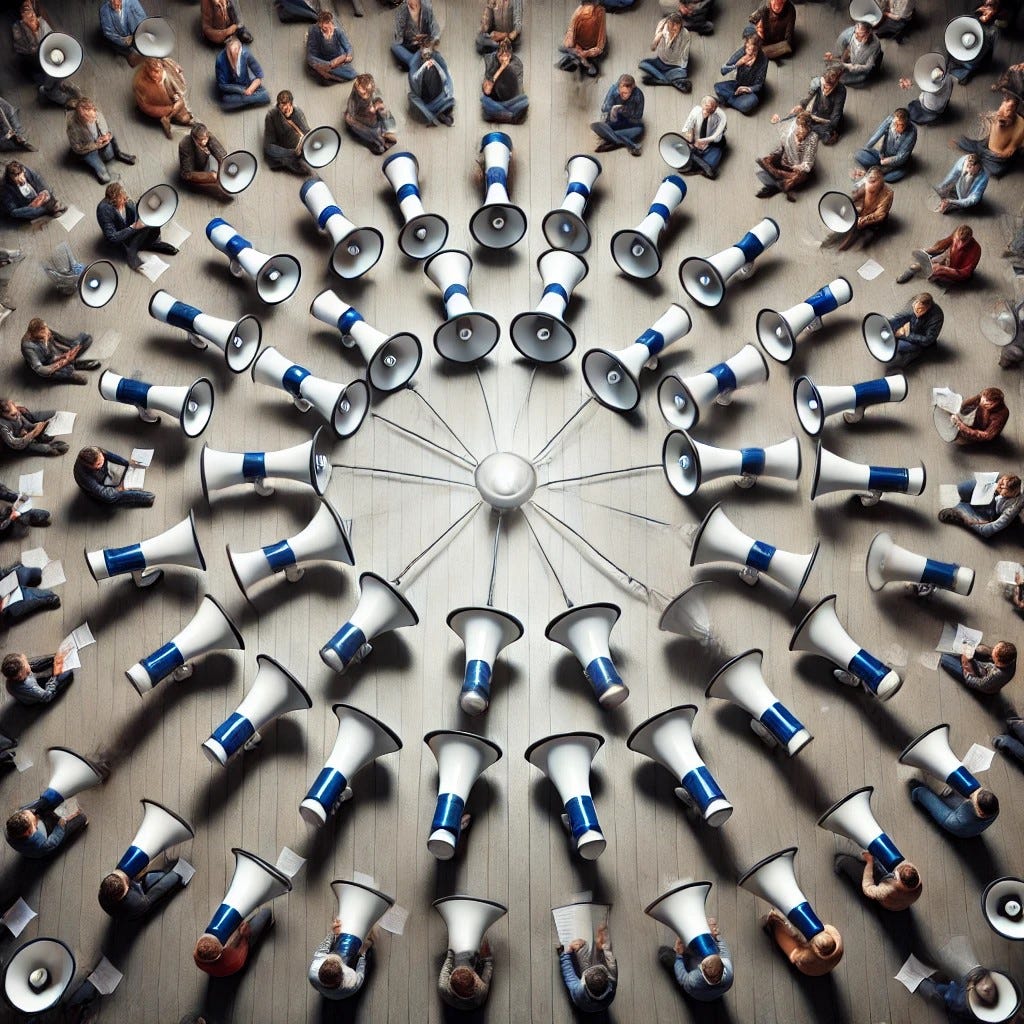
Echo Chamber This image was created using an AI image creation program.
2. The Right-Wing Media Machine: Repeating and Reinforcing the Narrative
A Network of Talking Heads, All Singing the Same Tune
Beyond social media, there’s a massive right-wing media infrastructure that’s been built to reinforce these narratives. Fox News, Joe Rogan, Glenn Beck, Tucker Carlson, Elon Musk, and a whole lineup of pundits and commentators repeat the same talking points, giving each other a boost to make it all seem valid, popular, and true. They use each other as sources to create a self-reinforcing loop, where the same ideas bounce around until they feel like undeniable “truths” to their audience.
Trump understood the power of this echo chamber better than most. He used every trick in the book — cognitive distortions, propaganda techniques, logical fallacies — to flood the airwaves with misleading or outright false information. And for the most part, mainstream media let it slide. They broadcast his speeches, fact-checking here and there, but largely giving him free rein to say whatever he wanted. By the time corrections came out, the damage was already done. People heard what they wanted to hear, and the “truth” was already in their minds.
The Left Lags Behind
While there are some progressive voices in the media, they’re often seen as more “political” or “partisan,” which can make it harder for them to reach people outside their core base. The left simply doesn’t have a media ecosystem that can match the scale and reach of right-wing outlets. Most mainstream media tends to be cautious, aiming to stay “neutral,” which sometimes leads to false balance, where they treat outright lies as just another opinion. As a result, the left’s messages often don’t break through as effectively, and many Americans don’t even tune in.
An Example: The Economy vs. Inflation
Take the economy as an example. By most factual measures, the economy has been strong, with low unemployment and steady growth. But people are feeling the pinch of inflation, which surged due to pandemic supply chain issues, demand spikes, and, honestly, some profiteering by big companies. For most people, that’s all they see. They’re paying more for groceries and gas, so it doesn’t matter what the data says about economic growth. Either they don’t understand the broader economic picture, or they simply can’t afford to care. And right-wing media is more than happy to exploit that frustration, hammering the idea that the economy is failing, even if the numbers say otherwise.
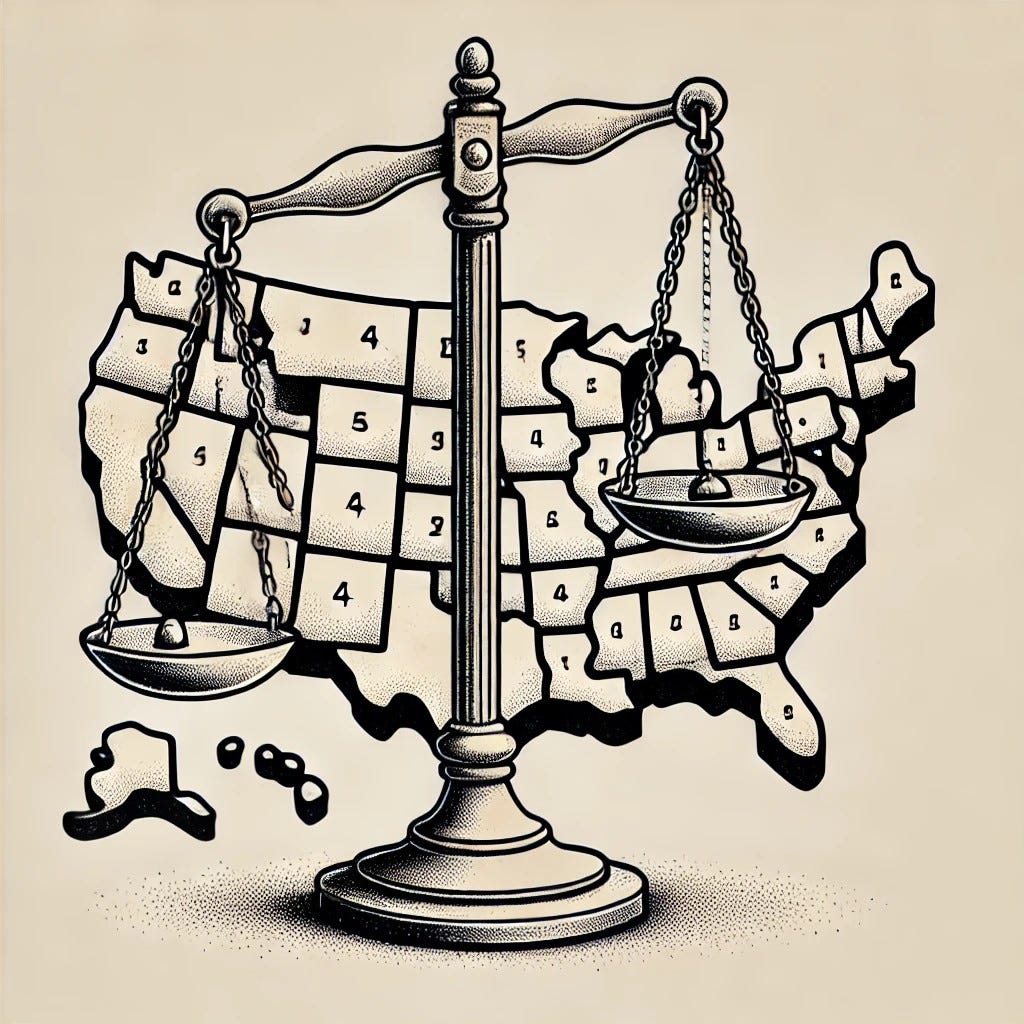
Structural Bias This image was created using an AI image creation program.
3. Structural Bias: The Electoral College and Gerrymandering
The Electoral College: Old Rules, New Power
The Electoral College might sound like something from high school civics class, but it’s still a massive force in shaping election outcomes. It gives smaller and swing states more influence, which means candidates pour all their energy (and cash) into a few battleground states, leaving voters in “safe” states feeling overlooked. Winning the popular vote isn’t the goal; it’s all about getting the right numbers in the right places.
Gerrymandering: Carving Out Power with Precision
Then there’s gerrymandering, the age-old trick of drawing district lines to give one party an advantage. It’s been around forever, but with modern technology, it’s become scarily precise. Republicans, especially in states like North Carolina, Texas, and Ohio, have used high-tech mapping software to create “safe” districts that all but guarantee their candidates a win. Both parties have played this game, but recent Republican efforts have taken it to a whole new level. With data-driven maps, they can carve out “safe zones” that turn competitive districts into party strongholds.
Digital Precision Meets Old-School Tactics
The Electoral College and gerrymandering aren’t new, but today’s tech has supercharged their impact. It’s not just about clever mapping anymore; it’s about slicing and dicing districts so precisely that even a small portion of voters can hold a lot of power. These old tactics have become almost surgical, giving a minority of voters outsized control over national policies.

Barriers to the Ballot This image was created using an AI image creation program.
4. Undermining Voter Access: State-Level Restrictions and Partisan Poll Workers
Restricting Voting Access Through State Laws
In recent years, Republican-led states have passed laws that make it tougher to vote, especially for groups more likely to vote Democrat, like low-income folks, young people, and communities of color. These restrictions include strict voter ID requirements, cuts to early voting days, and limits on mail-in ballots. The reason? “Election integrity” and stopping fraud. But here’s the truth: actual voter fraud is incredibly rare. Critics argue that these laws are less about security and more about keeping certain groups away from the polls.
Purging Voter Rolls and Challenging Ballots
In states like Georgia, officials have removed hundreds of thousands of people from voter rolls for reasons like outdated addresses or “inactivity.” While cleaning up old registrations is standard, some argue that these criteria are way too aggressive and end up disqualifying eligible voters. On top of that, campaigns challenging voter registrations are picking up, especially in cities that lean Democratic. This can lead to delays, confusion, and even disqualifications on Election Day.
MAGA-Aligned Poll Workers and Local Influence
There’s also been a push in MAGA circles to get supporters into roles like poll workers or election board members. These might seem like small roles, but they have a lot of control over how voting rules are enforced on Election Day. Some worry that having openly partisan poll workers could create a less neutral environment, making certain voters feel uncomfortable or even unwelcome.

Misinformation and “audits” This image was created using an AI image creation program.
5. Eroding Trust in the System: Misinformation and Election “Audits”
Casting Doubt on Election Legitimacy
One of the most powerful tactics has been casting doubt on the election system itself. In 2020, Trump and others repeatedly questioned the security of mail-in voting, despite there being little evidence of widespread fraud. This didn’t necessarily stop people from voting, but it left a lot of Americans wondering if the system was rigged.
Endless “Audits” to Keep the Story Going
After the 2020 election, states like Arizona held high-profile “audits” of the results, often led by partisan officials. These audits didn’t find any fraud, but they kept the “stolen election” story alive. Moving forward, these audits could become a regular tactic, especially in close races, as a way to keep supporters skeptical of any result they don’t like.

Voting in Chaos This image was created using an AI image creation program.
6. Election Day Disruptions: Bomb Threats and Voter Suppression
Bomb Threats and Temporary Poll Closures
On Election Day 2024, swing states were hit with bomb threats that, while ultimately hoaxes, caused real chaos. The FBI confirmed the threats, and although no one was hurt, some polling places had to close temporarily. For people on tight schedules, this kind of disruption can be the difference between voting and not voting. It’s a subtle form of voter suppression that technically doesn’t break any laws, but it can still keep certain groups, especially in dense, urban areas, from casting their ballots.
Polling Place Closures Hit Certain Communities Harder
For neighborhoods with fewer polling locations, often lower-income and communities of color, even a small hiccup can feel like a big barrier. With long lines and limited options, any delay makes voting harder. It’s like adding yet another obstacle for people who are already climbing an uphill battle to have their voices heard.

Democracy Fractured This image was created using an AI image creation program.
7. The Cumulative Effect: Democracy Under Strain
When Legal Tactics Feel Like Manipulation
Each of these tactics on its own might not seem like it’s “breaking” democracy. But when you add them all together, it starts to feel like a strategy designed to narrow, shape, and control who votes and how they vote. Social media echo chambers, a huge right-wing media machine, strict voting laws, gerrymandering, partisan poll workers, Election Day disruptions. It all adds up to a democracy that feels less like “one person, one vote” and more like a game where only certain people’s voices count.

Splintered Reality This image was created using an AI image creation program.
Truth Isn’t Truth Anymore
Maybe the scariest part of all this is how fractured our sense of reality has become. With “alternative facts” and social media feeds that let us pick our own “truth,” people are divided not just on issues, but on what’s real. Algorithms, partisan media, and constant misinformation make it easy to find “proof” for whatever you want to believe. The result? A society where trust in the whole system is wearing thin.
Calls for Reform
There’s a growing call for change, to bring fairness and transparency back into elections. Ideas like independent redistricting commissions, transparency rules for algorithms, and protections for voting rights (like the For the People Act) are on the table. None of these are quick fixes, but they’re steps toward a system where every vote counts equally.

Holding the Fragile Ballot This image was created using an AI image creation program.
Conclusion
At its core, democracy is supposed to be about fair representation, but right now it feels like the rules have been twisted, creating an uneven playing field where some voices matter more than others. If we want people to feel like their vote counts, we need real reforms. More accountability, less manipulation, and a commitment to a shared reality. Because if we can’t agree on basic truth, democracy doesn’t just feel fragile; it feels like something we could lose.
메타데이터
- post_id
- fff46ca7779b
- slug
- how-the-2024-election-was-won-the-tactics-shaping-our-democracy-fff46ca7779b
- url
- https://medium.com/@wsutherland5/how-the-2024-election-was-won-the-tactics-shaping-our-democracy-fff46ca7779b
- canonical_url
- https://medium.com/@wsutherland5/how-the-2024-election-was-won-the-tactics-shaping-our-democracy-fff46ca7779b
- author_url
- https://medium.com/@wsutherland5
- status
- ok
- fetched_at
- 2026-08-17 21:49:01

