I Would Not Mind Being Stuck on Opus 4.8 Forever
My real token bill for the last period should have been about $600,000. I paid $2,000.
I Would Not Mind Being Stuck on Opus 4.8 Forever
My real token bill for the last period should have been about $600,000. I paid $2,000.
That subsidy is going to die, and it still will not matter, because good enough already arrived and it is about to get cheap.
I ran the numbers on my own usage, honestly, at real prices rather than the ones I actually paid. For the last period, my token consumption would have cost somewhere around $600,000 (Un-cached for dramatic effect). I paid about $2,000. The difference is subsidy, plain and simple, and I am not naive about it.
So let me answer the obvious question first. Will that pricing survive? No. Definitely not. Nobody is going to sell you $600,000 of frontier inference for two grand forever. The subsidy is a land-grab phase, and land-grab phases end.
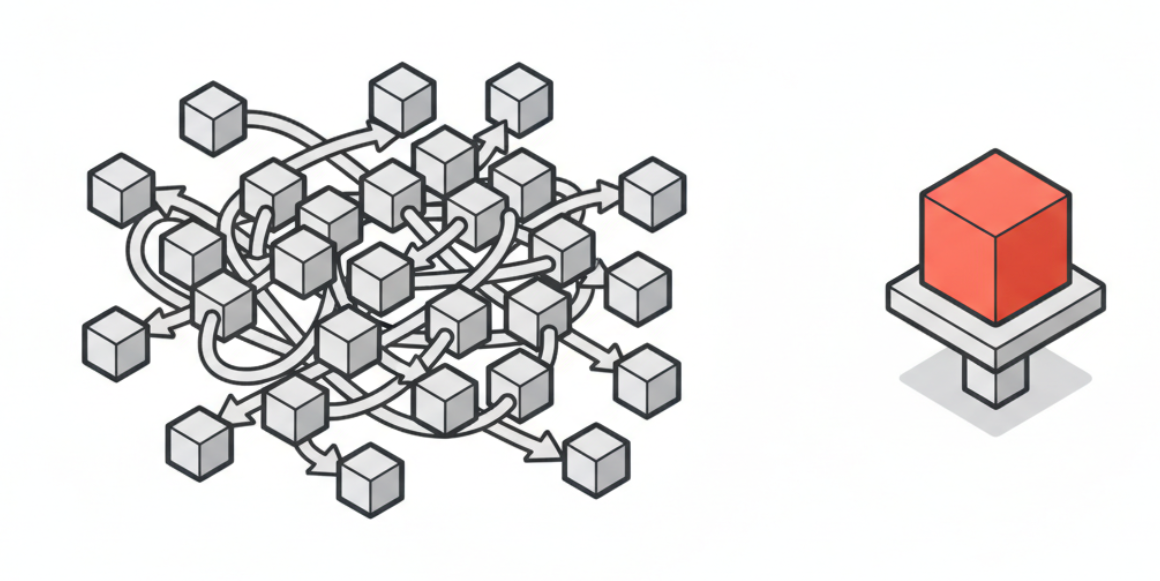
Most people treat that as the scary part. I think the scary part is something else entirely, and it points the other way. The scary part is that so many teams are architecting their entire operation, and their entire budget, around needing the frontier at all. I do not. I could be handed today’s best widely available model and told it is the last upgrade I will ever get, and I would be completely fine.
The line that already got crossed
The story everyone tells about AI is a vertical one. Each model is smarter than the last, the graph goes up and to the right, and the job is to stay as close to the top of it as you can afford.
That story is true and it is also, for most real work, beside the point. Capability is not a single axis where more is always better. It is a threshold. Below the line, the model cannot do the job. Above the line, it can, and piling on more intelligence stops changing the outcome. The interesting question is not how high the frontier goes. It is where that line sits, and whether you have already crossed it.
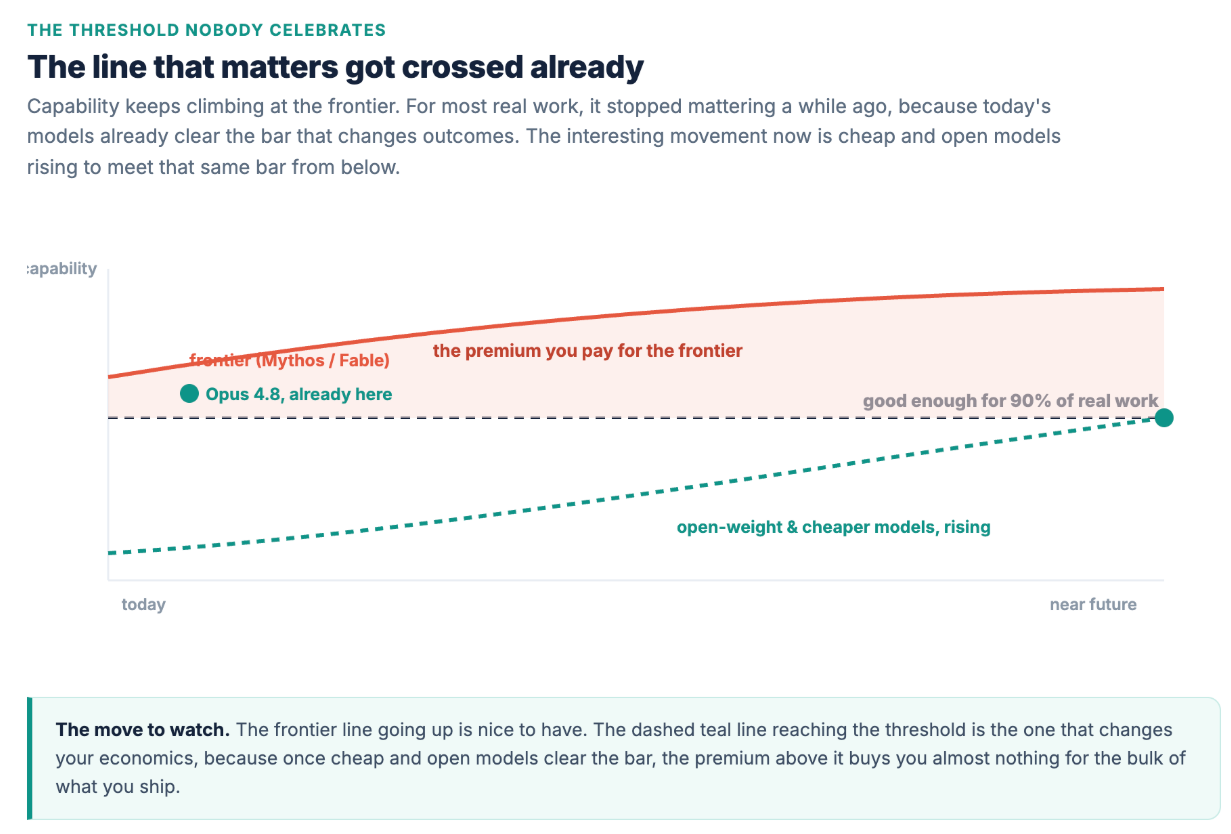
For the overwhelming majority of what I build, I crossed it a while ago. I can do essentially anything I need with an Opus-4.8-level model. The bottleneck in my work stopped being the model’s raw intelligence and became everything around it. When the tool is already good enough, a smarter tool does not make the work better. It just costs more.
Be honest about the ten percent
This is where the argument usually gets lazy, so let me not be lazy. I am not claiming model progress stopped mattering. That would be silly. I am making a claim about proportion.
There is a real slice of work, call it 10 percent, where the frontier genuinely earns its price: the hardest novel reasoning, the longest-horizon autonomy, the genuinely unsolved problems. If that is your daily work, chase the frontier and pay for it. It is worth it.
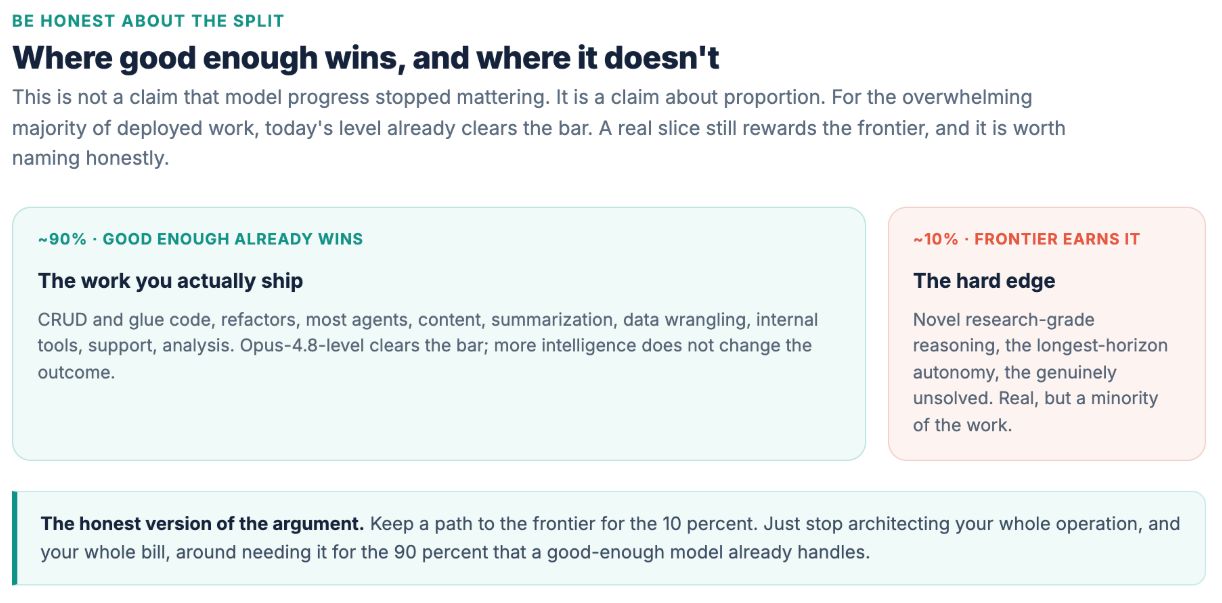
But look honestly at what most of us ship. Glue code and CRUD. Refactors. Most agents. Content, summarization, data wrangling, internal tools, support, analysis. For all of that, an Opus-4.8-level model clears the bar completely, and the next tier up changes nothing you would notice. Keep a path to the frontier for the 10 percent. Just stop building your whole operation, and your whole bill, around needing it for the 90 percent that a good-enough model already handles.
Would Mythos-level be cool? Of course. Am I glad Fable exists and I cannot wait for it to come back? Genuinely, yes. But wanting it and needing it are different sentences, and most of the industry keeps writing the second one when the first one is true.
Good enough is a floor that keeps rising
The part that makes me relaxed rather than worried runs the other way. Even if the frontier froze tomorrow, my position keeps improving, because the good-enough line does not stay expensive.
Every capability that debuts at the frontier eventually becomes the baseline. Today’s astonishing model is next year’s open-weight default. The open models and the Chinese labs are not chasing some permanently receding target. They are climbing toward a fixed, known point, today’s frontier, and they will reach it. When they do, that level of intelligence stops being a premium product and becomes a commodity, and commodities collapse in price.
So the thing a lot of people are paying thousands of dollars to rent right now is the exact thing that is about to be nearly free. Being stuck at Opus 4.8 does not mean being stuck at Opus 4.8 prices. It means that capability keeps getting cheaper underneath me while doing everything I already need it to do.
The advantage was never the model
If the model is going to commoditize, then betting your edge on having the newest one is betting on the most perishable asset in the whole stack. You pay a premium, you get a lead, and the lead evaporates the moment the capability drops to the tier below. Then you are still paying, and the advantage is gone.
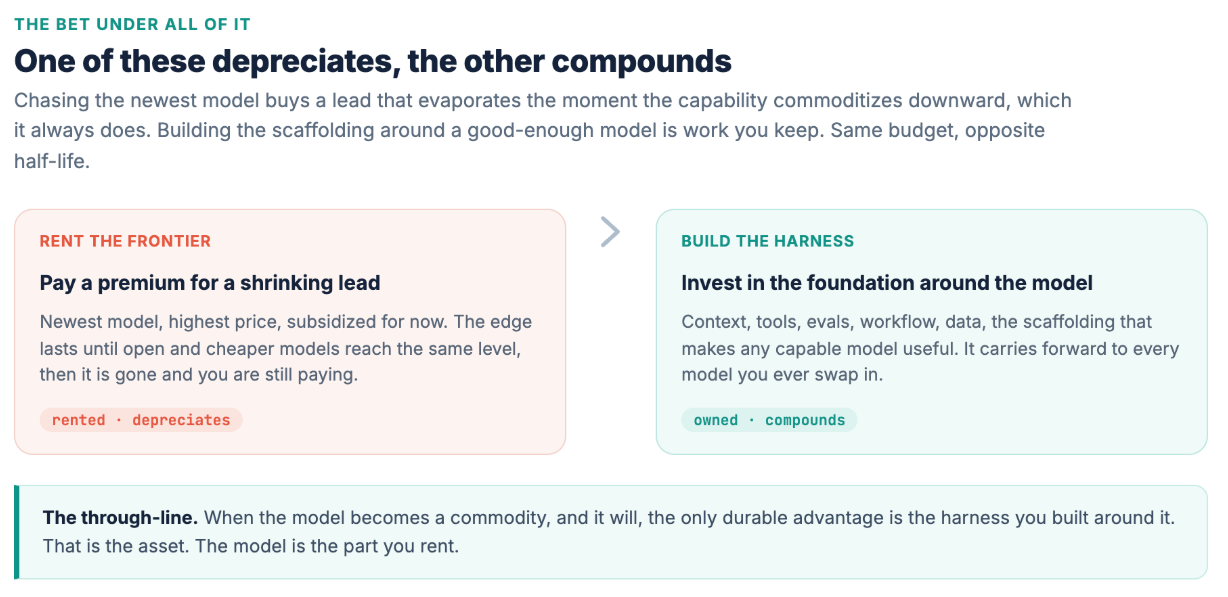
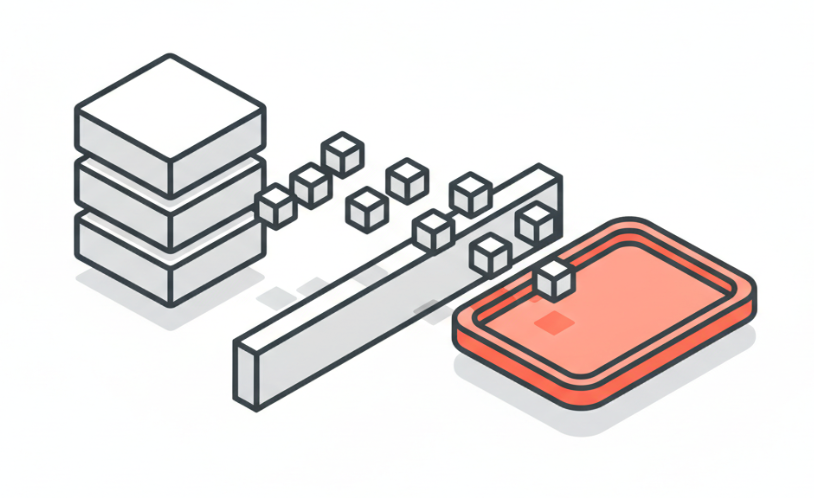
The other bet is the harness. The context you feed the model, the tools you give it, the evals that tell you whether it is actually working, the workflow and the foundations and the data. None of that depreciates when the next model ships. All of it carries forward to whatever model you swap in underneath. I have written before about the cost reckoning, teams discovering their AI bill tripled while token prices fell, and this is the same lesson from the other side. The spend that flows to the frontier is rented. The work you put into the scaffolding is owned.
That is where I am putting my effort, and it is why I can shrug at the question of whether the subsidy survives. My leverage was never in having a slightly smarter model than the next person. It was in having built something worth putting a good-enough model inside.
The future is already on your machine
There is a habit of talking about AI as though the good part is always six months away, one release from now, gated behind a model that has not shipped yet. I understand the pull of it. The frontier is genuinely exciting and the demos are genuinely impressive.
But step back and look at what you already have. A model you can hand almost any real task and get a real result. That is not the appetizer for some future capability. That is the thing. We are past the inflection point, and most people are so busy looking up at the next rung that they have not noticed they are already standing on a floor that would have looked like science fiction two years ago.
The subsidy will end. The frontier will keep climbing without me for the parts I do not need. And I will be here, on a good-enough model that keeps getting cheaper, spending my time on the only thing that was ever going to be a durable advantage: the foundation I build around it. The question worth asking is not when the next model arrives. It is whether you have built anything that a good-enough model could make great, because that model is already sitting on your desk.
Marco Kotrotsos, specializing in practical AI implementation for organizations ready to close the gap between AI hype and AI value. With 30 years of IT experience now focused purely on AI deployment, he works hands-on with companies to turn AI potential into measurable business outcomes.
This article is published in Autocomplete, a Medium publication about real-world AI for practitioners and decision-makers. We’re always looking for writers. If you’re building with AI and have something worth sharing, reach out.
My free Substack newsletter, also called Autocomplete, can be found here: https://acdigest.substack.com.
My books on Amazon: Claude Code for Everyone Else and From Vibe to Production.
I also take on a small number of mentees one-on-one on MentorCruise.
메타데이터
- post_id
- fff66eae4cf1
- slug
- i-would-not-mind-being-stuck-on-opus-4-8-forever-fff66eae4cf1
- url
- https://medium.com/autocomplete-real-world-ai/i-would-not-mind-being-stuck-on-opus-4-8-forever-fff66eae4cf1
- canonical_url
- https://medium.com/autocomplete-real-world-ai/i-would-not-mind-being-stuck-on-opus-4-8-forever-fff66eae4cf1
- author_url
- https://medium.com/@kotrotsos
- status
- ok
- fetched_at
- 2026-07-09 08:27:28