Scope 1, 2, and 3 Emissions for Suppliers: What to Report When a Customer Asks (2026)
How the GHG Protocol categories work, what VSME actually requires, and how to get your numbers from data you already hold
Scope 1, 2, and 3 Emissions for Suppliers: What to Report When a Customer Asks (2026)
How the GHG Protocol categories work, what VSME actually requires, and how to get your numbers from data you already hold
Most small business owners encounter Scope 1, 2, and 3 the same way: a questionnaire arrives from a customer or a bank, asks for emissions figures, and leaves you searching for terminology you’ve never needed before.
The framework behind those terms is more straightforward than it looks. And the data you need to respond is almost certainly already sitting in your utility bills.
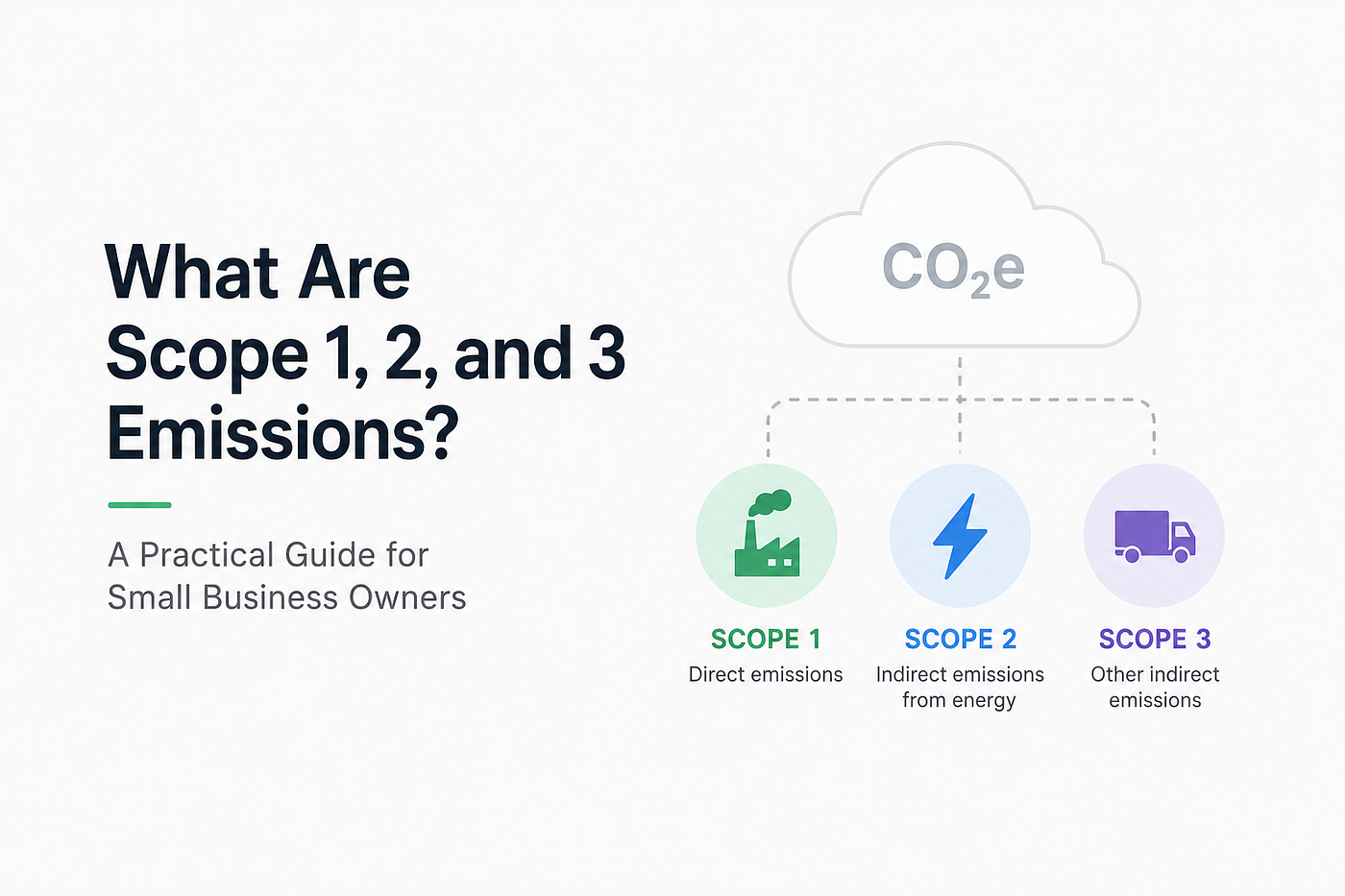
Scope 1, 2, and 3 are not three separate regulations. They are three categories within a single accounting framework, the Greenhouse Gas Protocol, built to answer one question: where exactly do a company’s greenhouse gas emissions come from?
You are being asked because the pressure has moved upstream. Large companies across Europe, the UK, and other major economies are now legally required to report their full supply chain emissions. To do that, they need data from their suppliers like you. In December 2024, the EU published a reporting standard designed specifically for smaller businesses, it sets the limit on what your larger customers and partners can ask you to provide.
In this guide, I’ll cover what each scope includes, which ones small businesses are most likely to be asked about, and the practical steps to get your numbers — no specialist software or sustainability team required.
Why Are Emissions Divided Into Three Scopes? The Logic Behind the Framework
In 1998, two organisations, the World Resources Institute and the World Business Council for Sustainable Development, set out to solve a problem that was becoming urgent.
Companies were starting to measure their carbon emissions. But what counted? If a manufacturer burned gas in its own boiler, that was obvious. But what about the emissions from the power station that supplied its electricity? Or the emissions from the steel company that made its raw materials? Or the trucks that delivered its products to customers?
Without a consistent answer, companies would measure different things and call them the same thing. The numbers would be meaningless.
Their solution was the Greenhouse Gas Protocol, the global standard for measuring and reporting business emissions. Across every major corporate sustainability reporting framework in use today, from Europe’s CSRD and ESRS to the global IFRS S2 standard and CDP, the GHG Protocol is the foundation. When companies, customers, regulators, and investors discuss Scope 1, 2, and 3, they are all working within the same framework.
The framework uses a simple principle to categorise emissions: the closer an emission is to your direct control, the lower the scope number.
[embed]
Scope 1 is what your business directly causes. Scope 2 is what your energy consumption indirectly causes. Scope 3 is everything else, up and down your entire supply chain.
Here’s what each one actually means.

What Are Scope 1 Emissions? Direct Emissions Your Business Controls
Scope 1 emissions are greenhouse gases produced by sources your business owns or directly controls.
Think of Scope 1 as everything that burns or leaks on your own premises or in your own vehicles. If you flip a switch and something combusts, that’s yours.
What Counts as Scope 1?
- Gas boilers and furnaces heating your factory, warehouse, or office
- Company-owned vehicles: vans, lorries, cars, forklifts running on diesel or petrol
- Manufacturing equipment that burns fuel on-site
- Refrigerants leaking from air conditioning units or cold storage (these are potent greenhouse gases)
- On-site generators running on diesel or gas
Electricity is a common source of confusion. Although your business purchases and pays for it, the emissions associated with its generation occur at the power station, not on your premises. For this reason, electricity is always classified as Scope 2, not Scope 1.
For a typical small manufacturer, Scope 1 looks like this:
A 40-person food manufacturer has a gas boiler heating the factory, two delivery vans, and a diesel-powered forklift. Those three sources make up their entire Scope 1 footprint — perhaps 30 to 50 tonnes of CO₂ equivalent per year.
Your Scope 1 data already exists within your business. It simply needs to be consolidated. Gas utility bills capture your heating and boiler consumption; fuel receipts and fuel card statements cover your company vehicles. For most small businesses, twelve months of each is sufficient to calculate your Scope 1 footprint. If you operate refrigeration or cold storage equipment, service and maintenance records showing refrigerant top-ups will also be required.
How to Calculate Scope 1 Emissions
The standard method applies a straightforward formula: activity data × emission factor = CO₂e emissions.
Emission factors for common fuels are published free of charge by national governments and updated annually. In the UK, these are available from DEFRA/DESNZ. The factors are expressed in kilograms of CO₂e per unit of fuel consumed, so a conversion step is required to reach your final figure in tonnes.
Using company vehicles as an example, with 5,000 litres of diesel consumed over the year:
- Multiply total litres by the relevant emission factor — for diesel, 2.57 kg CO₂e per litre (DEFRA 2025)
- 5,000 × 2.57 = 12,854 kg CO₂e
- Divide by 1,000 to convert to tonnes: 12,854 ÷ 1,000 = 12.85 tCO₂e
- Repeat the same process for gas consumption
- Add all figures together for your total Scope 1 footprint
Always use the emission factor published for your specific reporting year, as figures are updated annually.
All results are reported in tonnes of CO₂ equivalent (tCO₂e) per year.
What Are Scope 2 Emissions? The Greenhouse Gases Behind Your Electricity Bill
Scope 2 emissions are the greenhouse gases produced when generating the electricity, heat, or steam that your business purchases and uses.
Electricity does not arrive at your premises carbon-neutral. A power station generated it, using gas, coal, nuclear energy, wind, solar, or a combination of these sources. Scope 2 represents your business’s share of those generation emissions. Your business did not directly cause them, but they exist because you consumed the electricity.
This matters because for many businesses, particularly those in offices or light manufacturing, electricity is the single largest source of emissions. A company with minimal on-site fuel use can still carry a substantial Scope 2 footprint if it runs energy-intensive equipment.
What Counts as Scope 2?
- All electricity purchased from the grid
- Purchased heat or steam (relevant in industrial and district heating settings)
Electricity generated on-site from renewable sources, such as rooftop solar panels, is reported as part of your energy profile but carries zero emissions. It does not contribute to your Scope 2 total. On-site generation from diesel generators is classified as Scope 1, as the emissions arise from fuel combustion directly on your premises.
How to Calculate Scope 2 Emissions
The GHG Protocol recognises two calculation methods. The location-based method multiplies your electricity consumption by the average grid emission factor for your country. This is the method used by most small businesses and the one accepted by the majority of supply chain questionnaires. The market-based method uses supplier-specific factors or renewable energy certificates, and is required by some frameworks including CDP and ESRS. For most small businesses responding to standard requests, the location-based method is sufficient.
To calculate using the location-based method:
- Identify your total electricity consumption in kWh over 12 months from your electricity bills
- Multiply by your country’s grid emission factor, published annually by national governments free of charge
- Divide by 1,000 to convert kg CO₂e to tCO₂e
For a typical small food manufacturer consuming 100,000 kWh per year, running refrigeration units, production equipment, and lighting, the result is: 100,000 × grid emission factor ÷ 1,000 = Scope 2 tCO₂e.
Always use the emission factor published for your specific reporting year, as figures are updated annually.

What Are Scope 3 Emissions? Your Full Value Chain Footprint
Most businesses can calculate their Scope 1 and 2 emissions within a few weeks. The data is contained, the boundary is clear, and it lives in utility bills and fuel receipts.
Scope 3 is a different challenge entirely.
Scope 3 emissions are all other indirect greenhouse gas emissions that occur across your value chain, both upstream (before goods reach you) and downstream (after they leave you).
Upstream and Downstream: The Scope 3 Categories That Matter for Small Businesses
The GHG Protocol Corporate Value Chain Standard identifies 15 distinct Scope 3 categories. The most relevant for small businesses are:
Upstream (emissions that occur before your business):
- Greenhouse gases produced in manufacturing your raw materials and purchased goods, including steel, packaging, ingredients, and components
- Transport of goods from your suppliers to you
- Business travel by your employees, including flights, trains, and hotels
- Employee commuting
Downstream (emissions that occur because of your business):
- Transport of your products to customers
- Your customers’ use of your products, particularly where they consume energy during use
- Disposal of your products at end of life
The scale of Scope 3 relative to operational emissions is significant. In 2023, corporations reported that their upstream supply chain emissions were, on average, 26 times greater than their combined Scope 1 and 2 emissions (BCG and CDP, 2024). McKinsey estimates that Scope 3 typically represents around 90 percent of a company’s total emissions.
It is also the most difficult category to measure. Most of the underlying data sits with suppliers and customers, not within the business itself.

Which Scopes Do Small Businesses Actually Need to Report?
This is the question most guides on Scope 1, 2, and 3 fail to answer directly. They cover the framework thoroughly, then move on to reduction strategies and net-zero targets, leaving small business owners uncertain about what they are actually required to provide.
The answer depends on what you are reporting for.
Under the current GHG Protocol Corporate Standard, Scope 3 reporting is not mandatory for a basic corporate inventory. A business completing its first GHG inventory can report Scope 1 and 2 alone and remain within the protocol. Scope 3 is encouraged, particularly where it represents a significant portion of total emissions, but it is not a requirement at this stage. It is worth noting that the GHG Protocol is currently undergoing a formal revision, and mandatory Scope 3 reporting is under active consideration. Under the current standard, Scope 1 and 2 remain the baseline.
Beyond the GHG Protocol, different reporting frameworks and questionnaires carry their own requirements. For most small businesses receiving sustainability data requests from customers or banks, the most relevant framework is VSME. VSME is an EU framework, but its practical relevance extends beyond EU borders. Any business that supplies to a large EU company subject to CSRD may receive data requests structured around VSME, regardless of where the supplier is based.
The VSME Standard: The EU’s Sustainability Reporting Framework for SMEs
To understand VSME, a brief piece of regulatory context is needed. Not because the regulation applies to most small businesses directly, but because understanding why it was created explains the supply chain pressure many businesses are already feeling.
How CSRD Created a Supply Chain Data Problem
On January 5, 2023, the EU’s Corporate Sustainability Reporting Directive (CSRD) entered into force. It significantly expanded mandatory sustainability reporting in Europe, extending requirements from approximately 11,000 large listed companies under the previous regime to around 50,000 companies across the bloc.
Companies subject to CSRD must report under the European Sustainability Reporting Standards (ESRS), developed by EFRAG. ESRS is comprehensive: covering climate, biodiversity, water, workforce, human rights, and governance, it spans more than 1,000 individual data points. Large companies must produce this data, have it externally assured, and publish it annually.
CSRD and ESRS were designed for large companies. Smaller businesses were explicitly excluded.
This created an immediate problem. ESRS requires large companies to report their Scope 3 emissions and supply chain sustainability impacts, which means they need sustainability data from their suppliers, including smaller businesses that fall outside CSRD’s scope.
Without a consistent standard, large companies began sending ad hoc questionnaires in dozens of different formats, requesting data that smaller suppliers had never collected, with no guidance on what was proportionate. The burden was growing and the process was inconsistent.

Why EFRAG Created VSME: A Proportionate Standard for Smaller Businesses
In December 2024, EFRAG, the same body that developed ESRS, published the VSME Standard. Its purpose was direct: support smaller businesses in providing sustainability information to the large companies in their supply chain, and to banks and investors, without subjecting them to requirements designed for organisations far larger.
The proportionality is built into every aspect of the design. Where ESRS covers more than 1,000 data points, VSME covers 93. Where ESRS mandates a formal double materiality assessment, VSME applies a simpler “if applicable” approach. Where ESRS requires external audit, VSME has no mandatory audit requirement.
VSME’s Two Modules: Basic vs. Comprehensive
VSME is structured in two modules. Understanding the difference matters for knowing what you are likely to be asked to provide.
[embed]
The Basic Module (B1–B11) is the starting point for all businesses. It covers general business information, energy and GHG emissions (Scope 1 and 2 required; Scope 3 optional), pollution, water, waste management, workforce characteristics, health and safety, training hours, and governance. In total: 51 data points. For most small businesses responding to a first supply chain questionnaire, the Basic Module is the relevant module.
[embed]
The Comprehensive Module (C1–C9) builds on the Basic with additional disclosures required by banks, investors, or customers needing deeper information, including GHG reduction targets, climate risk analysis, human rights policies, and gender diversity in governance. It adds 42 further data points. This module is only relevant if a specific stakeholder explicitly requests it.
The EU Omnibus and VSME’s Legal Standing
In February 2025, the EU Commission proposed significant amendments to CSRD, a package known as the Omnibus. Following agreement between the European Parliament and the Council in December 2025, the Omnibus entered into force on March 18, 2026.
The headline change raised the employee threshold for mandatory CSRD reporting from 250 to 1,000 employees as the primary criterion, removing many medium-sized businesses from scope.
For smaller businesses, the Omnibus made an equally significant change: it established VSME as the legal cap on what large CSRD-reporting companies can request from their suppliers. Even a company required to report its full Scope 3 emissions under ESRS cannot ask more from its smaller suppliers than the VSME framework covers. VSME now defines the ceiling of what is considered proportionate for a business your size.
VSME remains voluntary for smaller businesses. There is no regulatory deadline requiring your business to adopt it. The commercial pressure, however, is immediate: large companies reporting under ESRS need their suppliers’ data now.
Crucially, under VSME’s Basic Module, only Scope 1 and Scope 2 are required. Scope 3 is explicitly optional.
If you have received an ESG questionnaire from a customer or a bank, the most useful question to ask is: “Are you asking for Scope 1 and 2, or do you also need Scope 3?” In most cases, Scope 1 and 2 is sufficient, and the data to calculate both is almost certainly already in your possession.
In practice, the businesses that respond to sustainability data requests well are not the ones with dedicated sustainability teams. They are the ones that understand what they are being asked, gather the right data, and report clearly on what they have. That is a bar most small businesses can reach without specialist support, using the data they already hold.
Scope 1, 2, and 3 Emissions: Frequently Asked Questions
Do small businesses have to report Scope 3 emissions?
Under the current GHG Protocol Corporate Standard, Scope 3 reporting is not mandatory for a basic corporate inventory. Under the VSME Standard, published by EFRAG in December 2024, only Scope 1 and Scope 2 are required in the Basic Module. Scope 3 is explicitly optional. Whether you need it depends on the specific framework or questionnaire you are responding to. When in doubt, ask your customer or bank directly what they require.
Is electricity Scope 1 or Scope 2?
Scope 2. Electricity purchased from the grid is always Scope 2, regardless of what it powers. If you generate electricity on-site from renewable sources such as rooftop solar panels, it carries zero emissions and does not increase your Scope 2 total.
Is gas for heating Scope 1 or Scope 2?
Scope 1. Gas burned in your boiler or heating system is a direct emission from a source your business controls. Your gas utility bills provide the consumption figure needed to calculate it.
Is business travel Scope 1 or Scope 3?
Scope 3 (Category 6) if employees travel in vehicles your company does not own, including flights, trains, taxis, and rental cars. Scope 1 if they use a company-owned vehicle. The rule is straightforward: if the vehicle is on your fleet, it is Scope 1. If it is not, it is Scope 3.
Are leased vehicles Scope 1 or Scope 3?
It depends on operational control. If your business makes day-to-day decisions about the vehicle and pays for the fuel, the GHG Protocol treats it as within your operational boundary and it should be reported as Scope 1. If the leasing company retains operational control and covers running costs, it falls under Scope 3 (Category 8, upstream leased assets). The practical test: who pays for the fuel?
Is waste Scope 1 or Scope 3?
Scope 3 (Category 5). Waste generated in your operations and collected by a third-party contractor is a Scope 3 emission. The emissions arise from disposing or treating that waste at a facility your business does not own or control, which places it outside Scope 1.
What does tCO2e mean?
Tonnes of carbon dioxide equivalent. It is the standard unit for expressing greenhouse gas emissions, converting different gases such as methane, nitrous oxide, and refrigerants into a single comparable figure based on their warming effect relative to CO₂.
How do I calculate my Scope 2 emissions?
Multiply your annual electricity consumption in kWh by the grid emission factor for your country, then divide by 1,000 to convert from kg CO₂e to tCO₂e. In the UK, DEFRA/DESNZ publishes this factor free annually. Always use the factor published for your specific reporting year, as it is updated annually.
What is VSME and how does it relate to the questionnaire I’ve received?
VSME is a sustainability reporting standard published by EFRAG in December 2024, designed to give smaller businesses a single consistent format for responding to ESG data requests from large customers and banks. Under the EU’s Omnibus package, which entered into force in March 2026, it became the legal cap on what large CSRD-reporting companies can ask their suppliers to provide; meaning a customer cannot demand more from you than VSME covers. For most small businesses receiving a first supply chain questionnaire, the relevant module is VSME Basic: 51 data points, Scope 1 and 2 required, Scope 3 optional, and almost entirely drawn from records you already hold.
What if I can’t provide the data by the deadline?
Be transparent. Report what you have, clearly label any estimates, and communicate that your data collection is in progress. First-year reports are often incomplete, and the VSME Standard only requires comparative data from the second year of reporting onward. A partial response with clear notes is significantly better than no response at all.
References
- World Resources Institute & World Business Council for Sustainable Development. Greenhouse Gas Protocol: A Corporate Accounting and Reporting Standard (Revised Edition). WRI/WBCSD, 2004. Available at: ghgprotocol.org
- World Resources Institute & Carbon Trust. Technical Guidance for Calculating Scope 3 Emissions (Version 1.0). GHG Protocol, 2013. Available at: ghgprotocol.org
- European Financial Reporting Advisory Group (EFRAG). Voluntary Reporting Standard for non-listed micro-, small- and medium-sized undertakings (VSME Standard). EFRAG, December 2024. Paragraphs 29–31, 53, 82, 97, 100–101. Available at: efrag.org
- KPMG LLP. GHG Emissions Reporting Handbook (December 2025 edition). KPMG International, 2025.
- International Organization for Standardization. ISO 14067:2018 — Greenhouse gases: Carbon footprint of products — Requirements and guidelines for quantification. ISO, 2018. Available at: iso.org
- UK Department for Energy Security and Net Zero (DESNZ) / Department for Environment, Food and Rural Affairs (DEFRA). UK Government GHG Conversion Factors for Company Reporting. Published annually. Available at: gov.uk
메타데이터
- post_id
- fff78ee4c1a6
- slug
- scope-1-2-3-emissions-suppliers-esg-questionnaire-2026-fff78ee4c1a6
- url
- https://medium.com/@olayanjurichard/scope-1-2-3-emissions-suppliers-esg-questionnaire-2026-fff78ee4c1a6
- canonical_url
- https://medium.com/@olayanjurichard/scope-1-2-3-emissions-suppliers-esg-questionnaire-2026-fff78ee4c1a6
- author_url
- https://medium.com/@olayanjurichard
- status
- ok
- fetched_at
- 2026-06-09 15:37:30