Using graphic facilitation to navigate interdisciplinarity
One of the greatest challenges of interdisciplinary collaboration is how to communicate ideas, methods and processes across disciplinary…
Using graphic facilitation to navigate interdisciplinarity
One of the greatest challenges of interdisciplinary collaboration is how to communicate ideas, methods and processes across disciplinary boundaries. Following the Insight Series session in May, here Dr Curie Scott shares some of the techniques she uses to help researchers communicate across disciplinary boundaries.
Interdisciplinary research often requires a detangling, or a remapping, a neatening up. Quite often it’s messy, or it will have messy phases, and graphical facilitation is often useful to help the process.
In the Insight Series session, I shared some examples that may work to improve communication for interdisciplinary research, after starting with a core hurdle of people feeling nervous about their ability to draw.
Overcoming objections
Using novel facilitation techniques, such as graphic facilitation, can lead to some objections from participants who find themselves out of their comfort zone.
Generally, people stop drawing or symbol making at 8 to 10 years old. They may have enjoyed drawing as children but they were either told off for being distracted (usually at school) or gave it up as they were ‘not artistic’.
If drawing materials and drawing processes are part of the set up at home and school, children are more likely to continue to use drawing as part of everyday thinking. As in my case, this is not usually what happens, so people being asked to draw will naturally be nervous.
That said, whether we acknowledge it or not, many of us readily use visuals to aid in understanding and communicating our work such as photographs, flow charts or scribbled sketches. Graphical facilitation does not rely on any drawing or artistic output.
Below, you’ll find a quick guide to graphic facilitation, including some suggested tools, techniques and considerations. Further examples are available in the recording of the session below, and in the book I co-authored with Steve Hutchinson *Graphical Facilitation: Enabling Conversation and Learning Through Images*.
Creating your own graphical facilitation kit
The type of materials that you use for graphical facilitation depend on what you want to achieve.
If you facilitate, you probably already have what you need. My graphical facilitation ‘grab bag’, includes:
- Sticky notes
- A range of pens, such as biros, felt tips and whiteboard markers
- Sticky notes
- Sticky tack
- Additional specialised materials such as cut out arrows, string, or postcards
Planning a facilitation session
When planning a session, there are a number of factors you may want to assess around the type of activity, or activities, you want to deliver.
You may want to consider:
- What resources do you already have?
- What is the purpose of the session?
- What is your relationship with the participants? Do you work with them regularly, or are you meeting for the first time? What is the group interaction you are aiming for?
- What time do you have? Are you coming in for one hour, or have you got several weeks with the group?
- What kind of environment are you working in?
- What experience do you have of graphical facilitation? Do you feel comfortable adapting your approach if you need to?
For me, graphical facilitation is in service to nurturing the discourse for the intended purpose.
Graphic facilitation without drawing
The easiest graphic facilitation to do with people, especially if they are uncomfortable with it, is no drawing at all!
This could involve:
Picture cards
Postcard-sized images can be scattered, with a guiding prompt such “Choose images that represents interdisciplinary working for you”. This can be adapted for online too as we did in the Insights Series session. Participants responded to this prompt by choosing three visual images of objects on a slide and typing these into the online chat with a volunteer chatting through their choices.
People can either grab one card, and talk about the meaning of a single card, or you can build it into a bigger activity where a bit like dominoes, people see what clusters together, and stick things together with notes. These are really nice ways to get people moving, talking, and are also quite light-hearted.
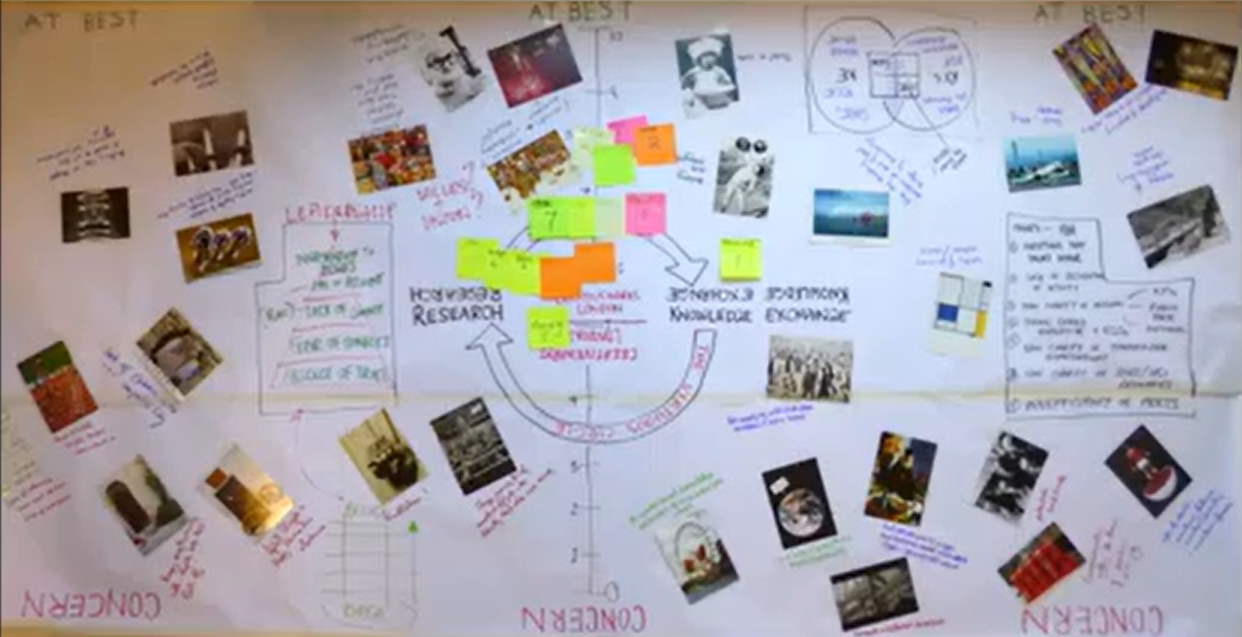
Collaging
I bring old magazines and give a group a short period of time to collect the images they’re drawn to before arranging them as they feel. For this, I recommend delivering the prompt or question after participants have found images they’re drawn to.
These are good for consolidating working definitions, as a mixed group will have honed different disciplinary ‘lenses’ or ways of seeing.
A prompt might be ‘collect images that represent sustainability or compassionate leadership’, or it might be a phrase such as ‘collect images that represent what success in this new interdisciplinary team might like’.
Digital collaging such as in Padlet
Nowadays, much interdisciplinary work is done in the online space where digital image collation works well. I’ve used this approach to help people refine their research questions, reflect on their PhD journey, and for vision casting.
Interactive drawing exercises
Cartoons and speech bubbles
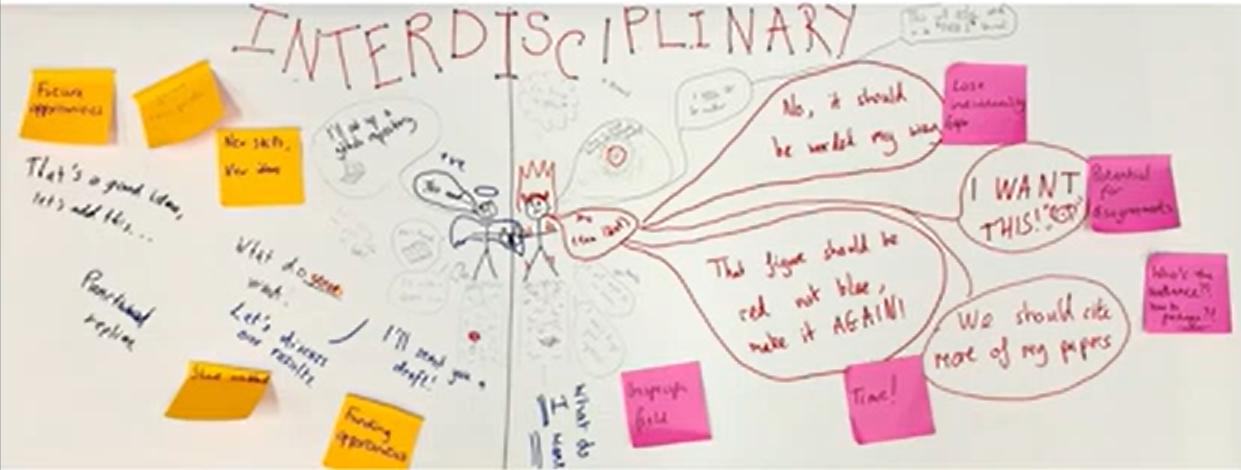
Another easy graphical facilitation approach is inviting people to draw stick figures with speech bubbles on a physical or digital white board.
These methods can surface otherwise unspoken dynamics of roles, boundaries, the implicit hierarchies and biases, using images.
Some care is needed here: it is helpful if you can use a tool that allows for people to remain anonymous.
Picturing the typical or ideal
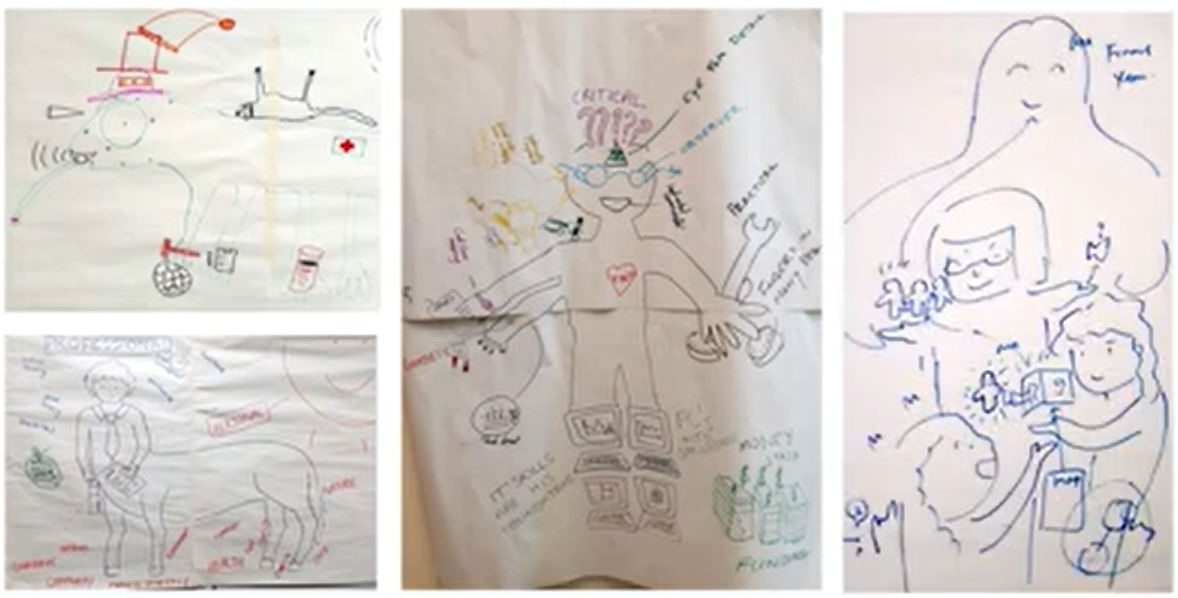
I asked Insight Series participants to create a quick cartoon drawing of their role or typical working week.
This is quite a nice way to start conversations. Visuals hold meta narratives and people can talk about whatever is most important to them as they describe what is happening in their cartoon.
Another prompt is to ask them about representing an ideal. For interdisciplinary research, you can ask people to “Draw their ideal leader or view of collaboration.”
More examples of graphical facilitation
Some other examples include are jigsaw pieces, Lego sculptures, flowcharts and diagrams. Another perspective is considering how the physical space can work as a three-dimensional ‘page’ for people to move about as part of individual and shared sense-making.
A newer strand of work, is inviting people to upload key emergent concepts from discussions to AI to generate an image. Again, this visualisation often opens up further conversation.
It isn’t about the visuals, it’s about making the space and time to have conversation around the visuals — whether that’s offering individuals the opportunity to discuss their creations, or for groups to share amongst themselves.
I have found that graphical facilitation is dynamic, invites meaning-making in the room and makes the experiences interesting and memorable. Another advantage is that these images can be readily shared on social media for dissemination of ideas.
For more, you can watch my Insight Series presentation in full:
[embed]
About Curie Scott
Curie Scott is a senior coach–facilitator and educator with a background spanning medicine, higher education, and the arts. Her work brings together organisational development, coaching, and creative, embodied approaches — including drawing‑as‑thinking — to support reflection and sense‑making in complex academic and professional contexts.
She is the co-author with Steve Hutchinson of Graphical Facilitation: Enabling Insight, Conversation and Learning (2024).
If you would like to find more Insights from this series, please visit our collection on Medium. For all future Insight Series sessions, please visit our collection on Eventbrite or connect with us via LinkedIn or Bluesky
메타데이터
- post_id
- fffaf68a807c
- slug
- using-graphic-facilitation-to-navigate-interdisciplinarity-fffaf68a807c
- url
- https://medium.com/horizons-institute/using-graphic-facilitation-to-navigate-interdisciplinarity-fffaf68a807c
- canonical_url
- https://medium.com/horizons-institute/using-graphic-facilitation-to-navigate-interdisciplinarity-fffaf68a807c
- author_url
- https://medium.com/@HorizonsLeeds
- status
- ok
- fetched_at
- 2026-06-27 18:20:27