Calculating Pressure At Different Flows
Here’s a quick tip of how to calculate pressure drop (or duct pressure) for different flow rates. These calculations could be useful in…
Calculating Pressure At Different Flows
Here’s a quick tip of how to calculate pressure drop (or duct pressure) for different flow rates. These calculations could be useful in several scenarios where we may want to determine what effect an existing duct system or filter will do at a different flow rate that it is currently running at. Learning this calculation may be faster than looking manufacturer’s specifications or perhaps they are unavailable.
Let’s start with the equation for calculating the pressure in a duct system at a different flow rate. It is as follows:
[embed]
Where:
Hn = New Pressure
Qn = New Flow
Q = Existing Flow
H = Existing Pressure
In order to use this calculation, you need to know a few things about the existing system. We need to know the existing duct pressure or pressure drop and the existing flow.
Let’s run through a given scenario, where we have a filter in a system that has an existing pressure drop of 0.23” at a flow of 1000 CFM. Now let’s say we want to see what the pressure drop of the filter would be at 1200 CFM.
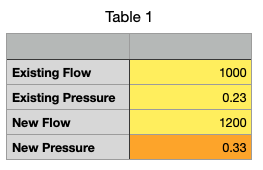
The table shows that if we were to increase the flow by only 200 CFM we would increase the pressure drop across the filter by 0.1”.
You could also graph the pressure drop of a filter over a range of flows. Such as in the picture below.

We can also rearrange the formula to solve for what flow we would need to have a desired pressure. For example, let’s say that we have an existing duct system that has an External Static Pressure of 1.125” and an existing flow of 1200 CFM. Perhaps it’s been eating EC Motors up and you want to know what flow rate would be required to have an External Static Pressure of 0.5”.
The equation to solve for a flow at a target pressure is as follows:
[embed]
Where:

Qn = Flow at given pressure
Q = Existing flow
H = Existing pressure
Hn = Target pressure
So we would have to drop the flow by 400 CFM in order to achieve a target External Static Pressure of 0.5”
I hope that these calculations may help technicians and designers in the field who need to make some assumptions of the performance of either existing duct / fittings or how upgrades may change the system performance.
메타데이터
- post_id
- fffcae71efb7
- slug
- calculating-pressure-at-different-flows-fffcae71efb7
- url
- https://medium.com/@michaelhoush/calculating-pressure-at-different-flows-fffcae71efb7
- canonical_url
- https://medium.com/@michaelhoush/calculating-pressure-at-different-flows-fffcae71efb7
- author_url
- https://medium.com/@michaelhoush
- status
- ok
- fetched_at
- 2026-07-18 17:48:23