INTMD — The Mario Game I’ve waited 32 years for
Super Mario Bros. Wonder — The Review
INTMD — The Best 2D Mario in Decades has Arrived
Super Mario Bros. Wonder — A Review Session
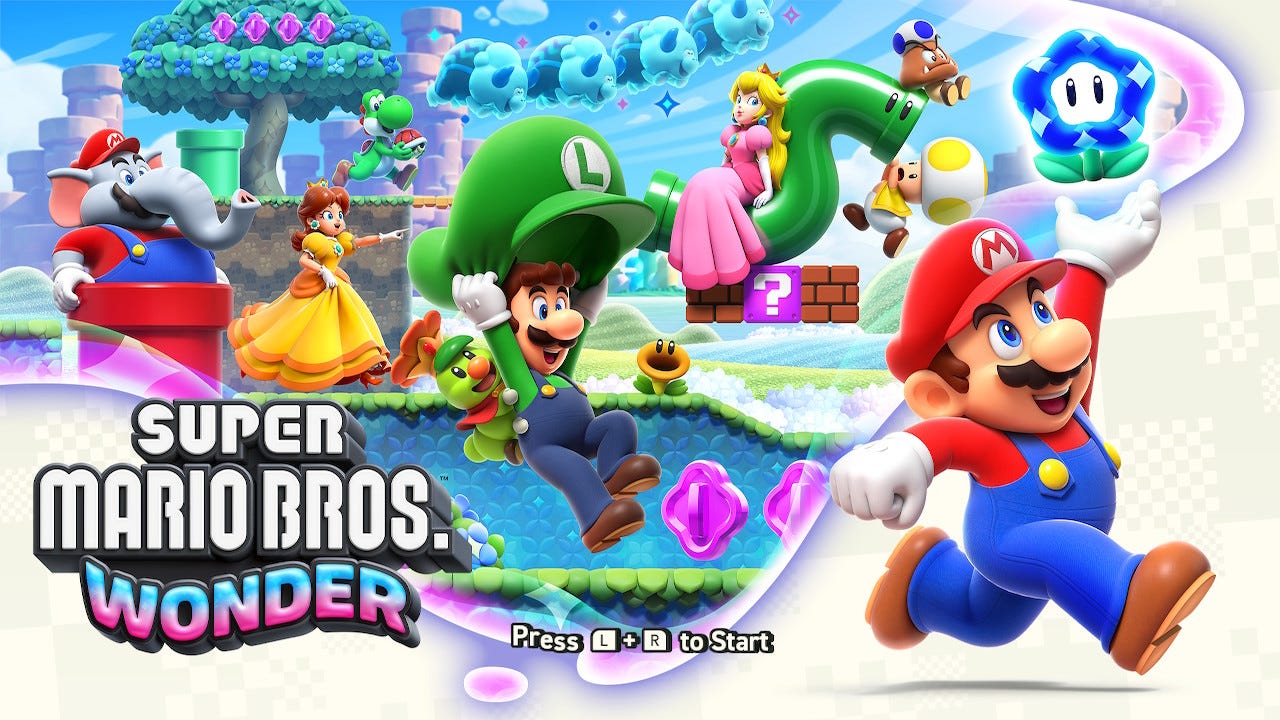
Oh boy oh boy oh boy oh boy
In 1990, my dad brought home a Nintendo Entertainment System, with Super Mario Bros. and Duck Hunt included, for $100. I remember watching my dad play and I fell in love with it. I also remember being told to go back to bed when I came down the hallway later that night, entranced by the notes of the Underground theme for the very first time.
The joy I felt back then, the excitement, the fascination and whimsy, is precisely what Nintendo tapped into with the release of “Super Mario Bros. Wonder”. I’ve been enthralled with the Mario franchise nearly my entire life. “Wonder” not only understood and respected that enthrallment, it innovated in ways to bring that joy to a whole new generation of gamers, and remind us older gamers what makes Nintendo shine as a developer.
[embed]This launch trailer generated enough power for a four-month-long hype machine.
After playing it to 99.9% completion, I can say that this is the 2D Mario Platformer I’ve been waiting for since 1991. “Super Mario Bros. Wonder” is on the same level as the original four Super Mario Bros. games. This is not just a glowing critique, it’s celebrating the return to form of Mario as an innovative platforming franchise.
Friday, October 20th, 2023 was the game’s worldwide launch date, and thanks to a tip from my friend Seth, I was able to snag a copy of the game and a set of trading cards for $7 off the retail price ($60).
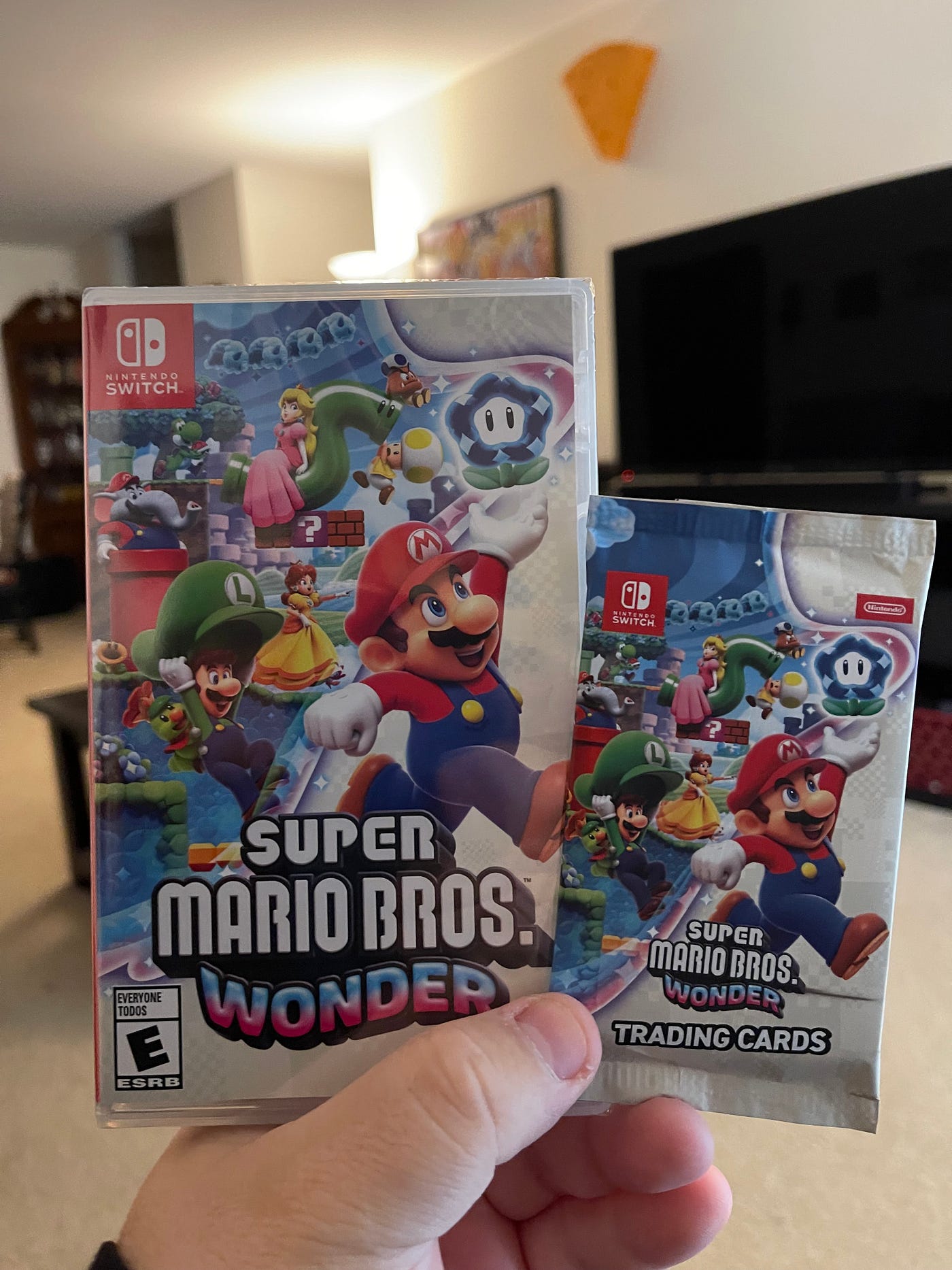
Another addition to the Curio Cabinet, these trading cards be. I’m told there might be a rare card in there, but I’ll never know!
The game starts off with a plot as expected as any other: Mario and his friends are visiting the Flower Kingdom, a neighboring kingdom to Peach’s Mushroom Kingdom. Here, the citizens cultivate “Wonder Flowers,” magical items that are able to warp reality when touched.
Apparently, Bowser got wind of the flower power and came to take it for himself. In a twist from the usual “Bowser gets a big powerup and Mario chases him across each and every land,” Bowser uses the Wonder Flower to merge with the Flower Castle, becoming a floating sentient fortress. Content with his near-invulnerable form, Castle Bowser effs off to the middle of the world map, forces all the citizens (Popplins) into a stay-at-home order by locking them up, and chills for nearly the rest of the game.

“I can’t believe he turned into a pickle like that. It … it’s just the funniest shit I’ve ever seen!”
The plot twist of Bowser borrowing a “One Piece” character’s powers is certainly a welcome change from, “Let’s kidnap Princess Peach again,” but that subversion is a mere footnote in what makes this game compelling.
Let’s start with the art design. Gamers are well aware that the Nintendo Switch is running on hardware designed in 2015, which means that anything ambitiously designed is going to suffer in terms of performance. So what can Nintendo do? They can do this:

It looks especially beautiful on an OLED screen.
Look at that wide range of colors. It’s not just the basic colors of red, blue, green, purple, and white, it’s all the colors in between. There’s effective use of sunbeams illuminating the green fields. Some of the fields even seem to have lawnmower tracks. The cliff faces feature a cross-stitch pattern of X’s. There is so much vibrant detail happening in this screenshot alone, and we haven’t even started a dang level. But look at this world map!
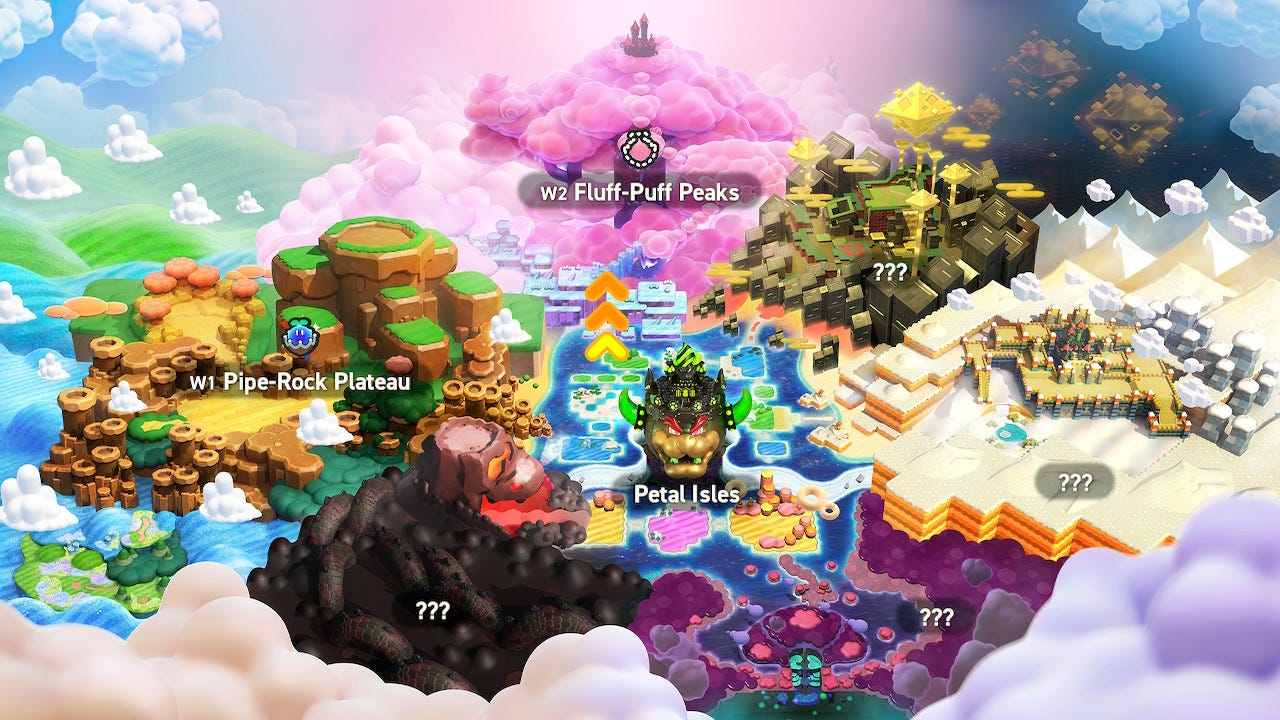
Linear? Never heard of ‘er.
The levels themselves feature distinct backgrounds that parallax scroll, which is reminiscent of the Acorn Plains level of New Super Mario Bros. U. But here in “Wonder,” these backgrounds are alive. Water glistens in the sunlight in the distant bays. Lifelike cirrus and nimbus cloud formations move at different heights in the atmosphere.
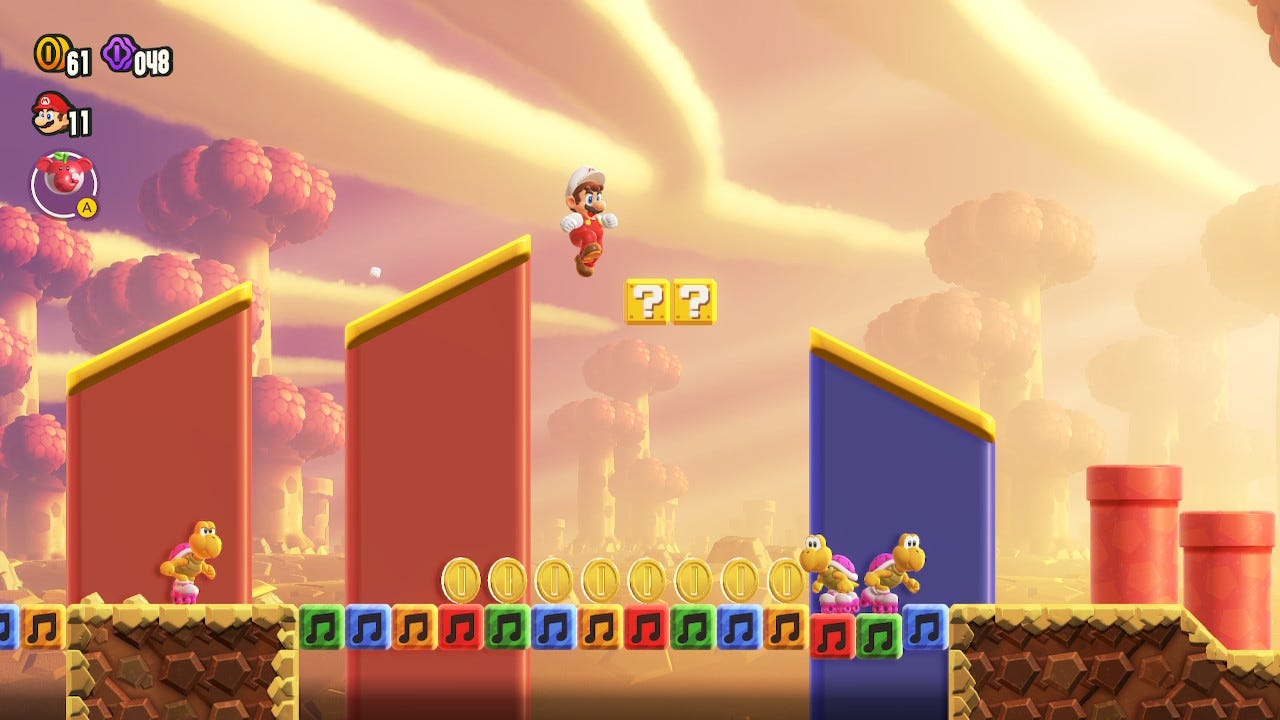
Some Koopa Troopas Roller Derby in this game. Somewhere, Hollys Hooks is pleased.
Leaves blow across the sky, sunlight pokes through the trees of a lush forest. Add the aforementioned deep color hues, and you feel as though you’re watching Nintendo scoff at the idea of HDR photography and choose to program it themselves. I don’t have enough adjectives to describe how beautiful this looks.
So let’s talk about the animation of the characters instead.
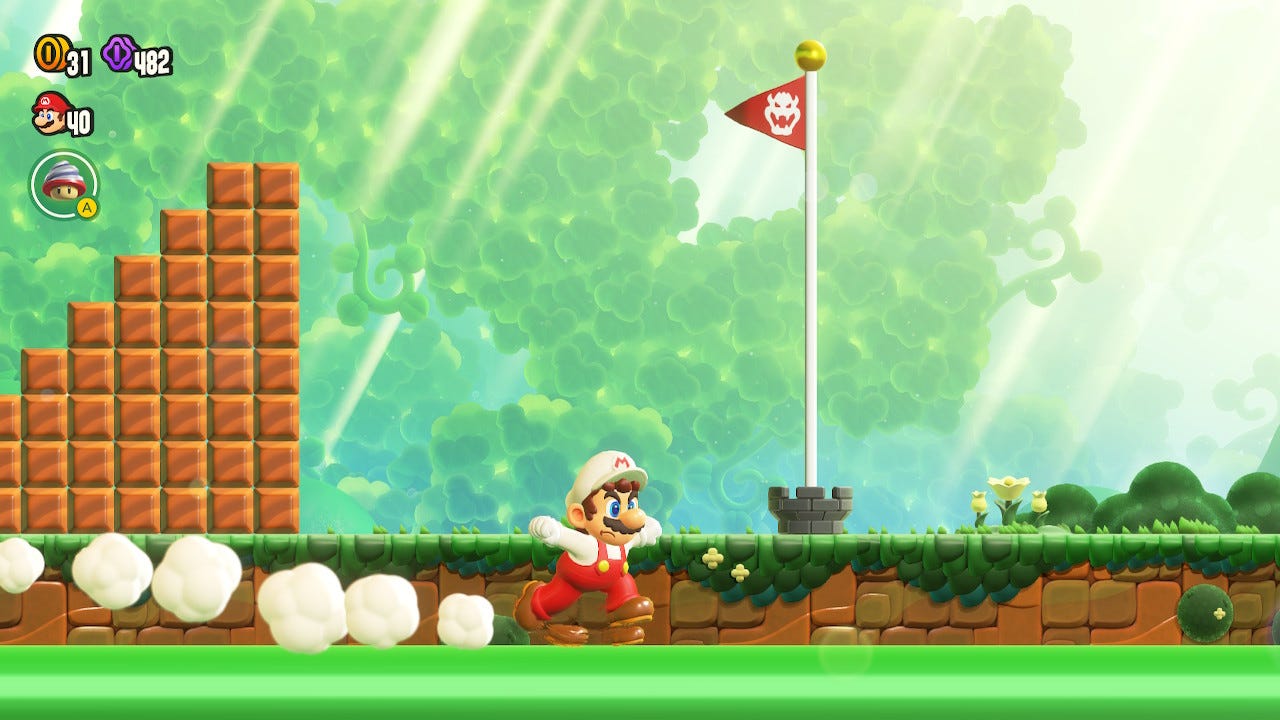
Look at that run animation with the partial shoes. Delightfully cartoonish, and purposely so.
You can play as Mario, Luigi, Peach, Daisy (her first mainline appearance in a Mario platform), Toad, Toadette, Yoshi, or Nabbit. Each character was given the benefit of Nintendo’s entire animation budget. Instead of standing perpendicular to the player, like in the New Super Mario Bros. series, characters stand at an angle towards the player, like in Super Mario Bros. 2, 3, and World. When Mario runs, his cap floats a little bit off of his head and he sports a determined look on his face. As you run with any character, you kick up a cloud of dust. If you reach the end of a platform, your character wobbles cautiously so as not to tip over.
As enemies approach Mario and the gang, the enemies come to life as well. A Goomba will gnash their teeth and attack you if you get too close. If you stomp a Goomba, a nearby Goomba will react with horror. A Koopa Troopa will narrow their eyes at you. When Koopa Troopas walk around and walk into each other, they playfully bump shells and walk in the other direction. These little things bring a level of life to characters both playable and non-playable that we haven’t really appreciated since The Wind Waker started it.
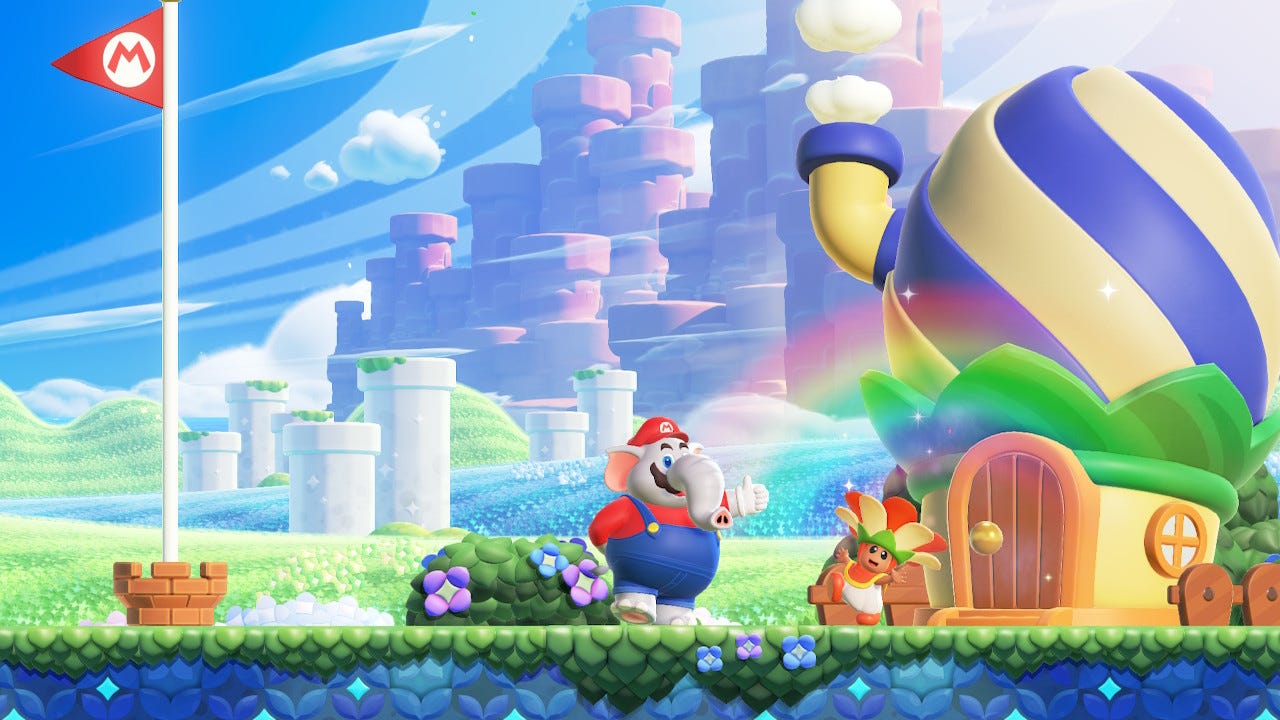
If you do things just right at the end of a level, the Popplins will bloom their flower-head thingies and show a rainbow! It’s so friggin’ delightful!
“Wonder” features several power-ups to help you along. Besides the usual Mushroom and Fire Flower, there are several new items:
- Elephant Fruit — Transforms you into an elephant, capable of destroying bricks and enemies with your trunk, and storing water.
- Bubble Flower — Gives you the ability to throw bubbles that trap enemies, or allow you to bounce on them as a platform.
- Drill Mushroom — Allows you to burrow into the ground (or the ceiling), avoiding enemies or traversing areas you couldn’t before. Also allows you to attack enemies that drop down from above.
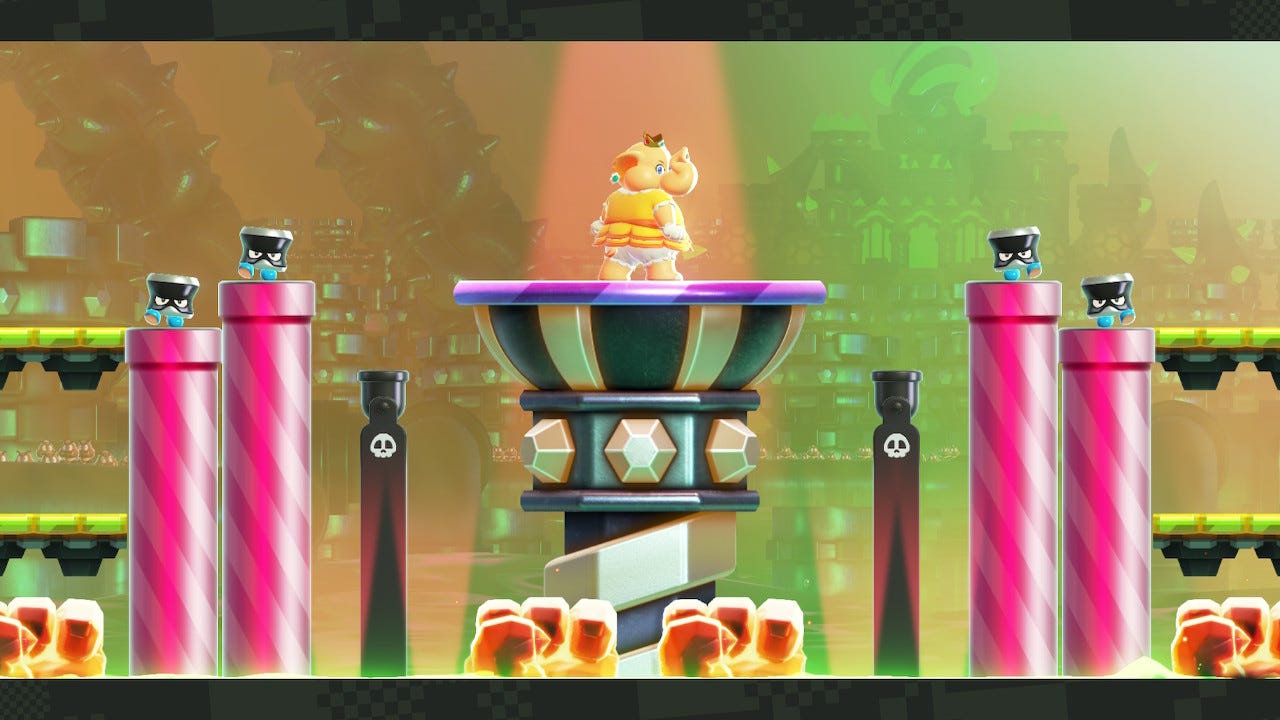
Welcome to Elephant Daisy: The Eras Tour.
You’re allowed to hold onto one powerup as a reserve, like in “Super Mario World,” and it only deploys if you choose to use it, unlike how it automatically drops in “Super Mario World” if you take a hit.
The greatest strength of the game is definitely the creativity used in the level designs, which are enhanced by the reality-altering properties of the Wonder Flower. When you touch a Wonder Flower, a reality-warping sequence begins, and the only way you can end it is either by finding a Wonder Seed or finishing the level.
The developers went all-out in creativity for the Wonder Flower portions of the game, and there’s a sequence in every single level. Without spoiling much of the game, here’s a short-list of the types of challenges you can expect to find in literally any of the levels of the game:
- Pipes come alive and inch along like inchworms.
- You ride a stampede of wild animals.
- Your character’s perspective changes and they walk on the background, top-down style.
- Racing against the clock as invincibility stars rain down from the sky, allowing you to take down a myriad of enemies.
- Transforming into creatures and figuring out how to control them
- Riding a resurrected dragon through lava.
Yes, you read that last one correctly.

Hang on, I’m in my Falcor era.
When it comes to enemies, the Rogue’s Gallery has been fairly stagnant since the release of “New Super Mario Bros.” in 2006. In “Wonder,” there’s a dizzying array of new enemies to fight, along with a respectable amount of seasoned baddies like Goombas and Koopa Troopas. There are birds who dive into the water to steal coins you’d otherwise collect. There are creatures who, upon seeing you, mimic your jumps, or chase after you like a heat-seeking missile. If you are expecting familiarity in enemies, you’re not going to find much of it here.
Outside of the regular levels, there’s also themed levels:
- “Break Time” has you solve a basic puzzle.
- “Item Search” has you solve a more advanced puzzle.
- “KO Arena” has you face a gauntlet of enemies.
- “Wiggler Race” has you literally racing a Wiggler who wears roller skates, and boy howdy are they speedy.
All of these additions make for incredibly creative combinations of level design, but also done in a way that is accessible to gamers of all experiences.
Each level features a star system for Difficulty, ranging from one star (easy) to five stars (dear god WHY). As a seasoned gamer, I was able to handle one-through-four stars no problem, but my first five-star level sent me reeling with anxiety and dread. I’ve completed every level in this game save for the very last stage. Guess I have to “git gud” to consider myself a true Power Player.
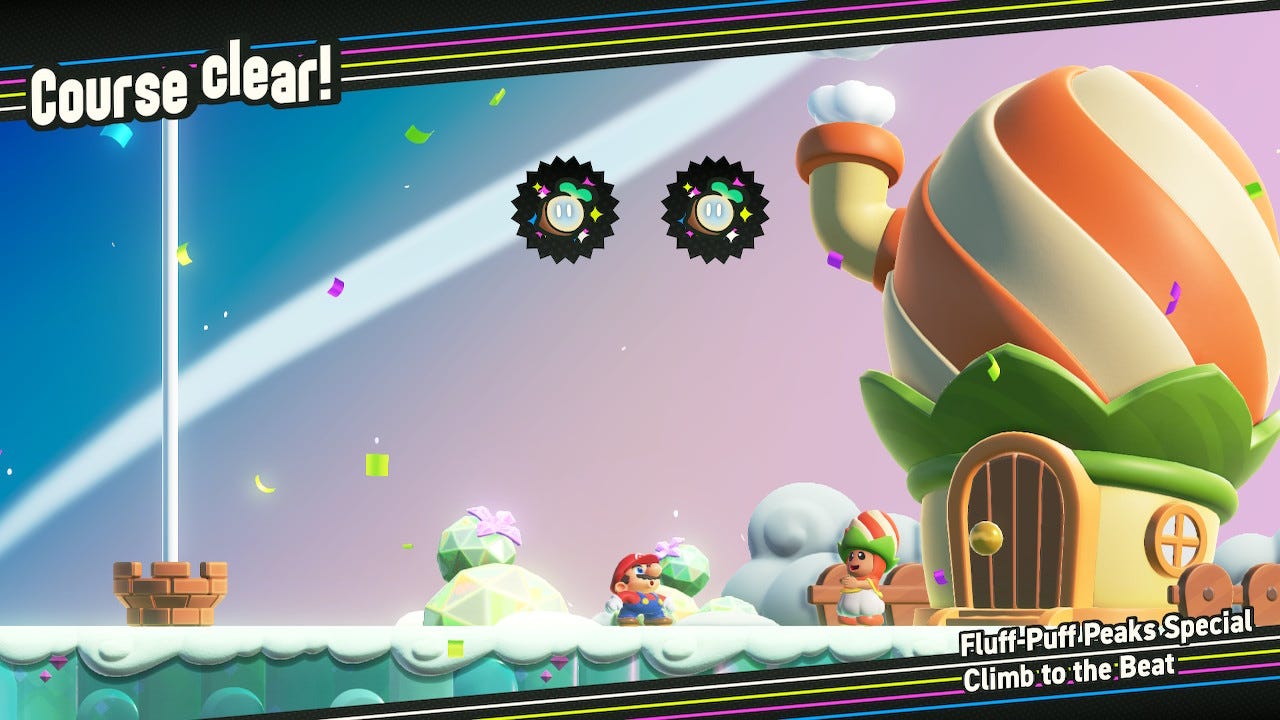
I posit that “Fluff-Puff Peaks Special — Climb to the Beat” is the second-hardest level in the game. I died 20 times trying to 100% complete it. I haven’t beaten the hardest level yet. The death count is still climbing.
Each level features at least two Wonder Seeds to collect (with a rare option for a third based on a second/secret exit), three purple coins, and a requirement to end the level by hitting the top of the flagpole.
Purple coins, known as Flower Coins, are the Flower Kingdom’s currency for spending at shops throughout the game. You can buy Standees or Badges, as well as 1up Mushrooms.
But I know what you’re thinking — “Grizzz, you haven’t said anything about Standees or Badges!” This game just keeps providing with even more content that I haven’t had a chance to explain.
Badges add an extra layer of fun added to levels throughout the game, as they provide an enhancement of some sort during the level. You can wear one badge at a time, and if you die midway through, you can swap badges if you want. Their enhancements range from turning your hat into a parachute, to executing higher jumps, to attaching to walls with a Grappling Hook (more like a Vine, really), attracting coins to you if you’re in their presence, and tons more.
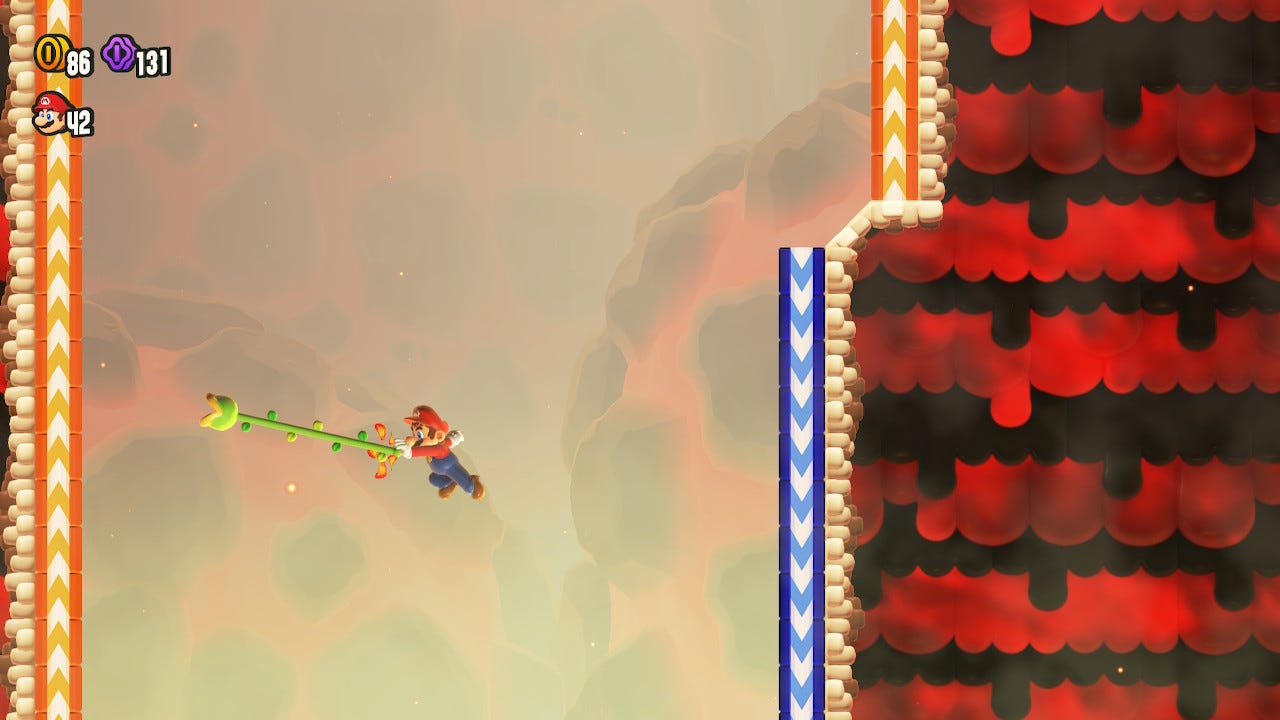
It really makes you feel like Spider-Man.
As for the Standees — admittedly, I didn’t use a single one in the game.
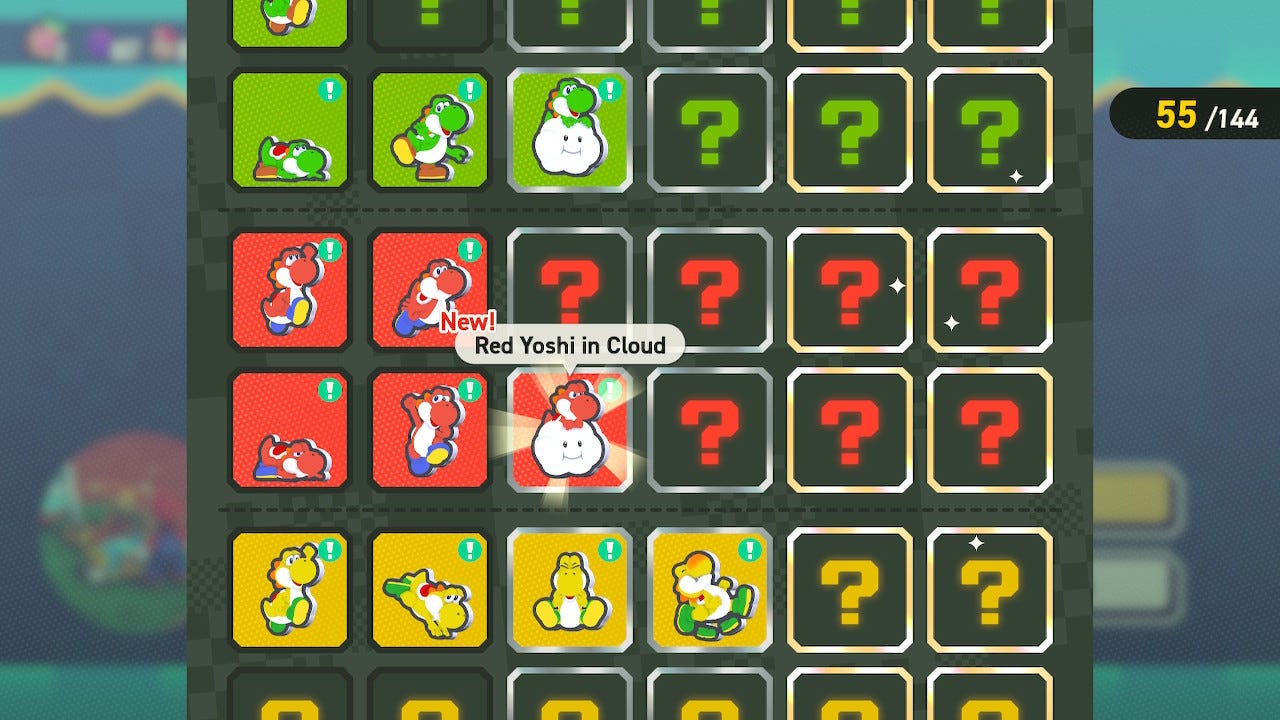
However, there are 114 standees, and you better believe I collected all 144 of them.
Standees are used as part of the online portion of “Super Mario Bros. Wonder,” which I haven’t played with just yet. While “Wonder” does not feature online co-op (only local co-op), it opts for a “Player vs. Environment” aspect where you can see the shadows of other players traversing the level in real time, an aspect made popular in the Dark Souls series of games.
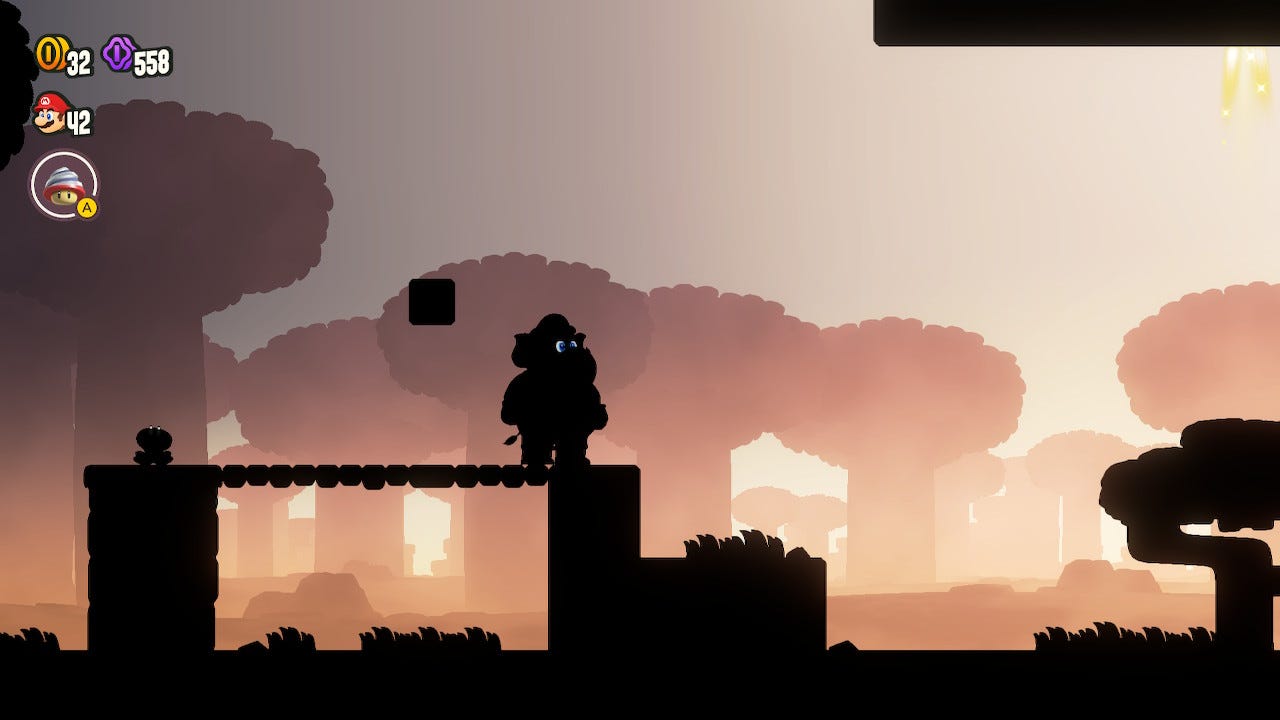
Note: This particular level design is dark. Not dark like Dark Souls, just regular type dark.
You can place a standee anywhere in a level. Part of it is more or less a “Kilroy was here” moment, but in the online mode, if you (or other players) die, they can touch the standee to come back to life instead of having to start the level over. This allows other players the ability to get past difficult/impassable parts of levels if needed.
With all this talk of what’s visually present in the game, it’s time to discuss what this game brings from an audio perspective. Throughout your adventure, you’ll encounter “Talking Flowers,” which very much live up to their names. They provide little quips, observational humor, and sometimes offer hints if you missed something. They’ll also commend you if you accomplish a particularly difficult platforming trick. I found them charming, but if constant yammering isn’t your thing, you can opt to either turn off their voices, change their voices to another language, turn off the text that appears, or turn everything off entirely.
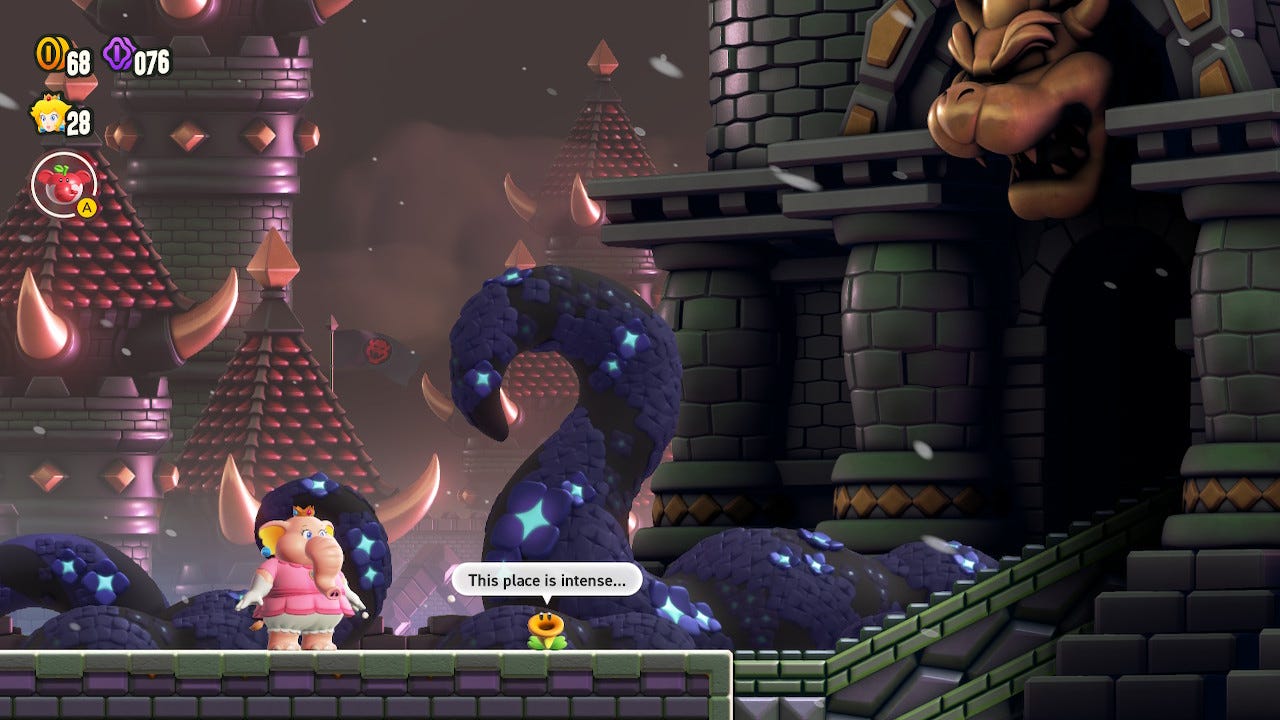
“Intense”? Bruh, I’m getting strong Zelda II dungeon vibes here
“Wonder” also saw the debut of Kevin Afghani as the new voice of Mario, replacing the legendary Charles Martinet after a 25-year career, along with a slew of new actors.
Admittedly the new actors take some getting-used-to. They’re doing a bit of the impressions of the previous voice actors, but adding their own little style. Mario has deeper inflections in his voice clips. In a way, it makes him sound less like the Mario we’ve known, but it doesn’t feel wholly foreign.
As for the music of the game, Nintendo once again delivers on a delightfully original soundtrack. And much like how “Super Mario World” would add a bongo track whenever you rode Yoshi, “Wonder” adds a horn when you have the Elephant power-up.
The game’s first track is especially delightful in capturing a nostalgic essence, but the new Underground theme, well … it’s composed like the rent was due:
[embed]Koji Kondo and crew, you did NOT need to go this hard (but I am grateful).
With all that’s great about this game, are there any downsides? Well, there are two things.
1. Despite having a wide variety of characters, they all play the exact same.
In previous Mario titles, Luigi could jump a little higher, and flutter-kick his way back down to the ground. Toad ran faster. Peach could float. None of these enhancements exist for any individual character, save for Yoshi and Nabbit. Those two can’t take damage, but they can’t use power-ups, either. They’re great for the least-experienced gamers wanting to just have a good time, and we certainly have the badge system to allow anyone to have such enhancements. Maybe Nintendo saw character quirks to be superfluous given all the varieties of platforming in this game. I have to say though, I miss Peach’s float ability.
2. Once in a great while, you’ll get stuck on a puzzle.
One stage in particular had me scratching my head for a good 30 minutes before giving up and consulting a walkthrough. To not give away what I had to do, let’s just say that there was a stage with a particular puzzle, implying that I had to solve whatever that puzzle was, when the reality was that it was a red herring for the real solution not far away. It felt cheap, especially since the rest of the level used puzzles much differently. In order to find everything in this game, sometimes you have to be willing to literally try everything. I don’t agree with “brute-forcing” as an effective method to solving a puzzle when clues are meant to be given out.
Even with these two blemishes, if the launch trailer wasn’t enough to sway you — the level and enemy designs, the orchestral score, the power-up and Wonder Flower mechanics, the badges, the online co-op, and new voice cast all confirm that Nintendo has overwhelmingly embraced change with the Super Mario Bros. franchise. They embrace that change in a way that looks back at what made their original games so iconic in the first place.
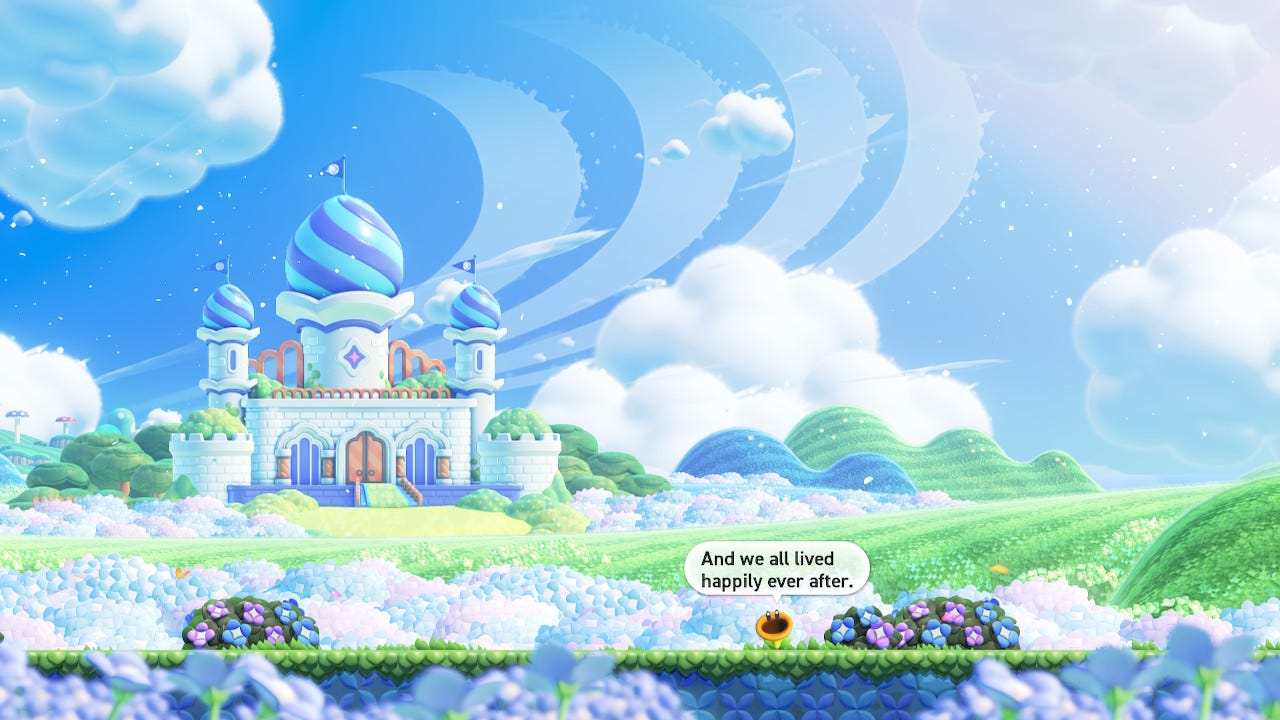
I’ll be back.
If this is the new direction we can expect with 2D Mario games, I’m here for it. I look forward to playing “Wonder” again with Online Mode turned on. And again with local co-op.
메타데이터
- post_id
- ffffc386b649
- slug
- intmd-the-mario-game-ive-waited-32-years-for-ffffc386b649
- url
- https://whileromeburns.net/intmd-the-mario-game-ive-waited-32-years-for-ffffc386b649
- canonical_url
- https://whileromeburns.net/intmd-the-mario-game-ive-waited-32-years-for-ffffc386b649
- author_url
- https://medium.com/@grizzz
- status
- ok
- fetched_at
- 2026-07-24 21:36:43