Who lived in Britain before the Anglo-Saxons?
The history of Britain is a story of successive migrations, mixing and cultural transformation.
Who lived in Britain before the Anglo-Saxons?
The history of Britain is a story of successive migrations, mixing and cultural transformation.
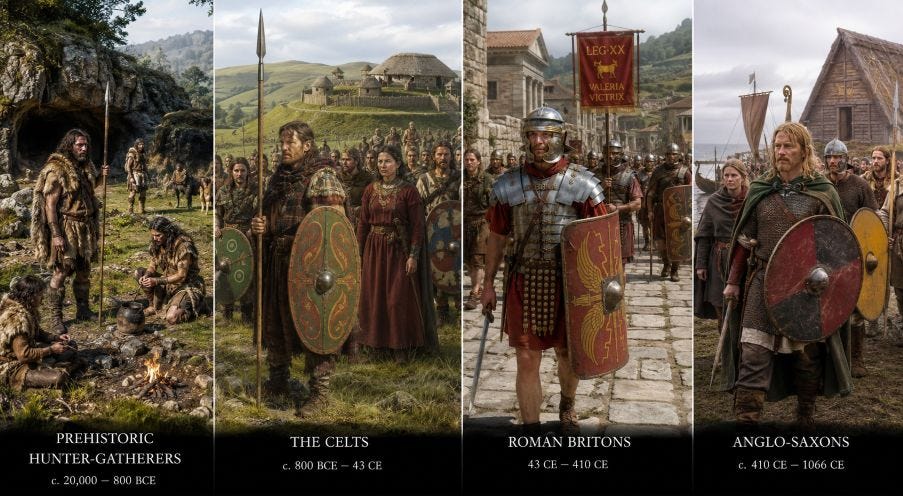
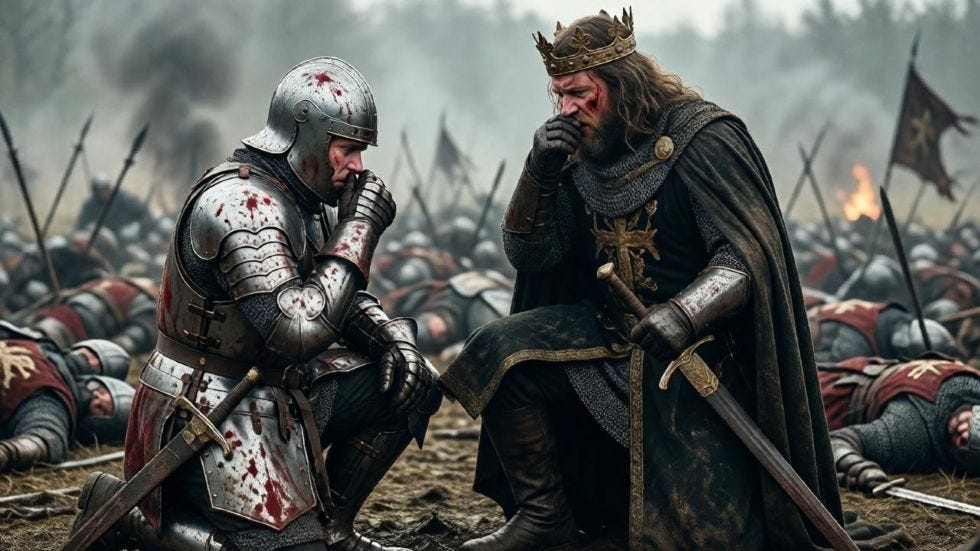
Generated with AI to illustrate the story.
In response to my story about how the Saxons ended up in Britain, one reader asked who inhabited Britain before them? Another wondered why they were called commonly Anglo-Saxons.
The answers are both straightforward and surprisingly complex, because Britain’s history illustrates a much larger truth: peoples are never static. Human populations have always been moving, mixing, merging and changing. This happens even today.
Therefore, we must accept that migration has never been an exception in human history; it is the rule. Sometimes it slows down, sometimes it accelerates, but it never truly stops.
Once this mindset is in place, we can begin.

Immediately before the arrival of the Anglo-Saxons in the fifth century, Britain was inhabited primarily by the Romano-Britons — the descendants of Celtic-speaking Britons who had lived under Roman rule for nearly four centuries.
They were joined by smaller populations of Roman settlers and their descendants, while northern Britain was inhabited by groups such as the Picts, and western Britain and Ireland by the Gaels.
Then, after the collapse of Roman authority around 410 CE, new migrants began arriving from across the North Sea. They were not a single people but several Germanic groups, chiefly the Angles, Saxons, and Jutes, with smaller numbers of Frisians.
The term Anglo-Saxon is actually a later label used to describe the culture and kingdoms that emerged from these migrations. The Angles originated in a region called Angeln, in what is now northern Germany, near the Danish border.
In fact, the name England comes from Engla land — the “land of the Angles.”

Stonehenge, a prehistoric stone monument on the Salisbury Plain in southern England. It was was constructed in stages between roughly 3000 BC and 1600 BC.
The Angles established kingdoms such as Northumbria, Mercia, and East Anglia, while the Saxons gave their names to Wessex, Essex, and Sussex.
For a long time, historians believed these Germanic newcomers almost completely displaced the native Britons. Modern archaeology and ancient DNA paint a far more complicated picture.
There was certainly substantial migration and, in some regions, considerable population replacement. But many Britons remained and gradually assimilated into the new Anglo-Saxon societies. The proportions varied greatly from one region to another.
In other words, the English did not simply replace one people with another. They emerged from the interaction and blending of several populations over centuries.
But who were the Britons themselves?
Long before the Anglo-Saxons arrived, Britain had already experienced multiple waves of migration.
During the Roman period, beginning in 43 CE, Britain became one of the empire’s provinces. The Romans built towns, roads, and forts, but most of the population remained native Britons. The empire also brought people from every corner of its vast territory, including settlers and soldiers from Gaul, Germany, Syria, and North Africa.

Remains of a fortified Celtic settlement in Dorset, England.
Before the Romans came, Iron Age Britain was inhabited by numerous Celtic-speaking tribes collectively known as the Britons, among them the Catuvellauni, Iceni, and Brigantes. Yet even the word “Celtic” describes primarily a language and a culture, not a single race or ethnicity.
Go back further and another migration reshaped the islands.
Around 2500 BC, people associated with the Bell Beaker culture arrived in Britain from continental Europe. Ancient DNA studies suggest they replaced a large proportion of the earlier population over several centuries. They brought metalworking, new burial customs, and perhaps the Indo-European languages that would later develop into the Celtic languages of Britain.
And before them came the first farmers.
Around 4000 BC, agricultural communities reached Britain from continental Europe. Genetic evidence indicates that many of these farmers descended from populations originating in Anatolia, modern-day Turkey. They introduced farming, domesticated animals, and the monumental stone structures that still define Britain’s prehistoric landscape.

And even before the farmers there were the hunter-gatherers who repopulated Britain after the last Ice Age around 11,000 BC.
Earlier still, during warmer periods of the Ice Age, Britain was inhabited by Neanderthals and even earlier human species such as Homo heidelbergensis. Modern humans, Homo sapiens, arrived around 40,000 to 45,000 years ago.
The deeper we look into Britain’s past, the harder it becomes to speak of any population as a pure, unchanged people.
In fact, human societies have been mixing since the dawn of humanity. Prehistoric communities exchanged men, women, and children for many reasons: to avoid inbreeding, create alliances, replace lost members, secure economic cooperation, and sometimes through warfare and captivity.
From an evolutionary perspective, these exchanges increased genetic diversity, reduced conflict, spread ideas and technologies, and improved the chances of survival during times of crisis.
Britain’s history is therefore not the story of one people replacing another in neat succession. It is the story of layer upon layer of migrations, assimilations and cultural transformations.

The Anglo-Saxons were once newcomers. So were the Romans. So were the Celtic-speaking Britons, the Bell Beaker people, and the first farmers.
Interestingly, Britain’s modern demographic landscape mirrors its long history. Just as the islands absorbed prehistoric farmers, Celts, Romans, Anglo-Saxons, Vikings, and Normans, modern Britain has been reshaped by successive migrations from Europe (Irish people, Poles, Romanians), Asia (Indians, Pakistanis, Bangladeshis, Chinese), Africa (Nigerians, Somalis, Ghanians), the Caribbean, and elsewhere.
The country’s population today is another layer in a long continuum of migration and mixing that stretches back thousands of years.
Britain’s genealogy is a testament to humanity’s endless journeys and encounters.
The lesson is simple: modern nations and identities are real, but they are the products of countless migrations and mixtures accumulated over thousands of years. None of us are entirely what we are called today.
We are, in large part, the sum of many journeys that came before us. I hope this historic account clarifies the issue.
If you’ve ever found comfort in my words, and if you have a little to spare, I’d be so grateful for your support — through BuyMeCoffee. Every small gesture helps more than you know. No pressure, just deep appreciation.
References and sources:
· Gretzinger, J. et al. (2022), The Anglo-Saxon migration and the formation of the early English gene pool. Nature 610, 112–119. DOI: 10.1038/s41586–022–05247–2
· Martiniano, R. et al. (2016),* Genomic signals of migration and continuity in Britain before the Anglo-Saxons. *Nature Communications 7:10326. DOI: 10.1038/ncomms10326
· Schiffels, S. et al. (2016),* Iron Age and Anglo-Saxon genomes from East England reveal British migration history. *Nature Communications 7:10408. DOI: 10.1038/ncomms10408
· Leach, S. et al. (2009), Migration and diversity in Roman Britain: A multidisciplinary approach to the identification of immigrants in Roman York, England. American Journal of Physical Anthropology 140(3), 546–561.
· Eckardt, H. (2010), Roman Diasporas: Archaeological Approaches to Mobility and Diversity in the Roman Empire. Journal of Roman Archaeology Supplementary Series.
· Cunliffe, B. (2010), Celtic from the West: Alternative Perspectives from Archaeology, Genetics, Language and Literature. Oxbow Books.
· Olalde, I. et al. (2018), The Beaker phenomenon and the genomic transformation of northwest Europe. Nature 555, 190–196. DOI: 10.1038/nature25738
· Haak, W. et al. (2015), Massive migration from the steppe was a source for Indo-European languages in Europe. Nature 522, 207–211.
· Brace, S. et al. (2019), Ancient genomes indicate population replacement in Early Neolithic Britain. Nature Ecology & Evolution 3, 765–771.
· Hofmanová, Z. et al. (2016), Early farmers from across Europe directly descended from Neolithic Aegeans. Proceedings of the National Academy of Sciences (PNAS) 113(25), 6886–6891.
메타데이터
- post_id
- 112e813e6094
- slug
- who-lived-in-britain-before-the-anglo-saxons-112e813e6094
- url
- https://medium.com/readers-club/who-lived-in-britain-before-the-anglo-saxons-112e813e6094
- canonical_url
- https://medium.com/readers-club/who-lived-in-britain-before-the-anglo-saxons-112e813e6094
- author_url
- https://medium.com/@sensmedia.srl
- status
- ok
- fetched_at
- 2026-07-15 02:34:55