What are units and measurements in physics, and why are they important?
Understanding the foundations of accurate scientific observation and calculation
What are units and measurements in physics, and why are they important?
Understanding the foundations of accurate scientific observation and calculation

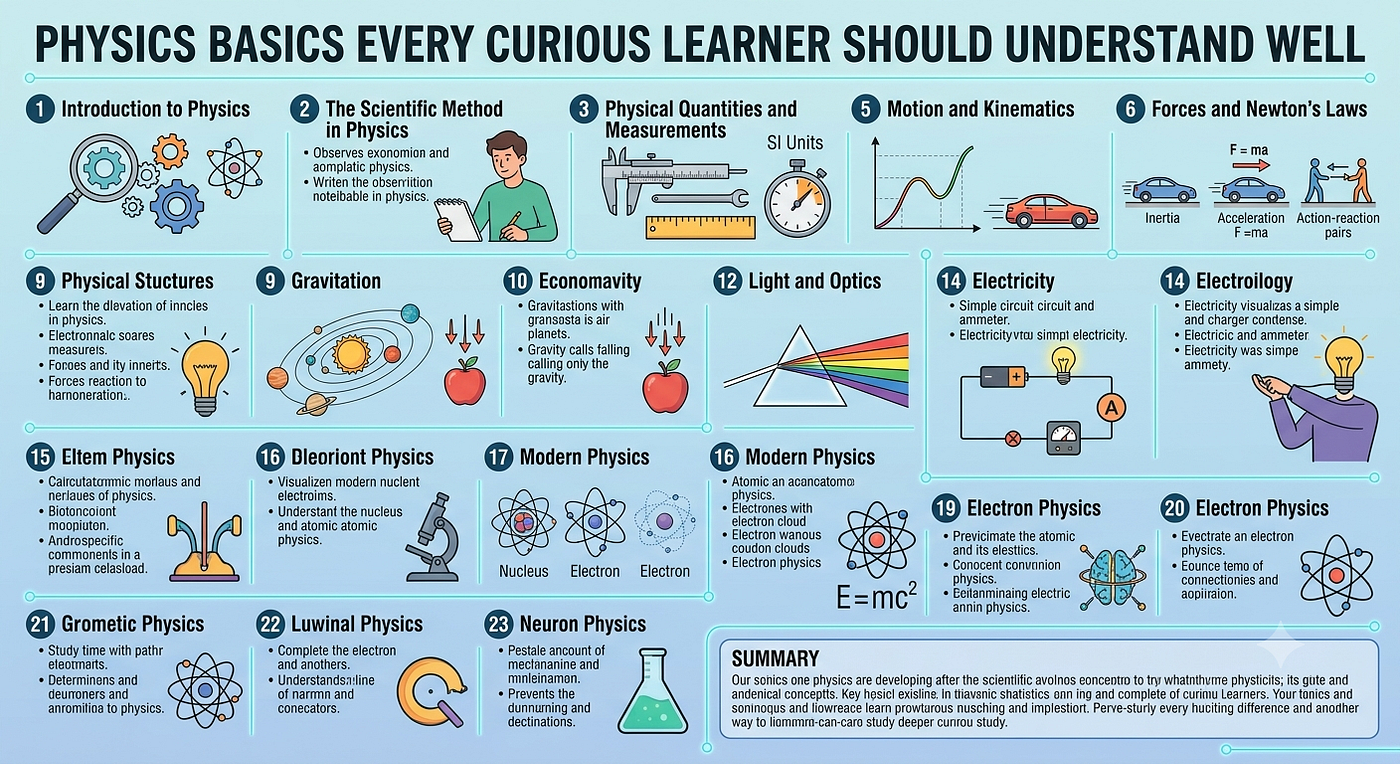
A detailed visual summary explaining the basic concepts of units and measurement in physics, including the seven SI base units, common instruments, and the importance of scientific accuracy.
Physics is the branch of science that studies matter, energy, motion, forces, and the fundamental laws that govern the universe. To accurately understand and describe natural phenomena, physicists rely on measurements and standardized units. Measurement is the process of comparing an unknown quantity to a known standard, and the unit serves as an accepted reference for that comparison. Without standardized units and measurements, scientific observations would be inconsistent and difficult to communicate. They form the foundation for experimentation, calculations, and technological progress, ensuring accuracy, reliability, and uniformity in scientific research, engineering, medicine, and everyday life around the world.
What Is Measurement in Physics?
Measurement in physics is the process of determining the magnitude of a physical quantity by comparing it with a recognized standard unit. This allows scientists to describe and analyze natural phenomena in an accurate and numerical way. Every measurement has two parts: a numerical value and a unit. For example, when we say that a table is 2 meters long, the number ‘2’ indicates the magnitude, while ‘meter’ is the unit used for comparison.
Measurement is necessary because it converts observations into reliable information that can be tested, compared, and communicated universally. Physical quantities such as length, mass, time, temperature, force, and energy can only be studied accurately when they are measured using appropriate instruments and standard units. Common measuring instruments include tape measures, measuring tapes, stopwatches, thermometers, and electronic sensors.
Measurement in physics can be direct or indirect. A direct measurement is obtained directly by an instrument, such as measuring the length of an object with a measuring tape. Indirect measurements are made using mathematical relationships between the measured quantities, such as determining velocity by dividing distance by time.
Accurate measurements are fundamental to scientific experiments, engineering design, technological innovation, and everyday tasks. They ensure consistency, reduce errors, and allow scientists around the world to verify their findings and advance our understanding of the physical universe.
What Are Units in Physics?
Units in physics are standardized quantities that are used as a reference for measuring physical properties such as length, mass, time, temperature, and electric current. They provide a common language that allows scientists, engineers, and researchers around the world to communicate measurements accurately and consistently. Without units, numerical values would have little meaning, because there would be no standard for comparison.
Every measurement in physics has a numerical value and a unit. For example, in the measurement “5 meters”, the number “5” represents the magnitude of the quantity, while “meter” is the unit used to measure length. Units ensure that measurements are clear, repeatable, and universally understandable.
To maintain global consistency, physics primarily uses the International System of Units (SI), which is based on seven base units: the meter (m) for length, the kilogram (kg) for mass, the second (s) for time, the ampere (A) for electric current, the kelvin (K) for temperature, the mole (mol) for the amount of substance, and the candela (cd) for luminous intensity.
In addition to these base units, many physical quantities are expressed using derived units. For example, velocity is measured in meters per second (m/s), force is measured in newtons (N), and energy is measured in joules (J). Units are essential for scientific calculations, experiments, technological development, and the accurate communication of physical measurements around the world.
History and Evolution of Measurement Systems
The history and evolution of measurement systems reflect humanity’s ongoing efforts to accurately measure and understand the physical world. In ancient cultures, measurements were often based on parts of the human body, such as feet, handspans, arm lengths, and strides. While these methods were convenient, they lacked consistency, as measurements varied from person to person and from region to region.
As trade, construction, and scientific work expanded, the need for standardized measurement systems became increasingly important. The ancient Egyptians, Mesopotamians, Greeks, and Romans developed more organized measurement systems, but regional differences still posed challenges for communication and trade.
A major breakthrough came in the late 18th century, when scientists and governments sought a universal and reliable system. These efforts led to the development of the metric system in France, which introduced standardized units based on natural constants and decimal relationships. The metric system greatly simplified calculations and improved internationa l consistency.
Over time, the metric system evolved into the International System of Units (SI), which is now the globally accepted standard for scientific and technical measurements. The SI system is based on seven base units and precise scientific definitions. Modern measurement standards are linked to fundamental physical constants, ensuring exceptional accuracy, reliability, and consistency. This evolution has played a significant role in the advancement of science, engineering, technology, and global cooperation.
The International System of Units (SI)
1. What Is the SI System?
The International System of Units (SI) is a globally accepted standardized measurement system used in science, engineering, industry, education and international trade. The acronym “SI” comes from the French word Système International d’Unités. The system was established with the aim of providing a common and consistent framework for measuring physical quantities, so that scientific information and measurements can be understood and compared worldwide.
2. Seven SI Base Units

A comprehensive guide to the seven basic SI units used in scientific measurement
Many physical quantities are expressed using derived units created by combining the basic units. For example, velocity is measured in meters per second (m/s), force in newtons (N), energy in joules (J) and pressure in pascals (Pa). The SI system also uses prefixes such as kilo-, milli-, and micro- to denote multiples and fractions of units.
One of the greatest advantages of the SI system is its universal acceptance and accuracy. By providing standardized measurement methods, it promotes accurate communication, scientific cooperation, technological development and reliable experiments worldwide.
Derived Units in Physics
Derived units in physics are units that are created by combining two or more SI base units through mathematical relationships such as multiplication or division. The seven SI base units measure fundamental physical quantities such as length, mass, and time, while many other physical quantities require a combination of these base units to be measured. The resulting units are known as derived units.
Derived units help describe a wide variety of physical phenomena and are essential for scientific calculations and practical applications. For example, area is measured in square meters (m²), which is the product of meters multiplied by meters. Volume is measured in cubic meters (m³), while velocity is expressed in meters per second (m/s), which is the distance traveled in a given time.
Some derived units have special names to make scientific communication easier. For example, force is measured in newtons (N), where one newton is one kilogram meter per second squared (kg m/s²). Energy is measured in joules (J), pressure in pascals (Pa), and power in watts (W). These nominal units make complex formulas easier to use and understand.
Derived units play an important role in physics, as they allow scientists and engineers to accurately measure, analyze, and compare various physical quantities. They provide a standardized way to express relationships between different quantities and help advance science, technology, and engineering.
Types of Measurements
In physics, measurement is generally classified into two main types: direct measurement and indirect measurement. Both methods are necessary for studying physical quantities and obtaining accurate scientific information.
1. Direct Measurement
Direct measurement is the process of determining the value of a quantity by directly comparing it with a standard unit, using a measuring instrument. This value is obtained without any additional mathematics. Examples include measuring the length of a pencil with a ruler, determining mass using a scale, recording temperature with a thermometer, or measuring time with a stopwatch. Direct measurement is simple, straightforward, and commonly used in laboratories and everyday life.
2. Indirect Measurement
Indirect measurement is the process of deriving the value of a physical quantity by using mathematical relationships between other measured quantities. In this method, the desired quantity is not measured directly, but is derived from known measurements. For example, velocity can be calculated by dividing distance traveled by time, density can be calculated by dividing mass by volume, and electrical resistance can be determined by measuring voltage and current. Indirect measurements are particularly useful when direct measurements are difficult, impractical, or impossible.
Both types of measurements are fundamental to physics and scientific research. Direct measurements provide basic experimental information, while indirect measurements help determine more complex quantities. These measurements enable scientists and engineers to study natural phenomena, test theories, and develop technologies with greater accuracy and reliability.
Measuring Instruments Used in Physics
Measuring instruments are essential tools in physics, enabling scientists, students, and researchers to accurately determine the values of physical quantities. Different instruments are designed to measure specific quantities such as length, mass, time, temperature, and electrical properties. The choice of instrument depends on the level of accuracy required and the nature of the measurement.
To measure length, common instruments such as meter scales, tape measures, vernier calipers, and screw gauges are used. Meter scales are used for general measurements, while vernier calipers and screw gauges provide greater accuracy for measuring small quantities such as the diameter of wires or the thickness of objects. Mass is commonly measured using scales, which include electronic and laboratory scales.
Time is measured using clocks, stopwatches, and digital timers, which are widely used in experiments involving motion and periodic phenomena. Temperature is measured using thermometers, which include digital, mercury, and infrared types. In electrical experiments, instruments such as ammeters, voltmeters, and multimeters are used to measure electric current, voltage, and resistance.
Modern physics relies increasingly on advanced electronic sensors and computerized measurement devices, which provide high accuracy and automated data recording. These devices reduce human error and improve the reliability of experiments. Accurate measurement instruments are fundamental to scientific research, helping researchers collect accurate data, verify theories, and drive technological innovation.
Accuracy, Precision, and Uncertainty
Accuracy, precision, and uncertainty are fundamental concepts in physics that help us assess the quality and reliability of measurements. Understanding these concepts is essential for conducting scientific experiments and interpreting results correctly.
Accuracy
Accuracy is how close a measured value is to the true or accepted value of a quantity. A measurement is considered accurate if it closely matches the true value. For example, if the true length of an object is 10.0 cm and the measurement is 10.1 cm, then the result is very accurate. Accuracy is affected by the quality of the equipment and the presence of systematic errors.
Precision
Precision refers to the consistency or repeatability of measurements. A set of measurements is precise when repeated observations produce very similar results, whether they are close to the true value or not. High precision indicates that the measurement procedure is reliable and produces minimal variation in readings.
Measurement Uncertainty
Uncertainty is the estimated range within which the true value is expected to lie. No measurement is completely accurate, because every measuring instrument has limitations and external factors can affect the results. Scientists express uncertainty to indicate the certainty and reliability of their measurements.
Accuracy, precision, and uncertainty help scientists evaluate experimental data and identify potential errors. These concepts ensure that measurements are recorded accurately and scientifically, allowing researchers in physics and other scientific fields to compare results, test theories, and draw reliable conclusions.
Significant Figures in Measurements
Significant figures are the significant digits in a measurement that indicate its accuracy and precision. They include all the definite digits recorded during the measurement, as well as the first uncertain or estimated digit. Significant figures are important in physics because they indicate the reliability of measured values and help to avoid inaccurate calculations and reported results.
The number of significant figures in a measurement depends on the precision of the measuring instrument. For example, the measurement 12.34 cm has four significant figures, while the measurement 0.00456 m has three significant figures, because leading zeros are not considered significant. However, zeros in non-zero digits and trailing zeros in decimal numbers are significant.
In calculations, certain rules are used to maintain the correct number of significant figures. In multiplication and division, the result must have the same number of significant figures as the number with the least significant figure. In addition and subtraction, the result must be rounded to the least precise decimal place of the measured value.
The correct use of significant figures ensures that calculated results do not represent more accurate results than the original measurements. They play an important role in scientific reporting, laboratory experiments, and data analysis. By indicating the limitations of measuring instruments and experimental methods, significant figures help scientists present results clearly, accurately, and consistently in physics and other scientific disciplines.
Errors in Measurement
A measurement error is the difference between the measured value of a physical quantity and its true or accepted value. Since no measurement can be completely accurate, scientific observations and experiments always contain some degree of error. Understanding measurement error is important because it helps scientists assess the reliability and accuracy of their conclusions.
Measurement errors are generally classified into three main types: systematic error, random error, and human error.
Systematic Errors
Systematic errors are caused by defects in the measuring equipment, improper calibration, or consistent experimental conditions. These errors affect the measurement in one direction and can reduce accuracy. For example, a scale that always shows a weight 0.5 grams too high has a systematic error.
Random Errors
Random errors are caused by unexpected changes in experimental conditions, limitations of the equipment, or environmental factors. These errors cause the measurement to fluctuate around the true value and affect accuracy. Repeating measurements and averaging them can help reduce the effects of random errors.
Human Errors
Human errors are caused by mistakes made by the observer, such as incorrect readings, improper use of instruments, errors in recording, or errors in calculations. These errors can be minimized through careful observation and proper experimental methods.
Identifying and minimizing measurement errors is essential to obtaining reliable information and accurate conclusions. By understanding the sources of error, scientists can improve experimental methods, increase the accuracy of measurements, and ensure the reliability of scientific research and technological applications.
Unit Conversion in Physics
Unit conversion in physics is the process of changing measurements from one unit to another, while keeping the physical quantity the same. This is an essential skill, as scientific information, experiments, and mathematics often involve different measurement systems and units. Correct unit conversion ensures consistency, accuracy, and clear communication of conclusions.
The conversion process is based on known relationships between units, called conversion factors. A conversion factor is a ratio that has a value of one and allows a quantity to be expressed in a different unit without changing its actual value. For example, since 1 meter is 100 centimeters, a length of 2 meters can be converted to 200 centimeters. Similarly, 1 kilometer is 1,000 meters, and 1 hour is 3,600 seconds.
Unit conversion is especially important when solving physics problems involving quantities such as distance, velocity, force, energy, and pressure. For example, in mathematics, speed may need to be converted from kilometers per hour (km/h) to meters per second (m/s) to ensure compatibility with SI units. Scientists and engineers also convert between SI and non-SI units when working on international data and technical standards.
Accurate unit conversion helps avoid mathematical errors and ensures meaningful comparisons between measurements. It plays an important role in scientific research, engineering design, technological development, and everyday applications where accurate and standardized measurements are required.
Applications of Units and Measurements
Units and measurements have a variety of uses in science, technology, engineering, medicine, and everyday life. They provide a standardized way to determine the magnitude of physical quantities, ensuring accuracy, consistency, and effective communication across fields and countries.
In scientific research, units and measurements are essential for conducting experiments, collecting data, and verifying results. Scientists rely on accurate measurements to test hypotheses and develop new theories. In engineering and technology, accurate measurements are essential for designing structures, manufacturing products, and ensuring the safety and performance of machines, vehicles, and electronic devices.
The medical field relies heavily on units and measurements to determine drug dosages, monitor vital signs, perform diagnostic tests, and operate medical equipment. Even small errors in measurement can significantly affect patient care and treatment outcomes. In space exploration, accurate measurements of distance, time, speed, and mass are essential for the operation of satellites, the navigation of spacecraft, and the study of planets.
Units and measurements are also important in everyday life. They are used when cooking, shopping, traveling, building, and participating in sports. For example, people measure ingredients in recipes, track distances while traveling, and monitor weight and temperature for health purposes.
By providing a common and reliable framework for quantifying physical quantities, units and measurement systems support scientific progress, technological innovation, international cooperation, and countless practical tasks that improve modern life.
Why Are Units and Measurements Important?
Units and measurements are important because they provide a standardized and reliable way to describe, compare, and communicate physical quantities. Without common units, scientific observations and experimental results would be inconsistent, making it difficult for people to accurately understand or repeat measurements. By converting observations into precise numerical information, they form the foundation of physics and all other sciences.
A major advantage of units and measurements is consistency. Standardized units allow measurements made in different places and at different times to be directly compared. This consistency allows scientists, engineers, and researchers around the world to collaborate effectively and share information without confusion. Measurements also improve the accuracy and reliability of experiments, allowing theories to be tested and verified with confidence.
In technology and engineering, accurate measurements are essential to design machines, construct buildings, manufacture products, and ensure safety standards. In medicine, accurate measurements help determine drug doses, monitor patient health, and operate diagnostic equipment properly. Even small errors in these areas can have serious consequences.
Units and measurements are equally important in everyday life, influencing tasks such as cooking, shopping, transportation, and sports. They help people make informed decisions and perform tasks efficiently. By providing a universal language for quantifying physical quantities, units and measurements underpin scientific discovery, technological progress, and global communication, making them indispensable to modern society.
Modern Advances in Measurement Technology
Modern advances in measurement technology have significantly improved the accuracy, precision, speed, and reliability of scientific observations and data collection. With the development of advanced instruments and digital systems, it is now possible to make measurements at scales ranging from the atomic level to vast distances in space. These innovations have transformed research, industry, healthcare, and many other fields.
One of the most important advances is the use of digital sensors, which can measure quantities such as temperature, pressure, motion, light, and humidity with extreme accuracy. These sensors are widely used in smartphones, industrial automation systems, environmental monitoring networks, and scientific laboratories. Smart measurement devices equipped with microprocessors can automatically record, analyze, and transmit information, reducing human error and improving efficiency.
Nanotechnology has enabled scientists to measure and manipulate matter at the nanometer level, opening up new possibilities in electronics, medicine, and materials science. At the same time, quantum measurement techniques have increased precision by exploiting the fundamental properties of atoms and subatomic particles. For example, modern atomic clocks measure time extremely accurately and underpin technologies such as GPS navigation and telecommunications.
Artificial intelligence and machine learning are revolutionizing measurement systems by improving data analysis, pattern recognition, and predictive capabilities. These advances enable researchers to process large amounts of information quickly and accurately. Together, modern measurement technologies are continuously driving scientific discovery, technological innovation, and a deeper understanding of the physical world.
Common Misconceptions About Units and Measurements
Units and measurements are fundamental concepts in physics, yet they are often misunderstood. These misunderstandings can lead to errors in mathematics, misinterpretations of information, and confusion in presenting scientific information. Understanding and correcting these misunderstandings is essential for accurate scientific work.
A common misconception is that a physical quantity and its unit are the same thing. In reality, a physical quantity is a measurable property, such as length or mass, while a unit is the quantity used to measure that property. Another misconception is that larger numerical values always represent larger quantities. For example, 1 kilometer is larger than 500 meters, even though 1 is a numerical value smaller than 500.
Many people also confuse accuracy and precision. Accuracy is a description of how close a measurement is to the true value, while precision is a description of how consistent repeated measurements are. A set of measurements can be precise without being exact. Another misconception is that measurements are always precise. In reality, every measurement has some degree of uncertainty due to instrument limitations and environmental factors.
Incorrect conversion of units is also common, especially when converting between SI and non-SI units. Mistakes can occur if conversion factors are applied incorrectly. By understanding this common misconception, students and researchers can improve their measurement skills, reduce errors, and ensure more accurate and reliable scientific conclusions.
Conclusion
Units and measurements are the foundation of physics and scientific research. They provide a standardized method for determining the magnitude of physical quantities, ensuring accuracy, consistency, and clear communication of findings. From basic observations to advanced technological applications, measurement plays a vital role in understanding the natural world. Concepts such as SI units, derived units, accuracy, precision, significant figures, and error analysis help ensure reliable information and meaningful conclusions. As measurement technology advances, it is enabling greater scientific discoveries and innovations. A solid understanding of units and measurements is essential for students, researchers, and anyone who studies science.
Frequently Asked Questions (FAQs)
1. How do modern SI units achieve greater accuracy than traditional measurement standards?
Modern SI units are defined using fundamental physical constants rather than physical objects or arbitrary references. For example, the kilogram is now defined using Planck’s constant, which ensures long-term stability and consistency worldwide. This approach avoids the changes that can occur due to reliance on physical objects. Advanced technologies such as atomic clocks, laser interferometers, and quantum measurement systems help scientists achieve these standards with extraordinary precision. By linking units to universal constants that remain unchanged throughout the universe, the SI system provides highly accurate, reproducible, and reliable measurements for scientific research, engineering, and technological development.
2. Why is measurement uncertainty considered essential in scientific research?
Measurement uncertainty is the range within which the true value of a quantity is expected to lie. This is necessary because no measurement can be completely accurate due to limitations of instrumentation, environmental influences, and experimental conditions. Reporting uncertainty allows scientists to assess the reliability and quality of information, compare findings across studies, and determine whether observed differences are significant. Without uncertainty estimates, measurements can be misleading or misinterpreted. Modern scientific research relies heavily on uncertainty analysis to ensure transparency, reproducibility, and confidence in experimental findings, making it a fundamental part of accurate scientific reporting.
3. How do quantum technologies improve modern measurement systems?
Quantum technologies use the properties of atoms, photons, and other quantum particles to increase the accuracy of measurements. Techniques such as atomic interferometry, quantum sensing, and atomic clock technology can detect very subtle changes in time, gravity, magnetic fields, and motion. These methods often exceed the limits of conventional instruments. Quantum-based measurements are used in navigation systems, telecommunications, geophysical surveys, and fundamental physics research. As quantum technologies continue to develop, they are expected to revolutionize precision measurements, enabling significant advances in scientific discovery, space exploration, environmental monitoring, and next-generation technological applications.
4. What role do units and measurement systems play in emerging technologies such as artificial intelligence and nanotechnology?
Units and measurement systems are crucial in emerging technologies, as accurate information (data) is the foundation of innovation. In artificial intelligence, sensors collect measurable information such as temperature, speed, pressure, and electrical signals, which are analyzed by machine-learning algorithms. In nanotechnology, scientists measure structures and interactions at a scale of billionths of a meter, requiring highly accurate instruments. Reliable measurements ensure accurate modeling, quality control, and system performance. As technology becomes increasingly complex and information-driven, standardized units and high-precision measurement techniques are becoming essential for research, development, production, and technological advancement in many industries.
5. How does metrology contribute to scientific and industrial progress?
Metrology, the science of measurement, provides a framework for establishing measurement standards worldwide and ensuring their accuracy. It supports scientific research by enabling accurate and repeatable experiments and helps industries maintain product quality, safety, and regulatory compliance. Accurate metrology is essential in sectors such as aerospace, healthcare, electronics, manufacturing, and telecommunications. It also helps international trade by ensuring that measurements are consistent across countries. Advances in metrology are continuously improving the accuracy of measurements, supporting technological innovation, and contributing to discoveries that advance our understanding of the physical world.
메타데이터
- post_id
- 013af58142ee
- slug
- what-are-units-and-measurements-in-physics-and-why-are-they-important-013af58142ee
- url
- https://medium.com/@sciencespectrum/what-are-units-and-measurements-in-physics-and-why-are-they-important-013af58142ee
- canonical_url
- https://medium.com/@sciencespectrum/what-are-units-and-measurements-in-physics-and-why-are-they-important-013af58142ee
- author_url
- https://medium.com/@sciencespectrum
- status
- ok
- fetched_at
- 2026-06-11 21:11:36