Why Your Backlink Checker Is Lying to You and What to Do About It
Your backlink tool shows strong numbers. The DR is climbing. The referring domains are growing. The anchor distribution looks balanced…
Why Your Backlink Checker Is Lying to You and What to Do About It
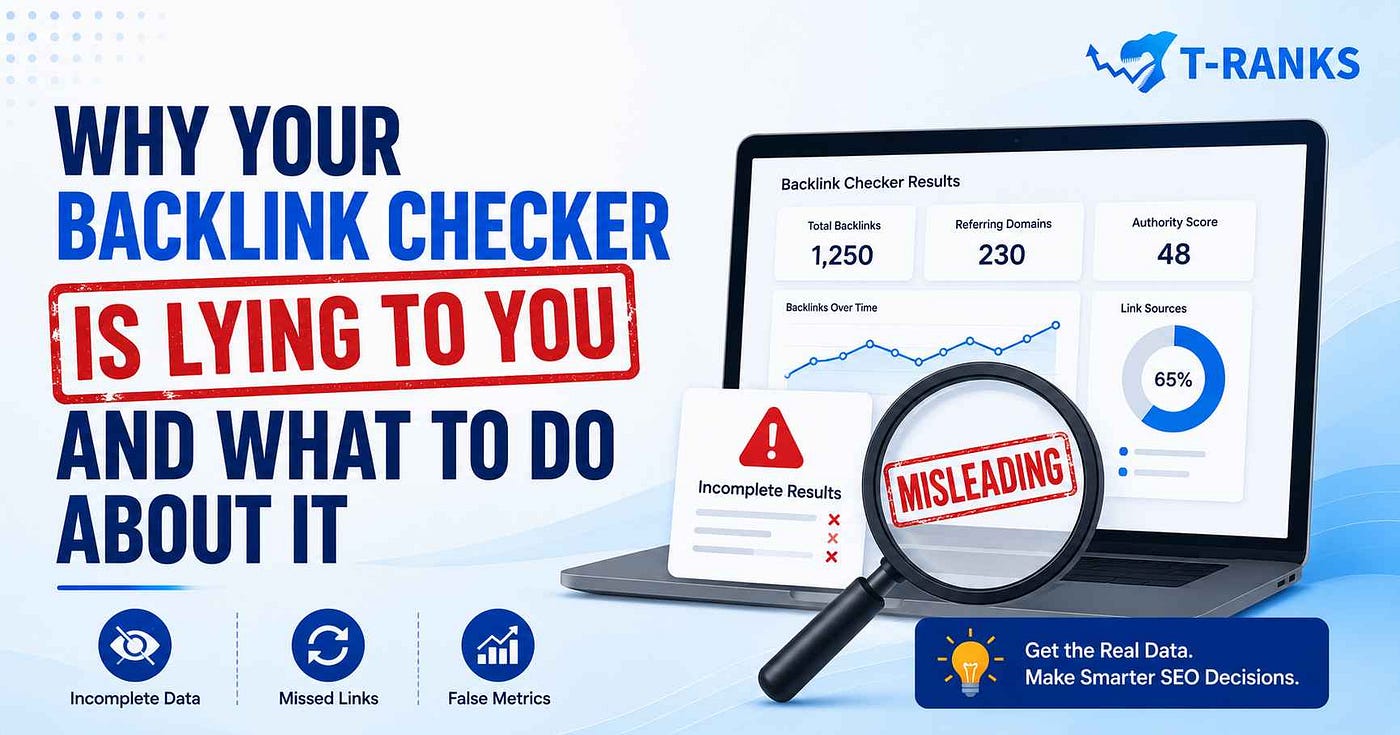
Your backlink tool shows strong numbers. The DR is climbing. The referring domains are growing. The anchor distribution looks balanced. Everything in the dashboard signals progress.
And then you check the rankings and nothing has changed.
The tool is not broken. But it is not telling you what you think it is telling you. Backlink checkers like Ahrefs, Semrush, and Moz are analytical comparison platforms, not Google ranking engines. The metrics they show are estimation models built for competitive research, not direct signals that Google uses to rank pages. When that distinction is not understood, backlink data stops being useful and starts being misleading. Understanding how backlinks actually work in Google’s algorithm is the foundation that makes every metric in your backlink checker actually interpretable.
Backlink Tools Are Comparison Systems Not Ranking Systems
Backlink checkers are misread because they provide fast, simplified, and measurable data in a space where Google offers almost no transparency.
Platforms like Ahrefs, Semrush, and Moz provide daily rank tracking, competitor visibility scores, simplified authority metrics, and optimization scorecards. Over time these numbers begin to feel official. They look precise. They update regularly. They appear in client reports as performance indicators. That familiarity creates a perception that these metrics reflect how Google actually evaluates links.
They do not. Domain Rating, Authority Score, and Domain Authority are third-party estimation models. Each tool builds its own scoring system based on the links it discovers in its own index. A score of 60 in Ahrefs does not mean the same thing as a score of 60 in Moz. These numbers exist to help you compare domains within the tool. They are not used by Google in its ranking system and they were never designed to be.
When this distinction is understood, backlink checker data becomes a useful directional signal. When it is not understood, the same data creates confusion, misallocation, and decisions built on assumptions that do not reflect how rankings actually work.
The Six Mistakes That Happen When Tools Are Treated as Ranking Systems
Treating backlink tools as ranking systems produces six predictable interpretation mistakes that drain SEO budget and produce flat results month after month.
Mistake 1: Confusing third-party metrics with Google ranking signals DR, DA, and Authority Score are not used by Google. They are estimation models created by tools for competitive comparison. Optimizing for these numbers does not mean optimizing for rankings. It means optimizing for a number that Google has never seen.
Mistake 2: Believing high DR automatically guarantees link impact Domain strength is a directional indicator, not a ranking guarantee. Actual link impact is determined at the page level by relevance, context, and intent alignment. A high DR domain with a weakly supported, topically irrelevant linking page transfers far less link equity than the score suggests.
Mistake 3: Trusting spam scores and toxic labels without manual verification These are warning indicators, not penalty confirmations. Acting on automated alerts without manual review can remove neutral links, reduce link equity, and create profile instability that would never have occurred if the alert had simply been investigated first.
Mistake 4: Panicking about lost backlinks without checking ranking impact Not every lost link carried meaningful ranking weight. Most link churn is normal web behavior. Acting on lost link reports without first confirming whether rankings actually changed wastes outreach budget on placements that were contributing nothing before they disappeared.
Mistake 5: Overanalyzing anchor text ratios as fixed mathematical thresholds Anchor profiles evolve naturally over time. Small percentage shifts do not automatically mean over-optimization or penalty risk. These signals require SERP context and competitor comparison before any profile adjustment is justified.
Mistake 6: Analyzing backlink data without studying the live SERP This is the most damaging mistake of all. Backlink tools show link numbers. They do not explain why a page ranks. Without SERP context, every metric in the tool is missing the most important half of the picture and every decision built on that incomplete data carries structural risk.
What Backlink Checker Data Actually Tells You and What It Does Not
Backlink checker data tells you four things reliably:
- The estimated authority strength of a referring domain based on its own backlink profile
- The total volume of referring domains pointing to a specific page or domain
- The anchor text distribution across the full link profile of a site
- Whether new or lost links have been detected within the tool’s most recent crawl cycle
What it does not tell you is equally important and almost never discussed:
- Whether those links are passing meaningful link equity to the target page at the page level
- Whether the linking page has topical relevance to the keyword the target page is trying to rank for
- Whether the page receiving the links actually matches the dominant search intent in the SERP
- Whether additional links are even what the page needs to improve its ranking position or whether a content problem is the real limiting factor
According to Search Engine Journal, rankings are determined by a combination of relevance signals, content quality, user experience, and authority balance within the live search results. Backlink data contributes to one part of that equation. When it is treated as the entire equation, decisions become reactive, misallocated, and disconnected from what actually determines whether a page moves up or stalls.
How to Use Backlink Checker Data the Right Way
Using backlink checker data correctly means treating every metric as a directional signal that requires context before it becomes actionable:
- When DR is high on a referring domain — ask whether the specific linking page is topically aligned with the target keyword before treating the placement as a quality signal
- When spam scores increase — complete a manual verification of flagged links before making any disavow decision. One elevated score does not justify removing links that may be neutral or harmless
- When referring domains drop — check whether rankings for the target keyword actually changed before concluding that meaningful authority has been lost. Most link churn requires monitoring, not intervention
- When anchor ratios shift — compare those patterns against the anchor profiles of top-ranking competitors in the same SERP before making adjustments. Context determines whether a shift is a problem or normal profile evolution
A focused backlink audit that combines tool data with manual page-level review and live SERP analysis produces decisions grounded in actual ranking behavior rather than metric fluctuations. Reviewing backlink data once or twice per month is sufficient for most sites. Patterns over time are what matter. Individual data points rarely justify aggressive changes to a link profile that has been built steadily over months.
The Foundation That Makes Backlink Data Interpretable
Backlink checker data only becomes misleading when it is interpreted without strong SEO fundamentals underneath it.
When page-level relevance is understood, DR becomes a rough filter rather than a quality guarantee. When search intent alignment is understood, anchor text ratios become a contextual signal rather than a mathematical formula to optimize. When SERP analysis is part of every backlink review, competitor authority becomes something to understand rather than something to fear or misread.
Strong SEO foundations do not make backlink tools less useful. They make them significantly more useful because every metric gets interpreted in the context that actually determines ranking outcomes. Analyzing backlinks like a professional means combining tool data with manual review, SERP context, and page-level thinking. That combination is what turns backlink checker data from a source of confusion into a source of genuine strategic clarity.
메타데이터
- post_id
- 0701d12f27e5
- slug
- why-your-backlink-checker-is-lying-to-you-and-what-to-do-about-it-0701d12f27e5
- url
- https://medium.com/@info_75606/why-your-backlink-checker-is-lying-to-you-and-what-to-do-about-it-0701d12f27e5
- canonical_url
- https://medium.com/@info_75606/why-your-backlink-checker-is-lying-to-you-and-what-to-do-about-it-0701d12f27e5
- author_url
- https://medium.com/@info_75606
- status
- ok
- fetched_at
- 2026-06-17 08:20:12