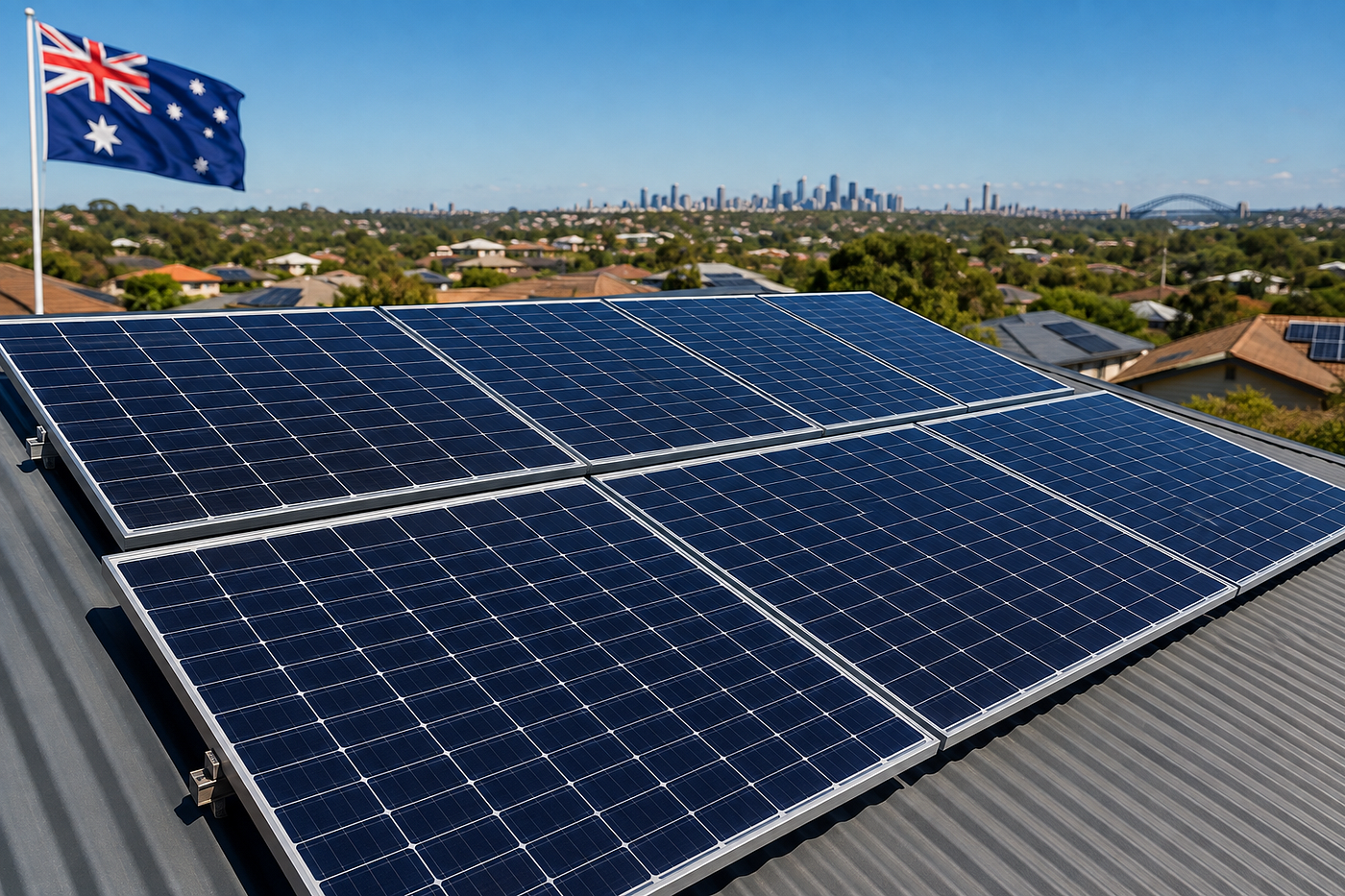
How Much Does a Solar Battery Cost in Australia?
In 2026, the average out-of-pocket cost for a quality home solar battery in Australia ranges from $7,000 to $11,000 for a standard 10 kWh…
How Much Does a Solar Battery Cost in Australia?

In 2026, the average out-of-pocket cost for a quality home solar battery in Australia ranges from $7,000 to $11,000 for a standard 10 kWh to 13.5 kWh system, fully installed. This pricing includes the federal Cheaper Home Batteries Program rebate, which offers upfront discounts of approximately $250 per usable kWh of capacity. Smaller 5 kWh systems start around $4,000, while premium, high-capacity systems (20 kWh+) can range from $14,000 to $18,000 depending on brand, installation complexity, and backup capabilities.
Why Are Aussie Homeowners Turning to Batteries in 2026?
The Australian energy landscape has undergone a tectonic shift over the last few years. If you own solar panels, you have likely noticed a frustrating trend: standard solar feed-in tariffs (FiTs) have steadily declined, with some retail energy providers offering as low as $0.00$ to $3$ cents per kilowatt-hour ($\text{kWh}$) during peak solar production hours. In some states, dynamic exports and grid constraints mean your excess energy is heavily restricted or even cut off when the grid is oversaturated.
This has dramatically changed the economics of home energy. Exporting your clean solar energy to the grid is no longer a viable way to offset your power bills. Instead, the smartest financial strategy is self-consumption — storing every drop of power your rooftop generates during the day and using it during the expensive peak evening hours (usually between 4 PM and 9 PM).
With retail electricity rates continuing to climb across Victoria, New South Wales, Queensland, and South Australia, a home battery acts as a personal buffer against volatile retail prices. Additionally, with the launch and maturation of the federal government’s landmark Cheaper Home Batteries Program, installing home storage has transitioned from an expensive luxury to a highly practical, fast-payback upgrade for everyday households.
How Much Does a Solar Battery Cost in Australia? (2026)
When calculating the cost of adding energy storage to your property, it is vital to distinguish between battery-only supply prices and a fully installed system cost.
A complete, code-compliant, and reliable installation requires specialized labor, electrical safety components, switchboard modifications, and frequently, a new hybrid inverter. The table below outlines the average realistic price ranges across Australia in 2026, representing quality equipment installed by Clean Energy Council (CEC) accredited professionals.
Average Installed Solar Battery Costs in Australia (2026)
Usable Capacity ($\text{kWh}$)
Estimated Cost Before Rebates ($\text{AUD}$)
Estimated Cost After Federal Rebate ($\text{AUD}$)
Recommended For
Common Brand Options
5 to 6 $\text{kWh}$
$5,500 — $8,000
$4,000 — $6,500
Small apartments, highly efficient 1–2 person homes
GoodWe Lynx (5.4 $\text{kWh}$), Enphase IQ 5P
10 to 11 $\text{kWh}$
$10,000 — $14,000
$7,000 — $10,500
Average 3–4 person family homes, standard daily usage
SigenStor (10 $\text{kWh}$), GoodWe Lynx (10.8 $\text{kWh}$), SolarEdge Bank
13.5 to 16.5 $\text{kWh}$
$13,500 — $16,500
$10,000 — $12,500
Medium-to-large families, high heating/cooling loads
Tesla Powerwall 3, SigenStor (16 $\text{kWh}$), BYD HVM (13.8 $\text{kWh}$)
20 to 25 $\text{kWh}$
$16,000 — $24,000
$12,000 — $18,000
Large homes with ducted AC, pools, and EV charging
Sungrow (25.6 $\text{kWh}$), Dual SigenStor units
Note: These prices are estimates and can vary based on individual property installation requirements, state-specific rebates, and whether the battery is bundled with a brand-new solar panel system.
The Value Metric: Understanding Cost Per Usable Kilowatt-Hour
To truly compare different battery products, energy experts use the “Cost per Usable Kilowatt-Hour” metric. This allows you to evaluate your return on investment accurately. The formula to calculate this metric is:
$$\text{Cost per Usable kWh} = \frac{\text{Total Net Out-of-Pocket Cost}}{\text{Usable Capacity in kWh}}$$
Generally, larger battery systems offer a much more competitive cost per usable $\text{kWh}$ than smaller systems. While a $5\text{ kWh}$ battery might cost around $\$900$ per usable $\text{kWh}$ installed, a premium $13.5\text{ kWh}$ or $16\text{ kWh}$ battery system can bring that rate down to roughly $\$550$ to $\$700$ per usable $\text{kWh}$.
This is why mid-to-large capacity systems represent the economic “sweet spot” for most Australian households. If you are looking to secure a comprehensive, future-proofed installation, we highly recommend checking out our tailored residential single-phase packages which feature top-tier, high-value hybrid configurations.
The Federal Rebate & State Incentives: How Much Do You Save?
The biggest catalyst for home battery adoption has been the Australian Federal Government’s Cheaper Home Batteries Program. This program provides a substantial upfront discount at the point of sale, applied directly by your installer so you do not have to wade through mountain-loads of paperwork.
How the Federal Subsidy Works in 2026
The subsidy value is calculated using Small-scale Technology Certificates (STCs) based on the battery’s usable capacity. However, to control government spending and account for manufacturing improvements, the rebate features a planned step-down mechanism:
- Before 30 April 2026: The subsidy was worth roughly $335 per usable $\text{kWh}$.
- From 1 May 2026: The subsidy stepped down to approximately $250 per usable kWh.
- Future Step-Downs: The discount will continue to reduce by a fixed percentage every six months through to 2030.
The program also applies a tiered capacity rule to target suburban residential homes:
- First 14 $\text{kWh}$ of Usable Capacity: Receives $100\%$ of the rebate rate (up to $3,500 in direct discount).
- 14 $\text{kWh}$ to 28 $\text{kWh}$: Receives $60\%$ of the rebate rate (approximately $150 per $\text{kWh}$).
- 28 $\text{kWh}$ to 50 $\text{kWh}$: Receives $15\%$ of the rebate rate (approximately $37.50 per $\text{kWh}$).
- Above 50 $\text{kWh}$: No federal discount applies.
State-Specific Battery Incentives
Depending on where you live in Australia, you may be able to stack state-based incentives on top of the federal program:
- Victoria: The Solar Homes Program offers interest-free loans of up to $8,800 to help eligible households cover the upfront cost of battery installations.
- Western Australia: The Residential Battery Scheme offers a state rebate that stacks with the federal program, allowing WA homeowners to shave up to $5,000 off a typical 10 $\text{kWh}$ system.
- Australian Capital Territory (ACT): Sustainable Household Scheme provides low-interest, fixed-rate loans up to $15,000 for energy-efficient upgrades, including batteries.
What Factors Actually Influence Your Total Installation Cost?
If you have obtained quotes from multiple installers, you may notice significant price discrepancies. These differences are rarely arbitrary. Several physical and technical variables impact the complexity — and therefore the price — of your installation.
┌─────────────────────────────────────────┐
                  │   TOTAL SOLAR BATTERY INVESTMENT COST   │
                  └────────────────────┬────────────────────┘
                                       │
         ┌─────────────────────────────┼─────────────────────────────┐
         ▼                             ▼                             ▼
┌─────────────────┐           ┌─────────────────┐           ┌─────────────────┐
│ EQUIPMENT COST  │           │ INSTALL DETAIL  │           │ GRID & SAFETY   │
│ • Battery Cell  │           │ • Cabling Runs  │           │ • Switchboard   │
│ • Inverter Type │           │ • Mounting Type │           │   Upgrades      │
│ • Backup Gateway│           │ • Indoor/Outdoor│           │ • Fire Safety   │
└─────────────────┘           └─────────────────┘           └─────────────────┘
1. Battery Chemistry and Performance (LFP vs. NMC)
The chemistry used inside the battery cells plays a major role in pricing.
- Lithium Iron Phosphate (LFP / $LiFePO_4$): This has become the gold standard for residential storage (used by brands like BYD, GoodWe, and Sigenergy). LFP batteries are exceptionally safe, offer superior thermal stability, and boast a long lifespan of 6,000 to 10,000 charge cycles.
- Nickel Manganese Cobalt (NMC): While NMC batteries are highly energy-dense (meaning they take up less physical space), they are more expensive to manufacture and generally offer a lower cycle lifespan than modern LFP chemistry.
2. Inverter Requirements (All-In-One vs. Retrofits)
Your existing solar system’s inverter determines how a battery can be integrated:
- If you have a standard string inverter: You cannot connect a battery directly. You must either replace your inverter with a modern, hybrid model (which handles both solar panels and battery storage) or install an AC-coupled battery system (which includes its own dedicated internal battery inverter). Replacing your old inverter with a high-capacity hybrid unit is often the cleanest, most efficient approach.
- If you are building a new system from scratch: It is highly cost-effective to buy a complete “Solar + Battery” package. This ensures your hybrid inverter is perfectly matched to your storage cells right from day one, saving you thousands on redundant equipment.
3. Switchboard Upgrades and Labor Complexity
Old residential switchboards may lack the safety switches, smart meters, or space required to integrate a modern battery system safely. Upgrading your switchboard to comply with modern Australian Standards (AS/NZS 3000) can add $500 to $1,500 to your final invoice. Additionally, complex cable runs (e.g., if your battery is mounted on the far side of your house away from the main electrical box) will increase labor costs.
4. Backup Power Requirements (Blackout Protection)
Do you want your battery to keep your lights, fridge, and internet running during a blackout? This feature — known as EPS (Emergency Power Supply) or backup capability — often requires an external backup gateway or an automatic transfer switch. Depending on whether you want “essential circuit” backup or “whole-home” backup, this hardware can add $800 to $2,500 to the installation cost.
Brand Comparison: Top-Tier Battery Systems Installed by United Energy Group
At United Energy Group, we source and install only the most reliable, high-performance battery systems on the Australian market. By partnering with leading manufacturers, we ensure our clients receive maximum efficiency, safety, and compatibility.
1. Sigenergy SigenStor (The Premium Modular Choice)
The SigenStor is a revolutionary, all-in-one energy storage system. It features a stackable, modular design that integrates the battery inverter, EV charger module, and battery packs into a sleek, column-like tower.
- Usable Capacity: Scalable from 5 $\text{kWh}$ to 48 $\text{kWh}$ per stack.
- Chemistry: Lithium Iron Phosphate (LFP).
- Why We Love It: It is incredibly fast to install, boasts advanced AI-driven management, and has a built-in EV charging pathway, making it the ultimate future-proof option. Check out our high-efficiency Aiko Solar + SigenStor single-phase packages to see this technology in action.
2. GoodWe Lynx Home F Series (The High-Voltage Workhorse)
Designed for seamless integration with GoodWe’s world-class hybrid inverters, the Lynx Home F Series offers high-voltage performance with excellent scalability.
- Usable Capacity: Modular stack from 6.6 $\text{kWh}$ up to 16.5 $\text{kWh}$ per unit.
- Chemistry: LFP.
- Why We Love It: Known for its robust IP65 outdoor-rated construction and highly reliable safety features, it pairs flawlessly with our GoodWe hybrid three-phase packages, perfect for larger Australian homes.
3. BYD Battery-Box Premium HVM (The Scalable Industry Standard)
BYD is one of the world’s largest manufacturers of electric vehicles and lithium batteries. Their Battery-Box Premium range is highly respected for its safety, thermal resilience, and incredible longevity.
- Usable Capacity: Modular from 8.3 $\text{kWh}$ to 22.1 $\text{kWh}$.
- Chemistry: LFP.
- Why We Love It: Extremely reliable, highly compatible with premium European inverters like Fronius Symo Gen24, and offers outstanding high-power discharge rates, meaning it can easily handle heavy appliance startups.
Is a Solar Battery Actually Worth It? Payback Period & ROI in 2026
To understand if a solar battery makes financial sense for your home, you need to calculate its payback period. The general formula to estimate your return is:
$$\text{Payback Period (Years)} = \frac{\text{Net Upfront System Cost}}{\text{Annual Electricity Bill Savings}}$$
Where your annual savings are defined as:
$$\text{Annual Savings} = (\text{Self-Consumed Battery Energy} \times \text{Peak Retail Tariff}) + (\text{VPP Earnings}) — (\text{Lost Feed-In Tariff})$$
Let’s Look at a Real-World 2026 Australian Example:
Assume a household in Victoria installs a 10 kWh battery system.
- Net Upfront Cost: $8,500 (after the federal Cheaper Home Batteries Program rebate).
- Daily Usage Shifted: The household stores $9\text{ kWh}$ of daytime solar energy and consumes it during peak evening hours instead of drawing from the grid.
- Peak Grid Tariff: $0.38 per $\text{kWh}$
- Avoided Feed-In Tariff (Opportunity Cost): $0.04 per $\text{kWh}$ (what they would have earned by exporting it instead).
- Daily Net Savings:
- $$9 \text{ kWh} \times (\$0.38 — \$0.04) = \$3.06 \text{ per day}$$
- Annual Savings (Direct Consumption):
- $$\$3.06 \times 365 = \$1,116.90 \text{ per year}$$
- Virtual Power Plant (VPP) Bonus: By joining a VPP, the household earns an additional $180 per year in grid-support credits.
- Total Annual Benefit: $1,296.90
- Estimated Payback Period:
- $$\text{Payback} = \frac{\$8,500}{\$1,296.90} \approx 6.55 \text{ Years}$$
With battery warranties extending to 10 years (and many modern LFP cells easily lasting 15+ years), this Victorian household will enjoy 3.5 to 8 years of pure profit and complete protection against future utility price hikes.
Step-by-Step Buying Guide: Choosing the Right Battery Size
Choosing the wrong battery capacity is one of the most common ways homeowners waste money. Here is a quick step-by-step framework to ensure you purchase the perfect system:
Step 1: Check Your Daily Winter and Summer Energy Consumption
Log into your electricity retailer’s portal and download your smart meter data. Look at your average daily usage in kilowatt-hours ($\text{kWh}$). Pay close attention to how much power you use after the sun goes down (between 5 PM and 8 AM the next morning).
Step 2: Match Your Battery to Your Evening Consumption
Your battery only needs to be large enough to cover your evening and overnight energy usage. Buying a battery that is larger than your overnight consumption means you will rarely empty it, leaving expensive capacity sitting idle.
- Small Homes / Empty Nesters (usage < 15 kWh/day): A 5 to 6 kWh battery is usually sufficient.
- Average Suburban Family (usage 15–25 kWh/day): A 10 to 13.5 kWh battery is the absolute sweet spot.
- Large Families with heavy loads (usage > 30 kWh/day): Consider a modular 15 to 24 kWh system.
Step 3: Match Your Battery to Your Solar Array Capacity
You need enough surplus solar generation during the day to fully charge your battery. As a general rule of thumb:
- You need at least 1.5 to 2 kW of solar panels for every 1 kWh of battery storage you install.
- For example, if you want a $10\text{ kWh}$ battery, your rooftop solar system should ideally be at least $6.6\text{ kW}$ to $8\text{ kW}$ in size. If your current array is too small, you should upgrade your panels simultaneously to maximize efficiency. We recommend exploring our comprehensive home solar systems to match your storage goals.
Crucial Pitfalls to Avoid When Buying a Solar Battery
Investing in home energy storage is a major financial decision. Avoid these four common traps to protect your investment:
- Chasing “Too-Good-To-Be-True” Online Prices: If you see ads online offering “fully installed 10 kWh batteries for $3,900,” be exceptionally careful. These are almost always uncertified, low-tier battery brands, or misleading “supply-only” prices that do not include mandatory electrical safety hardware, hybrid inverters, or professional installation costs.
- Overlooking Blackout Performance Limitations: Many homeowners assume that buying a solar battery automatically keeps their power on during grid outages. However, unless your system is configured with dedicated backup circuits and an automatic transfer gateway, your system will shut down during a blackout to protect network technicians. Ensure your quote explicitly details its backup capabilities.
- Ignoring the Depth of Discharge (DoD): Some older or lower-tier batteries cannot be safely drained to $0\%$. A battery with a nominal capacity of $10\text{ kWh}$ but a Depth of Discharge of $80\%$ only offers $8\text{ kWh}$ of usable energy. Always check the usable capacity specification before signing any contract.
- Buying from “Fly-by-Night” Installers: A solar battery warranty is only useful if the company that installed it is still in business to service it. Always choose established, local CEC-accredited installers who have physical offices, transparent customer reviews, and a long-standing presence in the Australian market.
Expert Tips from United Energy Group
As one of Victoria’s premier clean energy solution providers, our team has installed thousands of systems. Here is some invaluable advice straight from our engineering team:
Install with Future Upgrades in Mind: Even if you cannot afford a battery today, make sure your new solar system utilizes a high-quality hybrid inverter. This “battery-ready” approach means you can plug in a storage system down the line without needing to rewrite or replace your primary inverter.
Ventilation and Placement Matter: While modern LFP batteries have high temperature tolerances, placing them in a cool, shaded area (such as a garage or a south-facing exterior wall) protects the internal electronics and extends the operating lifetime of your cells. Avoid placing them in direct, harsh Australian afternoon sunlight.
Don’t Forget Your EV Goals: If you plan on purchasing an Electric Vehicle (EV) in the next 2–3 years, choose a modular system like the Sigenergy SigenStor that allows you to easily slot in an EV charger module or expand your storage capacity in the future. Integrating your vehicle with your home energy ecosystem saves massive amounts on fuel costs. Check out our high-efficiency EV charger systems to plan ahead!
1. How much does a 10kWh solar battery cost in Australia in 2026?
A premium, fully installed 10 $\text{kWh}$ solar battery typically costs between $7,000 and $10,500 after applying the federal Cheaper Home Batteries Program rebate. Before incentives, prices range from $10,000 to $14,000.
2. Can I add a battery to my existing solar system?
Yes. You can add a battery to an existing system by either replacing your old string inverter with a modern hybrid inverter (DC-coupled setup) or adding an AC-coupled battery system that has its own internal battery inverter.
3. How long do solar batteries last?
Most modern Lithium Iron Phosphate (LFP) batteries come with a standard 10-year manufacturer warranty. In real-world conditions, these batteries are engineered to perform efficiently for 15+ years before dropping below 70% of their original capacity.
4. What is the Cheaper Home Batteries Program?
It is an Australian federal government subsidy program that provides upfront discounts on eligible home batteries. In 2026, the discount is calculated at roughly $250 per usable kWh for the first 14 $\text{kWh}$ of capacity.
5. Will solar battery prices fall further in 2026?
While wholesale battery cell manufacturing costs are slowly dropping, the federal rebate is stepping down every six months. Therefore, waiting for hardware prices to fall is unlikely to save you money, as the shrinking government discount will offset any manufacturing savings.
6. Is a solar battery worth it with low feed-in tariffs?
Yes. In fact, low feed-in tariffs make batteries more financially viable. Since exporting power to the grid yields very little financial return, storing that energy to replace expensive peak grid power is the most effective way to lower your power bills.
7. Can I go completely off-grid with a solar battery?
While it is technically possible, going completely off-grid requires a massive solar array, large-scale battery storage, and a backup generator to cover extended periods of bad weather. For most suburban homes, remaining grid-connected while maximizing self-consumption is far more practical and cost-effective.
8. Does a solar battery provide power during a blackout?
Only if it has been configured with blackout backup capabilities. Standard grid-connected batteries switch off during blackouts for safety reasons. To maintain power during outages, you must specify that you need essential-circuit or whole-home backup when requesting a quote.
9. What is the difference between single-phase and three-phase battery packages?
Single-phase systems are standard for average residential homes. Three-phase systems are found in larger homes, rural properties, or commercial sites with high electricity demands. It is crucial to match your battery package to your property’s electrical connection. You can check out our dedicated commercial solar and battery packages for three-phase commercial configurations.
10. How do I calculate the payback period of my solar battery?
Divide the net upfront cost of your battery by your annual electricity bill savings. For a typical Australian household utilizing a 10 $\text{kWh}$ battery to shift their electricity usage, the payback period is currently between 5 and 8 years.
메타데이터
- post_id
- 080e0b660873
- slug
- how-much-does-a-solar-battery-cost-in-australia-080e0b660873
- url
- https://medium.com/@united_energy_group/how-much-does-a-solar-battery-cost-in-australia-080e0b660873
- canonical_url
- https://medium.com/@united_energy_group/how-much-does-a-solar-battery-cost-in-australia-080e0b660873
- author_url
- https://medium.com/@united_energy_group
- status
- ok
- fetched_at
- 2026-09-02 18:20:41