Astro 6.2, htmx at 40k Stars, and Lit Web Components: Why 2026 Is the Year “Less JavaScript”…
I remember the exact moment I stopped believing the “React for everything” gospel.
Astro 6.2, htmx at 40k Stars, and Lit Web Components: Why 2026 Is the Year “Less JavaScript” Finally Won
I remember the exact moment I stopped believing the “React for everything” gospel.
It was a Tuesday afternoon. I was building a documentation site. Five static pages, a search bar, and a sidebar that highlights the current section. A problem people solved a thousand times since 1995.
But my node_modules folder was 340MB. I had webpack loaders I didn’t understand, a hydration mismatch in production, and three SEO specialists telling me the site wasn’t being indexed properly. All for a documentation site.
That was 2024. Two years later, I’m building the same kind of projects with under 50KB of JavaScript budget. Not because I got smarter. The ecosystem finally caught up with a simple idea: the best JavaScript is the one you don’t ship.
Here’s what happened while nobody was looking.
The numbers are hard to ignore
Astro shipped version 6.0 earlier this year with a completely redesigned dev server, native Cloudflare Workers support, and built-in Content Security Policy enforcement. As of April 2026, they’re already on 6.2 with JSON logging and SVG optimization APIs. Their GitHub stars overtook Next.js. Not because Astro does more, but because for most web projects, it does the right things and nothing else.
htmx crossed 40,000 GitHub stars and is growing faster than React and Svelte combined by some measures. The State of JS surveys show a weird pattern: React usage stays high, but the “would not use again” sentiment keeps climbing. Nobody’s abandoned React yet. But the love is clearly cooling.
And Web Components? After a decade of “next year will be the year,” 2026 is actually delivering. Lit, Google’s web component library, hit production maturity. custom-elements-everywhere.com now shows perfect or near-perfect scores for every major framework. AgnosticUI, a cross-framework design system, recently documented their full rewrite into Lit. Their summary: “wish we’d done this years ago.”
These three, Astro, htmx, and Lit-based Web Components, are what people call the “lightweight frontend trio.” The joke part is fading. They’re increasingly showing up in serious production code.
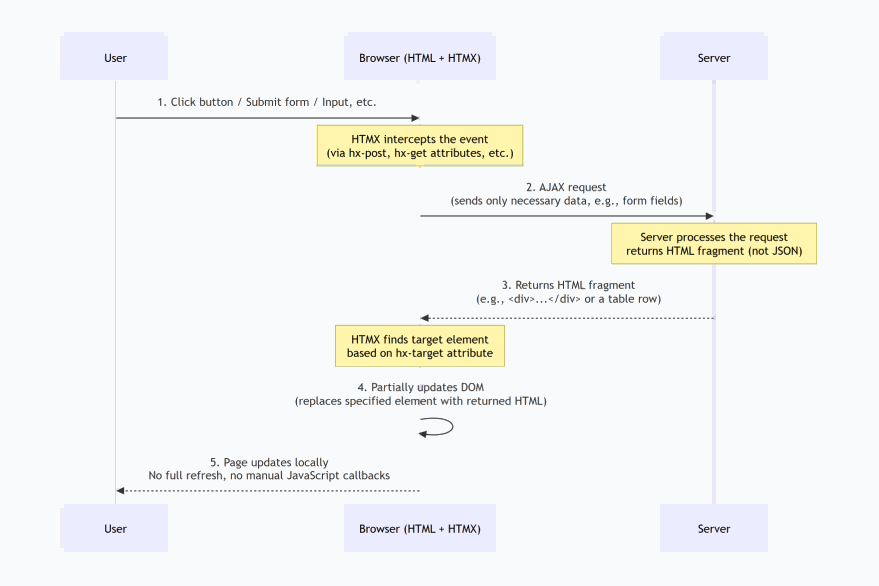
HTMX Flowchart
What actually changed
Astro Broke the “All or Nothing” Pattern
The most important thing Astro did was architectural, not technical. Instead of asking “which framework do you want,” they asked “do you need a framework at all for this page?”
Most pages on the web are content. Articles, product descriptions, documentation, landing pages. None of these need client-side JavaScript. They need HTML, CSS, and maybe a font file. Astro’s default output is exactly that: static HTML. If a component needs interactivity, you opt in with a client:load directive, and only that component ships JavaScript.
Obvious in retrospect. But it broke a decade of the “page is the app” way of thinking. Next.js pioneered SSR, a massive step forward from client-rendered SPAs. But even SSR ships the React runtime and hydration to every page. Astro’s islands architecture means your page load doesn’t pay for interactivity it doesn’t use.
Astro 6 doubled down. The refactored dev server eliminated the startup lag that bothered early adopters. Built-in CSP support deals with one of the most painful production security configs without another npm package. The Cloudflare Workers integration lets you deploy full server-side rendering on the edge for the pages that genuinely need it.
htmx Discovered the Boring Use Cases
htmx has been technically available since 2020. But it took a few years for developers to realize something: most interactive UI patterns on the web are boring.
Search with debounce. Form submission with loading state. Infinite scroll. Tab switching. Modal open/close. Pagination. That’s probably 80% of what “interactivity” means for an average web application. Not one of those patterns actually requires a JavaScript framework.
The htmx approach is so straightforward it almost feels like cheating. You add hx-get=”/search” and hx-trigger=”keyup changed delay:500ms” to an input. When the user types, it fires a GET request and swaps the response into a target div. The server returns HTML. No JSON endpoints, no client-side state, no virtualization concerns.
What changed in 2026 is the industry finally admitting this is enough for a huge chunk of real projects. A dev.to article titled “React is Overkill” went viral not because it said anything new, but because it articulated what a lot of teams were already thinking: we spent forty minutes configuring a React project for an admin dashboard that needed to list records and update a status field. Three things.
Web Components Grew Up
The Web Components story was frustrating for years. Low-level APIs. Shadow DOM styling headaches. Spotty framework integration. “Write once, run everywhere” always felt like it was almost there but not quite.
2026 is the year the almost turned into actual.
Lit, maintained by Google, is now competitive with React or Vue for component authoring. Decorators for reactive properties. Clean template syntax with tagged template literals. A rendering model efficient enough for production use.
Framework integration is effectively solved. React 19 got a perfect score on custom-elements-everywhere. The @lit/react wrapper handles React-specific ergonomics smoothly. Vue, Angular, and Svelte have had good support for a while.
The real win is for design systems. If you’ve ever maintained a React component library while also supporting a Vue team, you know the pain of keeping two implementations in sync. Web Components eliminate that category of suffering. Build with Lit once, use everywhere. AgnosticUI’s rewrite post-mortem says it plainly: “we should have bet on the platform standard years ago.”
When they actually work together
The trio aren’t competing. They complement each other well.
A typical architecture: the project scaffold is Astro. Content pages are pure HTML with Astro’s Markdown/MDX support. Server-interaction parts, like search, forms, filtering, and pagination, use htmx to make HTTP requests and swap HTML fragments. Reusable UI primitives (buttons, modals, tooltips, inputs) are built with Lit and ship as Web Components, usable in Astro, htmx partials, or even embedded in a legacy React app.
In this setup, most of your codebase is HTML and CSS. JavaScript files are small, focused, and genuinely necessary. Build times are fast because there’s no complex bundling pipeline for pages that don’t need it. Lighthouse scores get boring, in a good way.

This isn’t theoretical. Several production projects on the htmx discussion forum report consistent improvements after adopting this pattern: faster development cycles, smaller bundles, fewer production bugs related to client-side state management.
Where you should still use React or Vue
I’m not saying abandon React. That would be stupid. React is excellent at what it was designed for.
If you’re building a collaborative editor like Google Docs, a design tool like Figma, a real-time multiplayer game, or any application where the client manages complex, shared state, React or Vue is the right choice. htmx’s HTML-swapping model falls apart when you need optimistic updates, drag-and-drop, or fine-grained reactivity across disconnected UI elements.
Pick the right tool for the job. Not the right tool for your resume.
The real takeaway
The lightweight frontend trio is a course correction, not a trend.
For a decade, the frontend industry solved every problem by adding more JavaScript. More build tooling, more runtime, more abstraction. We convinced ourselves this was progress, and in many ways it was. The component model is genuinely better than jQuery spaghetti. But we overshot.
Astro, htmx, and Web Components put JavaScript back in its original role: a language that shows up where it improves the experience, rather than one that carries the entire weight of the web.
If you haven’t tried any of these three, start with Astro. Build a simple content site. See what it feels like when your page loads before your bundle finishes downloading. It’ll change how you think about frontend performance.
— -
Also worth reading: React Compiler 1.0 Is Here and The 2026 Frontend AI Toolbox for more on where frontend development is heading.
메타데이터
- post_id
- 08eb9c67d82e
- slug
- astro-6-2-htmx-at-40k-stars-and-lit-web-components-why-2026-is-the-year-less-javascript-08eb9c67d82e
- url
- https://medium.com/@caijunpeng1995.2/astro-6-2-htmx-at-40k-stars-and-lit-web-components-why-2026-is-the-year-less-javascript-08eb9c67d82e
- canonical_url
- https://medium.com/@caijunpeng1995.2/astro-6-2-htmx-at-40k-stars-and-lit-web-components-why-2026-is-the-year-less-javascript-08eb9c67d82e
- author_url
- https://medium.com/@caijunpeng1995.2
- status
- ok
- fetched_at
- 2026-06-17 08:20:12