On Memorising Poe’s ‘The Raven’
What a childhood challenge has taught me
On Memorising Poe’s ‘The Raven’
What a childhood challenge has taught me
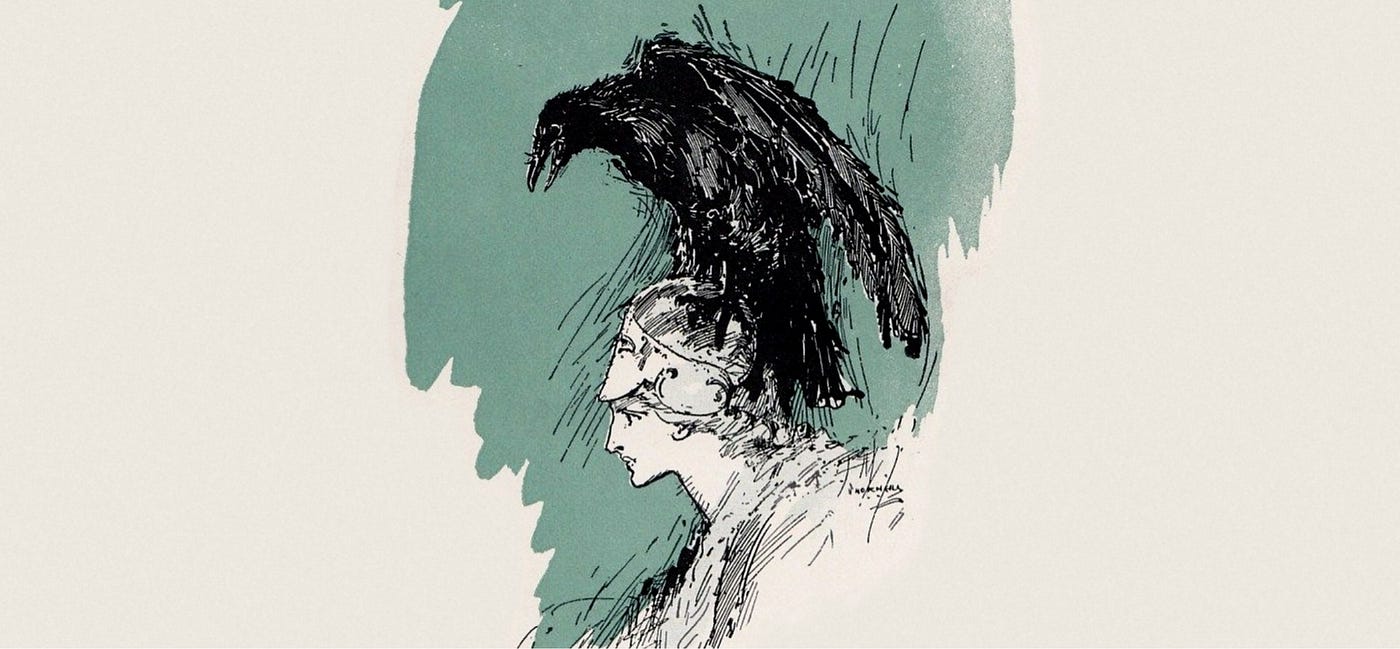
1910 illustration by John R. Neill (Public domain)
I was, perhaps, not the most “normal” of children. That much I remember clearly. These days I don’t think that holds as much water as it used to, but growing up in a rural community in the early 2000s with a love for the macabre and dark, I had little opportunity to share that love.
Aside from Halloween, my interests usually tended to place me more outside my peers than with them, so I often kept most of my thoughts to myself. One thing that I never managed to keep quiet however, was my admiration for the works of Edgar Allan Poe.
I’m not sure what my poor mother was thinking when her child came to her and asked for a copy of Poe’s stories and poems, but still she found it for me. I remember that it was a Penguin Popular Classics editions with a grotesquely luridly green cover. The darkness of his stories and their old-fashioned style drew me in and informed a lot of what my own writing came to be. But my love for Poe can actually be directly traced to Tim Burton’s 1982 stop-motion short, Vincent.

Vincent imagines himself as a mad scientist (Walt Disney Productions)
Telling the story of a young boy who is obsessed with Vincent Price (and is narrated by Price himself), the short shows Vincent throwing himself into fantasy worlds inspired by Price’s films; he is a tortured painter, a mad scientist, and a maniac wax artist. Several of his fantasies take inspiration from the Poe-adaptations directed by Roger Corman.
He slips further and further into his fantasy world and it all comes to a head when he mother grounds him for digging up her flower bed (which he does in search of his wife who has been buried alive). Vincent becomes terrified and feels that he is being tortured by ghoulish creatures. He collapses and feigns that he is dying as he quotes The Raven:
“And my soul from out that shadow that lies floating on the floor, Shall be lifted — Nevermore!”

(Walt Disney Productions)
I don’t recall exactly what age I was, but those two lines (aided by Price’s marvellous delivery) captured me and fired my young imagination. Their darkness and heaviness intrigued me, while their lyrical quality appealed to my aesthetic and literary interests. I wrote them down and kept them on my bedside locker (you know, a normal thing for any child to do). Eventually I felt compelled to find out more, to see if there were more to this snippet.
Imagine my joy when I found out that there was indeed an entire poem preceding these lines, and that Poe had so many more stories and poems for me to discover. The Raven still remains my favourite of his poems, but Annabel Lee is a very close second, with its romantically melancholic tone.
I read The Raven often, and eventually realised that I could remember pieces of it without looking at the page. This became an idea, an obsession even. I was determined to commit The Raven completely to memory. For a child this was a big undertaking. I had never memorised anything beyond brief lines before, so learning a 108-line narrative poem off by heart was a big ask for my still developing brain.

Detail from one of Gustave Doré’s evocative illustrations for “The Raven” (Public domain)
Taking the poem line by line, then stanza by stanza, it took shape in my mind. It was a slow process but gradually its words and images took up residence in my memory and for years it was something of a party trick to recite the entire poem (more of a party trick for myself than anyone else, but still). However, as the years went on and I progressed through school and then college, exams and study took precedence. Facts and figures, truth and opinion were the order of the day. The Raven began to float away, piece by piece. Although several snippets were still committed to memory, the connective tissue was severed and the poem was fragmented.
That’s part of life isn’t it, as we grow older reality takes more solid form about you, and childhood passions slip through our fingers, dropped due to loss of interest or necessity. But what is life without a little passion, a little poetry? My love for film has never died and that largely sustained me for several years, but in all honesty, it seemed that part of my passions had been lost. The things that seemed like they kept my heart beating and my mind functioning no longer figured as largely as they had.

Illustration by John R. Neill (Public domain)
I was unemployed for over a year. A temporary stint in a library gave me a sense of confidence that I didn’t think I could have, and I loved working there. I loved the people and the work, the overall peacefulness of it. After leaving that role and failing to find work elsewhere, I became more aware of my passion and drive dwindling as time went on.
That confidence that I had built up was fractured and I began to doubt my abilities and my interests. What had once driven me could not fire that same feeling anymore. It was perhaps the most difficult time that I have had in terms of my mental health, but funnily I didn’t seem to notice this for quite a while, until towards the end of 2025. I then determined to shake myself from my slump and rediscover what makes me happy, because who else was going to do it for me?
Happily I am glad to say that I have found new employment and although it is still early days yet, I think I could be content there. A sense of routine to rebalance my disordered life and a steady income feel like the keys to re-centre myself. Looking back on years gone by I am struck at how exuberant it felt to be so passionate about the strange things I drew love from, and I want to get that back.
It is for this reason that I have determined to re-memorise Poe’s The Raven. Additionally, I have also found in my examination of my current state that I have tend to consume “content” rather than engaging with it. In a time where attention spans, and the importance of the arts, are under attack by parasitic algorithms and the scourge of AI generated “art,” poetry and beauty are more important than ever. Genuine human creations and connections are vital to who we are as a species.

Detail of illustration by Gustave Doré: “Dreaming dreams no mortal ever dared to dream before.” (Public domain)
Art and creativity are part of what makes us human and their vitalness should not be underestimated. The power of art and poetry to capture experiences and emotions, to provide people with a sense that they are not alone, is crucial. The trials and tribulations of life can often feel isolating, but to realise that someone had those same feelings, either now or hundreds of years in the past, it feels a little less lonely. Our struggles and emotions are often not unique, but I find intense comfort in the knowledge that people thousands of years ago had experiences like ours. That human connection, that kinship across time and space, that is the real value of art.
Edgar Allan Poe’s works are full of bleak images, insanity, jealously, and misery, but they are exquisitely beautiful. The narrator of The Raven is an isolated individual struggling with the loss of the “rare and radiant” Lenore, with the titular bird a manifestation of his internal pain. Although it may be nihilistic, it is so carefully crafted and evocative that I take a strange comfort to the poem.That may not have been Poe’s intention, but art changes from person to person.
My copy of Poe’s work has now regained its place by my bed, and while The Raven still does not reside in its entirety in my mind, more pieces of it have been connected and it is again slowly taking shape. There is a ritualistic element to it, they flow and rythmn of the piece becoming a sort of hymn, a religious text. I close my eyes and allow the poem’s beats to flow through me.
As I child I had a passionate view of the world and art. I never intended to let that slip away but it happens. I want to fix my brain and embrace the artistry that captured my imagination in my younger years. The Raven is my first step to that. Ironic that a poem which ends with the narrator trapped under a deep shadow is the tool to get me out from under mine.

Detail of a cover design by Gustave Doré (Public domain)
메타데이터
- post_id
- 0b97dab99782
- slug
- on-memorising-poes-the-raven-0b97dab99782
- url
- https://fanfare.pub/on-memorising-poes-the-raven-0b97dab99782
- canonical_url
- https://fanfare.pub/on-memorising-poes-the-raven-0b97dab99782
- author_url
- https://medium.com/@alancorley
- status
- ok
- fetched_at
- 2026-07-08 21:20:17