How to Shard and Partition Databases for 1 Billion Orders
As e-commerce platforms scale rapidly, database performance becomes a critical bottleneck. When a single MySQL orders table approaches or…
How to Shard and Partition Databases for 1 Billion Orders
As e-commerce platforms scale rapidly, database performance becomes a critical bottleneck. When a single MySQL orders table approaches or exceeds several hundred million rows, query latency, backup windows, and replication delays escalate dramatically.
For those currently preparing for interviews, consider exploring the comprehensive resource at **Codes Tutorial**. The platform offers interview templates, scenario-based design questions, real interview experiences, project practice materials, and more.
This article presents a comprehensive, production-proven approach to database sharding and table partitioning designed to handle one billion order records efficiently.
The Problem: When a Single Table Becomes Unsustainable
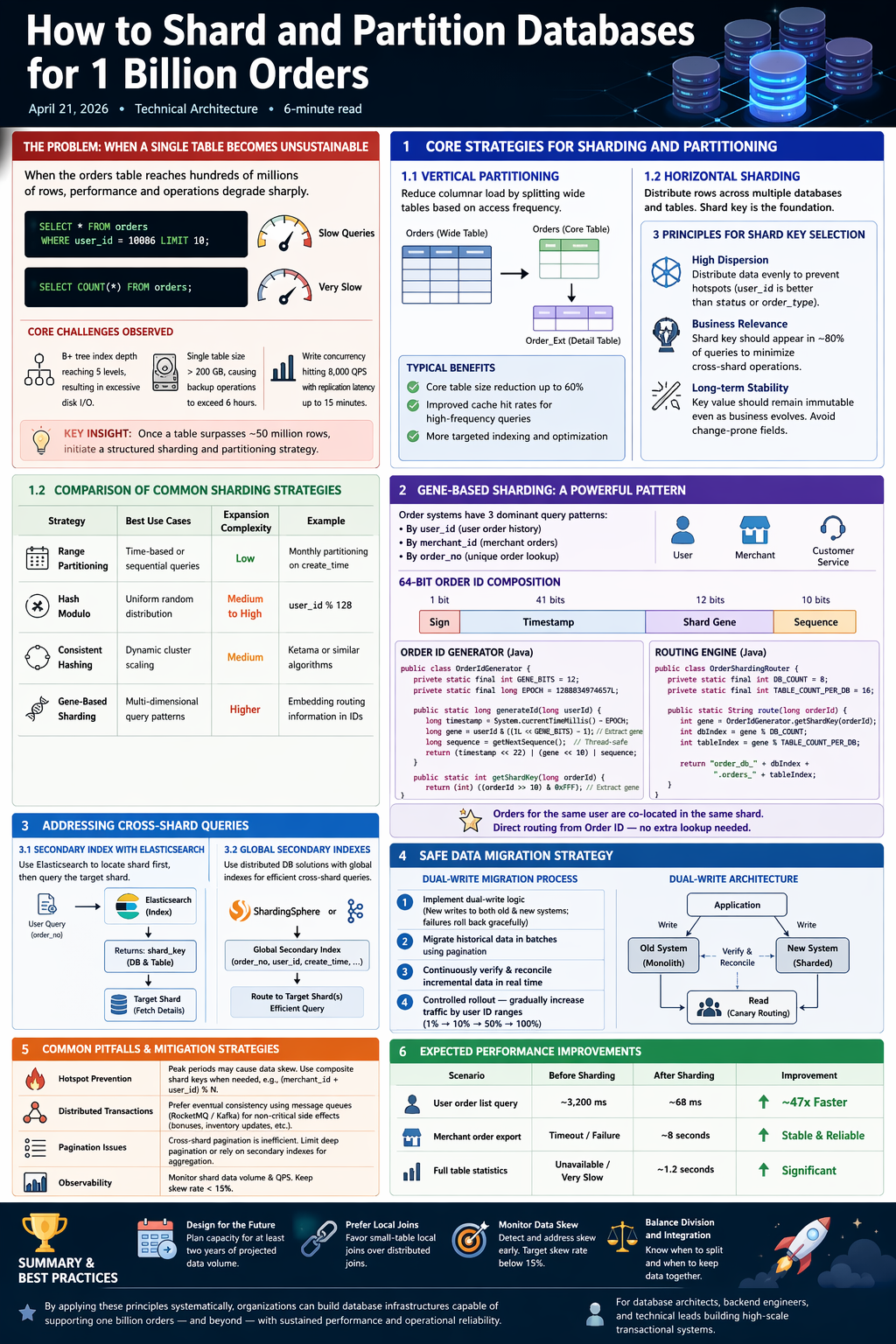
Consider a typical high-traffic e-commerce scenario where the orders table has reached 700 million rows. Common operations begin to degrade significantly:
-- Simple filtered query becomes painfully slow
SELECT * FROM orders WHERE user_id = 10086 LIMIT 10;

-- Full table operations turn impractical
SELECT COUNT(*) FROM orders;
Core Challenges Observed:
- B+ tree index depth reaching 5 levels, resulting in excessive disk I/O.
- Single table size exceeding 200 GB, causing backup operations to exceed 6 hours.
- Write concurrency hitting 8,000 QPS with master-slave replication latency reaching 15 minutes.
Key Insight: Once a table surpasses approximately 50 million rows, it is prudent to initiate a structured database sharding and partitioning strategy to maintain performance and operational stability.
1. Core Strategies for Sharding and Partitioning
Effective scaling requires a combination of vertical and horizontal approaches.
1.1 Vertical Partitioning: Reducing Columnar Load
Vertical partitioning involves splitting a wide table into multiple narrower tables based on access frequency and relationships. Frequently accessed columns are isolated, while infrequently used fields (such as detailed logs or metadata) are moved to secondary tables.
Typical Benefits:
- Core table size reduction of up to 60%.
- Improved cache hit rates for high-frequency query paths.
- More targeted indexing and optimization opportunities.
This step serves as an important preparatory measure before horizontal scaling.
1.2 Horizontal Sharding: Distributing Data Across Nodes
Horizontal sharding distributes rows across multiple databases and tables. The choice of shard key is fundamental to success.
Three Essential Principles for Shard Key Selection:
- High Dispersion — The key must distribute data evenly to prevent hotspots (e.g., user_id is generally superior to status or order_type).
- Business Relevance — The shard key should appear in the majority (ideally ~80%) of queries to minimize cross-shard operations.
- Long-term Stability — The key value should remain immutable even as business requirements evolve (avoid fields prone to change, such as phone numbers).
Comparison of Common Sharding Strategies:

2. Gene-Based Sharding: A Powerful Pattern for Order Systems
Order management systems typically support three dominant query patterns:
- Users retrieving their own order history (user_id).
- Merchants viewing orders associated with their account (merchant_id).
- Customer service or operations searching by unique order number (order_no).
A sophisticated solution involves embedding routing “genes” directly into the order identifier using a modified Snowflake ID structure.
64-bit Order ID Composition:
- Sign bit (1 bit) + Timestamp (41 bits) + Shard Gene (12 bits) + Sequence (10 bits)
Here is an illustrative implementation:
public class OrderIdGenerator {
    private static final int GENE_BITS = 12;
    private static final long EPOCH = 1288834974657L;

    public static long generateId(long userId) {
        long timestamp = System.currentTimeMillis() - EPOCH;
        long gene = userId & ((1L << GENE_BITS) - 1);  // Extract gene from userId
        long sequence = getNextSequence();             // Thread-safe sequence
        return (timestamp << 22) | (gene << 10) | sequence;
    }
    public static int getShardKey(long orderId) {
        return (int) ((orderId >> 10) & 0xFFF);        // Extract embedded gene
    }
}
Routing Engine:
public class OrderShardingRouter {
    private static final int DB_COUNT = 8;
    private static final int TABLE_COUNT_PER_DB = 16;

    public static String route(long orderId) {
        int gene = OrderIdGenerator.getShardKey(orderId);
        int dbIndex = gene % DB_COUNT;
        int tableIndex = gene % TABLE_COUNT_PER_DB;

        return "order_db_" + dbIndex + ".orders_" + tableIndex;
    }
}
This approach ensures that orders belonging to the same user are co-located in the same shard, while allowing efficient routing directly from the order ID without additional lookups.
3. Addressing Cross-Shard Queries
Cross-shard operations remain a common challenge. Two effective mitigation strategies include:
3.1 Secondary Index with Elasticsearch
Maintain a lightweight index in Elasticsearch containing essential fields such as order_no, shard_key, and create_time. Queries first resolve the shard location via Elasticsearch, then fetch detailed records from the appropriate shard.
3.2 Global Secondary Indexes
Modern distributed database solutions (such as ShardingSphere or compatible systems) provide global secondary index support, enabling efficient cross-shard queries without full table scans.
4. Safe Data Migration Strategy
Transitioning from a monolithic table to a sharded architecture requires careful execution:
Dual-Write Migration Process:
- Implement dual-write logic (new writes go to both old and new systems; failures roll back gracefully).
- Migrate historical data in batches using pagination.
- Continuously verify and reconcile incremental data in real time.
- Perform a controlled rollout, gradually increasing traffic by user ID ranges (e.g., starting at 1% and progressing to 100%).
5. Common Pitfalls and Mitigation Strategies
- Hotspot Prevention: During peak sales periods, certain merchants or users may create data skew. Use composite shard keys where necessary, such as (merchant_id + user_id) % N.
- Distributed Transactions: Prefer eventual consistency models using message queues (e.g., RocketMQ or Kafka) for non-critical side effects like bonus calculations or inventory updates.
- Pagination Issues: Cross-shard pagination can be inefficient. Consider business-level compromises, such as limiting deep pagination or relying on secondary indexes for aggregation.
6. Expected Performance Improvements
After implementing a well-designed sharding strategy, significant gains are typically observed:

Summary and Best Practices
Successful database sharding for large-scale order systems depends more on thoughtful shard key design than on raw implementation complexity. Gene-based sharding offers an elegant solution for systems with multiple access patterns.
Key Recommendations:
- Design with future growth in mind — plan capacity for at least two years of projected data volume.
- Prioritize small-table local joins over distributed joins whenever possible.
- Establish robust monitoring to detect and address data skew (target skew rate below 15%).
- Balance division with integration — the art of architecture lies in knowing when to split and when to keep data together.
By applying these principles systematically, organizations can build database infrastructures capable of supporting one billion orders — and beyond — with sustained performance and operational reliability.
🔖 Thanks for reading.
- If you enjoyed this article, please consider giving it a clap.👏
- I would appreciate hearing your thoughts in the comments below! 💭
- Follow me for ongoing learning and connection!🔔
메타데이터
- post_id
- 0ba00ba10491
- slug
- how-to-shard-and-partition-databases-for-1-billion-orders-0ba00ba10491
- url
- https://medium.com/codetutorials/how-to-shard-and-partition-databases-for-1-billion-orders-0ba00ba10491
- canonical_url
- https://medium.com/codetutorials/how-to-shard-and-partition-databases-for-1-billion-orders-0ba00ba10491
- author_url
- https://medium.com/@umeshcapg
- status
- ok
- fetched_at
- 2026-06-09 15:37:30