What is SLAM? A Simple Guide to One of Robotics’ Most Powerful Ideas
If you’re even a little curious about how robots understand the world around them, you’ll eventually run into the term SLAM. It’s a…
What is SLAM? A Simple Guide to One of Robotics’ Most Powerful Ideas
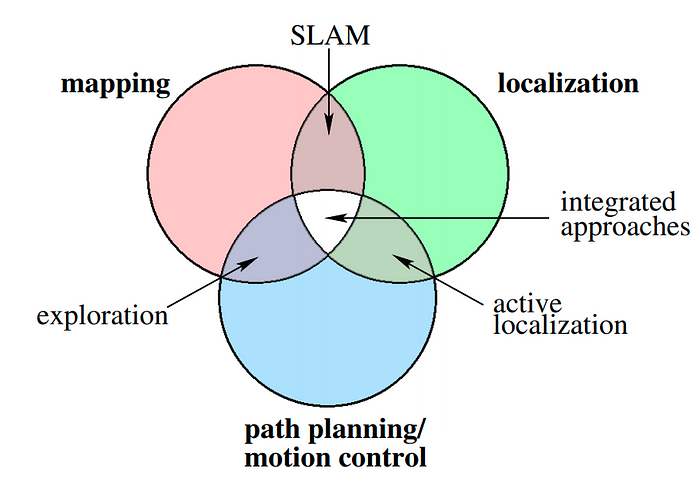
Photo by Medium
If you’re even a little curious about how robots understand the world around them, you’ll eventually run into the term SLAM. It’s a foundational concept in modern robotics — one that enables everything from autonomous vacuum cleaners to self-driving cars.
In this post, we’ll break SLAM down into plain language, explain why it’s so important, and explore where it’s used in the real world.
🔍 So, What Is SLAM?
SLAM stands for Simultaneous Localization and Mapping.
Let’s break that into two parts:
- Localization: Figuring out where the robot is.
- Mapping: Creating a map of the environment.
The key idea? A robot must do both at the same time — without prior knowledge of its surroundings.
Imagine walking into a dark room for the first time, with no map and no idea where you are. As you move around and feel the walls, you start to build a mental layout of the room while also keeping track of your position. That’s what SLAM helps robots do — except with sensors instead of hands.
🧠 Why Is SLAM So Hard?
It might sound simple, but SLAM is a complex challenge because it involves uncertainty and feedback loops:
- If the robot doesn’t know where it is, how can it make a map?
- If the robot doesn’t have a map, how can it figure out where it is?
To solve this, SLAM algorithms use sensor data (like lasers, cameras, or sonar), motion estimation, and probability theory (e.g., Kalman filters, particle filters) to guess and refine both the map and position over time.
In other words, SLAM is like solving a puzzle where the pieces are moving while you’re trying to fit them together.
🛠️ How Does SLAM Work?
Most SLAM systems follow this basic process:
- Perception The robot gathers data from sensors (like Lidar, IMU, camera).
- Odometry Estimation It estimates how far it has moved, using wheel encoders or IMU data.
- Scan Matching / Feature Matching It compares the new data to what it has seen before, to guess where it is.
- Map Update It updates the internal map based on this new location.
- Loop Closure If the robot revisits a place, it corrects past errors in the map.
Through continuous updating and refining, the robot builds a reliable map while constantly updating its location within it.
🚗 Where Is SLAM Used?
SLAM is used in any application where a robot or device must navigate without GPS or pre-made maps. Real-world examples include:
🧹 Home Robots
- Robotic vacuum cleaners like Roomba use SLAM to clean your room efficiently without bumping into walls or repeating paths.
🚗 Autonomous Vehicles
- Self-driving cars use SLAM (often with 3D Lidar) to understand their surroundings in real-time and navigate safely.
🚁 Drones
- Indoor drones can fly through unknown buildings using SLAM with vision sensors.
🤖 Industrial Robots
- Warehouse robots use SLAM to move packages around dynamic, cluttered environments.
🧠 Augmented Reality (AR)
- AR applications like Google ARCore or Apple ARKit use visual SLAM to map your room and place virtual objects accurately.
🧪 Variants of SLAM
There are different types of SLAM depending on the sensors and environments:
- Lidar-based SLAM: Uses laser rangefinders for high accuracy (e.g., Cartographer, GMapping)
- Visual SLAM (V-SLAM): Uses camera images to extract features and track motion (e.g., ORB-SLAM, RTAB-Map)
- RGB-D SLAM: Uses depth cameras (e.g., Kinect, Intel RealSense)
- 3D SLAM: Extends SLAM to build full 3D models of environments
📌 Why Should You Care About SLAM?
SLAM is not just a tool — it’s a key building block of intelligent robotics. It enables robots to:
- Be truly autonomous
- Navigate unknown environments
- Interact intelligently with the physical world
If you want to get into robotics, self-driving cars, drone navigation, or even AR/VR, understanding SLAM is a must.
💬 Final Thoughts
SLAM is where robotics starts to feel like magic: a machine that can learn, adapt, and move through the world like a living thing. But behind that magic is math, algorithms, and clever engineering.
As robots become more common in our daily lives, from delivery bots to warehouse workers to personal assistants, SLAM will be the invisible force guiding them through the world.
And now — you know what it is.
메타데이터
- post_id
- 18b9502974c3
- slug
- what-is-slam-a-simple-guide-to-one-of-robotics-most-powerful-ideas-18b9502974c3
- url
- https://medium.com/@NAMGH/what-is-slam-a-simple-guide-to-one-of-robotics-most-powerful-ideas-18b9502974c3
- canonical_url
- https://medium.com/@NAMGH/what-is-slam-a-simple-guide-to-one-of-robotics-most-powerful-ideas-18b9502974c3
- author_url
- https://medium.com/@NAMGH
- status
- ok
- fetched_at
- 2026-06-16 19:09:56