Why Software Teams Stay Busy but Ship Slowly
The problem is rarely laziness. It is context switching, unclear ownership, vague requirements, and codebases that make every small change…
Why Software Teams Stay Busy but Ship Slowly
The problem is rarely laziness. It is context switching, unclear ownership, vague requirements, and codebases that make every small change expensive.
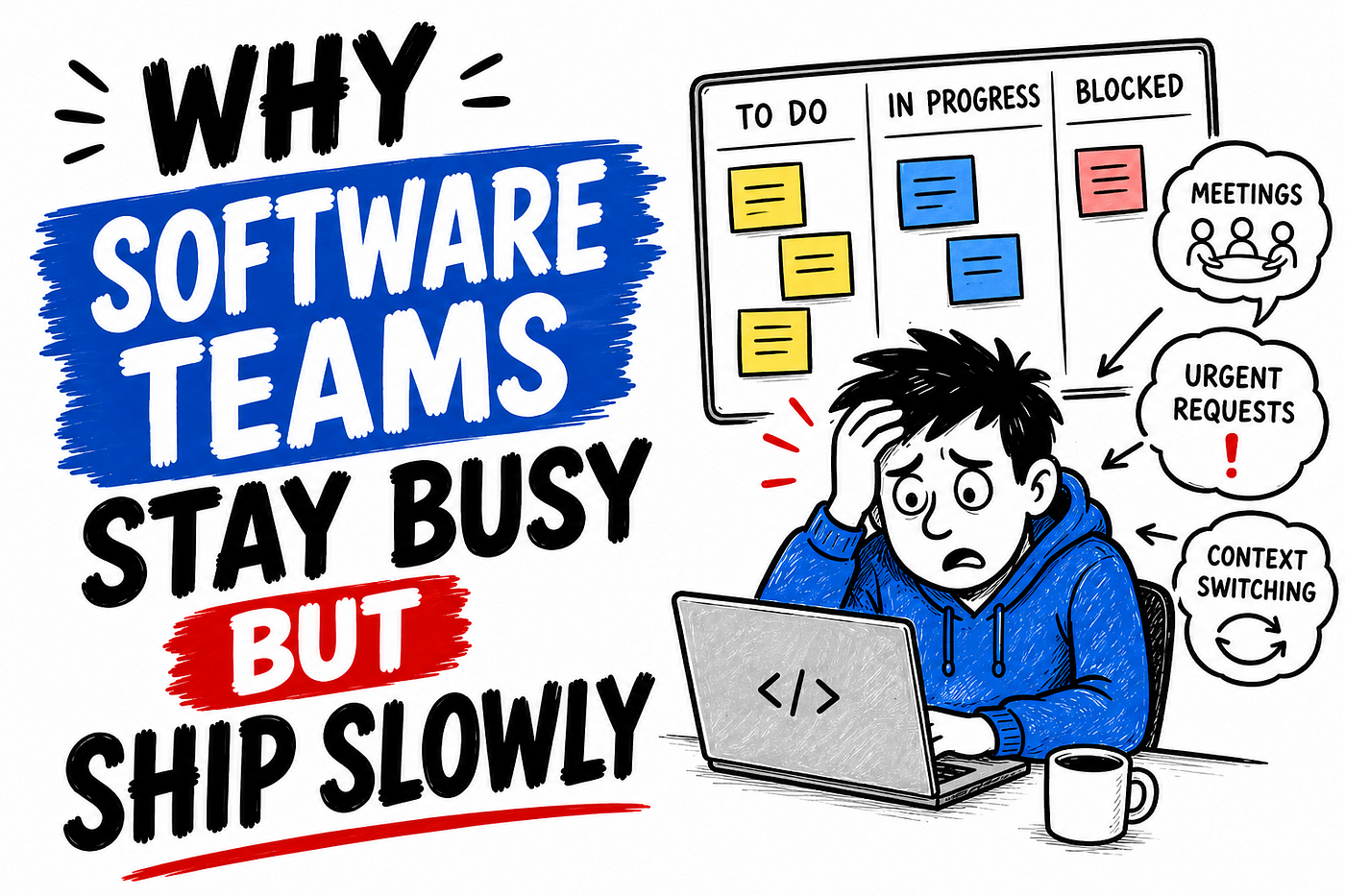
Most software teams are not slow because developers are lazy.
They are slow because everyone is busy with work that looks important but does not move the product forward.
The team is answering Slack messages. Reviewing unclear pull requests. Fixing small bugs from last week’s release. Rewriting half-finished work because the requirement changed again. Jumping between tickets. Explaining the same broken flow to three different people. Trying to understand a codebase where every simple change touches six files.
Everyone is working.
The product is barely moving.
That is the uncomfortable part. A software team can look extremely active from the outside while producing very little meaningful progress. Standups are full. Boards are full. Pull requests are open. Meetings are happening. Developers are online. Bugs are being discussed. Managers see motion everywhere.
But motion is not shipping.
I have seen teams where developers were exhausted every day, yet features still slipped. Nobody was wasting time in an obvious way. Nobody was sitting idle. The real problem was that the team had built a system where starting work was easy, interrupting work was normal, and finishing work was painfully expensive.
That is how teams stay busy and ship slowly.
Busyness Feels Productive Because It Creates Visible Motion
Busy work is dangerous because it looks responsible.
A developer answers a message quickly. That feels helpful. They jump into a bug investigation. That feels urgent. They review a pull request between two meetings. That feels collaborative. They pick up another ticket before finishing the first one because the board looks overloaded. That feels proactive.
None of these actions are bad by themselves.

The problem begins when a team spends most of its energy reacting instead of finishing.
Software work requires long stretches of connected thinking. You do not understand a messy payment flow in five minutes. You do not safely refactor an authentication path while checking Slack every three minutes. You do not design a clean API contract between meetings. You do not debug a production issue well while also reviewing an unrelated pull request and answering a product question.
But many teams behave as if development is just a sequence of small tasks that can be paused and resumed without cost.
That is not how real engineering works.
Every interruption forces the developer to rebuild context. What was I changing? Why did this test fail? Which branch was I on? What assumption was I checking? What did I already rule out? Where does this state come from? Which edge case was I holding in my head?
The cost is not only the interruption. The cost is the mental reload.
A team can lose hours every day without anyone noticing because those hours disappear inside context switching. Nobody logs “lost twenty minutes remembering what I was doing.” Nobody creates a ticket for “reconstructed half a debugging path after a meeting.” But that is where the time goes.
The practical takeaway is simple: visible activity is not the same as progress. Teams ship when they protect the kind of focus that lets developers finish hard things, not when they maximize how many conversations everyone can join.
Unclear Requirements Create Work That Has to Be Rewritten
One of the fastest ways to make a team busy is to let developers start with vague requirements.

At first, this feels like speed. The ticket says “improve the billing page,” “add export support,” “fix checkout issue,” or “make the dashboard easier to use.” The team wants momentum, so someone starts building. A few days later, product sees the implementation and says, “That is close, but not exactly what we meant.”
Now the developer is not finishing. They are rewriting.
This happens constantly in software teams. The requirement was never clear enough to build against, but the ambiguity stayed hidden until code made it visible. Then everyone treats the rework as normal development.
It is not normal development. It is preventable waste.
A vague requirement creates multiple versions of the same feature in different people’s heads. Product imagines one thing. Design imagines another. Backend assumes a simpler flow. Frontend discovers an edge case. QA tests a path nobody discussed. The developer builds the most reasonable interpretation they can, then gets punished by reality.
The issue is not that requirements need to be perfect. They never are. Real products evolve. Users surprise you. Edge cases appear. But a team should clarify enough before coding that everyone understands what “done” means.
A good engineering team asks sharper questions earlier.
What user problem are we solving? What is out of scope? What states must the UI handle? What happens when the API fails? Who can access this feature? What should be logged? What does success look like? What does this replace? What should not change?
These questions can feel slow in the moment. They are not slow. They are cheaper than rewriting the same work twice.
A common failure mode is a ticket that describes output but not behavior. “Add CSV export” sounds clear until you ask what filters apply, what columns are included, what permissions matter, how large exports are handled, whether the export is synchronous, and what happens when the data changes during export.
The team that asks those questions before coding looks slower for one hour.
The team that does not ask them looks busy for one week.
Nobody Owns the Work, So Everyone Touches It
Slow teams often have a hidden ownership problem.
A ticket is assigned to one developer, but the work depends on five people. Product owns the requirement. Design owns the screen. Backend owns the API. Frontend owns the UI. QA owns validation. DevOps owns deployment. Security has concerns. Customer support has context. Nobody owns the full path from idea to shipped behavior.
So the work bounces.

A developer waits for clarification. Then waits for an API change. Then waits for design confirmation. Then waits for review. Then waits for QA. Then finds out the original requirement missed an edge case. Then reopens the pull request. Then another reviewer asks why the pattern does not match a similar feature. Then the ticket moves back to in progress.
Everyone contributed.
Nobody truly owned the outcome.
This is how small features become slow. Not because the code is huge, but because the decision path is fragmented. Every handoff adds delay. Every unclear owner adds negotiation. Every missing decision sends the work backward.
Ownership does not mean one developer does everything. That is not realistic. It means someone is responsible for driving the work to completion, identifying blockers early, and making sure decisions do not evaporate between people.
Without ownership, teams confuse participation with progress.
You can see this in pull requests. A PR sits open for three days because everyone assumes someone else will review it. A comment asks for a change, but nobody decides whether it is required or optional. One reviewer focuses on naming. Another questions the architecture. A third notices the requirement is unclear. The author updates half the code, then waits again.
The PR is active. The feature is not shipping.
A better team makes ownership explicit. Who is the driver? Who must approve? Who is only giving optional feedback? Who decides tradeoffs? Who confirms done? Who removes blockers?
This does not require heavy process. It requires clarity.
The takeaway: work moves faster when ownership is clear. When ownership is vague, even simple changes become group negotiations.
Too Much Work in Progress Makes Everything Slower
Many teams are slow because they start too much.
The board has ten tickets in progress. Every developer is juggling multiple tasks. Half the pull requests are waiting for review. QA is testing work that depends on unfinished backend changes. Product is asking for updates on five parallel features. Everyone feels busy because everyone is touching many things.
But nothing reaches the finish line.
Software delivery is not improved by starting more work than the team can finish. It usually gets worse. More work in progress means more context switching, more partially completed decisions, more stale branches, more merge conflicts, more forgotten assumptions, and more coordination overhead.
A half-finished feature is not value. It is inventory.
It occupies mental space. It creates dependencies. It becomes harder to resume. It may need to be rewritten when the codebase changes around it. It gives managers the illusion that progress is spread across many areas, when in reality the team has only created more unfinished work to track.
This is especially painful in teams that measure progress by ticket movement instead of shipped outcomes. Moving five cards to “in progress” feels better than saying, “We will finish two things properly before starting the next three.”
But finishing fewer things is often the faster path.
A team that limits work in progress forces important conversations earlier. Is this ticket ready? Do we have the API contract? Is design final enough? Who is reviewing? What is blocking release? What must be cut to ship the core behavior?
Reducing work in progress can feel uncomfortable because it exposes the real bottlenecks. Maybe review is slow. Maybe requirements are weak. Maybe one person owns too much knowledge. Maybe deployments are risky. Maybe the codebase makes every change expensive.
That discomfort is useful.
It shows where the system is actually slow.
The takeaway: teams do not ship faster by starting more work. They ship faster by finishing important work with less interruption, less waiting, and less hidden rework.
Pull Requests Become Slow When They Are Used to Discover the Plan
A pull request should confirm a direction, not discover the entire direction from scratch.
In slow teams, PR review becomes the place where missing planning finally appears. The author submits code. Then reviewers ask why the data model changed, why the API shape looks different from other endpoints, why the component owns too much state, why the feature handles permissions this way, why the migration is risky, and why the ticket does not mention three edge cases.
These may be valid questions.
But if they appear for the first time in review, the team is already late.
The PR becomes a design meeting with code attached.
This is expensive because code creates attachment. Once someone has implemented a solution, changing direction costs more emotionally and technically. The author has spent time. The branch has grown. Tests were added. The solution might work locally. Now architectural feedback feels like rejection, even when it is correct.
Good teams do not wait until review to discuss important shape decisions.
They use lightweight alignment before implementation. Not a giant architecture document. Not a three-hour meeting. Sometimes just a short note: “This endpoint will return paginated results using the existing response shape. Filtering stays server-side. Export is out of scope. Permission check will reuse the billing policy. The UI will handle loading, empty, error, and permission denied states.”
That small alignment can prevent days of review churn.
A slow PR is often a symptom, not the root problem. The root problem is that the team started coding before agreeing on the contract, ownership, or scope.
Review should still catch issues. It should improve code. It should challenge risky decisions. But it should not be the first place where the team learns what it is building.
The takeaway: if every important discussion happens in PR review, the team is not reviewing code. It is doing delayed planning at the most expensive moment.
Messy Codebases Turn Small Changes Into Big Projects
Sometimes teams are slow because the product process is broken.
Sometimes they are slow because the codebase charges a tax on every change.
A button change requires touching permissions. A small filter requires changing the API, query builder, cache key, URL state, table component, export logic, and tests. A simple bug requires understanding a helper used in eleven places. A new field breaks a mobile client because response shapes are inconsistent. A copy change reveals that formatting logic lives in three different layers.
The work is small from the outside.
It is not small inside the system.
This is one of the hardest problems for non-engineers to understand. They see a small product request and assume the effort should be small. Sometimes they are right. Often, the codebase has made the simple thing expensive.
A codebase becomes slow when boundaries are unclear, business rules are duplicated, components are overloaded, APIs are inconsistent, tests are fragile, and nobody trusts changes to stay local.
Developers then spend most of their time protecting themselves from the system.
They trace call paths. They search for duplicated rules. They run tests that fail for unrelated reasons. They ask senior engineers if an area is safe to touch. They add defensive checks because they cannot trust upstream data. They manually test edge cases because automated coverage is weak. They avoid refactoring because the blast radius is unknown.
This is work.
But it is not product progress.
The better approach is not to stop feature work for six months and rewrite everything. That usually creates new problems. The better approach is to reduce change cost in the areas where the product keeps moving.
If the billing page changes every sprint, its rules need clearer ownership. If the table component blocks every feature, it needs a smaller contract. If API inconsistency slows frontend work, response shapes need agreement. If tests are noisy, the team needs to fix the test signal instead of ignoring it.
Technical debt is not equally important everywhere. The most expensive debt is in the path of frequent change.
The takeaway: when every small request becomes a large investigation, the team does not have a speed problem. It has a change-cost problem.
Constant Interruptions Destroy the Deep Work Software Requires
Software teams often underestimate how much deep work their systems demand.
A developer may need to hold a full flow in their head: request state, user permissions, cache behavior, database query, API response, frontend rendering, error state, test setup, and deployment risk. That mental model takes time to build. Once built, it is fragile.
Then a message arrives.
“Quick question.”
Then another.
“Can you review this?”
Then a meeting starts in twelve minutes.
Then a production alert appears.
Then someone asks for an estimate.
By the time the developer returns to the original task, the mental model is gone or damaged. They resume with less confidence, reread the same files, rerun the same tests, and rediscover the same assumptions.
The team sees a developer working all day.
The developer feels like they got nothing meaningful done.
This is not weakness. It is the nature of complex work.
Focus is not a personal luxury in software engineering. It is part of the production system. A team that constantly interrupts developers is not being collaborative. It is damaging its own delivery capacity.
There is nuance here. Teams cannot eliminate all interruptions. Production incidents matter. Blocked teammates need help. Fast communication has value. But if everything is urgent, nothing is protected. If every question deserves immediate attention, the team has chosen responsiveness over throughput.
Strong teams create communication norms that protect focus without creating isolation.
They batch non-urgent questions. They define response expectations. They create focus blocks. They avoid scheduling meetings across the entire day. They use written context before interrupting. They make ownership clear so every question does not route through the same senior engineer.
The goal is not silence. The goal is intentional communication.
The takeaway: a team that protects focus ships more than a team that treats every developer as always available.
Vague “Done” Creates Endless Almost-Finished Work
A lot of slow shipping hides inside the word “almost.”
The feature is almost done, but needs one API change. The UI is almost done, but error states are missing. The backend is almost done, but permissions are unclear. QA is almost done, but found a weird edge case. The release is almost ready, but migration needs review. The ticket is almost done, but product wants one more adjustment.
Almost done is where teams lose weeks.
This happens when “done” is not defined early enough. Developers finish the part they understood, then discover that done means more than implementation. It means tested, reviewed, documented where necessary, observable, permission-safe, deployable, and accepted by the people who requested it.
Weak teams define done at the end.
Strong teams define done before work starts.
That does not mean every detail is known upfront. It means the team agrees on the minimum conditions for shipping. What must work? What can be cut? What edge cases matter now? What will be handled later? What evidence proves this is ready? What tests or checks are required? Who accepts the result?
Without this agreement, every feature becomes a moving target.
This is especially common in UI work. A ticket says “build user management table.” The developer builds the table. Then the team realizes it needs empty states, loading states, failed API states, pagination, search, role-based actions, disabled states, audit visibility, and export behavior. Some of those may be necessary. Some may not. But discovering all of them late makes the work feel endless.
The better approach is to make done visible.
A short checklist can save days. Not a bureaucratic checklist with twenty boxes nobody reads. A practical definition of what must be true for this specific work to ship.
Done is not when the developer stops typing.
Done is when the product can safely absorb the change.
The takeaway: slow teams have many things almost finished. Faster teams make done concrete enough that work can actually leave the system.
Teams Mistake Local Optimization for Delivery
A common productivity trap is improving one part of the process while ignoring the whole flow.
A developer codes quickly, but review is slow. Backend ships an API, but frontend cannot use it because the contract is unclear. Product writes many tickets, but half are not ready. QA finds issues late because acceptance criteria were vague. DevOps can deploy fast, but releases are risky because feature flags are messy.
Each function may be doing its job.
The system still ships slowly.
Software delivery is a flow problem. Work moves from idea to shipped behavior through many steps. If one step is optimized while another creates delay, the team does not get faster. It just creates queues.
This is why individual productivity advice often misses the point. Telling developers to type faster, use better shortcuts, or manage their time better will not fix a team where requirements are unclear, reviews take days, deployments are scary, and the codebase makes every change risky.
The bottleneck is rarely one developer’s effort.
The bottleneck is usually in the handoffs, decisions, feedback loops, and system design.
A team should ask where work waits. Does it wait for requirements? For backend changes? For review? For QA? For deployment? For one senior engineer’s approval? For product clarification? For test fixes? For someone to decide scope?
Where work waits, the team is slow.
This is more useful than asking why people are not working harder. Most developers are already working hard. The better question is why so much of that work fails to become shipped value.
The takeaway: productivity is not about keeping every person busy. It is about making valuable work move cleanly through the system.
Real Progress Comes From Finishing Fewer Things Properly
The answer to slow shipping is not more pressure.
Pressure often makes the problem worse. Under pressure, teams start too much, clarify too little, skip cleanup, rush reviews, accept vague requirements, and push complexity forward. That may create short-term motion, but it increases long-term drag.
Real progress usually comes from doing fewer things with more discipline.
Protect focus. Clarify done. Reduce scope. Limit work in progress. Improve ownership. Fix painful boundaries. Make review smaller and earlier. Cut vague work before it becomes rework. Reduce the cost of change in areas the product touches most.
None of this sounds glamorous.
That is why many teams avoid it.
It is easier to say “we need to move faster” than to admit the team has too much unfinished work. It is easier to ask developers for more updates than to fix unclear ownership. It is easier to celebrate busyness than to measure shipped outcomes. It is easier to push another feature into the sprint than to ask why the last five are still open.
But software teams do not ship slowly because they lack activity.
They ship slowly because too much activity is disconnected from completion.
The strongest teams are not calm because they have less work. They are calm because their work has fewer leaks. Fewer unclear tickets. Fewer surprise decisions in review. Fewer half-finished branches. Fewer urgent interruptions. Fewer accidental dependencies. Fewer areas of the codebase where small changes become dangerous.
They still work hard.
They just spend more of that effort on finishing.
That is the difference.
A busy team can look impressive on a dashboard and still fail to move the product. A focused team may look less chaotic, but it ships because it protects the path from decision to delivery.
Most teams do not need more motion.
They need less waste between starting and finishing.
Call to Action
👏 Found it useful? Clap. 💬 Got thoughts? Comment. 🔔 Follow for more insights, practical lessons, and ideas that help you grow professionally and personally.
메타데이터
- post_id
- 18f5ed0ea3f9
- slug
- why-software-teams-stay-busy-but-ship-slowly-18f5ed0ea3f9
- url
- https://medium.com/skillstuff/why-software-teams-stay-busy-but-ship-slowly-18f5ed0ea3f9
- canonical_url
- https://medium.com/skillstuff/why-software-teams-stay-busy-but-ship-slowly-18f5ed0ea3f9
- author_url
- https://medium.com/@codetune
- status
- ok
- fetched_at
- 2026-06-22 17:31:34