Why I Built an AI That Compares Art Styles Instead of Mixing Them
What started as an experiment to stop AI from blending artistic styles became one of the most useful creative tools I’ve built.
Why I Built an AI That Compares Art Styles Instead of Mixing Them
What started as an experiment to stop AI from blending artistic styles became one of the most useful creative tools I’ve built.
When I first started experimenting with AI-generated art, I wasn’t trying to build a GPT.
I was trying to answer a simple question.
Which artistic style works best for this image?
So I opened a regular ChatGPT conversation and began generating the same subject in different styles.
At first, everything worked exactly as I hoped.
A watercolor version.
An oil painting.
A charcoal sketch.
An Art Nouveau illustration.
A stained glass design.
Then something unexpected happened.
As I continued experimenting, the styles began to bleed into one another.
The watercolor started borrowing textures from oil painting. Art Nouveau picked up details that belonged somewhere else. Instead of seeing each artistic language clearly, every new image carried traces of the previous one.
Comparing styles became harder because I was no longer looking at clean examples.
I started calling it style bleed.
That’s when I realized I didn’t need another image generator.
I needed a better way to compare artistic styles.
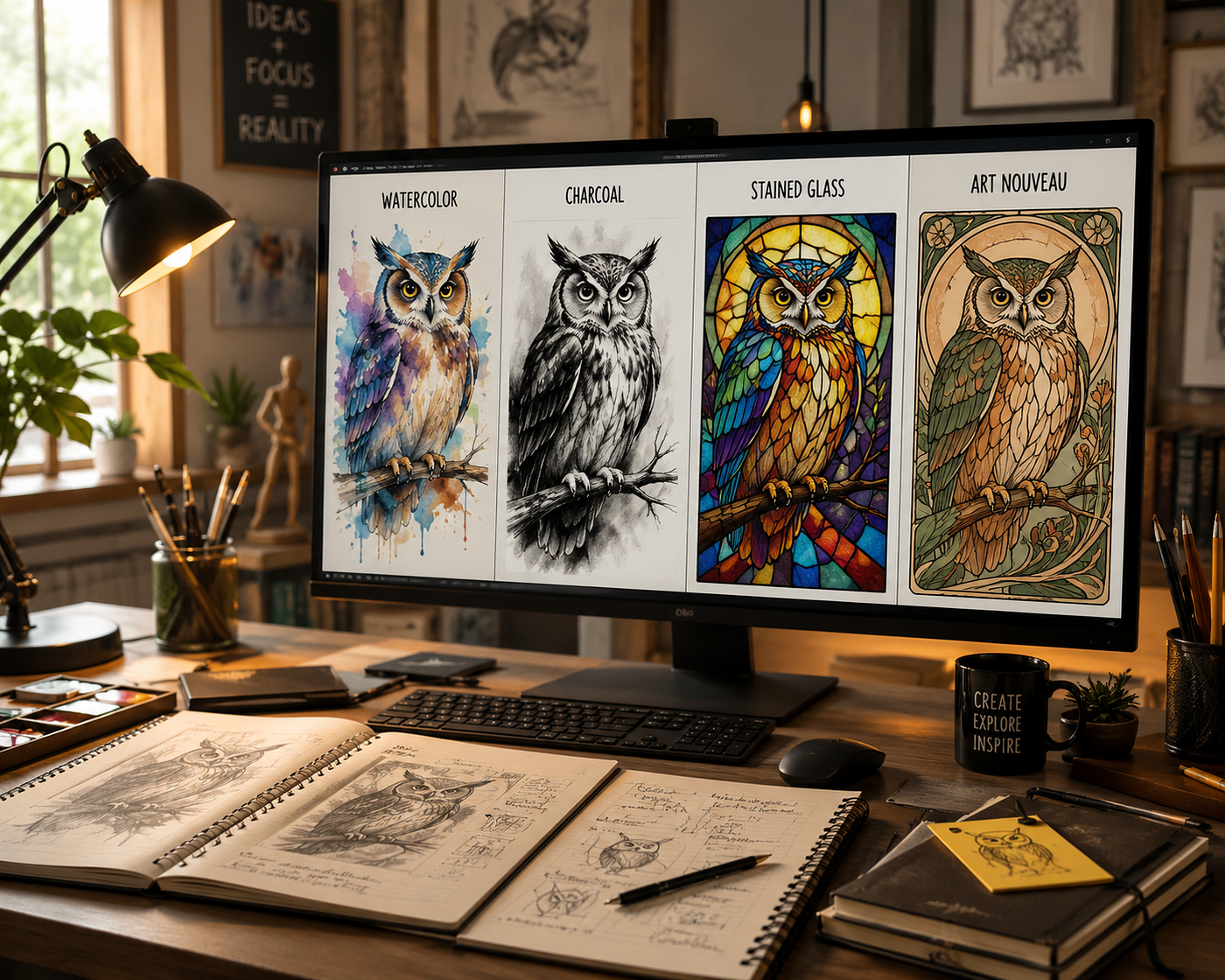
The goal wasn’t generating more images. It was comparing styles clearly.
The Problem Wasn’t AI
AI was doing exactly what I asked.
The problem was the workflow.
A normal conversation is designed to maintain context. That’s incredibly useful for writing, brainstorming, and coding.
It’s less useful when every artistic style should be treated as a completely independent creative direction.
I didn’t want one style influencing another.
I wanted every image to begin with a clean slate while keeping the subject exactly the same.
Only then could I make a fair comparison.
Building a Better Comparison Tool
Instead of continuing in a standard chat, I built a custom GPT with one purpose.
Generate each artistic style independently.
The same subject.
The same composition.
The same framing.
Only the artistic language changes.
That simple change transformed the experience.
Suddenly, comparing styles became easy.
Instead of wondering whether differences came from changing prompts or accumulated context, I could focus entirely on what made each style unique.

Keeping everything constant except the style makes creative decisions much easier.
Why Comparison Changes Everything
When you’re choosing an artistic style, you’re making a creative decision.
Should this YouTube thumbnail feel playful?
Should a blog illustration feel elegant?
Would a fantasy novel cover benefit from stained glass, woodcut, or watercolor?
Should an infographic feel modern, vintage, or hand-drawn?
Those decisions become much easier when you’re comparing identical subjects instead of unrelated images.
You’re no longer distracted by different compositions or lighting.
You’re evaluating visual language.
That is exactly what I wanted the GPT to do.
More Than Historical Art Movements
Historical movements are certainly part of the experience.
Comparing Renaissance, Impressionism, Cubism, or Art Nouveau can be fascinating.
But the GPT isn’t limited to art history.
It can explore almost any visual style, including:
- Children’s book illustration
- Editorial illustration
- Comic book art
- Pixel art
- Low poly
- Clay animation
- Paper cut
- Synthwave
- Minimalism
- Flat design
- Graffiti
- Fantasy illustration
- Anime-inspired artwork
- Modern digital painting
The objective isn’t studying history.
It’s finding the visual language that best communicates your idea.

One subject. Countless creative directions.
Who Is This Really For?
As I continued refining AI Art Style Explorer, I realized it was useful for far more people than I expected.
Content Creators
Creators constantly need visuals that match the tone of their videos, newsletters, websites, and social media posts.
Seeing multiple artistic directions side by side makes choosing one much easier.
Designers and Illustrators
Creative professionals often explore several visual directions before committing to one.
The GPT accelerates that exploration without introducing unnecessary variation.
Writers and Game Developers
The same creature, city, or character can feel completely different depending on the artistic language used to portray it.
Comparing styles quickly sparks ideas for world-building, mood, and storytelling.
Educators and Students
While education wasn’t the original goal, the comparisons naturally help people recognize the defining characteristics of different artistic styles.
Learning becomes a welcome bonus rather than the primary objective.
An Unexpected Benefit
The more I used the GPT, the more I realized something.
It wasn’t helping me generate images.
It was helping me make decisions.
That is a subtle but important difference.
Instead of asking AI to surprise me, I was asking it to present clear creative options.
The GPT became less like an image generator and more like a visual decision assistant.

Sometimes the hardest decision isn’t what to create. It’s how to present it.
The Bigger Picture
We often think AI’s greatest strength is generating images quickly.
After building this GPT, I think its greatest strength is something else.
It lets us explore possibilities before committing to a direction.
Instead of asking,
“Can AI create this image?”
we begin asking,
“Which artistic language tells this story best?”
For content creators, designers, writers, educators, marketers, and anyone who communicates visually, that may be the more valuable question.
The GPT doesn’t choose the style for you.
It simply gives you the clarity to choose with confidence.

Great creative decisions begin with clear comparisons.
Closing Thoughts
This project started because I wanted to stop AI from mixing artistic styles together.
What I ended up building was something much more useful.
A tool that makes creative exploration faster, clearer, and far more intentional.
Sometimes the most valuable AI tools aren’t the ones that generate the most impressive results.
They’re the ones that help us make better creative decisions.
메타데이터
- post_id
- 1ac8afc9f412
- slug
- why-i-built-an-ai-that-compares-art-styles-instead-of-mixing-them-1ac8afc9f412
- url
- https://medium.com/creating-custom-gpts/why-i-built-an-ai-that-compares-art-styles-instead-of-mixing-them-1ac8afc9f412
- canonical_url
- https://medium.com/creating-custom-gpts/why-i-built-an-ai-that-compares-art-styles-instead-of-mixing-them-1ac8afc9f412
- author_url
- https://medium.com/@ttrimm
- status
- ok
- fetched_at
- 2026-07-09 00:50:33