Read This Before Power Up Your Jetson AGX Orin
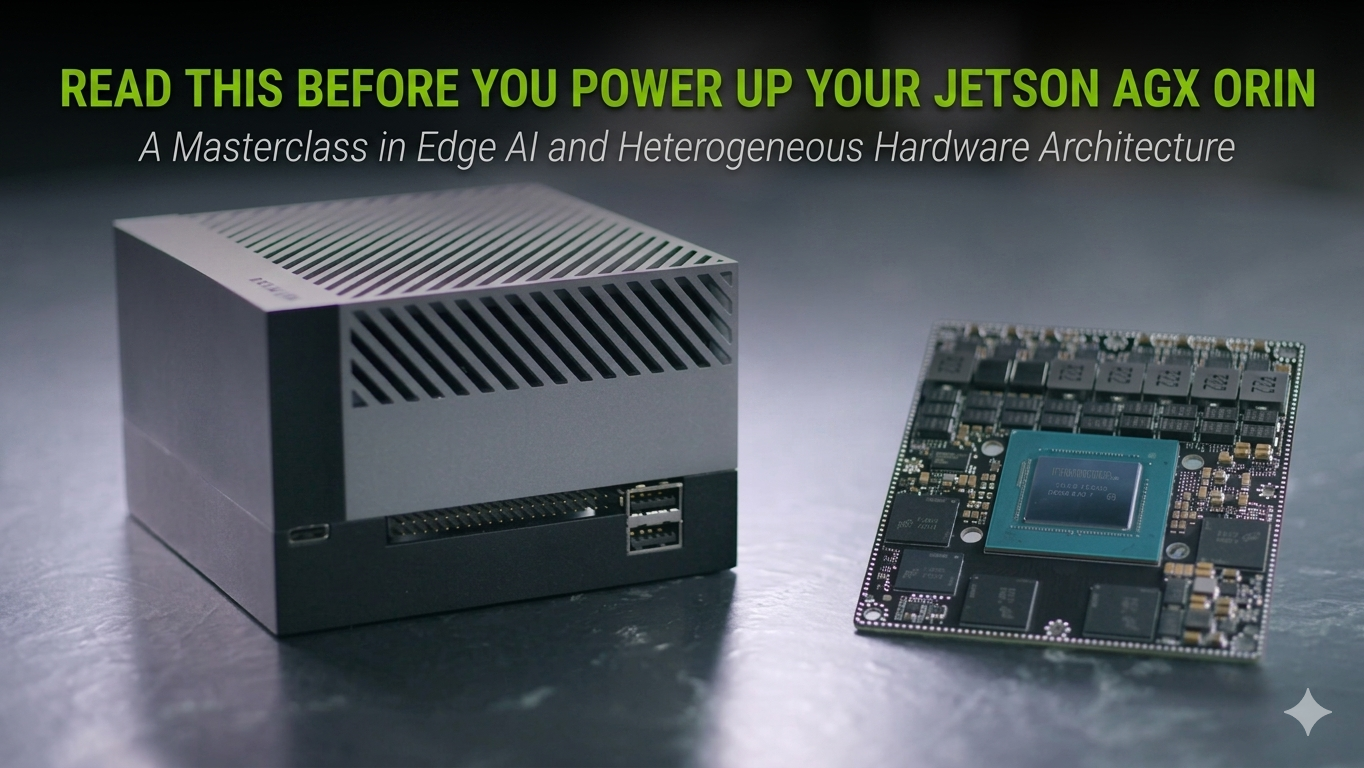
So, you just unboxed the NVIDIA Jetson AGX Orin 64GB Developer Kit.
Read This Before Power Up Your Jetson AGX Orin
Must Known things in AGX Orin
So, you just unboxed the NVIDIA Jetson AGX Orin 64GB Developer Kit.
Sitting on your desk is a literal masterpiece of modern engineering a compact, lunchbox-sized module capable of delivering a staggering 275 TOPS of AI performance. It is easy to look at this device and see it as just a glorified, ultra-powerful Raspberry Pi. You might be tempted to simply plug in an HDMI monitor, flash a quick operating system image onto a spare microSD card, and start running your script.
Don’t flip the power switch just yet.
If you treat the Orin like a standard desktop computer or a simple single-board microcontroller, you will likely run into immediate hardware failures, broken software pipelines, or severe processing bottlenecks. The Jetson AGX Orin operates on an entirely different computing philosophy called heterogeneous architecture. It relies on highly specialized processing engines working in strict coordination to maximize performance-per-watt.
Before you plug anything into that carrier board, here is the architectural and practical blueprint you need to understand to truly unlock the beast.
1. The Core Engines: Rebalancing the CPU and GPU
At the center of any computing architecture sit the CPU and the GPU. However, for a high-performance edge device, standard desktop designs fail because they draw too much power and generate too much heat. NVIDIA resolved this by merging two distinct processing philosophies.
The Brains: An Arm Cortex RISC Architecture
Instead of using a traditional x86 processor (the CISC architecture found in standard AMD or Intel desktops), the Orin utilizes a 12-core Arm Cortex-A78AE CPU .
The structural difference comes down to efficiency:
- x86 (CISC) architectures rely on large, complex instruction sets designed to push raw, single-threaded speed at the cost of high electrical draw (often 65W to over 300W).
- Arm (RISC) architectures use a streamlined, reduced instruction set. Instructions are uniform, requiring significantly simpler decoding hardware.
By utilizing Arm, the Orin achieves enterprise-grade general processing while keeping power consumption low enough for fan-cooled or even fanless deployment. The “AE” designation stands for Automotive Enhancements, meaning these cores feature hardware-level functional safety mechanisms vital for autonomous machines.
The Muscle: The NVIDIA Ampere GPU
For parallel workloads, the Orin features an NVIDIA Ampere architecture GPU packed with 2048 CUDA cores and 64 Tensor Cores .
Unlike older GPU architectures where processing cores were rigidly locked into handling either floating-point math (FP32) or integer math (INT32) sequentially, the Ampere Streaming Multiprocessor features a flexible dual-path design. If a line of software requires heavy physics calculations followed instantly by integer indexing, the cores dynamically alternate tasks without sitting idle. This architecture prevents memory bottlenecks, allowing massive streams of concurrent data to flow smoothly.
2. The Hardware Breakthrough: 2:4 Structural Sparsity
If you look at the math powering modern AI, deep learning models are essentially massive grids of numbers called matrices. During the training process, many of the connection weights in a neural network naturally drop to zero or numbers incredibly close to zero meaning they have no actual impact on the model’s accuracy.
In traditional hardware, these zeros are a waste of time. A standard GPU core will still load the zero, multiply an input by it, get zero, and move on, burning an entire clock cycle and electrical power on useless math.
To solve this, the Ampere architecture inside the Orin introduces a hardware feature called 2:4 Structural Sparsity.

2:4 Structural Sparsity of Ampere Tensor Core
The Math Made Simple
Imagine a simplified, tiny slice of an AI model’s weight matrix (W) containing four values, which needs to be multiplied by an incoming input vector (X):

Standard math requires the hardware to calculate:

This requires 4 multiplications and 3 additions.
With 2:4 structural sparsity, an optimization algorithm enforces a strict pattern: out of every four consecutive elements in a matrix row, exactly two must be zero. The hardware identifies the two least important weights and prunes them to absolute zero. Let’s say w2 and w3 are set to zero:

Because multiplying anything by zero is zero, the mathematical reality changes:

Suddenly, the useful work drops to just 2 multiplications and 1 addition. The computational workload is cut exactly in half. Refer this if you want to know more.
The Hardware Magic
Older architectures could not exploit this efficiently because checking for zeros via software loops creates more lag than it saves.
The Orin’s Ampere Tensor Cores handle this directly in the silicon. The hardware automatically drops the zeros, compresses the sparse matrix into a dense, half-sized matrix, and generates a tiny coordinate metadata map. Using this map, the Tensor Core instantly extracts only the required inputs from the vector, bypassing the rest.
Because a four-element problem is physically compressed into a two-element problem inside the silicon, the hardware can execute two independent matrix operations in the exact same physical space and clock cycle that a single dense operation used to take. This architecture effectively doubles AI math throughput without losing model accuracy.
3. The Secret Weapons: DLA and PVA Accelerators
A common misconception is that the GPU does all the AI work inside the Orin. If that were true, the GPU would quickly bottleneck, causing frames to drop. To prevent this, NVIDIA implemented a heterogeneous pipeline by offloading highly repetitive tasks away from the CPU and GPU onto dedicated silicon accelerators.
The Deep Learning Accelerator (2x NVDLA v2.0)
The NVDLA is a fixed-function hardware pipeline engineered solely to execute the mathematics of neural network inference . It features hardwired execution blocks specialized for convolution, activation functions (like ReLU), and pooling layers.
Using NVIDIA’s TensorRT compiler, an entire neural network model can be converted into a single binary block and handed over to the NVDLA. The accelerator loads the model and processes the data independently through its internal assembly line.

How it frees the GPU: By routing standard, high-throughput neural networks (such as object detection or image classification models) entirely onto the twin NVDLA engines, the main GPU is completely bypassed for those tasks. This leaves the Orin’s 2048 CUDA cores completely free to handle tasks only a general GPU can do well, such as processing irregular non-neural algorithms, complex sensor fusion, or real-time 3D physics simulations.
The Programmable Vision Accelerator (PVA v2.0)

Programmable Vision Accelerator workflow
Before an AI model can look at an image, that image must be captured, cleaned, and prepared. This is where the PVA comes in. It is a highly specialized digital signal processor utilizing a VLIW (Very Long Instruction Word) and SIMD (Single Instruction, Multiple Data) architecture .
- SIMD allows the PVA to apply a single mathematical instruction across an entire row of pixels simultaneously.
- VLIW bundles multiple distinct operations into a single clock cycle, ensuring mathematically predictable, real-time execution speeds.
The PVA specializes in traditional, non-AI computer vision algorithms. It handles lens distortion correction, perspective warping, image scaling, and optical flow (tracking pixel movement between frames).
4. The Unified Software Architecture: JetPack SDK
Hardware is only as good as the software that drives it. To tie these heterogeneous engines together, the Orin runs the NVIDIA JetPack SDK.
JetPack provides the underlying low-level drivers, the Linux operating system, and a suite of accelerated libraries designed to expose the hardware’s capabilities without forcing developers to write complex register-level code.
Key libraries included in this stack are:
- TensorRT: The compiler that optimizes neural networks by fusing mathematical layers and applying quantization (like converting FP32 models to ultra-fast INT8 precision) specifically for the Orin’s architecture .
- VPI (Vision Programming Interface): A software library providing highly optimized computer vision algorithms. VPI features a unique multi-backend design — a developer can write a single piece of code and tell JetPack to execute it on the PVA, the GPU, or the CPU based on which processor has available bandwidth at that exact millisecond.
- NVIDIA Container Runtime: Integrates natively with Docker, allowing developers to wrap complex AI applications into cloud-native containers. This makes deploying software updates across a fleet of thousands of physical edge robots seamless and highly reliable.
The true power of the NVIDIA Jetson AGX Orin 64GB Developer Kit doesn’t stem from brute-forcing calculations with high wattage. Instead, it succeeds through elegant, architectural specialization.
By offloading structural steps to the Arm CPU, deploying flexible Ampere streaming multiprocessors, cutting math in half via 2:4 Structural Sparsity, and utilizing independent NVDLA and PVA pipelines, the Orin sets a new benchmark for edge AI efficiency. It proves that the future of intelligent machines isn’t just about building larger processors it’s about building smarter, highly coordinated silicon architectures.
Let’s Discuss more about the Edge Deployment, connect with me. Thank you.
메타데이터
- post_id
- 1d5adf70867b
- slug
- read-this-before-you-power-up-your-jetson-agx-orin-1d5adf70867b
- url
- https://medium.com/@rusiruerandaka/read-this-before-you-power-up-your-jetson-agx-orin-1d5adf70867b
- canonical_url
- https://medium.com/@rusiruerandaka/read-this-before-you-power-up-your-jetson-agx-orin-1d5adf70867b
- author_url
- https://medium.com/@rusiruerandaka
- status
- ok
- fetched_at
- 2026-08-11 08:08:26





