We Had a Security Breach and Couldn’t Find the Logs.
Imagine your company gets breached, and the first thing you need is the server logs.
We Had a Security Breach and Couldn’t Find the Logs. So I Built a System That Finds Them in Seconds.
Imagine your company gets breached, and the first thing you need is the server logs.
But you can’t find them.
That was the exact situation in this lab scenario. A web gaming company experienced a security incident, and the compliance officer faced a frustrating reality. The logs existed, but accessing and analyzing them took far too long. Every minute lost meant more uncertainty, more risk, and slower response.
This lab challenged me to build a system that ensures logs are never lost, never hard to find, and always ready to analyze instantly.
What I built was a real-world cloud logging pipeline using Amazon EC2, Kinesis Agent, Amazon Data Firehose, Amazon S3, AWS Glue, and Amazon Athena.
And the result was powerful.
The Core Problem
Traditionally, application logs are stored directly on servers. When something goes wrong, engineers must manually connect to those servers, locate log files, and search through massive amounts of raw data.
This process is slow and stressful, especially during a security incident.
The company needed a better solution. They needed logs to be automatically collected, safely stored, organized, and instantly searchable.
The Solution I Built

I created a fully automated pipeline that moves logs from the application server to a system where they can be queried instantly using SQL.
Here is how the system works in simple terms.
The application runs on an Amazon EC2 server. This is where log data is generated.
I installed the Amazon Kinesis Agent on the EC2 server. This agent continuously monitors log files and sends them automatically to Amazon Data Firehose.
Amazon Data Firehose acts like a transport service. It takes the incoming logs and delivers them directly into an Amazon S3 bucket.
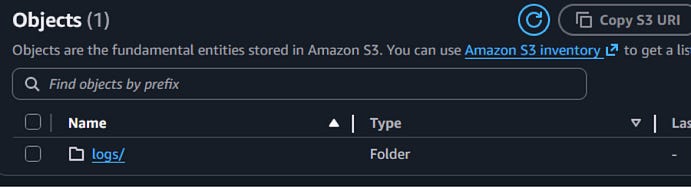
Amazon S3 becomes the central storage location. Instead of logs being scattered across servers, they are now stored securely in one place.
Next, I used AWS Glue. Glue scans the logs stored in S3 and understands their structure. It creates a schema and stores it in the Glue Data Catalog. This step makes the logs organized and readable.

Finally, I used Amazon Athena. Athena allows me to run SQL queries directly on the logs stored in S3. There is no need to move the data or install a database.
Within seconds, I could query logs and get meaningful answers.

What This Means in a Real Security Incident
If suspicious activity happens, the security team can immediately run queries like:
Which IP addresses accessed the system When the access happened What actions were performed How often certain events occurred
Instead of manually digging through files, everything is searchable instantly.
This dramatically reduces response time during incidents.
What I Learned From This Lab
This lab gave me hands-on experience building a real logging architecture used by modern companies.
I learned how to stream logs in real time using the Kinesis Agent and Firehose.
I learned how Amazon S3 provides secure and scalable storage.
I learned how AWS Glue automatically discovers data structure without manual configuration.
I learned how Amazon Athena makes it possible to query massive log datasets using simple SQL.
Most importantly, I learned how to design systems that support security investigations and compliance.
Why This Matters
Logs are one of the most valuable assets in cybersecurity.
They tell the story of what happened.
Without proper logging, companies are blind during attacks.
With the system I built, logs are always available, organized, and ready to analyze. This allows faster investigations, stronger security, and better compliance.
This lab helped me understand how cloud services work together to solve real-world security problems.
And as someone pursuing cybersecurity, building systems like this is a critical skill. It is not just about preventing attacks. It is about being ready to investigate and respond when they happen.
Because in cybersecurity, speed and visibility make all the difference.
메타데이터
- post_id
- 23463a48e131
- slug
- we-had-a-security-breach-and-couldnt-find-the-logs-23463a48e131
- url
- https://medium.com/@NIILK.sh/we-had-a-security-breach-and-couldnt-find-the-logs-23463a48e131
- canonical_url
- https://medium.com/@NIILK.sh/we-had-a-security-breach-and-couldnt-find-the-logs-23463a48e131
- author_url
- https://medium.com/@NIILK.sh
- status
- ok
- fetched_at
- 2026-06-16 19:09:56