Batch vs Streaming: When to Choose and Why
The choice between batch processing and stream processing is an architectural decision that directly affects infrastructure costs, user…
Batch vs Streaming: When to Choose and Why
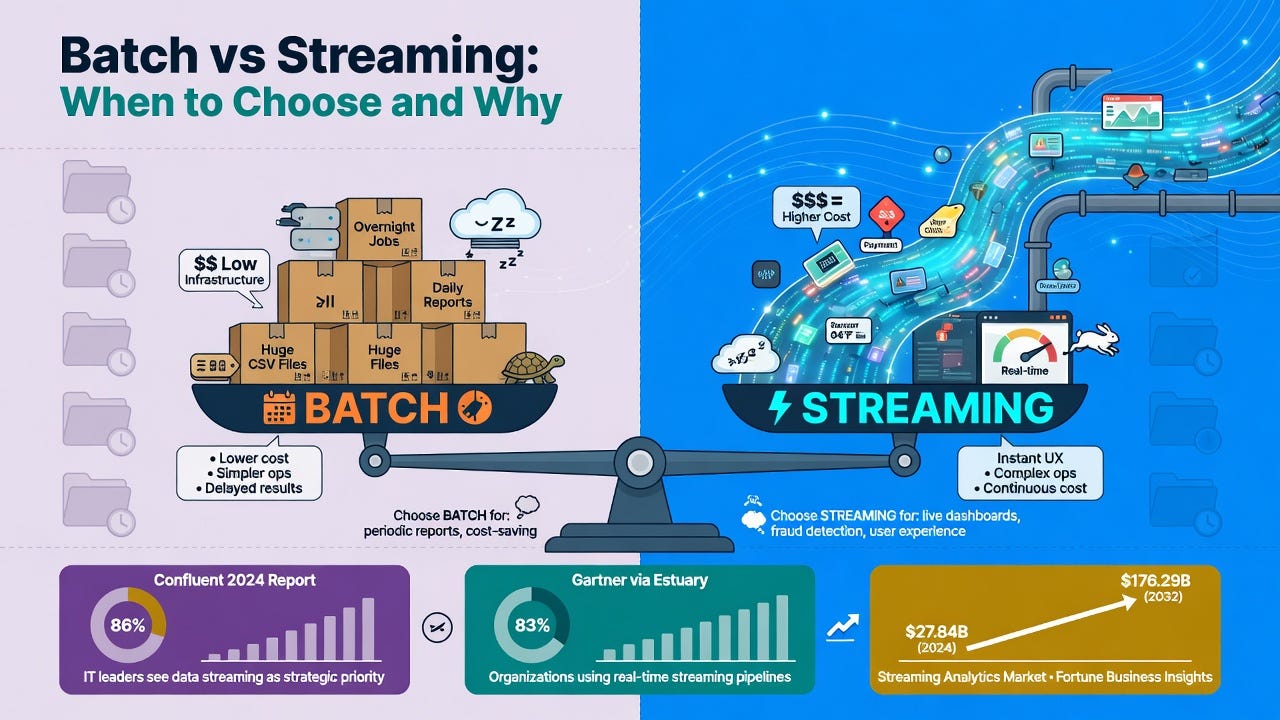
The choice between batch processing and stream processing is an architectural decision that directly affects infrastructure costs, user experience, and operational complexity. According to the Confluent 2024 Data Streaming Report, approximately 86% of IT leaders consider data streaming a strategic investment priority [5]. Meanwhile, a Gartner Peer Community poll cited by Estuary indicates that 83% of organizations now use real-time streaming pipelines [7]. The global streaming analytics market was valued at USD 27.84 billion in 2024 and is projected to reach USD 176.29 billion by 2032, according to Fortune Business Insights [8].
illustration
What Is Batch Processing?
Data is collected first, then processed on a set schedule — hourly, daily, or weekly. This approach is well suited for daily reports, financial reconciliations, and data aggregation tasks that do not require real-time results. According to Databricks, in batch processing the engine does not track which data has already been processed at the source — all available data is processed at the time of execution [2]. Its advantages include lower costs due to scheduled runs, stability through easy rollback and backfill capabilities, and straightforward debugging.
A simple analogy: batch processing is like a courier who picks up packages once a day and delivers them all at once. Confluent compares it to a printed newspaper delivered to your doorstep — information arrives on schedule, not instantly [1]. Batch processing is ideal for scenarios where data does not require immediate action, such as end-of-day reports, billing cycles, or data warehousing workloads [7].
What Is Stream Processing?
Data is processed continuously as it arrives, within seconds to minutes. According to GeeksforGeeks, stream processing can handle data in seconds or even milliseconds [10]. This makes it well suited for real-time notifications, fraud detection, operational monitoring, and live personalization.
An analogy for streaming is a faucet that runs nonstop — data is processed the moment it arrives. Confluent likens it to a real-time news feed where information is delivered instantly [1]. However, cost and operational complexity are higher because the system must run around the clock. Airbyte emphasizes that continuous processing demands constant computational resources, resulting in higher CPU and memory utilization compared to batch processing [6].
Three Key Parameters for Choosing
1. Latency
How quickly do you need results? If outcomes every 15 to 60 minutes are sufficient, batch is a safe choice. If you need results in under 5 minutes, consider streaming. Databricks explains that in streaming processing, the engine tracks which data has already been processed and only handles new data on subsequent runs [2].
2. Consistency
How complex is it to maintain data accuracy? Batch makes it easier to achieve idempotency. Streaming requires careful state and checkpoint management. Databricks also notes that streaming becomes more complex in scenarios involving out-of-order or late-arriving data, where processing logic must retain information from previous computations [2].
3. Cost
Is your team prepared to manage a system that runs 24/7? Streaming operates continuously, making it more expensive. Batch runs on a schedule, making it more cost-effective. Airbyte highlights that the always-on nature of streaming systems can lead to higher infrastructure costs, particularly during periods of low data volume [6].
The Hybrid Approach: A Realistic Solution
Many organizations adopt a hybrid approach: ingesting data via streaming for fast signals (alerts, real-time UI) while performing heavy aggregation through batch processing (nightly runs) for reports and audits. Snowplow Blog states that data-mature organizations use both batch and streaming approaches across various situations, capitalizing on the unique strengths of each method [3].
Google Cloud describes the concept of Lambda Architecture, where users run parallel copies of a pipeline — one streaming, one batch — to obtain both fast results and accurate results [4]. This approach provides a balance between speed and cost efficiency.
Real-World Use Case: Real-Time Fraud Detection
One of the most compelling use cases for streaming is fraud detection. Confluent explains that batch-based detection catches fraud after it has already occurred — often hours later. Real-time streaming, by contrast, can halt suspicious activity as it happens, minimizing financial impact [9]. Streaming platforms such as Apache Kafka process transactions as they occur, enabling anomaly detection, pattern matching, and automated responses before bad actors can succeed.
Not Sure? Start with Batch
If you are unsure, start with batch processing. Upgrade to streaming when there is a clear, justified need for low-latency data. The classic architecture reference from Martin Kleppmann’s Designing Data-Intensive Applications (O’Reilly, 2017) covers both batch and streaming paradigms in depth in Chapters 10–11 [11]. This book remains an industry standard for understanding the trade-offs between the two approaches.
video from article
- Youtube : https://youtube.com/shorts/PIq9eQGhHm4
https://www.tiktok.com/@belajar12jam.id/video/7630858607336099092
3. Facebook : https://www.facebook.com/share/v/1BHSfHshJD/
4. IG : https://www.instagram.com/reel/DXW7mpnDxd3/?igsh=MW93YnU0ZDg4Mml6eQ==
References
[1] Confluent, “Stream Processing vs Batch Processing,” Confluent Blog. https://www.confluent.io/blog/stream-processing-vs-batch-processing/
[2] Databricks, “Batch vs Streaming,” Databricks Documentation. https://docs.databricks.com/aws/en/data-engineering/batch-vs-streaming
[3] Snowplow, “Batch Processing vs Stream Processing,” Snowplow Blog. https://snowplow.io/blog/batch-processing-vs-stream-processing
[4] Google Cloud, “How Cloud Batch and Stream Data Processing Works,” Google Cloud Blog. https://cloud.google.com/blog/products/data-analytics/how-cloud-batch-and-stream-data-processing-works
[5] Confluent, “2024 Data Streaming Report,” Confluent Resources. https://www.confluent.io/resources/report/2024-data-streaming-report/
[6] Airbyte, “Batch Processing vs Stream Processing,” Airbyte Data Engineering Resources. https://airbyte.com/data-engineering-resources/batch-processing-vs-stream-processing
[7] Estuary, “Batch Processing vs Stream Processing,” Estuary Blog. https://estuary.dev/blog/batch-processing-vs-stream-processing/
[8] Fortune Business Insights, “Streaming Analytics Market,” Fortune Business Insights. https://www.fortunebusinessinsights.com/streaming-analytics-market-108619
[9] Confluent, “Real-Time Streaming Prevents Fraud,” Confluent Blog. https://www.confluent.io/blog/real-time-streaming-prevents-fraud/
[10] GeeksforGeeks, “Difference Between Batch Processing and Stream Processing,” GeeksforGeeks. https://www.geeksforgeeks.org/operating-systems/difference-between-batch-processing-and-stream-processing/
[11] M. Kleppmann, Designing Data-Intensive Applications, O’Reilly Media, 2017. https://www.oreilly.com/library/view/designing-data-intensive-applications/9781491903063/
메타데이터
- post_id
- 26b9c26c7ded
- slug
- batch-vs-streaming-when-to-choose-and-why-26b9c26c7ded
- url
- https://medium.com/@belajar12jam/batch-vs-streaming-when-to-choose-and-why-26b9c26c7ded
- canonical_url
- https://medium.com/@belajar12jam/batch-vs-streaming-when-to-choose-and-why-26b9c26c7ded
- author_url
- https://medium.com/@belajar12jam
- status
- ok
- fetched_at
- 2026-06-22 17:31:34