AI Search for Local Businesses: How to Compete Beyond Google Rankings
Google’s blue links are no longer the finish line. Here’s how local businesses win visibility in ChatGPT, AI Overviews, and Perplexity —…
AI Search for Local Businesses: How to Compete Beyond Google Rankings
Google’s blue links are no longer the finish line. Here’s how local businesses win visibility in ChatGPT, AI Overviews, and Perplexity — and how SoftWin helps them get there.
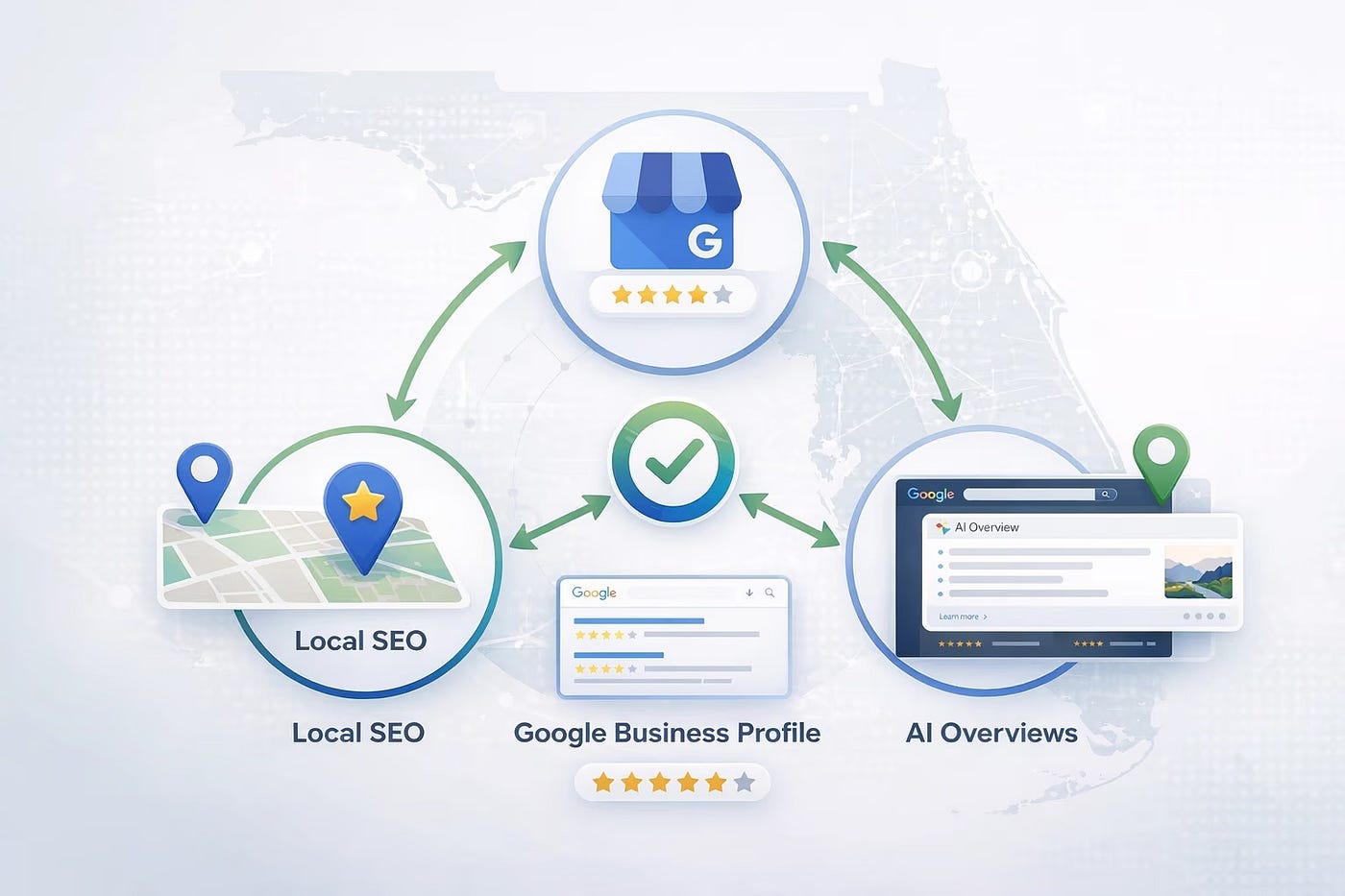
The problem: you can rank #1 on Google and still be invisible
A local bakery in Austin spent two years climbing to the top three of Google’s local pack for “best sourdough bakery near me.” Then AI Overviews rolled out, ChatGPT became a go-to for “where should I eat,” and Perplexity started answering “best bakery in my neighborhood” with a clean, three-sentence summary — citing a competitor with worse rankings but better structured data and fresher reviews.
That scenario isn’t hypothetical anymore. AI Overviews now appear in roughly 68% of local searches, compared to just 39% for the traditional local pack — a 29-point gap that keeps widening. For informational, “near me,” and pricing-style queries, AI-generated answers show up 80–97% of the time, often replacing the ten blue links entirely.
The answer isn’t to abandon SEO. It’s to expand it. Local businesses now need to be visible not just to Google’s crawler, but to the large language models (LLMs) that summarize, recommend, and cite businesses directly inside a conversation — before the user ever sees a ranked list.
This is where AI search optimization, sometimes called generative engine optimization (GEO) or AI Engine Optimization (AEO), becomes a core business function, not a marketing footnote.
What AI search is and how it actually works
Traditional SEO optimizes for a ranking algorithm that returns a list of links. AI search optimizes for a generation process: the AI reads multiple sources, decides which ones are trustworthy and relevant, and synthesizes a single answer — sometimes with citations, sometimes without.
For local businesses, that pipeline typically pulls from four layers:
- Structured business data — your Google Business Profile (GBP), Apple Business Connect, Bing Places, and data aggregators like Data Axle or Foursquare. This is the raw NAP (Name, Address, Phone) layer LLMs use to confirm a business exists and where.
- Third-party signals — reviews, review responses, and mentions on Reddit, YouTube, local blogs, and forums. Interestingly, Reddit accounts for around 21% of citations in Google AI Overviews, more than any single business website.
- On-site structured content — schema markup (LocalBusiness, FAQ, Article), clear FAQs, pricing tables, and location pages with genuine local detail rather than templated copy.
- Freshness and specificity — AI systems favor recently updated, fact-dense content. Studies show AI-cited pages are, on average, about 25% fresher than pages that rank well in classic organic search but never get cited by AI.
In short: Google’s algorithm asks “what’s the most relevant page?” AI search asks “what’s the most citable, verifiable, and current fact?” That’s a different game, and it rewards different behavior.
Why this matters for business — not just marketing
For a local business owner, this isn’t an abstract algorithm shift. It has direct commercial consequences:
- Lower click-through, higher stakes per click. When an AI Overview answers the query directly, top-ranking pages see roughly 58% lower average click-through rates. Fewer people click through — but the ones who do are further along in their decision, making each visit more valuable if you’re the business actually being recommended.
- AI is already a discovery channel, not a future one. ChatGPT is reportedly the third most-used source for local business recommendations, behind only Google and Facebook. That’s consumer behavior happening now, not a 2028 prediction.
- Being “chosen,” not just “found,” is the new competitive layer. Research suggests AI recommendation engines are roughly 30 times more selective than a Google search results page — they typically surface one or two options per answer instead of ten. If you’re not one of them, you’re functionally invisible for that query, regardless of your organic rank.
- Reputation has a numeric floor. Analysis of AI-recommended businesses shows LLMs tend to favor higher-rated businesses — with average ratings cited in the 3.9–4.3★ range depending on the platform. Review volume and response rate function almost like a second ranking signal.
For SoftWin’s clients — and for any business investing in digital presence — this reframes the KPI conversation. “Where do we rank” is becoming “are we the business the AI recommends,” and those two questions have overlapping but not identical answers.
Key features and steps to compete in AI search
Here’s the practical framework we use when auditing a local business for AI search readiness:
1. Lock down entity consistency. Your business name, address, phone number, category, and description must match, character-for-character, across Google Business Profile, Apple Maps, Bing Places, Facebook, Yelp, and major data aggregators. Inconsistency is one of the fastest ways to get quietly excluded from AI-generated answers, because the model can’t confirm which version is authoritative.
2. Add structured data AI can actually parse. Implementing LocalBusiness, FAQPage, and Article schema correctly has been shown to lift AI citation rates by roughly 28%. This isn't optional technical polish anymore — it's a direct visibility lever.
3. Build “fact-dense” location and service pages. Skip templated copy. Include pricing ranges, comparison tables, FAQs, and named local details (neighborhoods, landmarks, specific services). AI models favor pages that answer a question completely in a few sentences over pages optimized purely for keyword density.
4. Treat reviews as a ranking input, not just reputation management. Respond to close to 100% of reviews, ideally within 24 hours. Roughly 89% of consumers say they prefer businesses that respond to all reviews, and response behavior is increasingly a signal AI systems weigh when deciding who to recommend.
5. Show up where the AI already looks. Since a meaningful share of AI Overview citations come from Reddit, YouTube, and local editorial content rather than brand-owned pages, a presence in relevant local subreddits, video content, and third-party “best of” roundups is now part of the visibility stack — not a nice-to-have.
6. Monitor AI referral traffic separately from organic. Set up GA4 custom channels to track visits arriving from chatgpt.com, perplexity.ai, gemini.google.com, and similar referrers. Without this, AI-driven traffic silently blends into “direct” traffic and the impact becomes invisible in reporting.
SoftWin’s practical take
At SoftWin, we treat AI search visibility as an extension of technical SEO, not a replacement for it — because the two are converging. When we onboard a local business client, the AI-readiness audit now runs alongside the traditional one, checking:
- NAP consistency across every listing we can find, audited quarterly rather than once at launch
- Schema markup validation using structured data testing tools, not just “is it present” but “is it complete and accurate”
- A content gap analysis comparing what AI tools currently say about the client versus their competitors, using direct prompts (“best [service] in [city]”) as a diagnostic
- A review-response workflow built into the client’s ongoing operations, not a one-time cleanup
What we’ve found in practice: the businesses that struggle most with AI visibility are rarely the ones with weak websites. They’re the ones with inconsistent digital footprints — a great website, but a Yelp listing with an old phone number, or a Google Business Profile category that doesn’t match their actual services. AI systems are unforgiving of that kind of inconsistency in a way traditional search sometimes tolerated.
Common mistakes local businesses make
- Optimizing only for Google. Bing Places, Apple Business Connect, and data aggregators feed other AI systems directly. Ignoring them limits visibility on ChatGPT, Siri, and Copilot.
- Using templated location pages. Ten city pages with the same paragraph and a swapped city name read as low-value to both search engines and LLMs — and are easy for AI to detect as duplicate content.
- Letting reviews go unanswered. A strong star rating with no owner responses signals lower engagement than a slightly lower rating with active, thoughtful replies.
- No schema markup, or broken schema. Many sites either skip structured data entirely or implement it incorrectly, which means the effort produces none of the citation benefit.
- Treating this as a one-time project. AI models re-crawl and re-evaluate constantly. A “set it and forget it” NAP audit or content push loses relevance within months.
FAQ
Q: Is AI search replacing Google for local businesses? Not replacing — layering on top. Google remains the largest single traffic source, but AI Overviews, AI Mode, and standalone tools like ChatGPT and Perplexity now intercept a growing share of queries before they ever reach a traditional results page.
Q: Do I need a different SEO strategy for AI search, or does regular SEO still work? Regular technical SEO fundamentals — site speed, mobile usability, clean structure — still matter. What’s new is the added emphasis on structured data, entity consistency, third-party mentions, and content that directly and completely answers a question, rather than content built to rank for a keyword.
Q: How do I know if AI tools are already mentioning my business? Run direct prompts in ChatGPT, Perplexity, and Google’s AI Mode — for example, “best [your service] in [your city]” — and see whether and how you’re mentioned. Set up GA4 referral tracking for AI platforms to catch traffic you might otherwise miss.
Q: Does this apply to very small, single-location businesses, or only multi-location brands? It applies more urgently to small, single-location businesses. Multi-location brands often already have marketing teams managing consistency; independent local businesses are the ones most likely to have outdated listings and no schema markup — exactly the gaps AI systems penalize.
Q: How long does it take to see results from AI search optimization? Entity and schema fixes can influence AI citations within weeks, since many models re-index frequently. Content and reputation-based improvements — building genuine third-party mentions and review volume — typically take a few months to compound.
The bottom line
Ranking on Google is still necessary. It’s no longer sufficient. The businesses that will win the next few years of local discovery are the ones that make themselves easy for an AI to verify, cite, and recommend with confidence — consistent data, structured content, and a reputation that holds up to direct scrutiny.
If you want a clear picture of how AI tools currently describe your business — and a concrete plan to improve it — **SoftWin’s team runs AI-search visibility audits for local and multi-location businesses.** Reach out to get your free AI visibility snapshot and see exactly where you stand against your competitors, beyond the Google rankings you already track.
메타데이터
- post_id
- 26ebba6baa75
- slug
- ai-search-for-local-businesses-how-to-compete-beyond-google-rankings-26ebba6baa75
- url
- https://medium.com/@softwin/ai-search-for-local-businesses-how-to-compete-beyond-google-rankings-26ebba6baa75
- canonical_url
- https://medium.com/@softwin/ai-search-for-local-businesses-how-to-compete-beyond-google-rankings-26ebba6baa75
- author_url
- https://medium.com/@softwin
- status
- ok
- fetched_at
- 2026-08-17 00:03:24