Abusing LLMNR/NBT-NS Poisoning for Initial Active Directory Foothold
Introduction
Abusing LLMNR/NBT-NS Poisoning for Initial Active Directory Foothold
Introduction
In many Active Directory environments, legacy name resolution protocols such as:
- LLMNR
- NBT-NS
remain enabled by default.
These protocols are designed to assist systems when DNS resolution fails, but they also introduce an interesting attack surface that attackers can abuse to capture authentication hashes and gain an initial foothold inside the domain.
In this walkthrough, we explore:
- LLMNR/NBT-NS Poisoning
- Responder
- Inveigh
- NetNTLMv2 Hash Capture
- Offline Password Cracking
- Initial Active Directory Access
Understanding LLMNR & NBT-NS
When a Windows host cannot resolve a hostname through DNS, it may fall back to:
- LLMNR (Link-Local Multicast Name Resolution)
- NBT-NS (NetBIOS Name Service)
The problem is:
Any host on the local network can respond
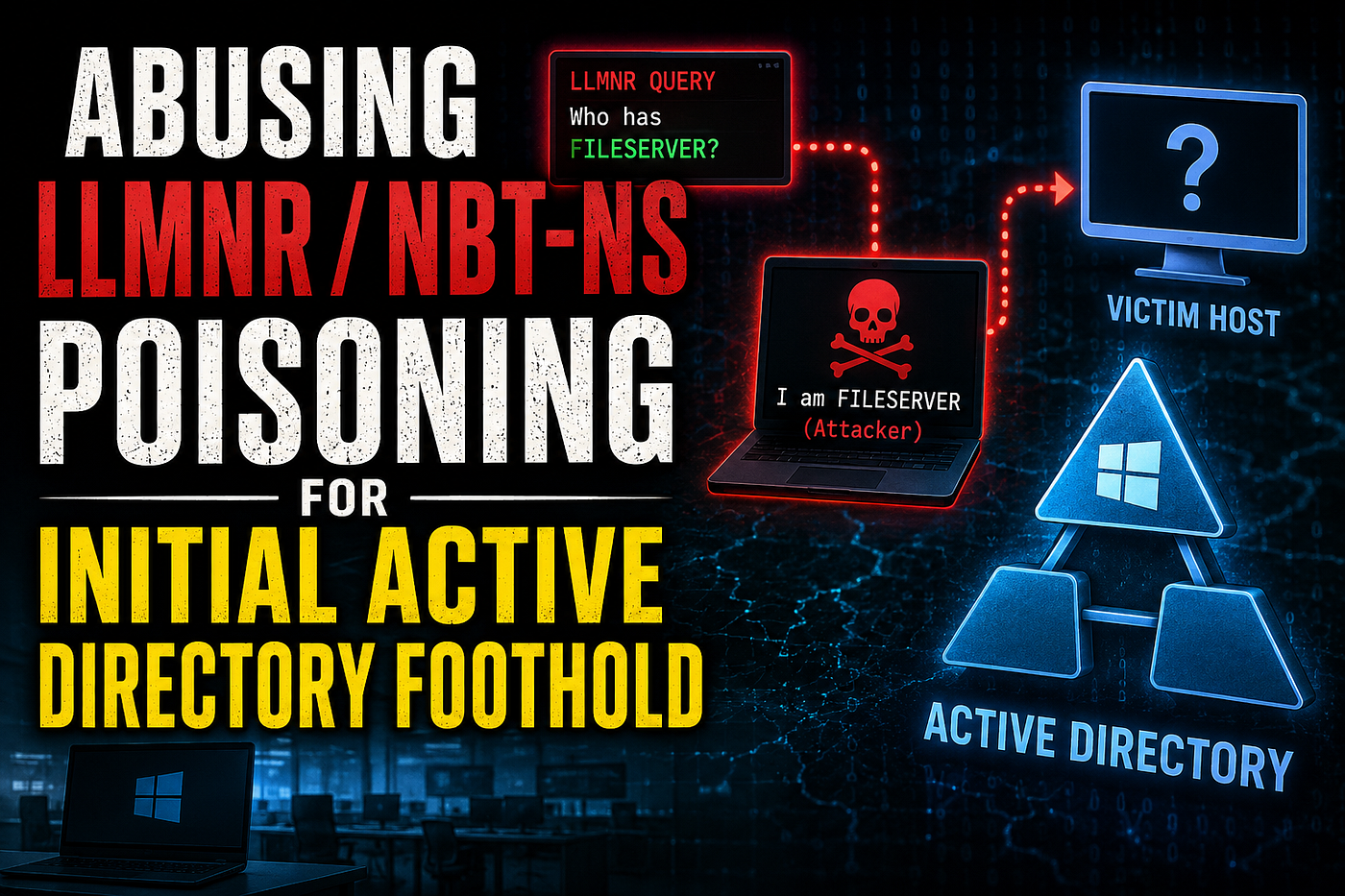
This allows attackers to spoof responses and trick victims into authenticating to the attacker’s machine.
Attack Flow
The attack works like this:
Victim requests unknown hostname
        ↓
DNS resolution fails
        ↓
Victim broadcasts LLMNR/NBT-NS request
        ↓
Attacker responds pretending to be target host
        ↓
Victim sends NTLM authentication
        ↓
Attacker captures NetNTLMv2 hash
Starting Responder
Responder is one of the most commonly used tools for LLMNR/NBT-NS poisoning.
Starting Responder:
sudo responder -I ens224Responder begins listening for:
- LLMNR requests
- NBT-NS requests
- mDNS traffic
and responds as a rogue name resolution source.
Capturing NetNTLMv2 Hashes
After some time, Responder captures authentication requests from hosts on the network.
Example captured hashes:
SMB-NTLMv2-SSP-172.16.5.25.txt
HTTP-NTLMv2-172.16.5.200.txt
These hashes are stored automatically inside:
/usr/share/responder/logsUnderstanding NetNTLMv2
The captured value is:
NetNTLMv2
which is used during NTLM authentication.
Important distinction:
NetNTLMv2 ≠ NTLM HashNetNTLMv2 hashes cannot be directly used for:
- Pass-the-Hash
Instead, they must first be:
Cracked Offline
Cracking the Hash
Using Hashcat:
hashcat -m 5600 hash.txt /usr/share/wordlists/rockyou.txtHash mode:
5600 = NetNTLMv2Successful crack:
FOREND : Klmcargo2At this point we successfully recover:
Cleartext Domain Credentials
Initial Foothold
This becomes the first foothold inside the Active Directory environment.
The attack chain becomes:
LLMNR/NBT-NS Poisoning
        ↓
NetNTLMv2 Capture
        ↓
Offline Cracking
        ↓
Valid Domain Credentials
        ↓
Initial AD Access
Using Inveigh on Windows
The same attack can also be performed from a Windows host using:
Inveigh
Starting Inveigh PowerShell version:
Import-Module .\Inveigh.ps1Launching the attack:
Invoke-Inveigh Y -NBNS Y -ConsoleOutput Y -FileOutput YInveigh Features
Inveigh supports poisoning and spoofing for:
- LLMNR
- NBNS
- DNS
- HTTP
- SMB
- LDAP
- WebDAV
- Proxy Authentication
Captured hashes can be viewed directly from the interactive console.
Viewing Captured Hashes
Inside Inveigh:
GET NTLMV2UNIQUEExample:
backupagent::INLANEFREIGHT
forend::INLANEFREIGHT
svc_qualys::INLANEFREIGHT
Why This Attack Works
The root cause is:
Insecure Name Resolution Protocols
combined with:
- Weak passwords
- NTLM authentication
- Lack of SMB signing
Important AD Concepts
This attack demonstrates several important Active Directory concepts:
ConceptPurposeLLMNR/NBT-NSAlternative name resolutionNTLMWindows authentication protocolNetNTLMv2Challenge-response authenticationResponderRogue responder/spooferInveighWindows-based poisoning toolOffline CrackingRecover cleartext passwords
Common Attack Goals
Captured hashes may lead to:
- Initial foothold
- Lateral movement
- SMB relay
- Privilege escalation
- Domain compromise
depending on:
- Account privileges
- Password strength
- SMB signing configuration
Mitigation
Several mitigations help reduce the risk:
Disable LLMNR
Through Group Policy:
Turn Off Multicast Name ResolutionDisable NBT-NS
Disable:
NetBIOS over TCP/IPon hosts.
Enable SMB Signing
SMB signing helps prevent:
NTLM Relay AttacNetwork Monitoring
Monitor:
- UDP 5355
- UDP 137
- Suspicious LLMNR responses
- Responder/Inveigh activity
Full Attack Flow
Victim hostname resolution fails
        ↓
LLMNR/NBT-NS broadcast
        ↓
Responder/Inveigh spoofing
        ↓
NetNTLMv2 capture
        ↓
Offline password cracking
        ↓
Credential recovery
        ↓
Initial Active Directory foothold
Conclusion
LLMNR/NBT-NS poisoning remains one of the most effective techniques for obtaining initial credentials during internal Active Directory assessments.
The attack requires:
- No exploit
- No malware
- No code execution
- Network access and weak operational security
This makes it extremely effective in real-world enterprise environments where legacy protocols remain enabled.
메타데이터
- post_id
- 308035accc80
- slug
- abusing-llmnr-nbt-ns-poisoning-for-initial-active-directory-foothold-308035accc80
- url
- https://medium.com/@fahimalshihabifty/abusing-llmnr-nbt-ns-poisoning-for-initial-active-directory-foothold-308035accc80
- canonical_url
- https://medium.com/@fahimalshihabifty/abusing-llmnr-nbt-ns-poisoning-for-initial-active-directory-foothold-308035accc80
- author_url
- https://medium.com/@fahimalshihabifty
- status
- ok
- fetched_at
- 2026-06-10 18:44:10


