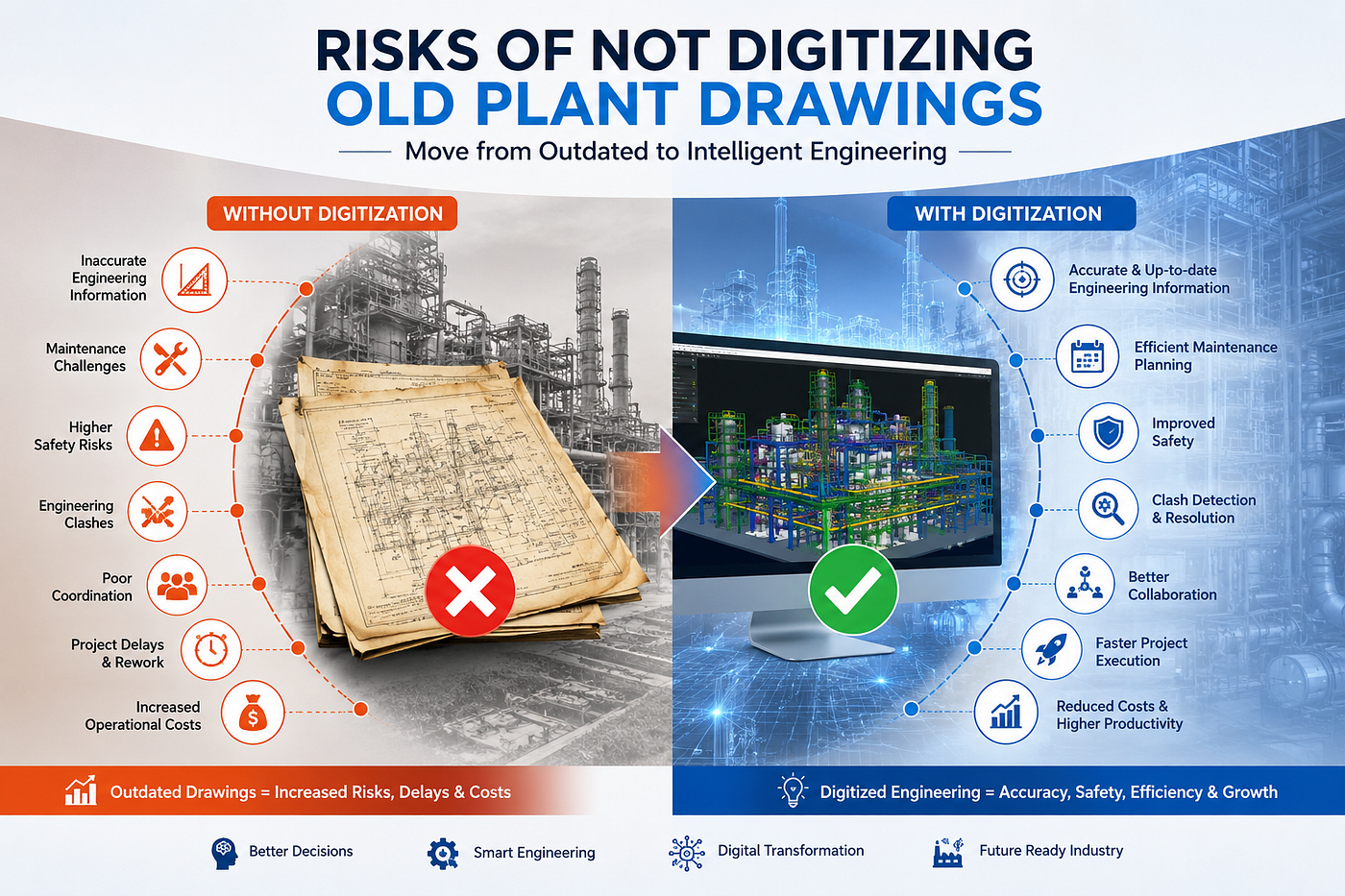
From P&ID to Intelligent 3D Models: The Future of Plant Engineering
Modern plant engineering is evolving from static drawings to connected, data-driven 3D environments that improve visibility, coordination…
From P&ID to Intelligent 3D Models: The Future of Plant Engineering

**Modern plant engineering is evolving from static drawings to connected, data-driven 3D environments that improve visibility, coordination and decision-making.**
For decades, plant engineering has relied heavily on drawings.
P&IDs defined how systems should work. Engineers interpreted them, coordinated manually and translated them into physical layouts.
It worked.
But only to a certain extent.
When Drawings Are Not Enough
As industrial systems became more complex, the limitations of traditional approaches started to appear.
A P&ID can define system logic — flow paths, valves, instruments and connections.
But it cannot fully represent physical reality.
- It doesn’t show spatial conflicts
- It doesn’t reveal routing challenges
- It doesn’t account for real-world constraints
So teams compensate.
They review drawings multiple times. They coordinate across disciplines. They rely on experience to fill the gaps. And still, issues arise.
Not because engineers lack expertise — but because visibility is limited.
The Missing Layer: Context
The real challenge in modern plant engineering is not just design.
It’s context.
Understanding how every component fits within the system. How pipelines interact with structures. How equipment placement affects accessibility and maintenance.
Traditional methods show what needs to be built.
But they don’t always show how it exists in reality.
The Shift to Intelligent 3D Engineering
This is where the industry is changing.
Instead of relying only on 2D drawings, organizations are adopting intelligent 3D engineering platforms like AVEVA E3D.
Here, design is no longer static.
It becomes:
- Visual
- Connected
- Data-driven
A P&ID defines the system logic. A 3D model defines the physical structure.
Together, they create a unified engineering environment.
👉 One that bridges the gap between design and reality.
More Than Just Visualization
At first glance, 3D modeling may seem like a visualization upgrade.
But its real value lies deeper.
It enables teams to:
- Understand entire systems in context
- Identify clashes and conflicts early
- Improve coordination across disciplines
- Make faster and more informed decisions
This changes the nature of engineering work.
From interpretation → to clarity From reaction → to prevention
Where Automation Becomes Critical
As engineering environments become more advanced, automation plays a key role.
But automation here is not just about speeding up tasks.
It’s about enabling consistency and intelligence.
- Design updates reflect across the system
- Data remains synchronized between teams
- Manual effort is reduced significantly
This creates a system where engineering is not only faster — but more reliable.
The Real Challenge
Despite having access to advanced tools, many organizations still struggle.
Not because they lack technology.
But because:
👉 Tools, workflows
and data are not fully aligned
In many cases:
- Manual processes are simply digitized
- Teams work in silos despite connected tools
- The focus remains on modeling, not integration
As a result, the true value of automation is not fully realized.
Where Roboclick Infotech Adds Value
At Roboclick Infotech, we work closely with engineering teams to bridge this gap.
Our focus is not just on implementing tools like AVEVA E3D.
It’s on enabling a complete transformation.
We help organizations:
- Integrate P&ID and 3D design environments
- Structure efficient and scalable engineering workflows
- Ensure data consistency across systems
- Improve collaboration between teams
👉 The goal is simple:
To move from disconnected processes to intelligent, automated engineering systems
The Bigger Impact
When design evolves beyond drawings:
✨ Engineering accuracy improves ✨ Rework is significantly reduced ✨ Project timelines become more predictable ✨ Teams collaborate more effectively
Most importantly:
👉 Organizations gain control over complexity
Final Thought
The future of plant engineering is not just about adopting new tools.
It is about changing how engineering is approached.
From drawings → to systems From tools → to workflows From data → to intelligence
The question is no longer:
👉 Do we have the right tools?
It is:
👉 Are we using them to their full potential?
Sometimes, progress is not about doing more.
It’s about seeing clearly — and building systems that reflect that clarity.
💬 If you’re exploring how to connect your P&ID, 3D models and engineering workflows into one intelligent system, Roboclick Infotech can help you make that transition effectively.
메타데이터
- post_id
- 32eb3b7e2622
- slug
- from-p-id-to-intelligent-3d-models-the-future-of-plant-engineering-32eb3b7e2622
- url
- https://medium.com/@roboclicksocialmedia/from-p-id-to-intelligent-3d-models-the-future-of-plant-engineering-32eb3b7e2622
- canonical_url
- https://medium.com/@roboclicksocialmedia/from-p-id-to-intelligent-3d-models-the-future-of-plant-engineering-32eb3b7e2622
- author_url
- https://medium.com/@roboclicksocialmedia
- status
- ok
- fetched_at
- 2026-06-09 15:37:30