Why 90% of Pet Factories Cannot Build Reliable Smart Hardware
In early 2025, a European pet brand contacted our engineering division after experiencing a catastrophic return wave on Amazon. The issue…
Why 90% of Pet Factories Cannot Build Reliable Smart Hardware
In early 2025, a European pet brand contacted our engineering division after experiencing a catastrophic return wave on Amazon. The issue wasn’t their branding, their logistics, or their digital marketing.
It was noise.
After just four months of real-world usage, thousands of customers reported that their “ultra-quiet” smart cat water fountains had become louder than a desktop cooling fan. Return rates exploded past 14%, product ratings collapsed to 3.2 stars, and their entire Q4 profit margin was vaporized by reverse logistics costs.
That incident perfectly illustrates the hidden manufacturing crisis behind today’s smart pet hardware boom. Global buyers are rapidly shifting from passive plastic accessories to interconnected IoT hardware. However, they are forcing these sophisticated electronics through a supply chain that still thinks like a basic plastic injection shop.
When traditional pet factories attempt to bridge the gap between simple tooling and electrical engineering, failure is almost mathematically guaranteed.
Inside Our Failure Lab: The 180-Day Acoustic Simulation
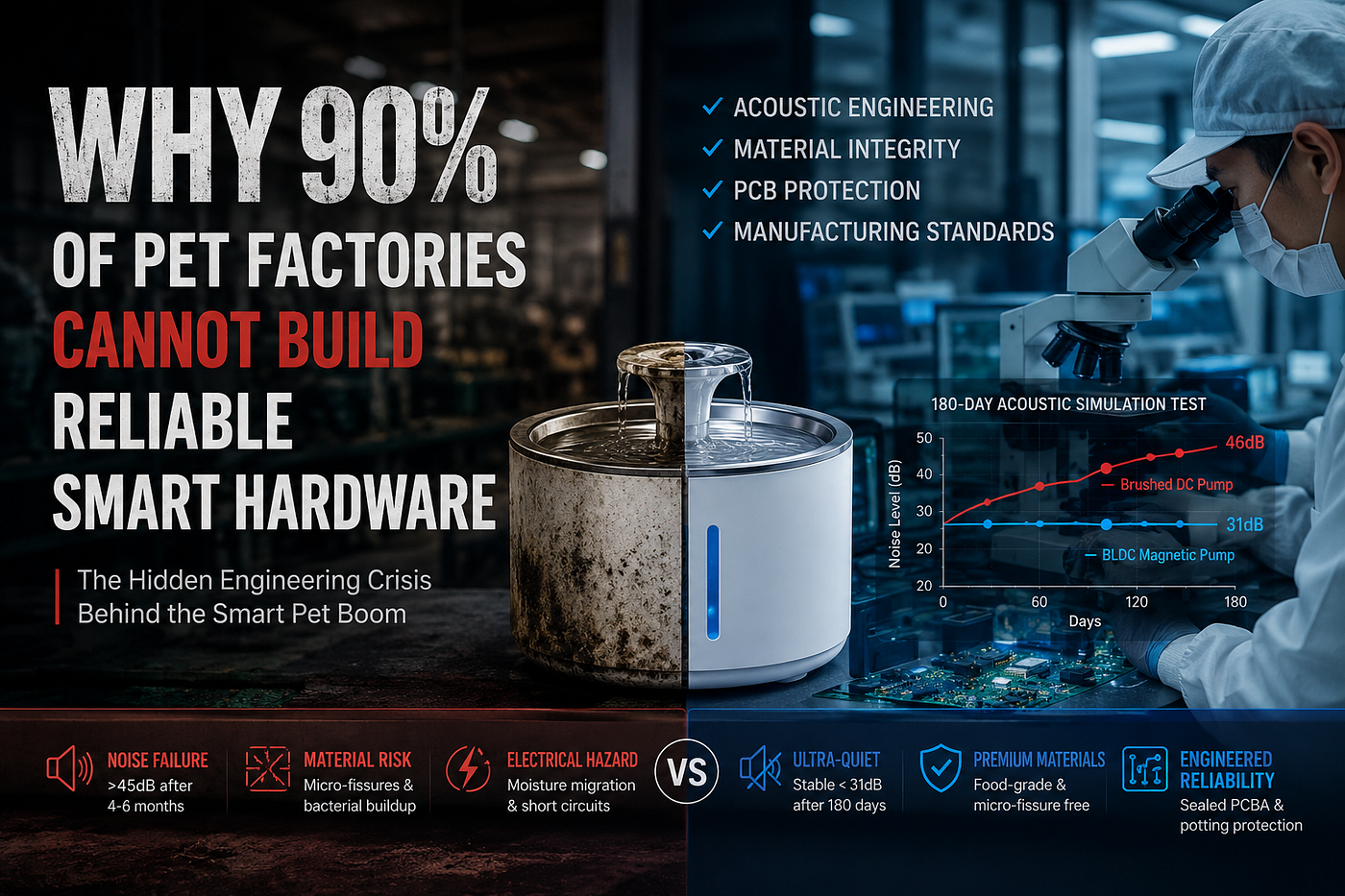
To understand why smart pet hardware degrades prematurely, we must look at empirical testing data. At the AITAKON acoustic testing facility in Zhejiang, China, we subjected standard off-the-shelf pet fountain pumps to a 180-day accelerated wear cycle simulating continuous real-world operation.
The results expose a stark divergence in engineering quality:

Failure Root Cause Analysis: Under high magnification, the 46dB brushed pumps revealed severe shaft wobble. Traditional factories utilize standard metal shafts and carbon brushes. Over a 3 to 6-month period, the pet’s saliva enzymes and hard-water calcium deposits corrode the internal commutator. This forces the impeller out of alignment, generating micro-cavitation turbulence that turns the entire plastic chassis of the fountain into an acoustic amplifier.
The Hidden Fluid Dynamics and PCBA Vulnerabilities
A pet fountain is an inherently hostile environment for electronics: it combines continuous moisture with automated power delivery. Traditional suppliers treat waterproofing as an afterthought, relying on basic rubber gaskets.

When liquid tracks along the copper core of a power cable via capillary action, it bypasses external seals entirely. If the factory lacks the instrumentation to perform automated potting — fully enclosing the PCBA in automotive-grade polyurethane or silicone resins — latent short circuits will occur within months of container delivery.
Furthermore, using recycled scrap resin (regrind) in the injection molding process to cut costs creates microscopic fissures under stress, creating perfect harborages for biofilm and bacteria that resist standard chemical cleaning.
Defining the New Infrastructure Standards
Overseas brands cannot audit a smart hardware factory using the same checklists they use for nylon dog leashes or silicone mats. To secure a resilient supply chain for next-generation pet hydration products, manufacturing partners must possess verifiable electronic manufacturing services (EMS) protocols.
This includes dedicated, dust-free static-controlled assembly lines, automated optical inspection (AOI) for circuit integrity, and isolated acoustic testing chambers that isolate ambient factory noise from product validation. Without these industrial baselines, any tech specification printed on a supplier’s datasheet is effectively meaningless.
Factory Audit Checklist for Smart Pet Hardware OEMs
We have compiled an internal engineering checklist used by leading international brands to evaluate hardware manufacturing compliance and risk mitigation during factory walkthroughs in China.
The document covers:
- Acoustic validation protocols for submersible BLDC motors.
- Potting thickness and conformal coating verification for PCBA lines.
- Material traceability and testing for micro-fissure resistance in food-grade polymers.
- Cross-contamination boundaries between injection lines and electronics assembly.
To review these structural engineering standards and download the complete framework, access our technical resource library at www.aitakon.com.
메타데이터
- post_id
- 33c36df1bd19
- slug
- why-90-of-pet-factories-cannot-build-reliable-smart-hardware-33c36df1bd19
- url
- https://medium.com/@aitakon/why-90-of-pet-factories-cannot-build-reliable-smart-hardware-33c36df1bd19
- canonical_url
- https://medium.com/@aitakon/why-90-of-pet-factories-cannot-build-reliable-smart-hardware-33c36df1bd19
- author_url
- https://medium.com/@aitakon
- status
- ok
- fetched_at
- 2026-06-09 15:37:30