Everyone starts with a blank resume — here’s how to fill it.
Somewhere between your first semester and your second year, it hits you.
Everyone starts with a blank resume — here’s how to fill it.
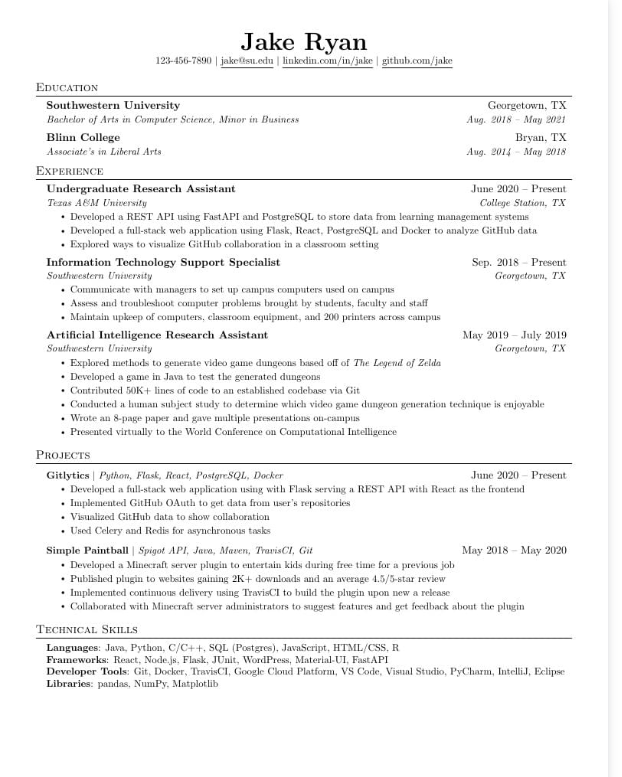
Somewhere between your first semester and your second year, it hits you.
A senior forwards a placement prep group. Someone drops a resume template in the class chat. And you open a blank document, stare at it for ten minutes, and quietly close it because there is genuinely nothing to put in it.
No internships. No projects. No achievements worth mentioning. Just a name, a college email, and a CGPA you are not fully proud of yet.Here is what nobody tells you in that moment: every single senior you look up to started in exactly the same place. The difference between a resume that gets shortlisted in third year and one that doesn’t is not talent. It is just what you decided to do in first and second year while everyone else was waiting to feel ready.
First, get the format right. Use Overleaf.
Before you write a single word of content, sort the format. Overleaf is a free LaTeX-based resume builder with clean, professional templates that are literally industry standard for tech roles. It handles fonts, spacing, and structure automatically — no wrestling with Word margins at midnight before a deadline. Pick a single-column template, keep everything to one page, and let the structure carry the first impression. A polished-looking resume gets read. A cluttered one gets skipped. Start right.
Education — go all the way back.
For a fresher, your education section is doing the heaviest lifting on the page. Add your BTech details — college name, branch, expected graduation year, and CGPA if it is 7.5 or above. Then keep going. Add your 12th board percentage and your 10th board results too, with school name and year. Most freshers stop at their college degree and leave two data points on the table that recruiters actually look at. A consistent academic record from school to college tells a quiet story of someone who shows up and delivers. Tell that story.
Your links are a secret weapon. Use them.
Right at the top of your resume, next to your name and phone number, drop your important profile links. LinkedIn. GitHub. LeetCode if you are actively grinding problems. Codeforces if you are into competitive programming. These links do something your resume text never can — they let a recruiter see your actual work in real time. A GitHub with live repositories, a LeetCode profile with a solid problem count, a LinkedIn with a proper photo and a written summary — these are the details most freshers skip. Do not skip them. A recruiter who clicks your GitHub and sees active commits is already more interested in you than they were thirty seconds ago.
Skills — honest, specific, nothing fake.
A dedicated skills section matters, but only if it is real. List the languages you actually write code in, the frameworks you have used, the tools and databases you know. If you are targeting tech roles, go deep on technical skills — Python, C++, SQL, DSA, web frameworks, whatever your actual stack is. If you are also open to non-tech, add a separate line for relevant soft skills or domain knowledge. What you should never do is list something you have only heard about in a YouTube video. Recruiters ask about everything on a resume. Being caught bluffing about a skill is far more damaging than simply not listing it. Keep it clean, keep it true.
Projects — this is where freshers win or lose.
For anyone without work experience, projects are the most important section on the entire resume. Full stop. This is your proof that you can take an idea from zero to something that actually works. It does not have to be revolutionary. An ML model, a web app, a full stack project, a database system, a REST API — anything you built yourself counts. What matters is that it is real, it runs, and you can explain every line of it.
For each project, write two to three tight lines: what it is, what stack you used, what problem it solves. Then link it. GitHub repo, live demo, anything that lets someone see it exists beyond your resume. A project with a working GitHub link is ten times more believable than one with just a name and a description. Build it. Push it. Link it. Repeat.
Achievements — think wider than trophies.
Most freshers either leave this section blank or think it only counts if they won something massive. Neither is true. Participated in a sports tournament and finished in the top three? Add it. Reached the finals of a hackathon? Add it. Got selected for a competitive cohort, scholarship, or program? Add it. Hit a meaningful milestone on LeetCode or a competitive programming platform? Add it. Earned a certification from Google, AWS, Coursera, or any credible platform? Absolutely add it. This section is not about perfection — it is about showing that you put yourself in competitive situations and have a track record of performing. That is exactly what early-stage recruiters want to see.
Experience — only what is real counts here.
Here is a mistake almost every fresher makes: listing society memberships and club roles under experience. Being the PR head of a college fest is not work experience. It belongs under positions of responsibility, which is a separate section entirely. Experience means actual work — a research project under a professor, a freelance gig for a client, an open source contribution with real impact, a short-term technical role of any kind. If you do not have any of that yet, keep the experience section honest and lean. An empty section is fine. A padded one that collapses under the first interview question is not.
For non-tech roles, case study competitions, domain coursework, and relevant projects can fill this space. For tech roles, your GitHub does the talking.
One resume will not work everywhere — tailor it every single time.
This is the mistake that costs students the most shortlists and nobody talks about it enough. You cannot send the same resume to Amazon, a seed-stage startup, a finance firm, and a research lab and expect all four to be equally impressed. Each of them is looking for something different. A startup wants to see what you have shipped. A finance company wants academic performance and analytical ability. A research role wants depth in a specific area. Read the job description like you are studying for an exam. Understand what they actually want. Then bring the most relevant parts of your resume to the front for that specific application — reorder sections, swap projects, re-emphasise different skills. The base document is yours. The version you send should always feel like it was made for them.
Update your resume every three months.
A resume is not a document you make once in second year and dust off before placements. It is a living record of who you are becoming. Every three months, open it and ask honestly: what has changed? New project finished? Add it. New skill picked up? Add it. New certification, new competition, new milestone on your coding profile? Add it. Remove things that no longer reflect where you are. A resume that is six months out of date before placement season is quietly selling an older version of you — one without the project you just finished, the hackathon you just entered, the skill you just learned. The students who update consistently never have to panic when an opportunity drops with a 48-hour application window. Their resume is always ready.
The blank document is not the problem. It is just the honest starting point.Open Overleaf today. Fill in your education and your links. Start one project this week and push it to GitHub. Enter one competition or finish one certification this semester. Do that on repeat across first and second year and by the time placement season arrives, your problem will not be having nothing to add — it will be deciding what to cut because you have too much.
메타데이터
- post_id
- 3bf6fd9722d9
- slug
- everyone-starts-with-a-blank-resume-heres-how-to-fill-it-3bf6fd9722d9
- url
- https://medium.com/@nehal77garg/everyone-starts-with-a-blank-resume-heres-how-to-fill-it-3bf6fd9722d9
- canonical_url
- https://medium.com/@nehal77garg/everyone-starts-with-a-blank-resume-heres-how-to-fill-it-3bf6fd9722d9
- author_url
- https://medium.com/@nehal77garg
- status
- ok
- fetched_at
- 2026-06-21 07:44:09