Part 9 — From Basic Agent to Structured Extraction in Microsoft Foundry
In this blog, we build the foundation step by step using Microsoft Foundry — transforming a simple prompt-based agent into a structured…
Part 9 — From Basic Agent to Structured Extraction in Microsoft Foundry
In this blog, we build the foundation step by step using Microsoft Foundry — transforming a simple prompt-based agent into a structured invoice processing component ready for enterprise workflows.
Why Start with Foundations?
Invoice processing may look simple at first glance:
- Extract vendor
- Extract amount
- Validate total
- Approve or reject
But in reality, invoices contain:
- Mixed layouts
- Different currencies
- Variable table structures
- Edge cases
- Policy requirements
Jumping directly into multi-agent orchestration without mastering these fundamentals leads to fragile systems. So we begin properly.
Microsoft Foundry enables this progression by combining:
- Model hosting
- Tool orchestration
- Thread-based memory
- Multi-modal intelligence
- Enterprise governance
It allows us to move from simple prompting to production-grade agent systems.

GitHub Repo, Sample Data & steps to produce demo :
alpaBuddhabhatti/invoice-agent-demo (API key + Agent Framework (Azure OpenAI endpoint style))
alpaBuddhabhatti/invoice-agent-demo-Keyless (Keyless (Entra ID) + Microsoft Foundry Project endpoint + Managed Agents SDK )
Stage 1 — Creating a Minimal Viable Agent (MVA)
We start with the simplest possible invoice agent.
agent = Agent(
 client=get_chat_client(),
 instructions="Summarize invoice data."
 )

 result = await agent.run(
 "Invoice INV-1001 from Contoso for 1200 USD"
 )
What This Gives Us
- Natural language understanding
- Flexible interpretation of invoice text
- Fast experimentation
What It Lacks
- Structured outputs
- Validation
- Integration capability
- Workflow automation
At this stage, it is a smart assistant — not a system component. But it proves the model understands invoice semantics.
File — step1_basic_agent.py

Stage 2 — Adding Conversational Memory with Threads
Real workflows are rarely one-off prompts.
Users ask follow-up questions:
- What is the total amount?
- Who is the vendor?
- When is the due date?
- Is it approved?
Microsoft Foundry enables thread-based memory:
File — step2_thread_memory.py

Microsoft Foundry allows thread-based memory:
thread = agent.get_new_thread()

 await agent.run(
 "Invoice from Contoso for 1200 USD",
 thread=thread
 )

 result = await agent.run(
 "What is the total amount?",
 thread=thread
 )
Now the agent maintains context across interactions.
🧠 What Memory Means in Our Invoice Agent
Memory is not just conversation history. It is structured context preserved during invoice processing. For our invoice agent, memory maintains:
- Extracted invoice fields (vendor, total, date, tax)
- Validation results
- Business rule decisions
- Processing state across tool calls
Without memory, each step would require the full invoice text to be re-sent to the model. With memory, the agent works incrementally and intelligently.
In our implementation:
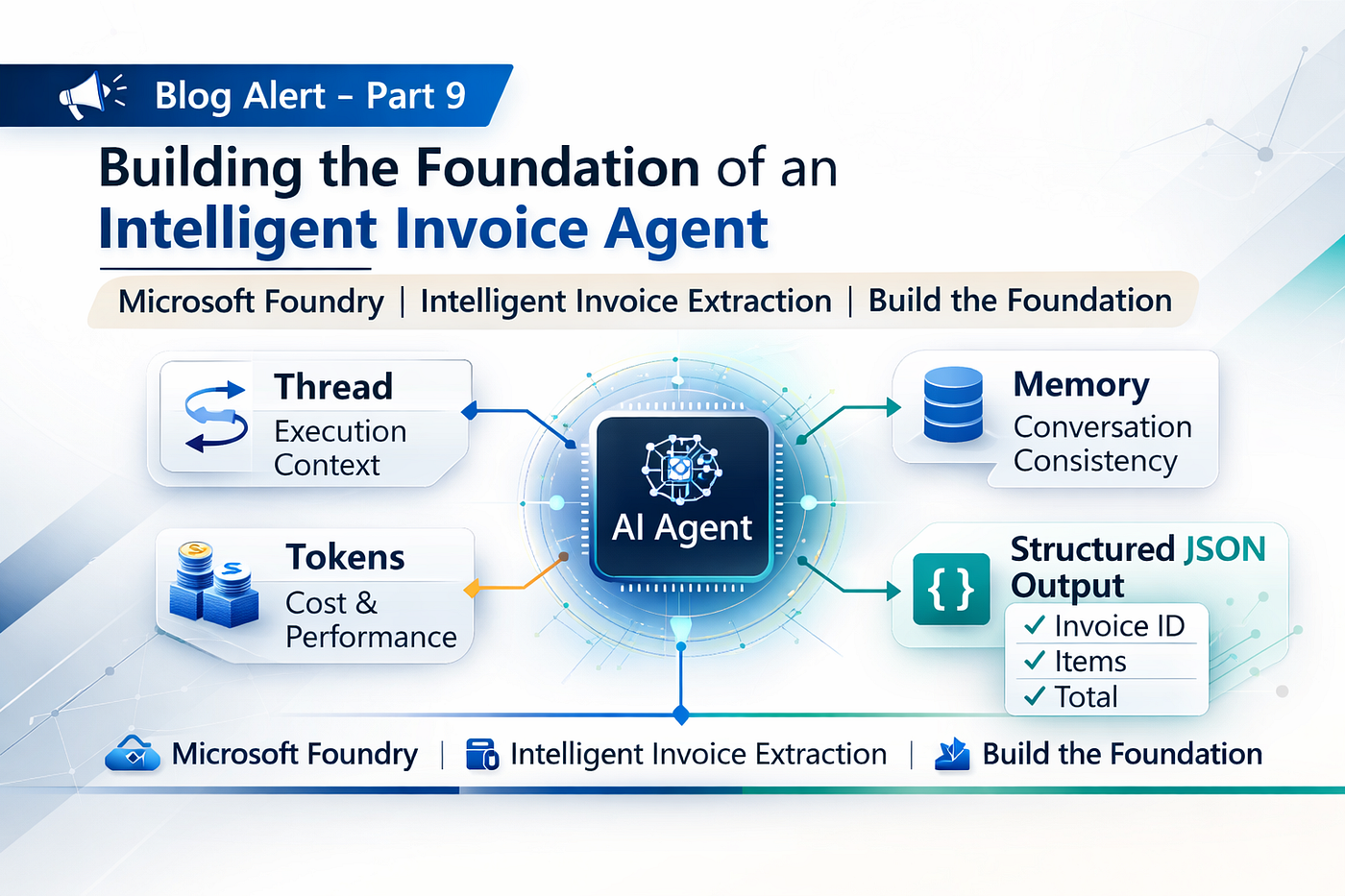
- Thread = Execution context for one invoice
- Memory = Structured data extracted during processing
Each invoice runs in its own thread.Memory keeps extracted facts isolated within that thread — preventing cross-invoice contamination.
This Enables
- Multi-turn conversations
- Context-aware responses
- Interactive financial workflows
However, responses are still unstructured text — and unstructured text cannot be reliably stored in databases or ERP systems. So we move forward.
Stage 3 — Introducing Tools for Structured Extraction
This is where the transformation begins. This is the turning point. Instead of only generating responses, the agent can call Python functions (tools).
@tool(name="extract_invoice")
 def extract_invoice(text: str) -> dict:
 return {
 "vendor": "Contoso",
 "amount": 1200,
 "currency": "USD"
 }
Now the agent workflow becomes:
- Read invoice text
- Call extract_invoice()
- Return structured data
File — step3_invoice_tool.py

🛠 Where Tools Fit in Our Invoice Workflow
Our processing flow now becomes:
- Extract invoice data
- Validate business rules
- Return structured JSON
- Prepare for enterprise scaling
Tools support each step. Instead of asking the LLM to “think about validation,” we define deterministic rules such as:
- Subtotal + Tax = Total
- Vendor exists in approved list
- Total < approval threshold
The validation tool enforces logic programmatically. In financial systems, hallucination is unacceptable. Tools provide control, determinism, and reliability.
We have now moved from:
Chatbot → Workflow component
This is the first major architectural shift.
Why Structured Output Matters
Structured output enables:
- Database storage
- ERP integration
- Reporting pipelines
- Power BI dashboards
- Audit logging
Without structure, automation breaks. With structure, systems scale.
Stage 4 — Adding Business Rule Validation
Extraction alone is not enough. Enterprise systems require policy enforcement.
Example rule:
- Invoices ≤ $10,000 → Auto-approve
- Invoices > $10,000 → Require approval
def validate_invoice(amount: int, currency: str) -> str:
 if amount > 10000:
 return "REQUIRES_APPROVAL"
 return "APPROVED"
Now the workflow becomes:
- Extract structured data
- Validate business rules
- Assign approval status
This introduces:
- Decision automation
- Policy enforcement
- Compliance alignment
At this stage, we are no longer “chatting with invoices.” We are building a financial workflow engine.

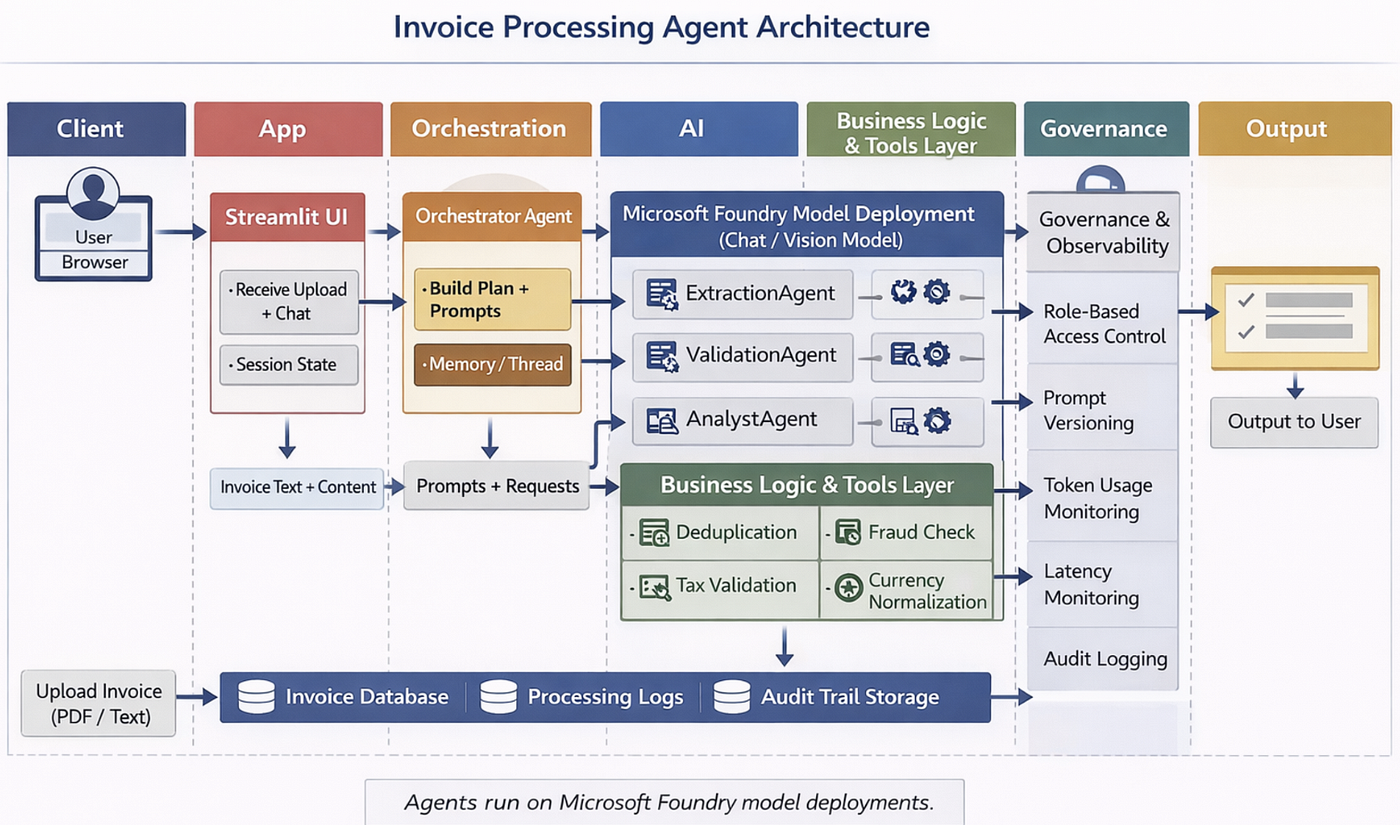
Architectural View of the Foundation
By Stage 4, your system contains:
- 🧠 AI Agent (semantic understanding)
- 🧵 Thread memory (context)
- 🛠 Tool layer (structured extraction)
- 📐 Validation logic (business policies)
This layered design creates a clean separation:

This structure is critical. Because in Part 10, we will extend it into a multi-agent enterprise system.
Why This Foundation Matters
Many AI demos stop at “Look, it extracts data.”
Enterprise systems require:
- Deterministic outputs
- Repeatable validation
- Structured storage
- Traceability
- Governance readiness
Without this foundational design:
- Multi-agent systems become chaotic
- Scaling becomes risky
- Compliance becomes difficult
Strong foundations prevent fragile architectures.
What’s Next (Part 10)
In Part 10, we will evolve this foundation into:
- Vision-based invoice understanding
- Specialized agent roles
- Multi-agent orchestration
- Enterprise-ready architecture
- Production governance considerations
We will move from:
Single Agent → Multi-Agent System Workflow Component → Enterprise AI Architecture
Final Thought
AI transformation does not start with complexity. It starts with clarity.
By designing:
- Clear responsibilities
- Structured outputs
- Deterministic validation
You create systems that scale safely. And that is how intelligent invoice processing begins — not with hype, but with architecture.
메타데이터
- post_id
- 3d71965e2d1e
- slug
- part-9-from-basic-agent-to-structured-extraction-in-microsoft-foundry-3d71965e2d1e
- url
- https://medium.com/@meetalpa/part-9-from-basic-agent-to-structured-extraction-in-microsoft-foundry-3d71965e2d1e
- canonical_url
- https://medium.com/@meetalpa/part-9-from-basic-agent-to-structured-extraction-in-microsoft-foundry-3d71965e2d1e
- author_url
- https://medium.com/@meetalpa
- status
- ok
- fetched_at
- 2026-06-23 03:48:11