A Quick Guide to Test-Driven Development with Microservice Example
Test-Driven Development (TDD)
Wiki topics:
💻 · Programming
A Quick Guide to Test-Driven Development with Microservice Example
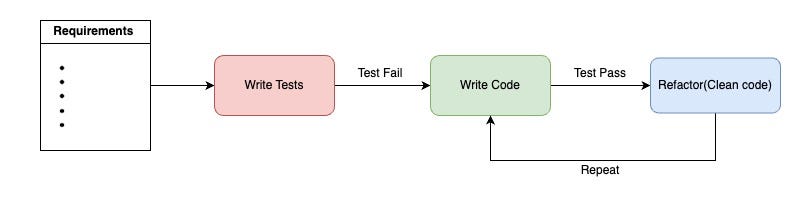
Test-Driven Development (TDD)
TDD is a software development approach where tests are written before the actual code. It focuses on writing small, specific tests that define the desired behavior of the code, and then writing the minimum amount of code necessary to pass those tests.
Process:
- Write a Test: Start by writing a test for a small piece of functionality.
- Run the Test: The test will fail initially since no code has been written.
- Write Code: Write just enough code to make the test pass.
- Run All Tests: Ensure that all tests pass.
- Refactor: Improve the code while keeping the tests green.
- Repeat: Continue with the next piece of functionality.
Benefits:
- Improves Code Quality: By focusing on small pieces of functionality, the code becomes more modular and easier to maintain.
- Reduces Bugs: Writing tests first ensures that each piece of code is thoroughly tested.
- Clarifies Requirements: Writing tests forces developers to think about the requirements and expected behavior before writing the code.
Example: Node.js Microservice with TDD
Step 1: Set Up the Project
mkdir tdd-microservice
cd tdd-microservice
npm init -y
npm install express mocha chai supertest --save-dev
Step 2: Write a Test (e.g., For a Health Check Endpoint)
Create a test/health.test.js file:
const request = require('supertest');
const app = require('../app');

describe('GET /health', () => {
  it('should return status 200 and a message', (done) => {
    request(app)
      .get('/health')
      .expect(200)
      .expect('Content-Type', /json/)
      .expect(res => {
        if (!('message' in res.body)) throw new Error('Missing message key');
      })
      .end(done);
  });
});
Step 3: Write the Code
Create an app.js file:
const express = require('express');
const app = express();

app.get('/health', (req, res) => {
  res.status(200).json({ message: 'Service is healthy' });
});

module.exports = app;
Step 4: Run the Test
npx mochaIf the test passes, you’ve successfully implemented the health check endpoint.
Step 5: Refactor and Repeat
- Continue adding more features, writing tests first, and following the same process.
How TDD Helps Build Quality Applications
- Early Bug Detection: Bugs are caught early in development.
- Better Design: Forces developers to write decoupled, modular code.
- Documentation: Tests serve as living documentation for the codebase.
- Confidence: Developers can make changes with confidence that the tests will catch any issues.
That’s it! 🎉 From here, you can expand by adding additional test cases or developing more microservices using the Test-Driven Development approach. Good luck!
메타데이터
- post_id
- 3de1933b7624
- slug
- a-quick-guide-to-test-driven-development-with-microservice-example-3de1933b7624
- url
- https://medium.com/@bhushankumar711/a-quick-guide-to-test-driven-development-with-microservice-example-3de1933b7624
- canonical_url
- https://medium.com/@bhushankumar711/a-quick-guide-to-test-driven-development-with-microservice-example-3de1933b7624
- author_url
- https://medium.com/@bhushankumar711
- status
- ok
- fetched_at
- 2026-08-22 21:14:35




